


Tony K
-
Posts
545 -
Joined
-
Last visited
-
Days Won
1
Everything posted by Tony K
-
Happy New Year all. I planned to heat my new bungalow (100m2, flat roof, UFH, reasonable-to-good airtightness but not Passive) with an ASHP. My electric infrastructure overlords, UK Power Networks, came out twice to see me and gave me quotes to connect to the network for circa 3k. As the project has progressed UKPN now say they need £40k+ to connect me, as the local network won't support an ASHP. Leaving aside the sharpness of this practice for a moment, I am looking at alternative heating methods. 1. Am I right to think I can power the UFH straight from the electric grid? If so, does anyone have an idea of the costs of this heating strategy vs the payback period for an ASHP over its lifetime? I wonder if I will actually be worse off without the ASHP in the end? 2. I had not planned to have gas, but could do so if I had to. I presume I would then be looking at a boiler and water tank as per usual, but is there in fact a specific set up required for UFH and gas? 3. I couldn't find a way to make solar power work for me when I did my initial research. Partly this was to do with orientation of the plot, but more it was a question of upfront costs vs payback time, affected of course by the end of the grant system. However, a relative of mine now works replacing solar systems and can apparently get me quite a lot of good second hand kit for free, so I may review this option. Is there a good place to go for a reliable solar / heating design? Thanks
-
The sand looks similar to mine but the rest of your recipe is different. I'll have another look at the sample section just before I need to make the final decision. Expensive stuff that snowcrete, by the way.
-
Did you use snowcrete and building sand at 1:4 to get the result in your photo @Buzz?
-
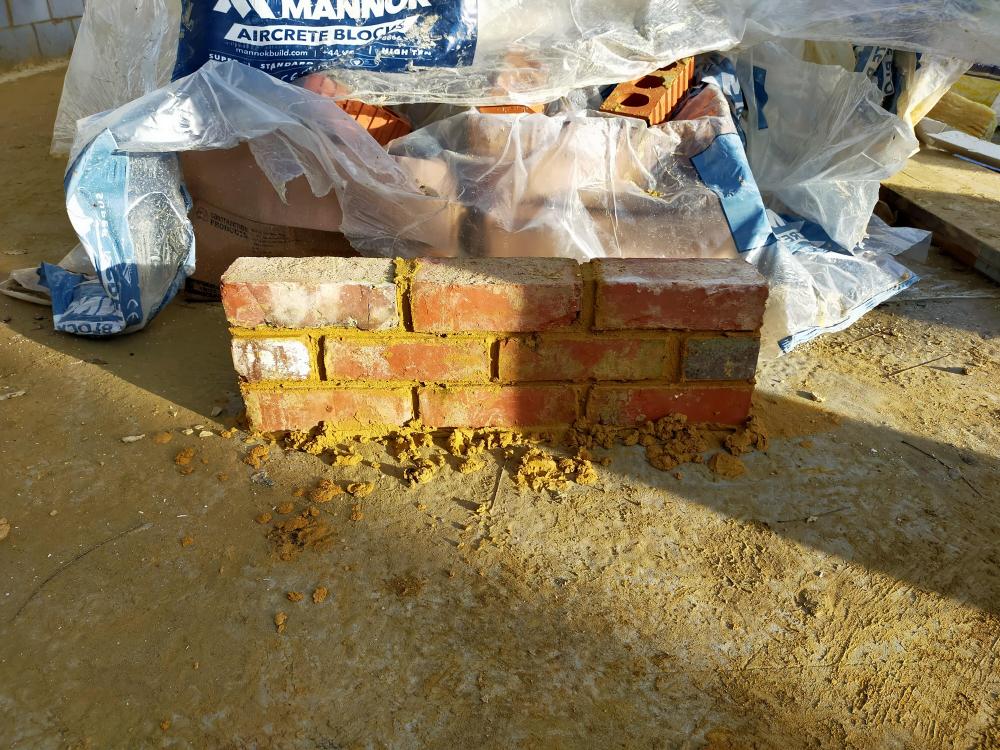
Here it is. 4 building sand to one snowcrete. Not very reminiscent of snow.
-
Yesterday, so perhaps more time is needed, though as of today it certainly isn't white. I'll pop a photo on here in a bit.
-
@Radian thanks, that's interesting. I'm experimenting with the white cement for use in a couple of feature walls made with reclaimed wire cut brick. I'm minded to go for recessed pointing, so I could use normal mortar and then consider white pointing later if I'm unhappy with the recessed results.
-
Well, having just done a trial sample I'm not blown away from the Snowcrete white cement, at least not in a 1:4 mix with yellow building sand. The resulting mortar is noticeably different in colour to the normal cement and sand mix, but its certainly not white, more like orange. The buckets were clean, we used clean water etc, so no obvious reason for this disappointing outcome, but at the price I can't see that I'll go with Snowcrete.
-
Interesting (mixed) results regarding my attempt to dry my slab. I hired a three headed torch (slightly terrifying to be honest, think Lord of the Rings), and it certainly has the ability to dry out the slab. The issue is that I have had to build my outside leaf of blockwork first (due to tightness to the boundaries), and am now drying the space where the inside leaf will go, once the damp detail is in place. This process requires that the DPC is left flapping loose inside the building, above the area I am drying. Even when pinned up out of the way, the heat from the torch is such that it seems likely to melt the DPC, which becomes noticeably more floppy during the drying process. I can't have a melted/perished DPC! I will experiment again with a smaller torch, but otherwise will admit defeat and shell out for a primer and membrane that work in the damp.
-
Three phase was the suggestion of the surveyor from the DNO, who advised future proofing. To be fair she gave me prices for single phase as well.
-
I'm sure you're right, but I'll need a detailed breakdown for the electricity firm.
-
I'll ask the spark, thanks.
-
No gas at all. No ev charger now or ever (too far from the parking area). ASHP yes. 100m2 Three. Ta
-
Evening. My electricity supplier wants an accurate breakdown of the required kVA load for my SB before they can arrange my connection to the grid. I don't have an architect I can palm this off to, having designed the place myself by and large. Any ideas who I can get to produce the figures? Is it one of those things that can be done with an online calculator, or do I need to employ someone? Cheers
-
Did you get a sample section of the screed? It's common enough to do so for concrete slabs and have them strength tested at 14 - 28 days. Perhaps a similar process might exist for screed. Interestingly, when I searched on line (YouTube especially) for advice on using a torch to dry the slab (meaning get the damp surface dry) all the results I found were to do with accelerated curing, which is similar to your question. Maybe give that a go?
-
Do you recall what kind of distance they held the torch from the slab? Did you spot any special techniques, tricks or things to avoid? I shouldn't think even I could manage to set a damp concrete slab on fire, but I'd rather not test the theory if there is some 'best practise' I can adhere to!
-
My concrete slab now has the walls around it but no roof. I need to finish a fiddly bit of damp detailing where the walls and slab meet. Back when the weather was dry and warm the primer and membrane I have bought worked just fine, but it is now neither dry nor warm, and the products don't like damp slabs. I have the option of buying in special primer and special membrane for damp conditions, but seeing as I've already bought a general primer and membrane and cut the latter to size and shape, I would like to at least try and get the slab dry and use what I have. It has been suggested that I could hire a three-headed gas torch to dry out the area of the slab I'm working in. Has anyone ever tried this, and if so, does it work? Thanks
-
Then I'm in luck, as I've got yellow. Didn't even know you could get red. Does anyone know the ratio? Would I be correct to presume that the lower the ratio the brighter white the mortar?
-
I've got plenty of decent builders sand, and I'll try that with the snowcrete, thanks.
-
Cheers. @Faz that looks good, and as I'm going for a rustic look I can happily risk some salting!
-
I have two feature walls in my SB to be made with reclaimed red wire cut bricks. I am considering white mortar rather than the standard sand and cement mix. Does anyone have any experience with white mortar? I have heard the occasional tale that it fades quickly or stains bricks but can't find any real evidence of that. I am aware that it costs significantly more than standard concrete, but otherwise I believe it is essentially the same product used the same way. Am I missing anything? Cheers
-
Most standard suppliers? Do you happen to know of one who will supply the whole kit to fit a standard flush wall opening?
-
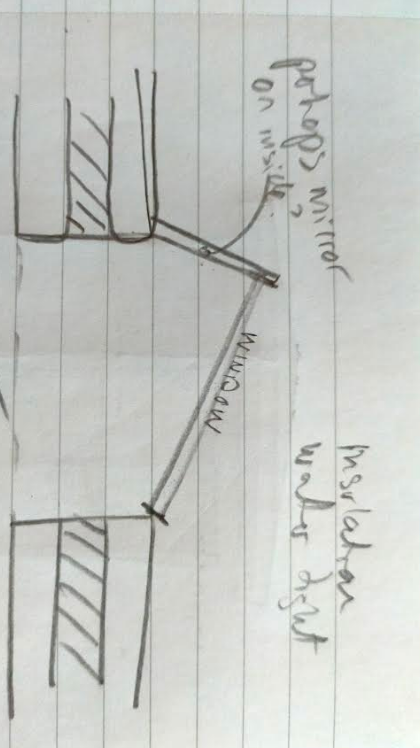
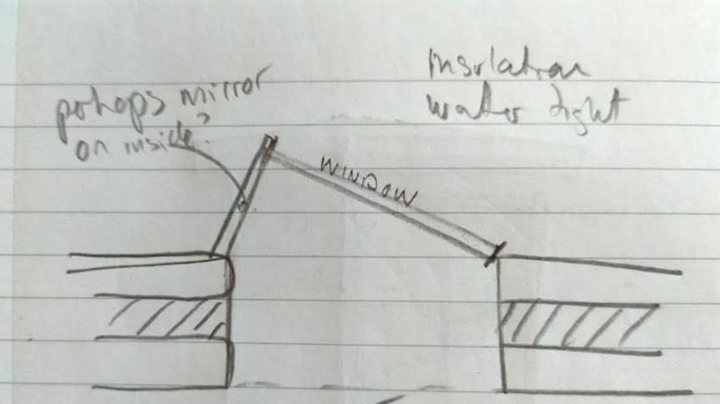
Almost. The need for this design feature is to prevent intervisibility between certain windows in the house, so the 250 wide window would be a fixed panel, but otherwise yes, that's the idea. What I am toying with is how to create a timber frame which protrudes from the building at the appropriate angle, and supports the window without having much structure underneath. This is my sketch (plan view): I have a standard cavity wall with a normal opening, so I am thinking cut some good ply or suchlike into an enlarged, angled windowsill (and same at the top of the frame), then essentially fit it out with insulation and make it watertight. I would not like to rely on the frame simply canterleving out from the opening, and so my instinct is to place one or two supporting struts at 45 degrees underneath the protruding sections, back to the face of the wall beneath the frame.
-
Yes, I have begun working up a design for an angled, protruding timber casement which could be fitted to a standard wall opening, and would then allow a normal window to be used, but it occurred to me that there might be suppliers who provide the whole thing in one bit of kit.
-
Afternoon all. I am trying to track down a supplier or windows that protrude from the surface of the wall at an angle, thereby directing visibility from within the room in one direction. Imagine this first floor window, but entirely simplified so that it has none of the timber structure around it: Does anyone know of suppliers who can produce angles windows to fit standard openings? Thanks
-
Ah. Its a cast suspended slab, not bb. Thanks though.

