


Tony K
-
Posts
545 -
Joined
-
Last visited
-
Days Won
1
Everything posted by Tony K
-
Thanks all. Yeah it's small, but so is the house and the garden. Every inch of every part of the whole thing has been planned meticulously, and the office is no different! Cheers. Right now the only thing I need to think about is whether to dig out foundations for the office at the same time as the house footings. If even a brick office would only require fairly shallow footings then I can afford to forget about it for now and make a decision later.
-
Thanks @Declan52 I had originally planned to do exactly as you suggest, it's really just an aesthetic choice on my part to go for brickwork on the outside. Perhaps I'll just talk myself around to using timber instead. Cheers
-
Cheers Mark. I'm not familiar with insulated slabs really. I presume the insulation sits under the whole thing, including the walls and can take that weight without becoming compressed? Is there a depth of excavation for the hardcore you would use (edges and centre)? Thanks
-
Thanks. What sort of thickness would you propose, and would you bring the edges down a little deeper than the centre?
-
Hi As part of our SB I am going to build a very small home office for myself in the garden. External footprint of the building will be 2m x 1.6m. It's far too small to need building regs, but I want to make it using brick walls, probably single skin with insulation and board on the inside. I'll damp proof it like a proper building, and it will ultimately have electric and heating inside. In terms of footings, how deep and wide should I be aiming for? Its clay soil, but a full 1m deep seems a tad OTT. Any ideas? Ta
-
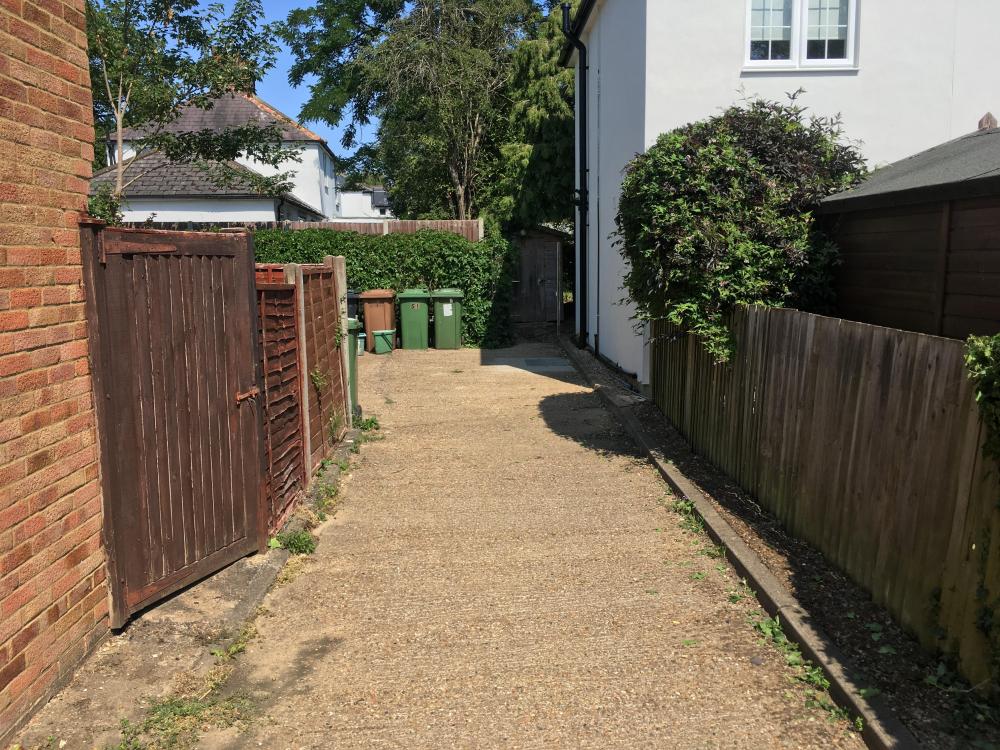
The actual access to the site is via an 80m long, 1m wide footpath. The attached photo shows where small muckaway trucks can get down to the far end of the adjacent private cul de sac to collect muck from the edge of my site. The muck will be piled up where the shed is in the photo. I doubt the little muckaway trucks could deliver a big digger or dumper over the fence so I'll use the long footpath to get a mini digger and dumper to site.
-
It's fixed into concrete at the end of a private cul de sac, the residents of which have been good enough to let me bring work vehicles up already. It's fine. I'll use a mini digger and a track dumper.
-
Thanks. I'll get a little dumper. The grab lorry is indeed grabbing spoil over the fence. The only grab lorry I can use is the little four wheel one, and so I'd have to find out if they could carry a larger dumper over or not. The rest of the build is fine. Screw piles for foundations so they can arrive to the edge of the site in a van, a pump for the concrete slab, blocks and bricks dropped off near the edge of the site too. It's a bit of a challenge but doable.
-
I'm having a mixture of artificial turf, patio and a sunken trampoline (just to give me a bit more earth to dig out).
-
@PeterW yep, it's all got to go due to finished building levels for planning. The site is too small to reuse it. Your idea of creating a pile then moving that pile more than once in a relay style is interesting. Mini digger has a shorter reach of course. @ProDave i thought I might end up squashing too much of the spoil back into the ground if I tried to bulldoze it. Guess I'll try it and see, and could add always hire a skid steer if I have to. Thanks
-
Hi My plot is 15m x 12m and I need to reduce it by about 60cm. Access is tight so I will be using a mini digger, but I can get the muck lifted away from a corner of the site. I've used a digger before but not for this purpose. Is there a best way to reduce the level whilst piling the spoil in one corner? I've considered digging the whole site down 20cm at a time so I can use the little bulldozer thing on the front of the mini digger to push the spoil into the corner. Alternatively, I could dig down 60cm at a time and pile up the spoil next to where I'm digging. Whether I could push that much spoil into the far corner of the site or not I don't know. Other options include hiring a skid steer or a track dumper. Any insights into how an experienced driver would approach the task?
-
Compelled to use a solicitor?
Tony K replied to Tony K's topic in Party Wall & Property Legal Issues
@Dan F Would you be able to tell me who you used please? I presume the solicitor doesn't have to be local to the site, and I've had trouble getting anyone round my way to take it on for some reason. If anyone else can recommend someone then please do! Thanks -
Cheers. I might try it without the receiver first and see how I get on.
-
I'm now trying to buy my level. This character in the US of A seems to have used a dewalt DW088K self-levelling line laser (or suchlike) without a receiver: Looking at what he has done I may not need a receiver, though of course the distances aren't the same. I will need the laser to reach me 20m away. Nevertheless, am I right to think that I could just set up as he has?
-
Compelled to use a solicitor?
Tony K replied to Tony K's topic in Party Wall & Property Legal Issues
I believe that will be the case for me too. Well, there goes another grand by the sounds of it. No wonder everyone on grand designs ends up over budget! -
Hi I am on the verge of getting my hands on the first chunk of my self build mortgage, but have been told by the broker that I have to use a solicitor. This, I am told, is because 'a mortgage is a legal transaction and therefore requires a solicitor'. I've nothing against solicitors, but is it really essential to employ one for this? I already own the land so there's no conveyancing to do. If it is essential then any idea what represents good value for this particular service? Thanks
-
Cheers. Be interesting to see if any of them will quote for the labour. I found general roofers didn't want to put the GRP on as a standalone project if they hadn't built the roof.
-
Ha! You'd be more than welcome to come to sunny Epsom and spend the day shouting orders at me while filming it! Some people are into that sort of video. I'm told.
-
Ah yes, a constant possibility! How am I most likely to screw it up do you think, and how best does one recover?
-
Sounds like very good advice. How big an area do you think I need for my practice run?
-
Thanks all, very helpful. My L shaped roof is in two sections at slightly different heights, so I can break it up into two separate jobs if I am struggling to get a long enough window of fine weather, though hiring a marquee might even be worth looking into if rain looks possible. Cheaper than scaffold I would guess.
-
Hi All My selfbuild is a single storey, L-shaped, 100m2 flat roof bungalow with GRP roof finish. Quotes for the roofing are coming in unreasonably high when the roof construction is so straightforward I reckon I could build it myself. The question is though, how feasible is it to do GRP covering myself? I've looked at videos online which make it seem like something one could learn, but is it really? I will have about 8 or 9 small non-opening rooflights to fit. They will just sit above the gaps between the joists, but will need upstands in the GRP. Any experience of trying this as a DIY project?
-
Thanks both for this. I have thought it through in great detail now and hopefully am not underestimating the task. My access is down a long narrow footpath from the highway. I will be using a mini digger with as much power and as bug (or wide) a bucket as possible, and a track dumper to get the muck away from site down to a large skip, where a series of muckaway lorries will collect it. All of which will be for nothing if I've got the levels wrong of course, but I shall follow the advice on here to avoid that.
-
Cheers. I'll look into this.
-
Surrey. Epsom to be precise. I have. It's a logistical pain and no mistake for all sorts of reasons. So much so the only way to get it done is to do it myself.
