


Jeremy Harris
-
Posts
26430 -
Joined
-
Last visited
-
Days Won
360
Everything posted by Jeremy Harris
-

Wall vents for mvhr
Jeremy Harris replied to ProDave's topic in Mechanical Ventilation with Heat Recovery (MVHR)
I can usually clean mine with a soft broom, from ground level, as our eaves are quite low (around 2.6m above ground, IIRC). It's not easy to get at the vents from inside with the ones we have, as the outer grille is hinged at the top and clips open from outside to clean it. I think our problem is largely to do with the type of grill and it's location and orientation. It's located in the narrow alley (around 2m wide) between the rear of our house and the retaining wall behind, on the North elevation, at the East end. This has been a bit of a wind tunnel (until I fitted a fence behind the garage a few months ago), with the prevailing wind blowing stuff through that gap, and I suspect that may well have contributed to the fluff problem. If I get the new duct cowls in place in the next week or two then I'll monitor them and report back on whether or not they are as susceptible to catching fluffy stuff. The main problem seems to be fluffy weed seeds, like dandelion and Old Man's Beard, the latter grows in profusion in the hedges to the West, alongside the stream and ponds. -
That's a good point, Declan. I bent over backwards to keep all our neighbours happy as best I could, and in the main it worked well. One neighbour has, though, just taken the piss, if I'm honest. I changed the design of our retaining wall (at an additional cost of around £8k to us) because he wasn't happy with gabions or Permacrib. I had budgeted around £3k to replace the broken and rotten three bar post and rail timber boundary fence with a more robust and secure timber boundary fence, but he insisted I build a stone wall, topped with a timber fence, which cost another £3k over the budget. Since then he has constantly moaned, first about the ridge height being too high (we had the council in with a surveyor and it's 90mm below the limit in the PP). Then it was over an alleged "promise" I'd made to make some stone steps up his garden (nothing at all to do with our build - he came around and asked if he could have some left over blocks and I said yes, which he took to mean that I was going to employ someone to build steps up his garden with them!). The last moan was about the poor quality of the soil infill behind the retaining wall, which is frankly rubbish as I paid to have a few tonnes of imported high grade topsoil to replace the rubbish clay that was removed. It seems that the more I did to try and keep this bloke happy, the more he moaned. Eventually, just before Christmas, when he came around to have another moan and get me to try and sort some more work out in his garden for him as he could see we had a landscaping bloke in, I lost it, told him he'd added thousands to our build, delayed us by making us use money we should have spent on the house and had been taking me for a ride for the past couple of years. Funny thing was he then smiled, shook my hand and said, "well, it was good while it lasted" and wandered off. It was only then I realised he'd set out from the start to con me out of as much as he thought he could get away with. His wife has been around three times since and keeps apologising for him.....................
-
I agree, I've found loads of old service manuals on a couple of Russian sites, but there seems to be a massive increase in these spoof PDF downloads, that only contain a partly-hidden link to a Russian site. The one above wasn't a one-off, I've seen dozens of these over the past few months, almost always when I've been searching for documents and used "pdf" in the search term, knowing that the document I was after was in pdf form. They exploit the ability to embed links within a pdf file, so you download the pdf, only to find a blank page with one or two "download link" icons. These are links to malicious sites, AFAICS. Most pdf readers will detect the attempt to open a link, and ask for confirmation, but for a fair few people who are after the document they may not bother to look at what the link really is (as finding link properties in a pdf file isn't entirely obvious).
-
One thing worth noting is that there are an awful lot of fake PDFs around that contain dodgy links purporting to be download links to the document you were really searching for. Nine times out ten these seem to be Russian domains, and without being racist, I have to say there seems to be far more dodgy stuff on Russian sites than almost anywhere else.
-
Worth remembering that once you have PP, you have PP, full stop. They cannot withdraw it, and if you do submit a new application the outcome of that CANNOT undo the the decision notice you already have. This means that the "submit another application" option can only, as a very worst case, cost the application fee, nothing more.
-
There are approved details from some of the manufacturers of things like I beams, and I used these for the rafter to ridge beam connection detail and the rafter to wall plate detail for our build. IIRC, I downloaded a PDF from the I beam supplier and then just cut and pasted the detail drawings that showed things like the ridge straps, wall plate attachments etc. Off the top of my head I can't remember where I got them from, and don't seem to have kept a copy of the original document for some reason, but a poke around on the web site of whoever is supplying your bits may help. Alternatively, I think there used to be lots of approved details for this both in the old version of Part A and in the TRADA stuff (which you now have to pay for). You may well find the details you want there - there are old copies of Part A around I know, as I nicked the TRADA joist span tables from an old copy a while ago and saved them (they are another thing you now have to pay to get hold of from TRADA).
-
Wall vents for mvhr
Jeremy Harris replied to ProDave's topic in Mechanical Ventilation with Heat Recovery (MVHR)
Not a bad idea, provided it doesn't increase heat loss from bridging. As this has come up again I'll try and fit the less restrictive terminals in the next week or two and see if that reduces the intake noise. If it does, then that's a reasonable indication that it may well have also reduced any flow restriction, as often flow restriction causes additional noise. -
Just a word of caution. That link above downloads a pdf document that is not SPONS, but that contains links to what looks like a malicious Russian website. From the limited look I've had (in a sand box for safety) this is not a link to SPONS. If you are running a Windows machine, I would urge extreme caution, as my experience is that being diverted to a plain http site on a Russian domain that won't easily resolve to an IP address (which itself is suspicious) is highly likely to result in malware of some description getting to your machine. Not my sphere of expertise, I know just enough about this stuff to be dangerous! The Russian URL it tries to direct to (from the links within the document it downloads) is http:// dzaipdf . ru (DO NOT GO TO THIS URL! I've disabled the link by adding spaces)
-
There is a middle path here. First off, I wholeheartedly agree with all the views expressed, from the fact that pissing off planners, the council and neighbours may cause long term ill-feeling, as well as more hurdles you have to jump over, to the flip side that this is plain unjust, in your case grossly unjust, to the tune of more than just a couple of £k. If we don't attempt to address unfairness like this, it will continue, and others will face similar problems. So, I think I would very politely request that the local authority state their case clearly and unequivocally for requesting that you put in place all the GCN harm mitigation strategies you've had to do whilst the neighbouring builds have not. Be clear that at this stage all you want from them is a clear, evidence-based, rationale for the difference in the decisions for each PP, and that you require them to provide the evidence that supports each decision. My guess is that this can go two ways, they can comply with your request and effectively admit that they've applied to different policies to adjacent developments, or they can try and fob you off. The most probable is that they will try and fob you off with an argument unsupported by any evidence at first. If you then politely ask for the evidence, they may well realise they are in a difficult position. What happens after that is anyone's guess, but some things cannot happen. They cannot rescind the planning permission they have granted to the adjacent developments, neither can they retrospectively apply additional conditions, so you're not at risk of upsetting the neighbours. If your request is polite and carefully worded they have no cause to get the hump with you, either, and if they do they know that you have recourse to the LGO for redress. You could decide to just pass all the information you have to the LGO and let him/her decide what to do. That pretty much takes you out of the loop and lets someone independent look at whether there was a failure of process within the local authority, that failure being that they seem to have not applied law and planning policy fairly and even-handedly. The LGO has powers to seek redress from local authorities, I believe, so could decide that you should be compensated, but again you would be one step removed from this process, also, it's slow, so in all probability it wouldn't affect your relationship with the planners until you were past caring.
- 42 replies
-
- 2
-

-
- gcn
- permitted development
- (and 2 more)
-
Unfortunately it is inaccessible, as all attachments and large versions of photos on Ebuild seemed to be locked out now. Certainly I tried to get back all the attachments that were in my blog there and couldn't retrieve any of them at all.
-
If this is your key concern (and I have to say it would be mine, too, in principle) then you need to have a think about your desired outcome. What would you like to see done to address the inherent unfairness in the way all of you building adjacent to these ponds have been treated? I have to say that I've asked several insurance companies this question over the years, when they've asked me to act on their behalf (usually via their in-house legal team) and a fair percentage have decided not to proceed having decided that they couldn't answer that question. In your case, although you say that the additional expenditure isn't your motive (and I believe you completely) you have to decide on what would be an acceptable way to address the seemingly unprofessional and unfair way that you have been treated. The obvious course of action is for you to be returned to a position that is the same as those around you that are building, with your additional costs being paid to you by way of compensation. You may not want the money back, but realistically this is probably the only way that the inherent unfairness could be resolved.
-
I should say I didn't invent it, an acquaintance, Peter Ladkin (a former professor at Bielefeld University) came up with the idea of using what he terms Why-Because Analysis. I just found it an extremely powerful way to cut through the crap and determine what was likely to have contributed to an event and what wasn't.
-
A carefully worded FoI, or more than one - you might want to consider getting the minutes of any meetings where the current policy was set, as well as correspondence relating to the planning decisions, would be a very good idea. If I were doing this (but bear in mind this is not my area of expertise) I would start with a review of the sites, taking photos, using aerial imagery, detailed maps etc to establish the facts regarding the absolute positions (in 3D) of every relevant structure or feature. The next stage would be to collect and collate all correspondence and pertinent data, in this case planning policy, wildlife law, planning permission correspondence for all the developments and a copy of the full planning file for each. I'd then put together an event diary, with dates and times for every key element that impacted on the outcome, and try to weight each one. My approach is to use causality analysis, and that could be adapted to this, in that some elements will be rated as having a high probability that they were causal (in this case, contributed to you being asked to do things that cost you money and the others not being asked to do the same things) and some will have a low, or no, probability of being causal. I often draw causality diagrams, with time on the horizontal axis and every single element abbreviated and placed in a circle, with causal links from each to other elements. For example, on a given date correspondence requested that you undertake a GCN survey. This is then linked to the survey element and that to other elements, each of which will have a differing degree of causal impact on your additional cost burden. I weight the strength of these links on the diagram, with dotted lines for weak links and very bold lines for very strong links. Personally I always find this process very useful at removing much of the emotive, but not particularly relevant, stuff, from the core elements that, in this case, caused you considerable additional expenditure (in my case it's usually either the most probable cause of an event, or the person, company or organisation most probably to blame, but the principle is the same).
-
My inclination, given the hassle you've had, is also to "go nuclear". There's only one thing that would stop me - how are your neighbours going to respond to you bringing the authorities down on them for breaking the law? There clearly is a case to be made regarding the costs you've had to incur (including the costs caused by the delays) which the other builders have not. Although it seems that there is a permitted breach of the law by the neighbours, in that the Council haven't fulfilled their legal obligation to ensure that wildlife is protected, is the criminal law the right way to deal with this? My inclination is to look at using the civil law, and sue the council for the full costs they have made you incur. You could also go very public with this at the same time, something you couldn't do as easily if you wanted the police to investigate a criminal offence. There's a case to be made, I'm sure, but it will take some time to pull together the basis for claim and longer for it to go through the courts. As someone who earns a modest income from collecting, collating and presenting evidence for civil (and very occasionally criminal) cases my professional view is that, if you have the commitment and patience, and can find a good civil claims lawyer, your prospects of recovering all of the additional costs you've incurred from the council may well be reasonably high. My guess is that they would push you hard for a year or two, then settle out of court.
-
Every standard digital meter I've looked at measures exports, they just don't display the data, but only make it available via an IrDA port. For example, the cheap Elster meter I fitted inside the house transmits a host of data out of it's IR port all the time, that is relatively easy to read. This data includes the exported energy as well as the imported energy, so any meter reader with the right equipment can just hold it to the meter data port and read it all out at any time. This £30 standard meter makes the following data available at the IR port: Import energy total (kWh) Reverse run event count Reverse run energy total (kWh) Reverse run indication on LCD Power fail count Elapsed time count Time in rate 1 and rate 2 Hours since last power-up Hours spent in anti-creep Most digital meters made in the last 5 years or so have this level of functionality (or more) built in, so all are perfectly capable of being used as export meters IF the companies really wanted to do it.
-
Wall vents for mvhr
Jeremy Harris replied to ProDave's topic in Mechanical Ventilation with Heat Recovery (MVHR)
That's a good point, I'll measure up the area of the open intake versus the duct area and see if there is a difference. Certainly the square plastic grilles I have are restrictive, I'm sure. Although they are around 200mm square, a lot of are is taken up by the slats, plus there is a plastic mesh behind the slats that seems to get clogged up fairly easily. One reason for me buying the cowl-type terminals was so that I could angle the intake (which is tucked up right under the eaves overhang) away from the prevailing wind, as one mistake I made was to put the intake and exhaust at right angles to each other, at the corner of the house. Although we've in a sheltered area, the slightest breeze does unbalance the system a lot, as I discovered when I was setting it up. The prevailing wind comes from the right in that photo above, so blows across the intake duct and probably creates a slight pressure reduction at the exhaust terminal. The plan is to angle the intake cowl so that there is also a slight pressure reduction from the prevailing wind, with the hope that this will help reduce the imbalance. I was also hoping that angling it like this might reduce the chance of wind-blown "fluff" getting caught in the grill.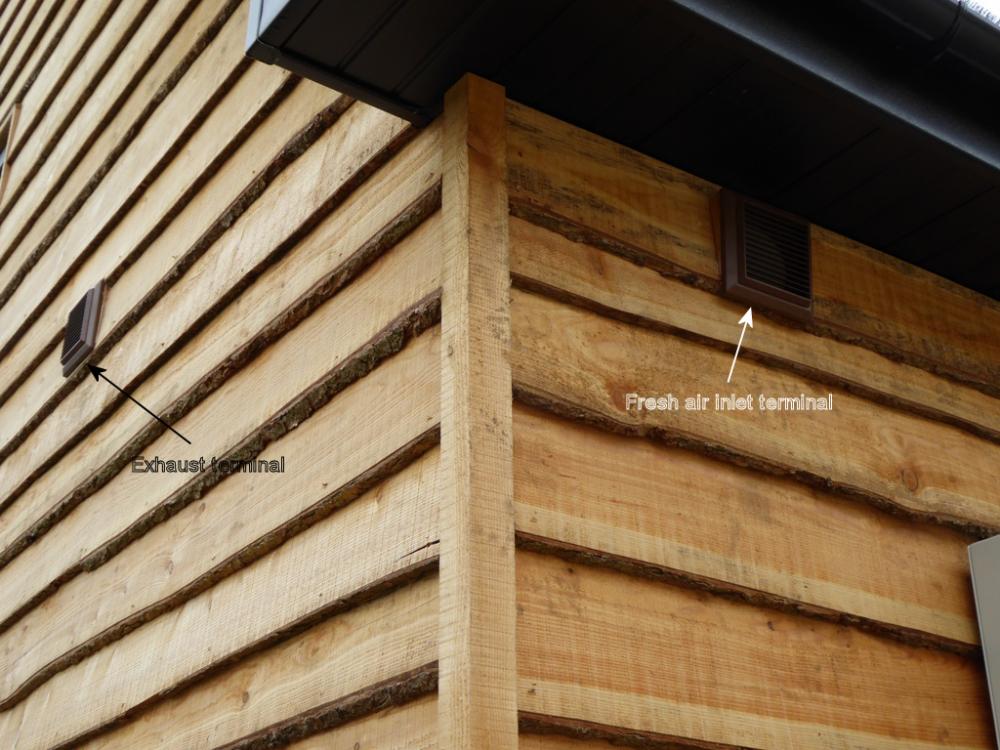
-
Contamination Survey....deep breaths!
Jeremy Harris replied to pauldoc's topic in Planning Permission
I sometimes think we should have a "useful tips before you submit a planning application" sticky here. On it would be things like, before you submit an application, or seek planning advice, do the following: - Fill in any ponds that might possibly contain Great Crested Newts - Remove the roof from any structure on site that might possibly house bats - Remove any indication of there ever having been oil tanks or any other form of hazardous substance from the site. - Fell all and any trees that you think might possibly restrict what you want to do. - Run a bulldozer over the site to scrape the topsoil clear and remove any evidence of there ever having been a trace of anything of ecological value there. - If you suspect there could be archaeology, dig down to a depth as deep as your foundations will be over any area you may have to excavate as a part of the build. - grub up and remove any old hedges that might be in the way, lest they contain nesting birds, dormice etc that could impact your application adversely. (the above was written tongue-in-cheek, but I'd suggest that doing all, or some, of it would save a lot of self-builders a great deal of money...................) -
Wall vents for mvhr
Jeremy Harris replied to ProDave's topic in Mechanical Ventilation with Heat Recovery (MVHR)
I must get around to fitting the new SS cowls I have, I've had them for months and just haven't got around to making up a tapered backing board from a bit of spare larch to allow them to fit flush with the cladding. Be aware that some suppliers charge really silly prices for those cowls, £40 plus each. I bought mine (which are absolutely identical to the one in the photo above, but 150mm rather than 125mm) for a lot less than the price some ventilation suppliers were aslking. IIRC, Mine came from ebay for around £20 each, probably from a seller like this one: http://www.ebay.co.uk/itm/Stainless-Steel-Ventilation-Vent-Outlet-Exhaust-Grilles-100-125-150mm-Ducting-/261528397833?var=560404344005&hash=item3ce44ea809:m:m4MVEHjFVSZC4Zds85pdE1g -
I can say that when charged the Sunamp PV is cool, not hot. I'm not surprised by this, as that is exacltly how sodium acetate behaves in things like hand warming pads. When it's a liquid (i.e. "charged" to it's maximum heat capacity) then it stays at the temperature of its environment. When the phase change is triggered by a nucleation device (the small "clicker" inside the hand warmers) then heat is released. What I don't fully understand is how nucleation is controlled, but that, together with the precise make up of the form of sodium acetate they use is, I think, one of the keys to the way it works. I remember discussing this years ago on the GBF, and concluding that the key to making a PCM store work was finding a way to control nucleation and the subsequent phase change it triggers. If I was to guess, then I'd say there if the heat release is controlled, such that the storage cell can reach a high temperature when a nucleation event has started, but heat has stopped being taken from the storage cell, then there may well be a stable situation in which part of the storage cell is in the high energy, liquid, form and part is in the low energy solid form, and that some how nucleation stops and a state of equilibrium is reached, where the storage cell temperature gradually reduces, with most of the stored heat being in the remaining liquid phase of the sodium acetate. I've had the lid off mine a couple of times, and removed the top insulation, and can say the cells are not very hot when fully charged, which I am sure is a key part of the low overall standing losses. The insulation definitely isn't fantastic, it looks like 20 to 25mm thick vacuum insulation panels, which is about the same as 60 to 75mm of PIR foam (lambda for a VIP is around 0.007 I think, that for PIR is around 0.022).
-
You'll get used to this. Some companies think self-builders (or anyone other than a company asking for a quote) are numpties that can be fleeced. Many of the quotes we had for various things were stupidly priced, some because they didn't really want the business, I think and some because of what I've come to call the "Grand Designs Factor", i.e. all self-builders have loads of money so let's try and relieve them of as much it as we can. I gave an example in this post recently:
-
Wall vents for mvhr
Jeremy Harris replied to ProDave's topic in Mechanical Ventilation with Heat Recovery (MVHR)
I used 150mm plastic duct (fine for the max airflow with our unit) but did, like Peter Starck above, find that the external fittings restricted the airflow. They also increase the external noise on the inlet, I think. It is surprising how much external noise there is with a short duct on the inlet - the exhaust doesn't seem to make much noise at all, even though the duct is still pretty short. What I've found is that the square plastic external terminals I've fitted, these ones: tend to collect a lot of fluff, spiders webs, dandelion seeds etc on the inlet side and need very regular (as in every two to three weeks in summer) cleaning. I also think they may well be quite restrictive, so I've bought some stainless steel cowl-type external grills that I'm hoping will reduce the flow noise a bit and not get so easily blocked up, like this, but for 150mm duct: -
That was my immediate reaction, followed by the inevitable "What's in it for them, as they are spending tens of thousands on advertising?". I don't know of any company that willingly spends a great deal of money on promoting something that only appears to give a free benefit to their customers, at a significant cost to them in implementing it. It reminded me very much of the "free" electric car charge points that were being offered, if you live somewhere with a mobile signal - the "free" offer magically disappears when they find they can't get a signal when they come to do the site survey, as I found. In that case the significant installation cost was being paid for by using the data they gathered from you and selling it to others for marketing purposes. I'll lay money that part of the reason for advertising smart meters is because there is a hidden revenue stream from them, most probably from the data they provide. I have an objection in principle to data about me being used for profit, especially by a company whose service I'm already paying for. We have a very poor mobile signal here anyway, but that from inside our meter cabinet will be a great deal poorer, as I covered the outside of it with earthed aluminium foil as a screen. I was just thinking ahead to the time when smart meters become mandatory, rather than optional....................
-
That's a very good point about the insulation. I used Knauf insulation above the ceiling downstairs and found the occasional stiff bit of what look like black, oily, bitumen, and smelt a bit like it, too. I've no idea how this stuff gets into a roll, but I can see that if it was left there (I tore the black bits off) then it could cause a stain, and it may well be that the black stuff melts when it gets warm, making it run and drip on to the plasterboard. I was just intrigued at the time as to where this black stuff came from, because it seemed to be very like tar or bitumen, and I can't see why something like that should be used when making rockwool/fibreglass insulation.
-
I started another thread on smart meters, to avoid deflecting this one. I found that even adding lots of additional insulation around an already double-foam-sprayed thermal store (i.e. one with near double the normal insulation level to start with) still didn't reduce the losses a great deal (IIRC it dropped from around 3.5 kWh/day to around 2.5 kWh/day at 65 deg C, for a 260 litre TS with a rated standing heat loss of about 1.5 kWh/day at 75 deg C, using the test spec they use). Against this, the Sunamp PV loses around 600 Wh/day and runs 10 deg hotter to start with than the TS (I ended up turning it down to 65 deg C, because at 75 deg C the TS losses were even higher and seriously overheating the services room). The difference between the Sunamp and a thermal store isn't the insulation at all, the effect of the insulation on the Sunamp performance is minor, the major standing loss saving comes from using a phase change material, that doesn't sit at a high temperature when it is charged, but only releases heat on demand, via selective phase change. If I was to guess, then I'd say our old 260 litre thermal store, with double-sprayed insulation plus an added foamed-on layer of 50mm PIR foam, would have had a standing heat loss of around 3 kWh/day at 75 deg C, the original design temperature.
-
I looked into the technology being used and the data collection and security, some time ago (probably around 4 or 5 years ago now, when the first "smart" meters were being rolled out. There are a stack of issues with them, even though the intention is partly good. The major one hitting consumers right now is that each supplier came up with their own implementation, so when you change suppliers (as we're all encouraged to do to maintain competition in the market) then the meter needs to be changed as well, or you just lose the "smart" meter "advantages". The more serious flaws were that the entire system, from the meter data link to the storage of data by the suppliers and intermediaries, was open to malicious attack. In fact the protocol was so insecure that it was laughable, with virtually no security provisions at all at the meter end. Whether consumers would have trust in the data collection end, run by the suppliers is open to question. Right now there's no significant problem there, apart from the frequent "computer errors" that seem to effect the billing part of the systems some suppliers use. With the advent of control of meters and supplies by the suppliers, using their systems, there comes a whole new set of security issues that some could choose to exploit to there advantage (anything from crooks fiddling usage data to malicious interference with supply control). The annoying thing is it wouldn't have been at all difficult to make smart metering effective and secure. Adding hardware encryption to the data link would have been easy, cheap and effective. Making the metering systems all work to a common standard, with rigid controls to ensure interoperability between suppliers would have been easy, and not added significantly, if at all, to the cost. Focussing on effective incentives, rather than replicating existing energy usage displays and hoping that will change behaviour (for most it won't, as has been shown) might have given real benefits. For example, EDF in France charge different prices for electricity to all domestic consumers depending on their forecast load. It's not smart metering, it relies on radio, TV and internet warnings of the days/times when prices will be high. We have friends who lived in France for years, and they would always watch out for the price changes and plan their usage pattern to avoid using things like the washing machine during high price periods. From what I gathered from talking to them, this was commonplace; lots of consumers were used to just adjusting things around the varying energy price. Smart meters would have allowed that easily, and a simple display showing the consumer the current price and usage, with a short calendar of forecast prices over the next few days, would almost certainly start to do the same as what has been happening in France for some time (I think the reason for doing it in France had lot to do with their shortage of short-term fast ramp-up generation; they use a lot of very slow to respond nuclear plants). The real nail in the coffin seems to be that widespread roll out of smart meters in other countries hasn't resulted in any saving, if anything it's produced the opposite effect!
