Jeremy Harris
-
Posts
26430 -
Joined
-
Last visited
-
Days Won
360
Everything posted by Jeremy Harris
-

The tale of the sale of our old house
Jeremy Harris replied to Jeremy Harris's topic in General Self Build & DIY Discussion
Thanks Herb. I'll be "off the air" here for much of tomorrow, but with luck should have everything settled by the evening. -
The tale of the sale of our old house
Jeremy Harris replied to Jeremy Harris's topic in General Self Build & DIY Discussion
Back on topic. It's pretty grim being back in the old house. Had to turn the heating up, as when I came back from the new house to here to finish clearing out and packing our last few bits and pieces up it felt miserably uncomfortable (and noisy). The heating's been on, set for 21.5 deg C, but I'm sitting here with cold feet and not looking forward to our last night here. The stark difference between a much-improved (loads of extra insulation, lots of attention paid to improving airtightness, reasonably decent uPVC double glazing, condensing combi boiler) 1986 block and brick bungalow and our passive house is just unbelievable. The room temperature of both is the same, but for some reason (most probably the far more even temperature in the new house, with the walls, floor, ceiling and windows all at the same temperature) the new house feels so much more comfortable. I won't regret finally moving out of this old house. Having experienced the comfort of a passive house I doubt I could ever feel comfortable in any other type of house in future. Good job we have no intention of ever moving house again. Best of all, I'm finally shifting out of "self-build mode", and starting to think about life when we're not working almost exclusively on house-related stuff. First off is a nice holiday, though... -
cold bridge would this help
Jeremy Harris replied to scottishjohn's topic in Structural Insulated Panels (SIPs)
Very good point, I'd forgotten about cold flow... -
You can set the command unit to report different temperatures; I have mine set to report the flow temperature. There is very definitely a setting that's awry in the command unit programming - if I was able to access ours I could sort this for you in a few minutes by just reading out the parameters from ours so you can try exactly the same ones in yours. I'm near-100% certain that this is just a parameter setting that's awry, that's setting the heating flow temp to 25 deg C. These things have a myriad of interactive settings, and it seems highly likely that one or two of these aren't set correctly for what you want to do. Sadly the settings aren't well documented, they could do with more descriptive text as to EXACTLY what each parameters does.
-
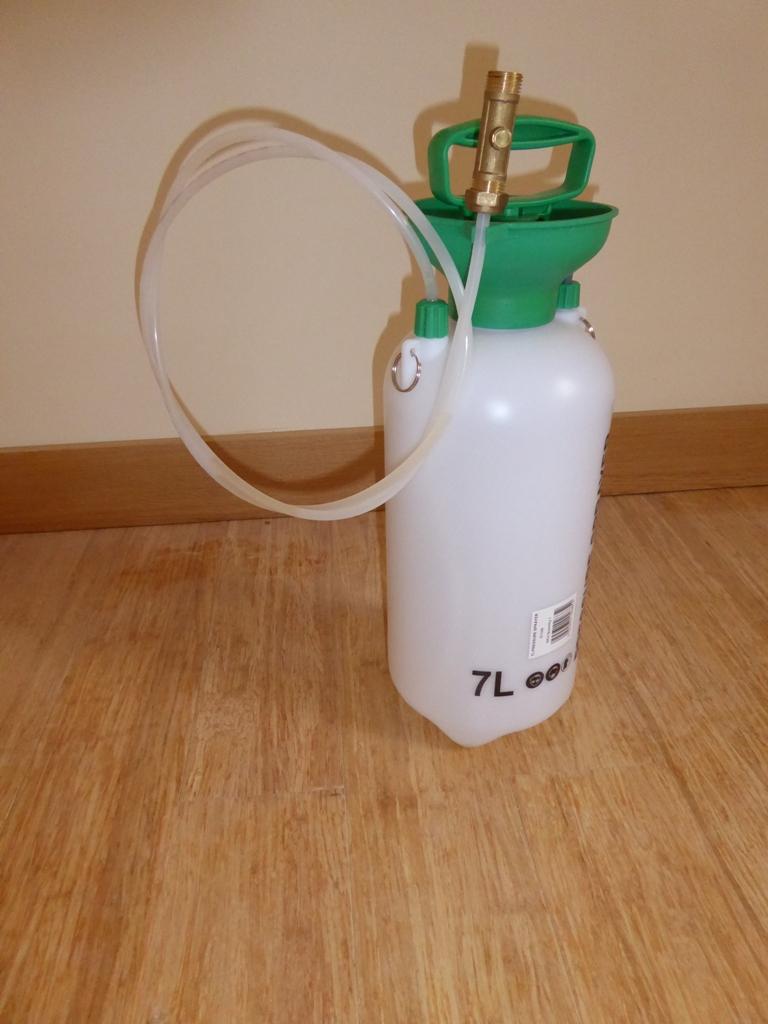
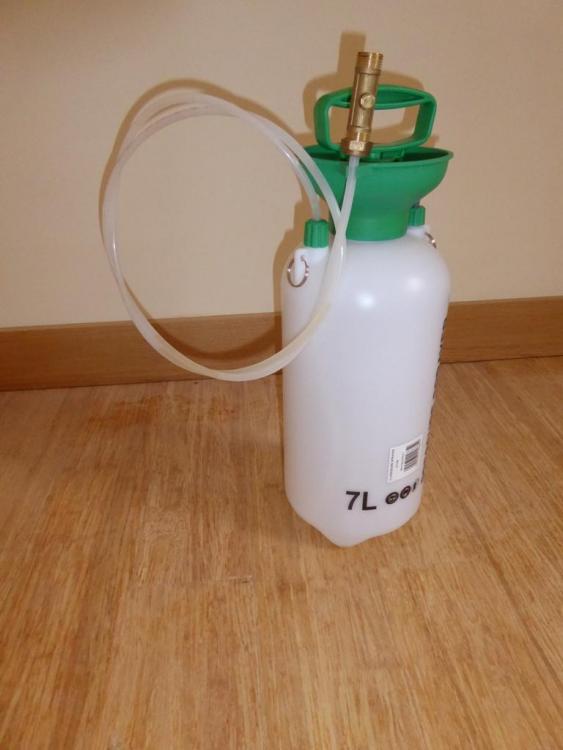
Solar thermal isn't fed by mains water, though, it has to be pumped up with a pressurisation set filled with high temperature inhibitor/antifreeze. I made a pump set to fill our UFH and ASHP circuit, as I was a cheapskate and didn't want to pay silly money for one: IIRC this will happily pump up to around 5 bar, and is near-enough identical to the purpose made ones that are sold for filling and pressurising solar thermal systems.
-
If you're peaking at 5 bar, then the accumulator will charge to that peak pressure and hold it whilst the mains pressure drops for intervals from other users demanding water. You can then regulate down with a PRedV and your problem is solved. Adding bigger pipes in any configuration after a pressure restriction point won't make any difference at all.
-
If you have a wide variation in supply pressure, which is what your symptoms suggest, then fitting an accumulator and NRV will fix that, and combined with a downstream PRedV will give you a solid, constant supply pressure, irrespective of flow.
-
5 bar is a bit on the high side - IIRC we have a couple of bits of kit that won't take a pressure that high, and are limited to a maximum of (I think) 4.5 bar. No reason why a correctly sized PRedV should have any effect on flow rate, all they do is convert the excess inlet pressure into flow as the demand increases on the load side.
-
As long as they're back on line within two or three years I think we'll be OK...?
-
We're in the midst of clearing out of the old house, so I don't have time to go over to the new house and have a look, but there may be a parameter that I think disables the custom heating curve, which may be why you can't set the right heating (not DHW) temperature. The unit treats heating and DHW as two separate functions, with different operating regimes and settings, and the manual is not clear as to which settings only apply to DHW (which I think they refer to as sanitary water) and which only apply to heating. As this is a new board, I'm near-100% certain that all the parameters have to be set initially from the command unit, and there are some that tell the board the type of machine it's running, IIRC. With a bit of luck I may get some time after the removal truck has done it's thing tomorrow to take a look at all the settings and jot them down for you. By just copying exactly our set up you should at least be able to get heating at 40 deg C, and once you have that then fine tuning it for what you need should be fairly straightforward, as it will just be a matter of changing one parameter at a time and seeing what effect it has.
-
cold bridge would this help
Jeremy Harris replied to scottishjohn's topic in Structural Insulated Panels (SIPs)
Looks like a good detail. I remember the discussion with the Kingspan chap who took a while to grasp the need to keep the sole plate insulated with a bit of EWI, as I think Kingspan were struggling to understand the dynamic interstitial risk, and were just using (as does virtually everyone else) steady-state risk models. The real-world case can be pretty dynamic - I've measured a 15 deg temperature change within an hour in our cavity, with the RH rising from the low 40% region to over 90% in that time. With a cool sole plate and vapour permeable outer construction there was a substantial risk that condensation would occur, and unless enough heat energy was pumped in during the day to warm up the sole plat enough to convert the condensed water back to vapour so that it could move outwards again when the outside temperature drops, there is a significant risk that damp conditions there could prevail for some time - not good for the sole plate timber. -
@joe90, what heating curve parameters have you set? These must be set to the correct values (all of them) to get the right flow temperature in heating mode. I posted this in the other thread for 40 deg C output in heating mode and 12 deg C in cooling mode (it's exactly the settings I have set up in our unit):
-
I haven't worked it out yet, but it was delivered a couple of years ago and we have hardly made a dent in the stack. At a guess I'd say we have few years worth left, but next time I'm going to take the price hit and just order a half pallet load. That eBay pricing is silly. IIRC, a twin pack was around £7 if bought singly in one of the local DIY sheds, and buying a pallet load brought the price down to less than £3 per twin pack. Seemed like a bargain at the time...
-
It is indeed, quite outstanding, and far, far neater than any of my plumbing!
-
cold bridge would this help
Jeremy Harris replied to scottishjohn's topic in Structural Insulated Panels (SIPs)
The thermal conductivity of recycled plastic "timber" varies a fair bit, but would typically be around 0.3 W/m.K to 0.4 W/m.K, whereas dry softwood would be around 0.12 W/m.K, so better to use timber by a fair bit in terms of decreased thermal conductivity. The only advantage would be the rot resistance, but the big disadvantage is that the cold spot would move up to the ends of the structural studs, and as the recycled plastic would be impermeable, there would be a significant risk that it could act as a condensation locus, and stay damp. -
(Update) Foundations on a site of archaeological interest
Jeremy Harris replied to Sjk's topic in Foundations
The vendors had a team in from Bristol University who had dug two big trenches across the plot already, and found loads or stuff, including millstones, a cobbled floor, the remains of walls, etc, and the old mill leat was still visible running through the woods that formed the rear of the plot, as was the wheel pit at the back of the plot. I took a detour back past the plot around 3 years after we walked away from it and it was still empty, so my guess is that others walked away much as we did. -
I did a bulk buy, bought a whole pallet load of Harveys salt blocks for around half the list price for a single pack. Great idea until you realise you need to find storage for them all, somewhere warm and dry!
-
So did ours at our old house. Main problem was that newer cisterns do a sort of trickle top up after the flush, to get the water level up to the right level, and this results in a sheet of slow moving water running down the back face of the pan for ten seconds or so after a flush. This area always ends up covered in scale, as does the area around the underside of the pan lip. All the toilets in the new house flush on softened water, mainly because it was always my job to sit there spraying Vaikal up and all around the toilet pans to try and get the blasted scale off. Our water isn't has hard as @PeterStarck's. either, as our total hardness is around 280 ppm IIRC, damned hard, but perhaps a bit lower that that in East Kent.
-
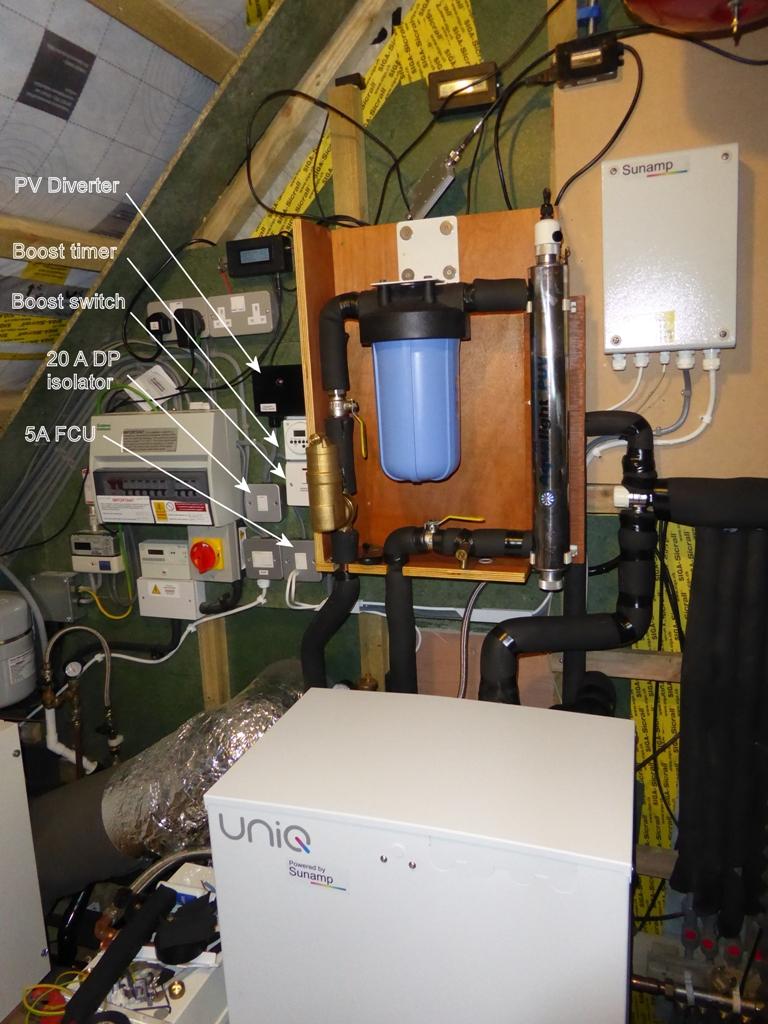
By the same token, one of the early problems with the old Sunamp PV was that the pump over run time (essential to stop the water heater tube from over-heating from heat soak and tripping the over-temp switch) was too short. That system used to run at around 65 deg C or so normally, but with the short pump over run time the water heater tube would trip a 90 deg C resettable switch a minute or two after the heater shut down.
-
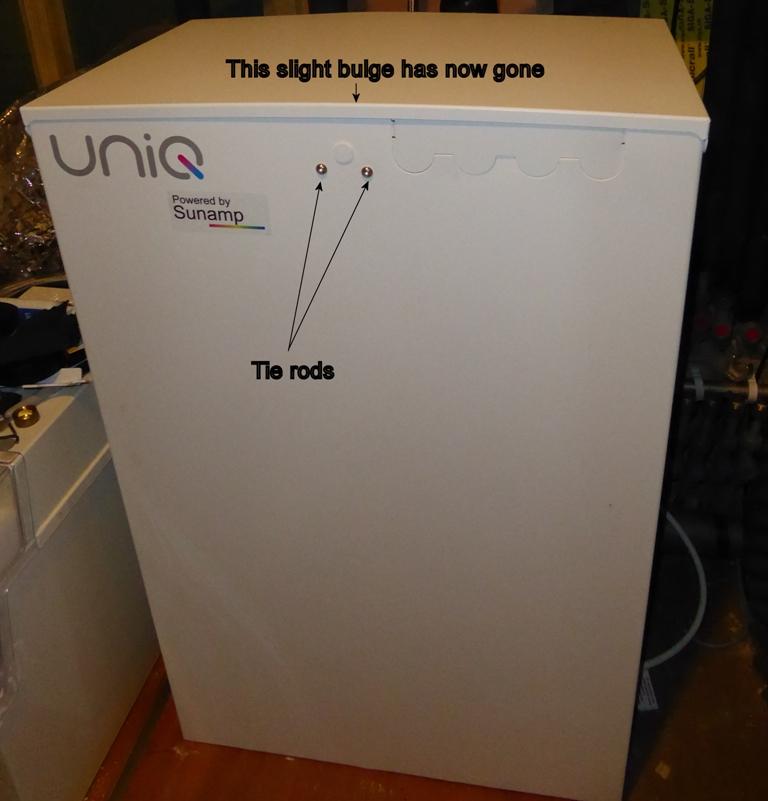
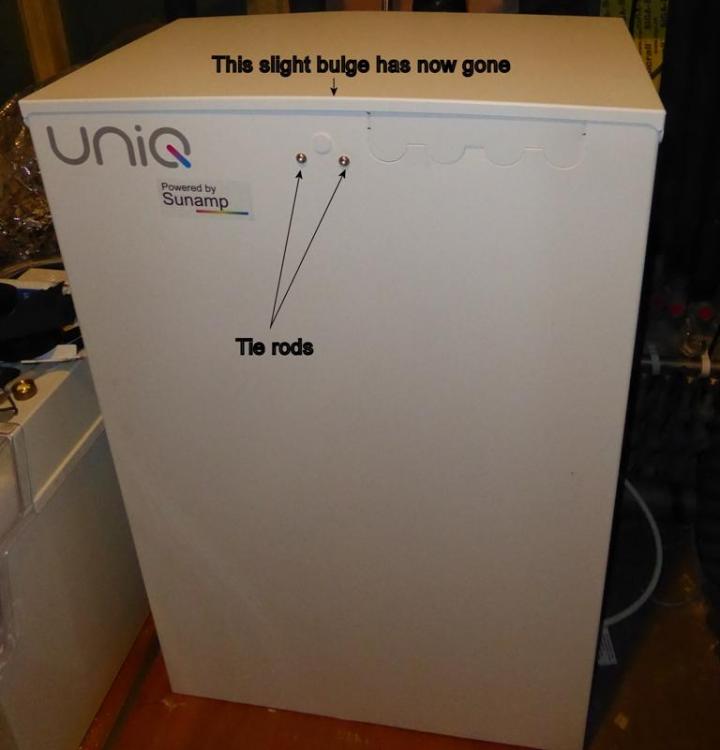
There are two important differences between yours and mine. Mine has tie rods running front to back to stop the sides bulging, and my lid has a flange all around, so that it sits like a biscuit tin lid on the top. If you look at this photo you can see the screws holding the tie rods across the top of the cell and the flange on the lid: It seems clear that Sunamp are making incremental improvements to address the bulging issue, and with one or two minor changes I think they will have solved it. Mine now has a flat top after trimming more of the insulation out and pre-bending the lid to a slight curve in the opposite direction in order to push the centre of the neoprene insulation down first, so it can spread outwards as it compresses. You have the older style lid that mine was supplied with, but which was replaced free of charge by Sunamp a couple of days after my unit was delivered.
-
I honestly can't remember, other than that they were brass four port ones that came with 15mm pipe fittings. I thought I bought them from Screwfix, but they don't seem to list them now. I know they weren't very expensive.
-
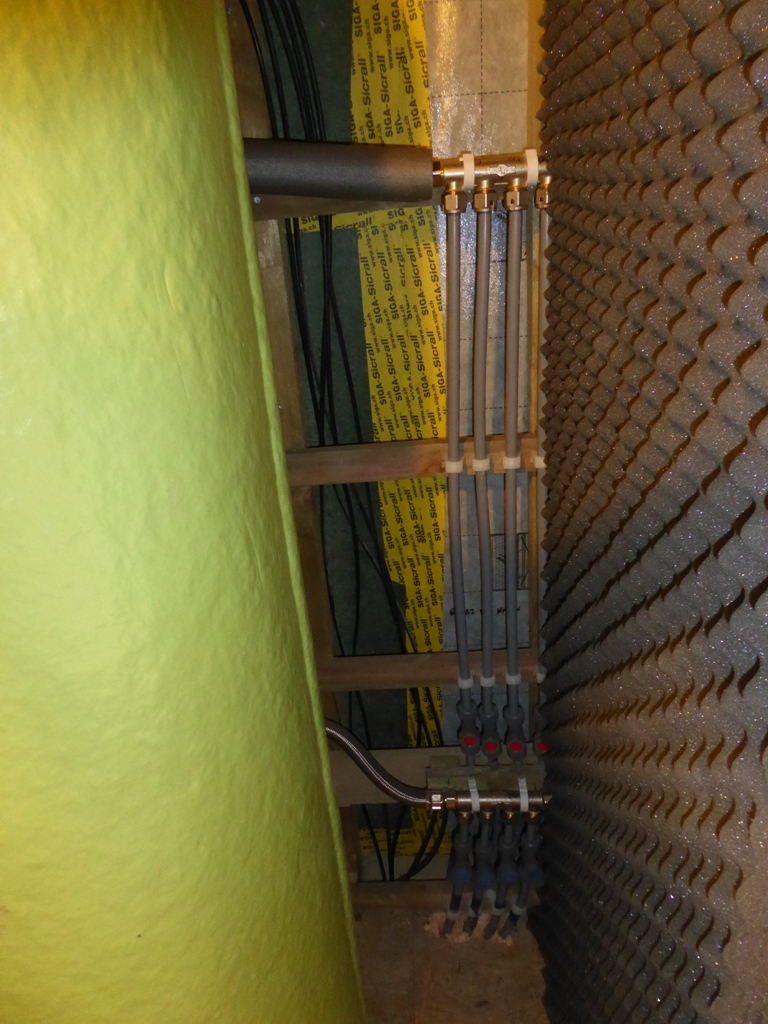
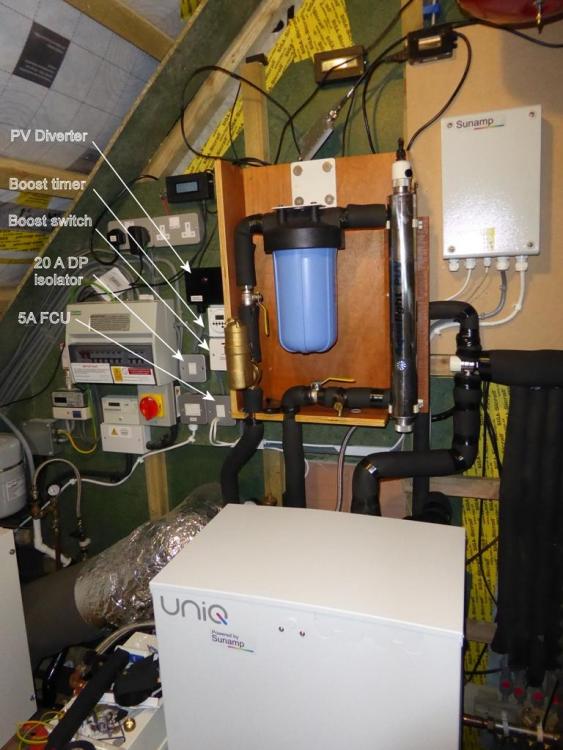
Yes, @Pete is right. I plumbed the whole house in plastic wherever pipes were behind plasterboard or under floors, so that I would run a continuous length of pipe without joins out to every point. I used copper for all the stuff from the ends of the plastic runs to everywhere else, especially where it might be seen, as plastic tends to look a bit untidy (unless you're @PeterStarck...). The thermal store (green thing) in that photo has gone, and there's a Sunamp sat there now, and the feeds to the ends of the manifolds are 22mm copper. All the pipes are insulated now, too, you can get a glimpse of them at the right hand side of this photo: The DHW mixer valve is fitted directly to the end of the hot manifold now, with the hot water from the Sunamp coming up at the base of it and the cold mix water coming in the top.
-
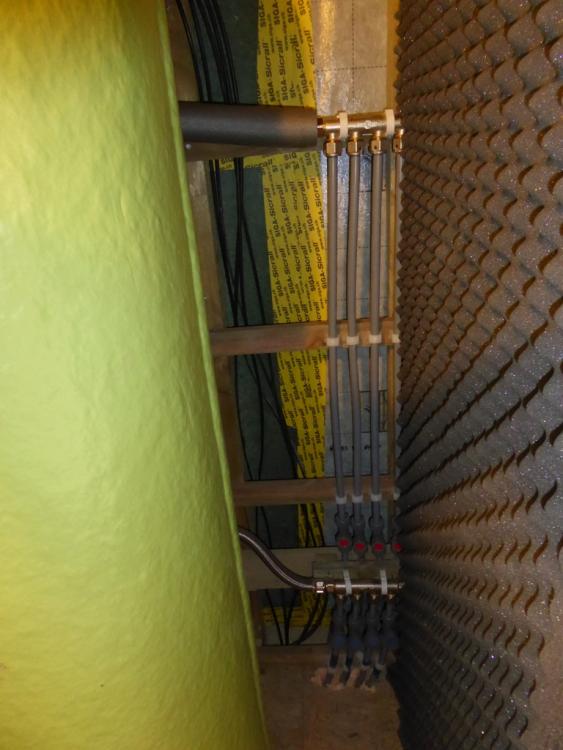
This is one taken before I insulated the pipes and when we still had the big thermal store fitted, rather than the Sunamp (hot manifold is at the top, cold at the bottom, and there are no flexi pipes on them any more, they were a temporary bodge to get water on quickly for testing):
-
In my case the "internals" haven't moved at all, there is no "expansion and contraction" causing this, AFAICS. It's a dead simple case of the insulation (which is closed cell neoprene foam) being too tight for the available space. Not at all sure where "chineese involvement" comes in with regard to this either, as the construction method and insulation looks to be very similar to that of the Sunamp PV, with regard to the insulation, cell design etc. The difference is that the Sunamp PV insulation wasn't such a tight fit in the case.
-
The tale of the sale of our old house
Jeremy Harris replied to Jeremy Harris's topic in General Self Build & DIY Discussion
That's a heck of a lot better than I expected. To have the phone able to be on standby and able to receive calls for 10 to 15 days is probably just about OK, although three weeks would be better, as we're often away on holiday, sometimes without the ability to charge a phone, for that long. The Nokias we have used to last around 6 weeks turned on on standby but that's been dropping as the batteries age. I keep meaning to get some new battery packs for them, as decent BL5s are only three or four pounds or so each.