Jeremy Harris
-
Posts
26430 -
Joined
-
Last visited
-
Days Won
360
Everything posted by Jeremy Harris
-

Anyone fitted a pre-charged aircon unit?
Jeremy Harris replied to Jeremy Harris's topic in Air Source Heat Pumps (ASHP)
Tonight will be the test for this! The plan is to cool the bedroom right down, then turn the air con off and see if just the MVHR will keep it cool. If push comes to shove I can leave the air con on it's lowest setting, at ~23dB it's virtually silent as far as either of us can tell. The considered view at the moment is that it won't disturb sleep at all it's that quiet, but the real test will be to try it. Flat out on it's highest setting it seems to draw about 650 W, which won't have any effect on our electricity usage if we only run it during daylight ours. Usually the temperature drops a bit at night, although the forecast here is saying that it will only dip to about 19°C, which for us probably means over 20°C. -
+1 for Hedgehogs, they are brilliant. We had them in the gutters of the last house, where we initially had a problem with moss growing on the tiles and breaking away and clogging the gutters, and Hedgehogs completely fixed the problem. I pulled the Hedgehogs out and checked the gutters before we put the house on the market last year, and after ten years or so without being touched they were all as clean as a whistle. I fitted Hedgehogs here when the house was first built, based on our experience at the old house.
-
Also, make sure you pull the PTFE tape tight into the threads when wrapping it, and wrap it so it tightens as the parts are screwed together. As above, fairly usual to need 20 wraps or more of PTFE tape pulled tight on fittings like this. I'm also a fan of the Screwfix Liquid PTFE. Stupidly designed bottle it comes in, but I've yet to find a fitting it can't seal up first go.
-
Anyone fitted a pre-charged aircon unit?
Jeremy Harris replied to Jeremy Harris's topic in Air Source Heat Pumps (ASHP)
Just to close this off, I finished commissioning the Toshiba unit this afternoon (good timing, probably the hottest day of the year). It was delayed by me not realising I needed an adapter to allow the pressure gauge I'd bought to fit the test port on the outdoor unit - took a week to arrive. It was also a bit of a palaver hoisting the 23kg outdoor unit up on to the wall bracket. Apart from that these things are pretty easy to connect up and get going. I bought a package which consisted of an indoor unit (with remote), an outdoor unit, 4m of insulated pipework, with pre-flared ends, and a wall mounting bracket for the outdoor unit. I had to buy a length of 3 core 1.5mm² flex, plus a length of outdoor-rated 4 core 1.5mm² flex. I also chose to buy a vacuum pump, pump oil and a set of test gauges. Total cost for everything came to: Toshiba MIRAI RAS-10BKVG-E 2.5Kw/9000Btu outdoor and indoor unit, inc. shipping and VAT £574.08 4m pipe set £62 Wall mounting bracket £21.15 Trunking for pipework and cables £32 Cables £15 10m of 16mm bore water drain pipe £16.99 Total for parts used in installation £721.22 In addition, I had to add another double gang outlet to the upstairs ring final, tucked away in the service room. I happened to have a spare metaclad one, and the cable was easy to get at, so it was only a ten minute job. The unit plugs in and works fine on a 10 A fuse in an ordinary plug (the indoor unit is designed to accept flex, rather than T&E). I also chose to buy a vacuum pump for £42.99, plus a set of test gauges for £25, some vacuum oil for £6.25 and an adapter to convert 1/4" to 5/16" for £5.18, so £79.42 on tools. I'd be happy to lend these out if anyone wants to have a go at installing one of these things - not easy to post, though, as the pump is now full of oil. Installation was not difficult, but hampered by doing the job on my own. Coming up with a way to hoist the outdoor unit up on to the wall bracket, mounted just under the eaves, took the best part of a day, and was a real faff. The rest was pretty easy, run a duct through the wall (a bit of 68mm drain pipe is ideal), screw the indoor unit to the wall and hook it into place. Carefully unroll the copper pipes and feed them through the wall and connect them to the short pipes that come out of the back of the indoor unit. Connect up the 16mm drain pipe and run that outside and down to just above ground level. Connect the 3 core cable and 4 core cable to the indoor unit, and run the 3 core to a 13 A plug somewhere easily accessible. Run the 4 core cable outside with the pipes. Connect up the pipes to the outdoor unit, with a bit of vacuum oil on the threads and flare fittings and tighten them up. Connect up the test gauge and vacuum pump to the test port on the outdoor unit and pump the system down to vacuum, checking for leaks by turning the pump off, closing the valve on the test gauge and waiting to see if the pressure rises. If all is leak tight pump the system for around 15 minutes, to get any water out of the pipework, then turn the pump off and leave the system under vacuum for a while as a further test for leaks (I left it for over an hour whilst I had lunch). If all is well, then wire the 4 core cable to the outdoor unit, remove the test gauge, cap the test port and remove the caps over the gas valves. Open these to let gas into the system with a 5mm Allen key, then replace the caps and do them up tightly. Turn on the power and it should work. It seems to be working very well, and is extremely quiet, even when running flat out. The bedroom temperature is now heading for 18°C, so we should be able to get a good nights sleep. I think my timing has to be just about spot on, getting this running on a day like today. Time for a nice cold glass of wine... -
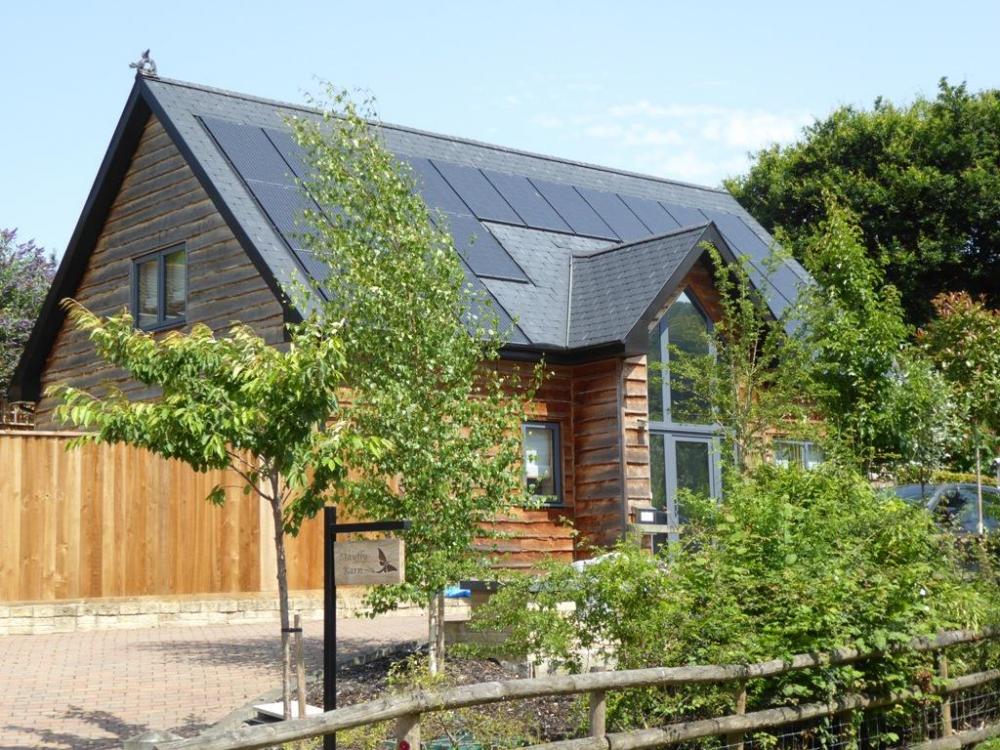
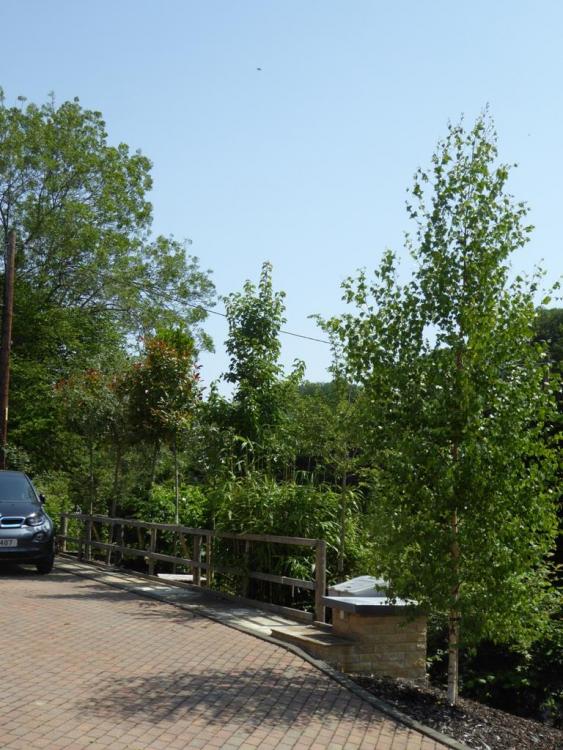
Thought I'd update this, now we're nearly a year and a half on from planting, with some photos of the way the trees look today:
-
We're generating about 5.9 kW at the moment, down a bit because of the heat, I think (it's 31.8°C outside and still rising). Luckily we have no shade:
-
When I was commuting from our old house to here every week day, I drove past a lay by (really the entrance to a bye way) that was regularly used for large-scale fly tipping (as in a tipper truck load). The council would usually arrange to clear it within a few days, as a local riding school used to use the bye way. I would hazard a guess that it costs a great deal more to collect fly-tipped rubbish than it does to allow free access to the recycling centres, but maybe cleaning up roads comes out of a different budget, so no one can be bothered to correlate the two.
-
Thanks, I'm also very impressed with Makita kit. I won a Makita tool chest years ago, and since then have stuck with the brand. The current tally of Makita cordless tools is: 36 V lawn mower (takes two 18 V packs) Three cordless drills (one is the dying NiCd drill/driver, the others are 18 V ones) A circular saw (brilliant bit of kit, but eats batteries) Hedge trimmer Strimmer Nine or ten 18 V battery packs, some old 3 Ah ones, some 4 Ah ones I also have a double battery charger plus a single battery charger, so can charge three battery packs at once Plus a tiny high speed Makita mains drill (used to use a lot it when I was building aeroplanes, ideal for rivet holes), and a 4" mains mini grinder. Did have a big Makita grinder but gave it away as I never really used it. Looks like I'm a bit of a Makita junkie, reading the above...
-
The thing that annoys me is that pretty much all this hassle started not long after they privatised refuse and recycling. Certainly the council people at the local centre were a bit surly at times, but I never once encountered this petty use of crazy rules. I suspect that it has something to do with the way that the recycling contractors get paid that makes them behave like this. Maybe the commercial use fees go to them, so they have a vested interest in trying to maximise the number of people forced to pay to use the facility.
-
I hope you've managed to get your floor cooling going, @NSS. We've just hit 30°C here, and the temperature is still rising, the forecast seems to suggest it will peak sometime in the late afternoon. At the moment the floor cooling is holding the downstairs temperature at around 22°C (it was around 21°C first thing) but upstairs is over 23° and heading for 24°+ I suspect. I've just finished vacuuming down the new air conditioning system, just need to wait while I have lunch to see if there are any leaks, then, with luck, I may be able to get it working to cool down our bedroom for tonight. Certainly a good day to test it!
-
The issue seems to be that the system has flagged me as a commercial user, rather than just a resident, so unless I register, and pay to use the facilities as a commercial user, I cannot gain access. The fact that this was done in error seems to be something their system cannot cope with. Once a car registration number is recorded as being for a commercial user there is no way to remove it from their database, apparently. TBH, now we've moved house it doesn't matter, as it's just as easy to use the nearest Dorset recycling centre (actually slightly easier, as it's easier to access). If Dorset start imposing restrictions then I may summon the energy to try and do battle with Wiltshire again, but for now we don't have much need to get rid of stuff.
-
Turning up at the tip triggers automatic eviction via the ANPR system, unless I was to go there in someone else's car. What has happened when I've tried it is that I get intercepted as I drive in and asked to drive out immediately. There's no one at the recycling centres that has any authority to do anything about it, they are apologetic, but say they have to do what the system tells them. It is completely mad, and I've reported it (several times) to the council, made a fuss about it at a public event and had words with my local councillor about it. It seems that the council are powerless to intervene in actions taken by their contractor.
-
My experience of the built in motion detection was that it can be tricky to get to work reliably, especially if you have anything that may move with the wind in the field of view. You can block out some areas of the field of view on ours, to try to stop it triggering on things that normally move, but I still found that there was a fairly high level of false alerts. I ended up switching to beam-break sensing, as that was relatively easy to do for us, and seems to be a lot more reliable. The only false alerts we get are from animals breaking the beam, and that could be fixed easily enough by raising it up a bit. I deliberately set it low to record the animals, as I was puzzled by some of the droppings we kept finding around the place (turned out it was a visiting otter).
-
The controller for our ASHP is a bit of a nightmare, the user interface is really dire. I opted to set it up so that the controller is only used as a programmer, with the control of the ASHP operating modes being by dry contacts. Our outdoor unit has separate dry contacts for ASHP on, cooling or heating mode, DHW mode, and quiet/eco mode. By just connecting dry contacts to 0V the unit can be made to switch on in heating mode, cooling mode, DHW mode or quiet mode (in addition to the other modes). Makes it fairly easy to control, but needless to say none of this is documented well; I had to reverse engineer the thing and then experiment to find out how it really worked. I made up a relay box, with a bit of simple diode logic, to translate the various combinations of thermostat and timer inputs to dry contact outputs that just run via a multicore cable to the ASHP. It's easy enough to change this fairly easily, plus I used DIN rail mount relays, with LED indicator bases, and fitted them inside a small consumer unit box, that has a clear lid. This makes it easy to see what's going on, just by looking at which LEDs are lit.
-
I've got a couple of 18V Makita drills that are still doing fine, a fairly old BDF452 and a newer DHP453 (not as well made as the older one, IMHO). The old Makita drill/driver that is on it's last legs is a NiCd one, that never had that much grunt, but was handy because it's relatively small. The small size of the impact driver is one of the attractions, and having good low speed control would be nice. I find that having both a drill and a separate driver to hand is a lot easier than faffing around swapping drill bits for the screwdriver bit holder.
-
I don't think you'd have a problem with the flooring, @ProDave. Our floor cooling has been on most of yesterday, it's just come on again this morning, and I've been around and measured the floor surface temperature and it varies from 18.9°C on the travertine to 19.5°C on the bamboo flooring. The RH inside would need to be over 75% for there to be any significant risk of condensation on the flooring, and currently the RH is sitting at about 49%. I don't think I've ever seen the RH downstairs get above 60%, it's usually down around 40%. I think it's a bit higher this morning because it was really misty here first thing (just radiation fog from it being a clear night, and our location in a deep valley, next to a stream).
-
It's interesting about alarms. Where we used to live there were a couple of houses with alarms that would regularly go off, usually when there was a power cut. They were like this for many years, and I can't ever recall anyone being called out when one of those alarms sounded. We all just got used to them going off and ignored them. Based on that experience, plus a chat we had in the village hall about community policing (which revealed that there was one car and two officers covering about 20 villages) I concluded that an alarm was pointless, as most people would most probably ignore it, and if they did report it the police could well take over an hour to get here. I fitted CCTV when we were still building, as kids kept getting in to the building site. CCTV worked well to deter them, after I'd caught a couple of them and shown them the CCTV recordings. I find the main use of CCTV is being able to glance up and the monitor to see who's at the front door, though. Recording is triggered by a break-beam sensor across the drive, which acts as an early warning that we have visitors. Also handy for spotting wildlife (and the neighbour's cat).
-
I split the controls on ours, so the "turn on the UFH actuator" line is separate from the "call for heating" line. We also have two room stats, one set up for cooling and one for heating. The control lines we have are: Timer - has overall control of on and off times for the whole system, also switches the circulating pump on and off UFH on - turns on the UFH actuator, either for heating or cooling, or turns it off Call for heating - puts the ASHP in heating mode and turns it on Call for cooling - puts the ASHP in cooling mode and turns it on We also have a DHW pre-heat mode, controlled by a tank stat on the buffer, that ensures that the UFH circuit is off if cooling mode is active, before switching the ASHP to heating mode to heat the tank. I'll probably bin this, and the buffer tank, next time I drain the system down, as it's not needed and we've had the pre-heat tank stat turned off for months not.
-
I can check later, but I think the stainless ones I have are made by Timco. They look just like timberloks, though, with a hex head.
-
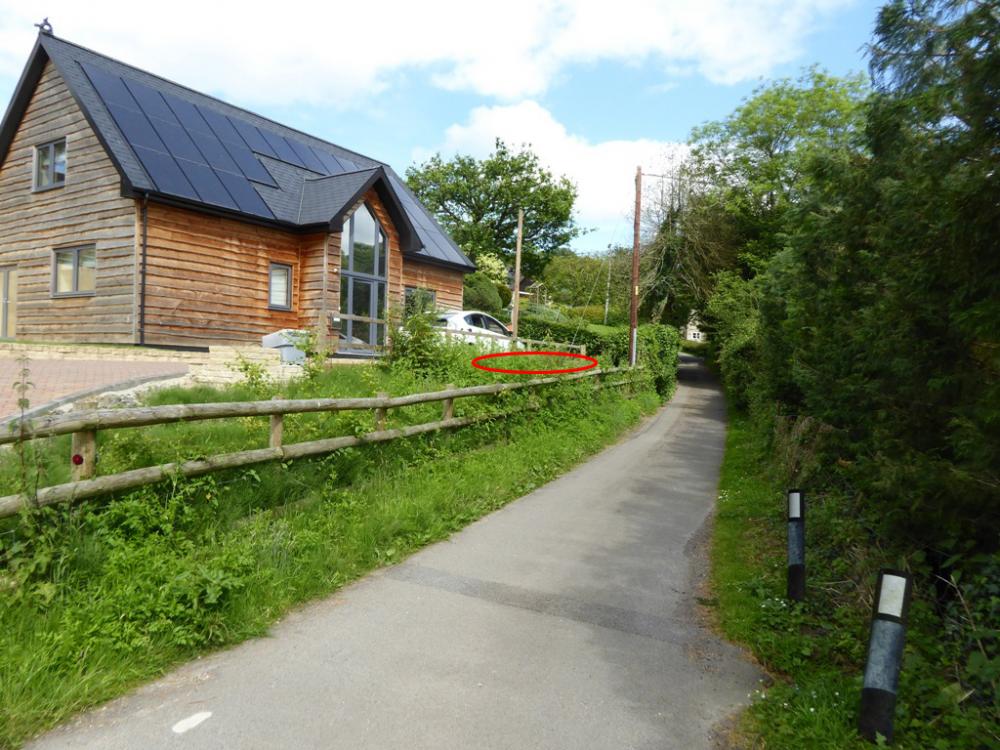
Yes, the efficiency of thin film panels is a fair bit lower. Worth looking at ordinary black panels, as these are almost indistinguishable from thin film when viewed from ground level. We have black panels set into our roof:
-
Thanks all, I think I'll probably spend the extra and get the brushless one, just for the better control. I've already fitted half a dozen oak sleepers with stainless timberlok screws, and they went in OK by hand (hard going, though, and I did pilot drill first).
-
We find that floor cooling works really well downstairs, it's upstairs (where we don't have UFH) that tends to stay a bit too warm (I'm hoping to commission the air con in our bedroom tomorrow). Be very interested to find out how you get on with floor cooling @NSS, as I think that @jack and myself are the only ones here that have tried it so far.
-
My ancient Makita drill/driver is dying, and I've been meaning to replace it for years. It's the only non-lithium tool I have, and has lasted well, but now the gearbox is in its death throes. A joiner friend swears by his Makita impact driver (not sure which model, and he's away at the moment so I can't check). I already have a couple of Makita chargers and nine or ten 18V lithium battery packs, plus several other 18V Makita tools, so I only really need to buy a bare machine. I'm struggling to find out whether the brushless model is really worth the extra over the brushed version. My old drill/driver was brushed, and has done all I ever asked from it, so my inclination is to save a bit and just get the brushed one. However, I have sometimes wanted a bit more torque, and have a job coming up where I'll need to drive lots of long stainless screws into some oak railway sleepers, so the extra torque from the brushless version may be useful. Having said that, even the brushed impact driver has a heck of a lot more torque than my old drill-driver and there doesn't seem much to choose between the two when it comes to justifying the difference in price. It seems my choices are: DTD153Z brushless, 170 Nm, at ~£85 DTD152Z brushed, 165 Nm, at ~£62
-
Presumably the existing retaining wall had planning consent, so there should be no requirement for another planning application to replace it on a like-for-like basis. As the failing wall was built less than 10 years ago it should be covered by whatever warranty the house came with. These warranties (NHBC etc) aren't really worth the paper they are written on, though. The original wall should have been included on the planning consent for the house itself. This would be normal, and you could check this by looking at the planning application for your house on your local authority website.
-
There's a clause in Part G that refers to alternative sources of water being taken into consideration when looking at water efficiency. Our BCO (the final one) agreed that, as our whole water supply was considered to be an "alternative source" (i.e. not mains water) that exempted us from the efficiency requirements. Makes sense, as in terms of the water cycle we draw water from under our plot and drain it back to the ground around 20m away, so there's no significant environmental impact from our water use.