


Garald
-
Posts
1113 -
Joined
-
Last visited
Everything posted by Garald
-
I'll double- and triple-check my calculations by hand. I have to make a decision that is tighter - I'm getting a predicted consumption of about 6kWh for heating alone if I heat the whole house (admittedly this doesn't take some further improvements into account - for instance, we'll be preheating the air in our PIV, and that should give efficiency gains relative to just using radiators, though the manufacturer's propaganda is a bit overly cheery and imprecise on that particular) and then there's hot water. The question is whether to install a 7kWh heat pump (which would be considerably quieter (-6dB) than a 10kWh heat pump, also from Saunier-Duval aka Vaillant). I'd lean towards "yes", except "7kWh" is clearly a bit optimistic, if you read the technical specifications closely. That's what I am surprised that an installer just told me that his back-of-the-envelope calculations gave him enough confidence that he'd recommend the 7kWh model. He was telling me on the phone that people in his branch do calculations so as to cover 90% (if I remember well; it was something less than 100%) of heat loss - as if 90% were plenty. What do they use for the remaining 10%? Cats?
-
(I'll redo the calculations for the attic by hand, incidentally; there's no way to tell the Freedom Heat Pumps that you have a room that is not a box, so the spreadsheet is underestimating the value. OTOH, the architect just told me that there's more insulation in the attic than I thought. Let us see...)
-
At any rate, yes, from what I see now, the Freedom Heat Pumps does add a fudge term of 0.15 to the stated value of the wall. Fair if that's what experience shows them, I suppose; does it sound sensible? (It's a bit funny that it's a fudge additive term and not a fudge factor - it does affect things very heavily when you've worked hard to get the U all the way down to 0,23 - but perhaps that's what reality indicates.) It also adds 0.15 to windows' U value (there, it matters less). Or is there a meaning to that term?
-
So, should I be happy with what I have got with the worksheet and double-checked by hand? Notice that I'm not actually getting the same values by hand, at least not for the ventilation heat loss.
-
But third parties here use it as a tool. Most likely there are simply internal parameters that aren't set right (for this project), and now have to be reset (but how?). It's annoying, as it is rather opaque.
-
I'm taking the air inside the insulation into account (without any excessive optimism) when computing the total R value (the R value of the insulation material alone is 3.8). Thermal bridges: no, and I entirely believe that the spreadsheet may be including a fudge factor for safety, and that it's right in doing so. That may explain why it gives a different value for heat envelope loss than I do. What still remains a mystery to me is how Heatpunk gives such high values.
-
Perhaps it's that I (truthfully) answered that the house is from 1930 when queried - now Heatpunk may be internally assuming some fantasy values. Of course I would like to see what happens if I insert the fiction that the house is from 2010 (... which is roughly the date of the last renovation before mine), but, try as I may, I do not see how to do that!
-
Let me do this by hand, for the room I just described. Outside wall area (U=0.23 W/m^2K): (9.2+3.9)*2.8 = 36.68 m^2 Window area (U=1.4 W/m^2 K; this is the value from the spreadsheet - mine are allegedly a tad better): 7 m^2 Outside wall area minus windows: 36.68 - 7 = 29.68 m^2 Design temperature = -1.8 C, or -2.1C correcting for altitude, aiming to be at 21 C, we have Delta = 23.1 So, heat loss through the envelope: (29.68*0.23 + 7*1.4)*22.8 = 384.0... W, of which 157,68...W are through the walls and 226.38 are through the windows. Now I'm already getting a bit confused, since the spreadsheet gives me 263W through the walls and 251W through the windows. Is the spreadsheet adding some necessary fudge factors, or am I making a mistake? Ventilation losses: Volume = 9.2*3.9*2.8 = 100.4... m^3 0.6 air changes per hour (this is the medium setting in my PIV) So, heat loss through ventilation: 100.4*0.6*23.1*0.33 = 459.2... W, which does correspond almost exactly to the value given by the spreadsheet (458W) Then the spreadsheet adds 60W for heat loss through the floor, which seems reasonable (I'll probably have to give myself more margin in reality: the GP downstairs presumably turns down his heating when he's not there). At any rate, while I can't trust myself yet (as I said, the spreadsheet gives me a value for loss through the envelope different from the one I'm getting), the spreadsheet would seem to be in the right ballpark, and Heatpunk is not. Question: are there some parameters in Heatpunk that I am setting incorrectly, or that are set to default values that aren't right? (I'm a bit frustrated by how non-transparent it is.) That seems to be the most likely explanation. Otherwise, how to account for the difference?
-
But the room I mentioned is on the first floor, so the floor and ceiling figures can't matter. How can I be getting two figures, one of them larger by 50%?
-
PS - the last five hours of my life, which should have been devoted to sleep, where spent on this instead. I am not made for GUIs. PPS. I can't ask Heatpunk's default values for things such as ventilation frequency, heat and ceiling insulation, etc. Perhaps the problem resides somewhere there?
-
I am getting very different results from Heatpunk, as in, 50% higher in every room. What can be the reason? Example - take the library(/music room/everything else): 9.2m by 3.9m average ceiling height: 2.8m One of the long walls and one of the short walls are internal; the other ones are insulated up to U=0.23. Total window area = 7m^2, iwith a value of U=1.4, say (new, high-grade double-glazing with PVC frame) 0,6 air changes per hour desired temperature: 21C Outside design temperature: -1.8C Heated rooms above and below (this is a first floor) Then, from the spreadsheet, I get a heat loss of 1034,2 W, whereas Heatpunk gives me a heat loss of 1533W. What gives? Which result is right? ---- (BTW, the default choices for windows and the like in Heatpunk are starting to show their age - but that is another matter.)
-
Thank you. Wait, I thought I had input 4 persons (since that's the realistic maximum)? I don't see where there is a cell where more was stated. (Perhaps that will give us the key to the issue.) Sure, and the installers will come up with their own calculations. One of them already did something back-of-the-envelope and was of the opinion that a 7kW Saunier-Duval would be best. That would be great, but it surprises me a little, given that I am getting a 6kW heat loss (greater on cold waves, obvs), there's DHW, and the "7" in "7kW Saunier-Duval" is optimistic (at all temperatures, and in particular at the intended temperature of 45 C). I'll make sure to insulate as well as possible the door opening into the lower level of that small but damaging uninsulated stairwell leading to the attic.
-
Do you think it's essentially correct? I have no clue as to how debug a spreadsheet.
-
But the unit doesn't produce the label output even then! At 7C/35C, it gives 5.8 nominal, 9.8 maximal, whatever that means. At -7 C/35C, it gives 6.7 nominal, 6.7 maximal. (45C will probably be more typical for me when it's -7C outside; I don't have UFH, and I need most of my wall space (because books), though it's true I also have PIV with pre-heating. Then it's 5.8/6.0.)
-
Current state of the saga: I'm now trying to estimate heat loss as accurately as possible - and also making small changes that seem obvious in retrospect and, according to the spreadsheet, make a large difference. (For instance, the stairwell going to the attic is small and narrow and will have to remain uninsulated for now; I will try to deal with this issue (which costs me 0.4kW, apparently - more than the loss from the largest room) by insulating the door at the bottom of the stairwell - convection should be enough that not much heat is lost from the attic through the stairwell, no?) My aim was to get safely under 6kW, so that, allowing a margin for the production of DHW, I could consider getting a GeniaSet Split 7 rather than a GeniaSet Split 10 (there's nothing in between - and the Split 7 is 6dB quieter than the Split 10, which, in turn, is just 4dB quieter than a Yutaki S Combi 8kW). Except - https://files.izi-by-edf-renov.fr/files/catalogue/produits/fiche-technique-pompe-a-chaleur-saunier-duval-geniaset-split.pdf shows that the power of the GeniaSet Split 7's power is not 7kW, ad I was expecting - rather, it is under 6kW in most circumstances, with the maximal power often not being that much higher (6kW at 45C when it is -7 outside). Is the number "7" in the name just a fantasy? It might be best to get the Split 10 unit, then, and choose the "silent" mode when possible. The technical information list gives no information on efficiency while on silent mode, however - it states that power is then cut by 60%, but it's unclear whether that means power consumed or heating power produced. I'm starting to think that Saunier Duval's publicity department is a little too talented... (Or am I misreading things?) PS. A comparison of figures confirms that this is the same as the aroTHERM Split 7kW and 10kW. Again, I don't really see how the "7kW" label is earned (whereas the 10kW generally produces more than 10kW, i.e., quite a bit more than I need). https://www.vaillant.co.uk/downloads/aproducts/renewables-1/arotherm-split-1/vaillant-arotherm-split-1-0-lr-1454128.pdf It's interesting that the brochures in French emphasise much more the unit's relatively low noise levels (to the point of overselling them, I'd say).
-
Thanks in advance!
-
Insulate internal door *and* put a cat door in?
Garald replied to Garald's topic in Doors & Door Frames
Ah, interesting. You mean, like this one? https://www.amazon.com/Catwalk-W-MCD-Multi-Magnetic-Cat-Door/dp/B0016H9GK6?th=1 But that's a lockable one (opening for a specific cat with the right microchip or key around his or her neck). Are there simpler ones? -
Insulate internal door *and* put a cat door in?
Garald replied to Garald's topic in Doors & Door Frames
99 pounds is a bit steep for a product that the cat might refuse. Is there an alternative? -
There is an internal door that I want to insulate (thermally, and possibly phonically as well), as it leads to a stairwell that we cannot insulate. (It's a very tight stairwell going to the attic.) However, the space under that stair is also the planned location for the cat toilet, and I do not know whether we will succeed in herding the cat into the attic every night. Are (a) insulating the door (b) carving out a cat-door in the bottom part of the door compatible goals?
-
Thanks for spotting that. I just went over it, and couldn't find the mistake. Do you think it is somewhere in the cells feeding into the DHW calculation? Which ones are those?
-
Soundproofing a heat-pump's external unit
Garald replied to Garald's topic in Air Source Heat Pumps (ASHP)
Right - regulations are actually not so different, but one has to be careful; the acceptable value at someone's doorstep is defined in France in terms of what the ambient value would have been without the heat-pump - it should not exceed it by more than 5dB during the day and 3dB during the night. This is a quiet courtyard, at least when the kids in the neighbouring elementary school aren't having recess. Moreover, one can also be called to task if the legal level is not surpassed overall but is in fact surpassed in certain frequency bands. As other people have pointed out, there are also echos in a small courtyard. Thank you very much for - I'll do this after teach class. Right; Saunier-Duval, in particular, seems to sell a good product a little too eagerly. Even if you go by their estimates, if we need to get the 10kW model (the next one down is 7kW, which could be very tight, considering the unit also needs to produce DHW - the heating needs are around 6kW), then we are at 43dB at 3 meters (without counting the echo). So, we are not really talking *whether* to have some soundproofing, but *what* kind of soundproofing to have - something that reduces the noise by 5dB (say), costs hundreds, is relatively slim and improves the unit's appearance while also protecting it, or something that reduces the noise by 14dB, costs 2000eur+installation costs (optimistically speaking) and is bulky and ugly. Or something in between. Here is the floorplan. Courette = little courtyard, R+1+C = place where I live (a GP occupies most of the ground-floor, and I now own the rest; the heat-pump would be in front of my main staircase, close to the room that will be my guest-room/girlfriend's home office/in-law apartment that can hypothetically be rented out but will probably be mainly used for my actual parents; other people live in the building labelled RDC+C. The total width of the courtyard is a bit under 4m at its narrowest point, if I remember correctly.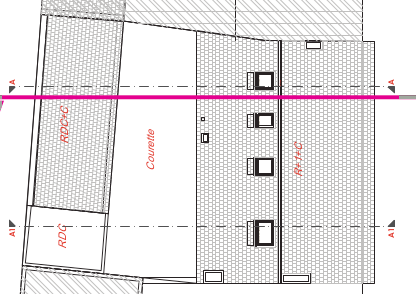
-
As lots of people here already know, I am getting a heat-pump - and do not have much of a choice but to install it on a shared courtyard that, while long, is not very wide (about 4m on the narrower end). While the other owners are very receptive to the idea, I want to avoid future trouble (with the neighbors, and also for myself - the external unit will have to be close to my home-office/guest room downstairs) by getting one of the quieter heat-pumps, e.g., Saunier-Duval: https://www.saunierduval.fr/france/download/genia-air-1/geniaset-split/saunier-duval-geniaset-split-brochure-gp-202103-2041667.pdf or, less perfectionistically by a couple of decibels, https://www.hitachiaircon.com/uk/ranges/heating/yutaki-s-combi Then I also want to put a sound-reduction box around the external unit. Look, for instance, at this heavy-duty device: https://solflex.eu/en/hcsschalldaemmgehaeuse14db/?lang=2 - the manufacturer claims it (a) reduces noise by 14dB, (b) will not reduce the efficiency of an air-pump installed within. Is this really possible? Is such an outcome likely? (The smallest model here would be suitable for the 7kW Saunier Duval; the Hitachi external unit is probably too small for this sound-reduction box - I'd have to find some other one.) From the moment the air flow is being limited in anyway, I would imagine performance would be affected. Or is there no significant effect in this case?
-
Conversely: how much cooling can 0.6 air transfer deliver? The one and only way in which I plan to use my heat-pump for cooling is to cool the air being sucked into the building (by the same device that heats it in winter).
-
The difference between what and what? Should I set my unit to heat water to 50C or more for a while, once every couple of days? At any rate, how should I eyeball how much power I need, given that my heating needs would apparently be covered by 6kW? Would a total of 7kW be enough? 8kW? In the other direction: would 10kW be already grossly inefficient? (Some brands have nothing between 7kW and 10kW, for example.)
-
Not sure either. What I do know is that one of the side external walls is humid (presumably because the neighbor has a beautiful garden with, sigh, creeping vines) so we have to be extra careful there. That's the wall with the chimney (working chimney, btw - we are assuming that, since it is a massive stone chimney, it will still be safe to use).