Garald
-
Posts
1113 -
Joined
-
Last visited
Everything posted by Garald
-
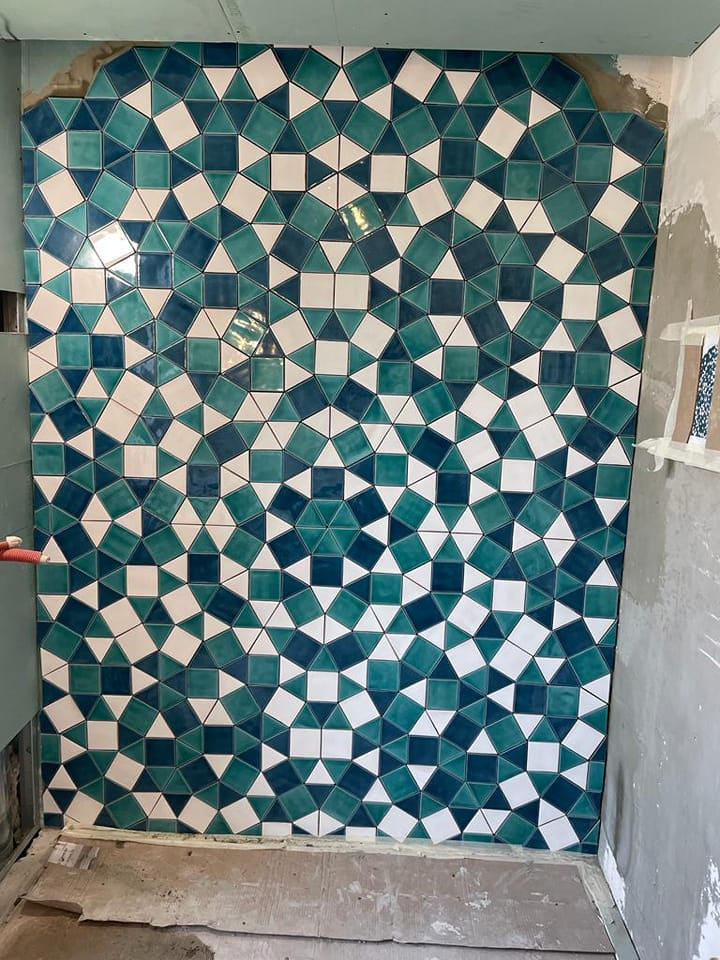
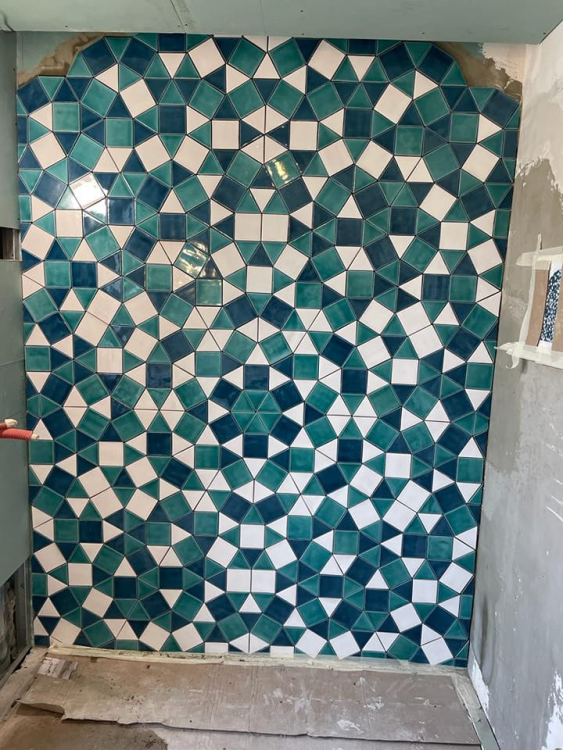
The contractor was remarkably fast (and I'd say he's done a good job). Planning, though, took more days than I'm ready to confess. I chose all the colors by hand - they don't really have a mathematical significance. The triangle-square pattern is in fact significant (https://tilings.math.uni-bielefeld.de/substitution/square-triangle/) and perhaps because of that wasn't so hard for me to do (I hacked up the Python routines to produce Latex/TikZ code within a day).
-
Exactly (though I'd call that color "green", and my more civilized friends call it "teal"). Also, one of the bottom-right white triangles should be teal (again to keep symmetry - both left-right and top-bottom).
-
... or at least the central panel. I have spotted only one error so far. Are there more? (Symmetry should make it easy to spot them.)
-
Removing outside piping that probably has asbestos in it
Garald replied to Garald's topic in Building Materials
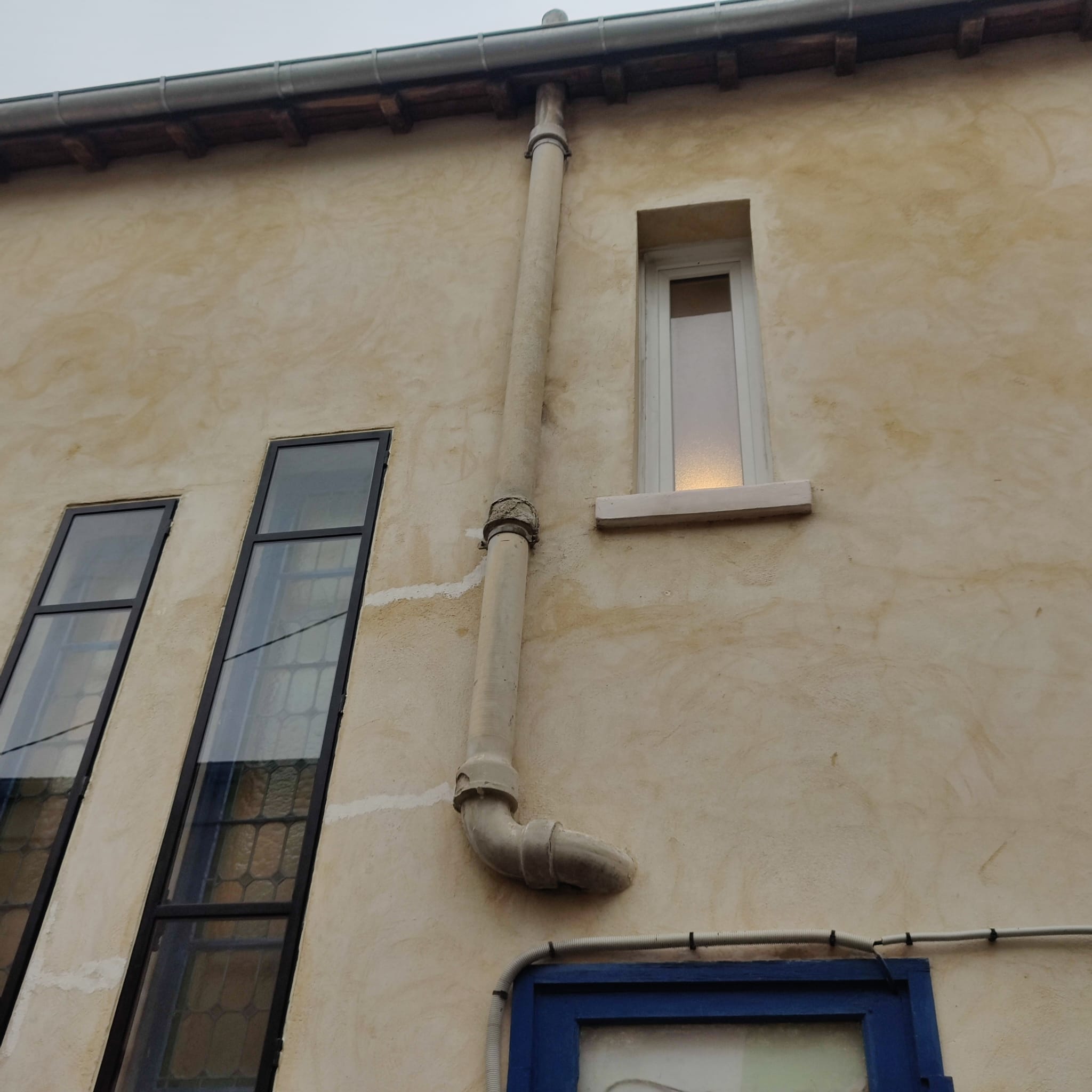
Successfully removed. -
These are tilings by irregular pentagons (type 8 (Kershner, 1968) in https://en.wikipedia.org/wiki/Pentagonal_tiling). It wouldn't be very fair to challenge you to figure out the mathematical meaning from this angle, but I don't want to include spoilers either! Pentagonal tiles from Mosaic Factory (Zelliges, Penta model); hexagonal tiles from the Kromatika line of Mainzu.
-
Removing outside piping that probably has asbestos in it
Garald replied to Garald's topic in Building Materials
I thought it was lead paint that was tasty? Ah, second layer of glazing. Well, whatever I should call it... -
Removing outside piping that probably has asbestos in it
Garald replied to Garald's topic in Building Materials
Right, I trust my builder. (He sometimes has communication issues, or gets upset because of delays caused by people other than myself, but it would seem that he is good at everything he does.) Recall he was the one who managed to magically transfer moulding on top of the insulation. Notice also the nice job he has done putting a second layer of glazing on top of the stained glass (picture above). -
Removing outside piping that probably has asbestos in it
Garald posted a topic in Building Materials
There's an outside drain pipe (useless nowadays) that most likely has asbestos in it (in the form of fibre-cement). My contractor is offering to remove it for what looks like a reasonable amount of money (about 500 quid), given the need to put in scaffolding, the potential hazard, etc. The architect was just trying to dissuade me, however - she was saying: fixing one problem leads to another, you may find yourself under a cascade of bills, you were not planning to fo work on the outside (this is the courtyard side, not visible from the street), etc. The contractor is reassuring us that the matter will stop there, and that he has ways to make the mark left by the drain pipe inconspicuous. My instinct is to have it removed: (a) even if the risk is less than it would be if it were indoors, there has to be *some* risk, (b) if removing the pipe leads me to learning about potential problems with the facade - well, knowledge is better than ignorance (even if I do currently have the budget to fix any major problems)! What do you think?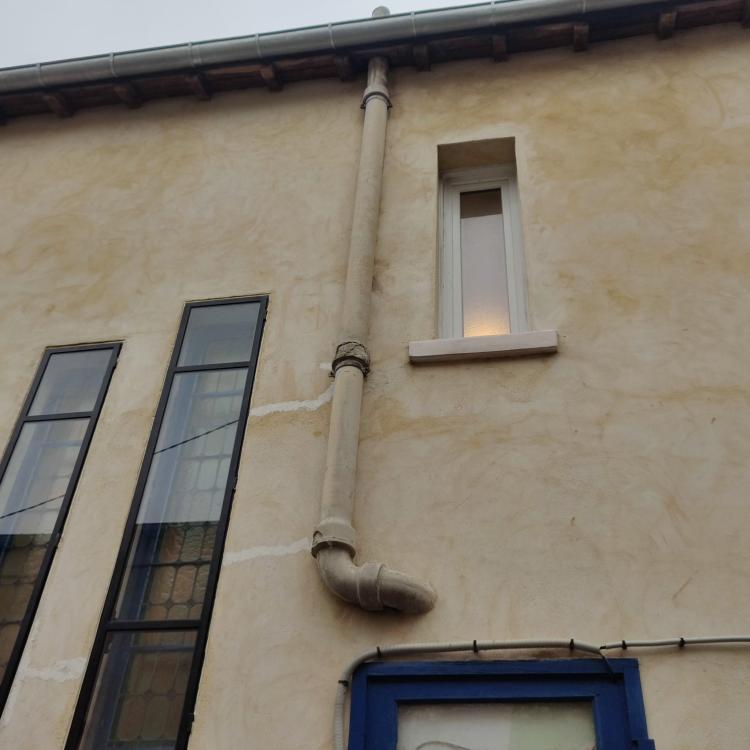
-
Well, Mitsubishis are the quietest of the lot, but there's a strong cultural perception in France that heat pumps are noisy, and that increases the probability of complaints by neighbors. The rule is that you are not allowed to surpass ambient noise by more than 5dB during the day or 3dB during the night, "valeurs auxquelles s’ajoute un terme correctif en fonction de la durée (article R. 1336-7 du code de la santé publique)". Now, *what* counts as ambient noise, that's another matter. Of course a Mitsubishi will be quieter than the noise coming from the adjacent elementary school during recess (it's indistinct enough that it's not unpleasant, actually), let alone the occasional helicopter, but...
-
In the end, we'll go for a Mitsubishi Zubadan Silence producing 60dB - the least noisy unit we could find (well, we could have gone a notch lower by going for a lower-powered unit Of course the documentation states that, 1m away, the noise is only 46dB, but the courtyard is small, regulations are strict, and, even if we meet them, I'd rather not annoy the neighbors. So, I'll have to put money aside to get some sort of soundproofing enclosure, if needed. Not looking for anything dramatic - 10dB would be more than enough, and already 5dB or 6dB would be something. Questions: 1. What sort of arrangement do people recommend here? My architect mentioned https://solflex.eu/fr/ - but unfortunately the Mitsubishi's outside unit (1020 x 1050 x 480 mm) is one cm too thick to fit into the boxes in their reasonably priced range; the ones that would fit are nasty metal boxes starting at € 3.118,80 2. I imagine *any* sort of soundproofing enclosure harms performance to some extent, whatever the ad copy says - air flow is bound to be affected somewhat. How can one estimate how much performance is lost?
-
PIV, heating and cooling: pros and cons, can and can't
Garald replied to Garald's topic in Other Heating Systems
What's the problem will letting the heat pump's thermostat determine whether the VMI's heater gets hot water? I don't see how that's grossly suboptimal from the point of view of the VMI, and of course it means the heat pump doesn't get abused. -
[So, I am still on the look for a heat-pump installer, though by successive approximations I may be getting close to the goal. I am now talking to one who is offering a reasonable price for a Mitsubishi ("reasonable" compared to what I've been offered elsewhere) and who seems reasonably honest for a couple of reasons: he's downgraded his original off-the-cuff estimate on the power required to heat the place, and he's also honestly arguing why a Mitsubishi heat-pump (the only kind he sells, AFAIK) can't do, or shouldn't do, something that I was interested in having it do, and that, if I insist on it, I should look into Panasonics (presumably elsewhere).] I am going to have Positive Input Ventilation (PIV) - that's has been the plan all along, and, if I understand correctly, ventilation is one of the things my architect does very well, as opposed to the other kind of thing. The question is then how to couple it with heating (or cooling). I can't very well extract heat from the output as in non-PIV ventilation systems ("negative input ventilation"?), so the question is what do I do with the air the PIV takes in. Enter Hydro'R/Aquarea: https://www.vmi-technologies.com/wp-content/uploads/2020/09/aquarea-purevent-visionR.pdf https://www.ventilairsec.com/wp-content/uploads/2019/11/VisionR_16pages_BAT-BD.pdf https://www.ventilairsec.co.uk/products/range-vmi/ - the idea being to preheat or cool air coming into the house through the PIV. Cooling air coming in using cold water produced by a heat pump. You can see the system has a maximal capacity of 800W in cooling - really not much, so it can't make that much of a difference. More than one installer has expressed skepticism or puzzlement about the possibility of using a non-Panasonic system for cooling. Now I've come across an installer with what sounds like good reasons for having that attitude: apparently, Panasonic compressors tolerate a greater number of restarts (their documentation states that they tolerate being restarted up to 11 times per hour, as opposed to 6 times per hour) - and that makes them usable for cooling a rather small flow of water. (The installer is also a bit skeptical about whether that can really be great for the longevity and efficiency of a Panasonic system.) Preheating air coming in using hot water produced by a heat pump - pretty much like any other radiator. I may yet convince the installer to try his hand at that; it's difficult to see how it is different from any other radiator. (He just warns me that it would then be regulated by the same thermostat as the "normal" radiators - how is that a problem, though? ) At the same time, I wonder: how much does preheating air actually help with efficiency? From the moment that new air enters a room, it is no less likely to be expelled at any given moment than any other ("stale") air. What is your take?
-
Another stupid question: can a radiator be too tall?
Garald replied to Garald's topic in Central Heating (Radiators)
Ah, sorry, I meant 220cm tall! Hah! -
I just found myself trying to decide between a 2m tall radiator (which already has more power than I need) and a 220mm tall radiator. (Both are 60cm wide.) And so the thought struck me: is there such a thing as a radiator that is too tall? Won't the extra power be lost, in that the top bit will be heating mainly the air that will start over my head and go only upwards from there? (OK, it will eventually go down, by convection, but...)
-
Stupid question: is a towel-warmer enough?
Garald replied to Garald's topic in Central Heating (Radiators)
I am talking about something very normal: https://www.cedeo.fr/p/chauffage-et-climatisation/seche-serviettes-atoll-spa-eau-chaude-716w-haut-1468-larg-500-A1940326 Why have a radiator that doesn't radiate well? -
I'm in a bit of a tug-of-war with my contractor; I compute how much heat loss a room would have at -7 C (I'm near Paris, where -2C is a much more common temperature, but hey, pessimism), add 20%-30%, and propose a radiator that produces that much at 45 C (adjusting the T=50 C value by Newton's law); the contractor suggests a radiator that produces four times the heat loss (which he never computed); I end up compromising and getting a radiator that produces twice the heat loss (... for much less than his providers ask, since of course there's such a thing as Google). He was surprised when I said that, since the (new) towel-warmer in one of the shower rooms will produce more than twice the heat loss at -7C, there is absolutely no need of another radiator - we can move the radiator that was there before and use it elsewhere. Why wouldn't this be true? (Of course a towel probably reduces the power of a radiator somewhat - but by how much?)
-
Right. Is it possible to have the heat-pump in the ground-floor and the water heater (with its own heat-pump, and ducting that enabled it to feed off both outside air and inside air, at will) in the attic? My naive take is that, in the summer, we could just let it feed on ambient air and thus cool the attic, which I would expect to get hot (by convection; we also have skylights, but they have outside shades, so they should be OK). Of course that may be too major a change by this stage.
-
Please educate me. What do you mean by "phasing" here? Again, not sure what "siting" means here. Right. Yes, I'll get it - through the Aquarea Hydro'R system (which hopefully is compatible with non-Panasonic reversible heat-pumps, though who knows - maybe there's an odd bit of plumbing to be done). It's a modest 1kW, though. (Water goes around the PIV - hot water during winter, cold water during summer.) For comparison, the water heater can extract up to 650W from ambient air. Of course I don't want it to do that during most of the year, but wouldn't it be nice during the summer? Now, doing it in the garage - or the ground floor in general, though perhaps it would make some sense in the downstairs bedroom/studio - doesn't make much sense, but, if we could do it in the attic... but it's too late for that. Right, this is a retrofit - which is running very late. If we had known everything from the start, we might have decided to try out the arrangement sketched above in the attic. That's also what we could do in the future (5-10 years) if I ever have money again and decide to raise the roof.
-
Right. I'm trying to arrange for a visit from a Mitsubishi installer next week - hopefully he'll have a machine with DHW included available. Otherwise I'll have to choose between this installer (he doesn't have Mitsubishis with their own hot-water heater incorporated available - it would be the combination of Mitsubishi without DHW and an Atlantic Calypso) and the installer that has an exclusive deal with Atlantic for heat pumps. Word on the (French) street is that Atlantic heat pumps are good (clearly better - whatever that means - than Saunier-Duval aka Vaillant) and good value, but that the noise of their outside unit, while OK on paper (62dB) is very noticeable, presumably because Atlantic uses a Fujitsu double-rotor compressor rather than a spiral compressor. That's for the main heat-pump - the little heat-pump in the DHW heater is 50dB, and I can and will insulate the garage ceiling, so it doesn't matter.
-
The specifications of the Atlantic Calypso (the better water-heater he is now proposing, ducted to outside air) are not bad, but a bit below those of the main Mitsubishi heat-pump used as a water heater. Atlantic Calypso: COP at 7 C = 3.18 When it's -5C or less outside, it stops heat-pumping and becomes purely a classic electric water-heater. (As I said, it's a good product; most water heaters of this sort stop heat-pumping well above -5C - I read somewhere that 5C is more typical.) It can of course do plenty of "classic" (resistance) water heating above that temperature - it never pumps more than 650W, and can produce up to 1800W by resistance. Mitsubishi: COP at 7C (for DHW, not heating - I take the difference is the temperature required): 3.41 The technical information claims the Mitsubishi works even when it's -28C outside (note: it's never even close to that cold in Paris!), though of course I imagine the COP is terrible then. Still, it still does a great deal of its heat production by heat-pumping at -7C (for heating the house, and presumably also for producing DHW). I get his argument for the summer - not annoying their neighbors on those few days when it's quite hot and they may have their windows open. (My thought: one could even install a switch in the ducting so as to take input from somewhere inside the house during the summer, so as to cool it, no?) What would be the arguments for separating the processes during the winter be? Are they strong enough to justify the somewhat lower efficiency? (I was also worried about the noise produced by the boiler - but if it really produces 50 dB(A) and no more (and it's not some sort of measurement taken 1 meter away or what have you) then it's something we should be able to deal with when we insulate the garage's ceiling. We've added a solid brick wall to the side wall separating us from the GP next door - hopefully that will be enough to protect him.)
-
Right, I would hope he would propose something like this. What he is proposing now is to get a Mitsubishi without hot-water storage and add a water-heater (Atlantic Calypso) with its own heat-pump and ducting to outside air that would take care of hot-water production throughout the year. The specifications of the Atlantic Calypso are not bad, but those of the Mitsubishi are better. It may make more sense to use the Mitsubishi during the winter, but he seems to think that it's necessary to get a Mitsubishi with its own hot-water storage (thereby duplicating costs) in that case.
-
With this installer, given that I can't wait for several units for the Mitsubishi with DHW to materialise, I think my only option is to have a Mitsubishi PAC and a "thermodynamic" water heater *with its input and output ducted to the outside air*. He's offering an Atlantic Calypso 200L - I think this has already been recommended in this forum. My architect will probably be upset at the last minute change, but also relieved that we are finally getting things done. Hopefully the carpenter hasn't got that far in his work on the garage door yet, as that may need to be modified a little. The manufacturer's claim is that the unit produces 50dB when it's 7C outside - I guess that's a level we can deal with by insulating/sound-proofing the garage ceiling (it is right under part of my library)? Washing machines are louder. Alternatively, perhaps the third installer will have a Mitsubishi with DHW in stock. Let us see...
-
In the summer, can a heat pump do cooling *and* hot water?
Garald replied to Garald's topic in Air Source Heat Pumps (ASHP)
Yes, exactly. Sorry! Late-night failure of translation module in the brain! ECS = DHW. The module is Hydro'R Aquarea, something designed by Panasonic. Installers are a bit scared about using it with non-Panasonic heat pumps, but I don't see the issue. Hopefully the module is properly designed! https://www.google.com/url?sa=t&source=web&rct=j&url=https://www.vmi-technologies.ie/wp-content/uploads/2021/03/EN-Catalogue-VMI%C2%AE-2021.pdf&ved=2ahUKEwjhjK6xwvv8AhXOh_0HHQWGAh4QFnoECBsQAQ&usg=AOvVaw0LXu1ytQzrm1W_PM3MkJAp -
It seems my search is converging to a Mitsubishi reversible ASHP with its own water heater ("Duo"). (Reversibility is nice - we'll be able to circulate cold water around the PIV module.) Question: will there be any obvious issues during the summer, when the heat pump will have to switch between its ECS task and producing cold water for its cooling function? (Potentially useful information: it will use only a tiny proportion of its cooling capabilities - less than 1kW.)
-
Right, but how do I get another cylinder to accept the hot water coming from the heat pump? Is it tricky? I'm getting the feeling that this installer won't do it.