jamieled
-
Posts
639 -
Joined
-
Last visited
-
Days Won
1
Everything posted by jamieled
-
Reservoir Levels rapid Changes
jamieled replied to Ferdinand's topic in General Self Build & DIY Discussion
It also usually involves more than just a reduction in garden hosepipe usage so you can often get a bit more saving. We work on the basis of about a 5% reduction. UU are one of the worst offenders for leakage I think which usually dwarfs any demand saving (but as you say, still worth doing). -
Reservoir Levels rapid Changes
jamieled replied to Ferdinand's topic in General Self Build & DIY Discussion
It's interesting to see where different water companies sit on the hosepipe ban problem. Some definitely see it as a political problem whereas others just see it as good practice. It seems to have been received OK in NI. In NE Scotland, river flows we might only expect to see for a day or two a year have been persistent for over a month. The picture below shows the River Spey which has recorded some of it's lowest levels. It makes life as a hydrologist a bit more interesting!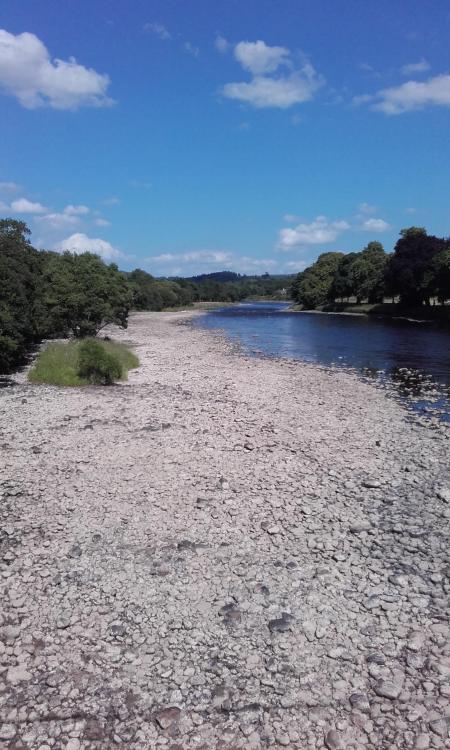
- 45 replies
-
- 1
-

-
- reservoir levels
- cumbria
- (and 2 more)
-
@A_L thanks, I've done a quick calc to compare a couple of insulated foundation systems and it ties in with your comments on the quantity of insulant needed. I'm not really that knowledgeable about thermal bridging analysis. In this case, is is because in the examples the outer skin block work sits directly on the slab? If we just have a timber frame (no block work outer skin) how does this change(if at all?).
-
I've seen a couple of docs simply certifying that the system's compliant with English and Welsh building regs under an LABC certification scheme. This statement exists for Scotland: If you would like to discuss a specific use of the product in Scotland it will require an additional assessment under the Scottish Building Regulations and accordingly you should contact the LABSS STAS Administrator at www.labss.org I'm not sure if that means it just needs a SE to do a bit of work and sign off or whether it's a lot more than that. @MikeSharp01 not a full passive build, just fairly well insulated/airtight to minimise space heating. I'll speak to them and if I get anything useful I'll report back.
-
We're working on our building control details at the moment. The Sylfaen insulated foundation system has been pointed out to us as an option, but until now I've never heard of them. Does anyone here have any experience with them? https://view.publitas.com/p222-14383/sylfaen-insulated-foundation-system/page/1 If it's of any relevance, this is for a smallish timber framed house. cheers Jamie
-
cheers everyone. @Dreadnaughtthis bit of the wood is a prime candidate for a bit of 'rewilding'. It'll just be left to do its own thing and we'll concentrate on areas with better soils. I think there were some beavers in the area few years ago. One of the old farmers (now deceased) who lived on the other side of the Glen had the distinction of being the last person to trap a big cat I think! @joe90 we're going for a bit more modern timber frame - we don't have the skills or the know how to do that and meet building regs (though it can clearly be done).
-
@vivienz Thanks and yes the house is in a woodland although the plot doesn't look quite like that (the previous owner took a bit of a scorched earth approach to it). There's a photo in an earlier post I think. @NickfromwalesFunnily enough it will be a timber frame although unfortunately the quality of the timber is probably not up to it (yet, although we're working on that, but it's a long term project when you're working with trees!).
-
Rather surprisingly our planning permission was granted at the end of last week. It turned out to be easier than we'd thought and a good few weeks before the planning authority were required to make a decision. We have a few conditions, some tree related as we're surrounded by them and one or two of the usual suspects related to foul drainage etc. As there's no progress on site, we've been doing a bit of woodland restoration (the main reason for building a house here). As I know you all like photos, the pictures below show the removal of some checked/failed sitka on an area of bog close to the plot. The plan is that it will eventually help restore the hydrology and then the habitat. I suppose you say we're just dealing with the 'garden' until we're ready to build.
-
Does it have a TPO on it?
-
I'm currently considering the use of JJ I joists for our external walls, partly to allow me to get the insulation thickness we will need. The web documents suggest that they can supply in standard 2.4 or 3m lengths with other lengths 'on request'. For a couple of reasons we have, at present, downstairs ceiling heights slightly higher than 2.4m. Has anyone used JJ ijoists for stud walls and did you procure them in non-standard lengths? How easy is it and was there a significant cost premium? Clearly one option would be to cut the 3.0m lengths to size, but that seems wasteful. I've asked the same question of JJ with no reply as yet.
-
Thanks all - this is still the bit we're thinking/changing about. Currently thinking of moving the W.C. into the lean to, accessed from the utility room to allow a bit more light into the utility room. As for the entry into the utility room, I'm wondering about leaving it for now, but making sure there's space for a wee stud wall in the future to separate the entry from utility . The cupboard in the study is the downstairs shower, although it will only have the plumbing for one, rather than being an actual shower. @Temp No bother with playing around with the drawing - for me one of the benefits of this site is getting a second, third,fourth... opinion. I had thought of a sliding door, but I have little experience of them internally. Any particular reason for not liking it?
-
@Mr Punter yep the woodburner needs consideration, it will most likely allow a very low kw input into the room and a much higher kw into water. Today's job is to look at whether everything will fit in. Utility room and larder will also be used for white goods. The overall space is way bigger than our current, very spacious flat and so I'm not overly concerned at the moment. As for en-suite's, I'd imagine it might make it more attractive from a resale point of view but personally I think they're a bit of a waste of space. @ProDave - thanks for the tip regarding the stairs. It would be grand to have a bit more flexibility with what happens in the loft space so we'll think about that. Thanks also for the offer of having a nosey, we may well take you up on that.
-
We've got some initial ideas together, image attached. For anyone interested, we've used an architect to help us. The picture roughly shows the situation, the current plan is to take out some of the conifers in the background and place the house there, replanting some other areas with natives. To give the attached a bit of context, this is a house which allow us to work/restore an area of woodland, hence why the main entry is through the utility room. Overall we're looking for a fairly functional house that will cheap to run but will also make the best of the views as we're in a nice spot. The 'bottom' wall of the plan faces roughly SSE (lean-to/kitchen on north side). Windows are sort of nominally placed and sized as we just wanted to get the outline design and room arrangement sorted first so expect them to change. Same for external wall thickness. What's missing/not going to work?
-
Understanding building regs about stoves (Scotland)
jamieled replied to ProDave's topic in Stoves, Fires & Fireplaces
I used cement board to protect the walls in our Caravan from the wee wood burner that we have. Although it's not quite what your asking, I filled the gaps where the cement boards join with fire cement (fairly rough cut and join) and I can confirm that movement has resulted in the lot flaking off despite them being well screwed to the batons behind. In retrospect fire cement was probably a bad idea as it needs to be fired to a certain temperature to cure and that was not going to happen in the joins. Anyway, I'd share your concern that skim plaster wouldn't last long. -
Thanks to all, some useful thoughts to ponder. The selling aspect is a good one. We are in a slightly different situation to many in that the house will probably be tied to some woodland and hence any future owners would also have some wood supply although they may not fancy chopping it. Most of the wood fire timber is excess from the main felling, rather than chopping down stuff particularly for burning. Space is not an issue. @SteamyTea I reckon you'd need at least 6m3 storage as you'd need two years worth of drying storage (assuming you weren't buying it dry). The main plus point I see is the ability to be in control of our heating to some extent, rather than reliance on an electricity supply (even if it is small usage). Power cuts are not unheard of, we will be on a line that few others connect to and I want to be able to have some heating which is not reliant on having an electricity supply, even if most of the time we might use renewables for a central heating type system.
-
@ProDave it's mainly that I don't like the idea that I might need a pump, and hence use electricity to heat the house, even if it's a fairly low running cost. However, we'd have a wood burner and you'd hope any power cuts would be limited. If it looks like the best way to go then we'll do it, but I'd rather see if there's something simpler out there before we do.
-
For our new build we will making use of the large quantity of timber that we have access to for heating. While we are not planning on building a passive house as it is commonly known, we are planning on something well insulated and airtight. For several reasons I would prefer not have any wet central heating system (cost, faff) other than a dump radiator if we need it. Has anyone else done this or are we a bit too optimistic that this will suffice in a potentially fairly cold area of Scotland? I'll be looking at heating requirements in more detail once we have a finalised design, I'm keen on understanding whether anyone else has done this and what they think about it. Did you use any other form of heating such as electric panel heaters in the bedrooms? In winter it will also be doing the DHW. The house will be ~130m2 We've had several varying opinions up until now ranging from no problem to bad idea.
-
How to avoid boxy fascia/soffit
jamieled replied to Tin Soldier's topic in Roofing, Tiling & Slating
I was told by an architect that, particularly on the west coast they (as in the days before architects were commonly used) used to avoid overhanging roofs because the winds there put a lot more uplift force on the roof structure (if it's overhanging). Now with more non-stone materials used externally there is a greater benefit from having an overhanging roof structure providing a bit of additional protection. -
Plot Boundarie Identification
jamieled replied to iSelfBuild's topic in Party Wall & Property Legal Issues
RTK GPS could work (mushroom on a pole). Most of the kit uses a mobile network to carry out the necessary corrections so you'd need a mobile signal. You can hire them from places like speedy hire and they're not that difficult to figure out (particularly compared to total stations). It would be easier to just get a surveyor to set it out. -
Indeed. I wonder what it would look like if you calculated the energy required to manufacture and install solar vs the energy expended in felling, transporting, processing and drying timber. Even on a local basis where the trees are next to your house.
-
I wouldn't dispute the overall point, as there's plenty of evidence linked above. But.... I'm not sure I'd expect a five year experiment to illustrate much with trees. You wouldn't expect most tree stock to put on much biomass in the early years due to the typical growth curves (Sycamore is faster than most though). Even though it doesn't work from a practical point of view, if we were to use timber, then growing a tree, cutting it down and then planting a new one would be a pretty inefficient way of doing it - there's a reason coppicing became popular when wood was in high demand as the developed root system allows for much faster regrowth (although not enough to negate the general conclusions above). Chopping wood is quite satisfying
-
Thanks to you both for the replies. @Thedreamer - it needs a lot more investigating from me and working out how they've come up with that number. We will be the only people using that transformer I reckon. As both you have @ProDave have mentioned I'll take a look into siting a meter box elsewhere - space is thankfully not a problem so it would make sense. I think they just threw together a cost fairly quickly, as we couldn't give them much of a plan. Water will be a gravity feed from a burn, probably with a ceramic and UV filter although that's also to be determined. While I know not everyone is a massive fan of wood burners, I do think that they make sense in some circumstances, particularly if they're run efficiently. Part of the woodland plan is to establish a bit of birch coppice for this purpose.
-
Hiya. We have a plot not far from Inverness. Looking to hopefully start building at the end of this year. Planning a simple timber frame with wood fibre board and wooden cladding. Aiming for 3 bedrooms, well insulated and airtight. Working on our planning at the moment. If anyone up this way (either Inverness or Glasgow) ever needs some help I'd be happy to do a day or two's free labouring in exchange for being able to take a look at what you're up to/discuss what you've learnt!
-
Thanks for the comments, particularly ASHP which we haven't given a lot of thought to yet. As we don't have plans for SSE to give a firm quote, I asked them for a budget estimate and that's what they told me. So perhaps they quote on the high side to cover themselves at this stage. Admittedly there was no breakdown from them and so I don't know how the contestable/non contestable elements would work out. I also haven't spent much time pressing them on the cost although it will be worthwhile at some point. This was what they said they needed to do: Shutdown the network and tee-off existing pole X, and install a stay. Install a new overhead Extra High Voltage line, consisting of 1 span, 1 x stout terminal pole, 1 x stay. Install a new 16kVA transformer to take the new load of supply. Take a connection from the transformer and lay new single phase service cable to the new 100 amp cut out. Customer to excavate and reinstate all tracks at no cost to SSEN. Our current thinking is to use a masonry heater style stove (something like the ecco stoves), partly as they're more efficient, but also because I think it makes more sense to have something that releases heat slowly in a well insulated house.
-
We're at the beginning of the self build process, up in the Highlands. We have a site that has full planning and we have quite a few ideas, so for now it's cracking on with a lot of research. We originally acquired the land as a bit of an exercise in woodland management, specifically with the long-term aim of developing native woodland and productive timber (though we might not see it in our lifetime). The planning is almost a bonus, living on site will make the woodland worl easier. We've found an architect to help work up some plans with the aim of getting a building warrant by the end of the year. Currently we're pondering: What the best way of integrating a wood burner, solar (thermal and/or pv) and potentially ASHP is. Whether we go for a completely off grid electrical system or pay SSE an estimated £15-17k! How much of the build we will do ourselves and what sort of construction method we go for. We will be using timber in one form or another. Lots of things to think about and probably loads more.