JamesPa
-
Posts
1899 -
Joined
-
Last visited
-
Days Won
2
Everything posted by JamesPa
-
Continuing the discussion about the viability of thermal stores for DHW delivery which originated in the Vaillant Arotherm Thread, I think I have worked out the equations governing the amount of heated water a TS can deliver. I will present the argument hear in case anyone is interested, please feel free to critique/correct (or better still for our sanity ignore). I also attach a model. If the model is right, you do need a BIG store to make a reasonable amount of DHW if the TS is at 60C or less. Surprise, surprise, the first two laws of thermodynamics (energy = constant and heat flows from hot to cold) are the governing factor. Argument: Consider a storage tank with volume v at temperature T. Consider also an incoming body of water also of volume v at temperature t1. At this stage lets assume complete mixing of the water in the tank, no stratification and that the heat exchanger is 'perfect' in the sense that there is no temperature difference across it The maximum energy which can be transferred to the incoming water before the two bodies of water reach the same temperature is v c (T-t1)/2, at which point no more energy can transfer (c is the specific heat capacity of water). This is enough to heat v litres of incoming water by (T-t1)/2. Turning this round the amount of water that you can heat from t2 to t1 with a perfectly mixed TS of volume v initially at temperature T is: v(T-t1)/2(t1-t2) (t2 being the starting temperature of the incoming water). With ideal stratification you do better: Consider now the situation where you have incoming water at 15C with a target outgoing temp of 45C. Pass this through a tank with volume v and a thermal gradient from 30C at the bottom to 60C at the top (same stored energy as a tank all at 45). This tank can cool down to the point where its temperature is 15C at the bottom and 45C at the top, before it will stop heating the incoming water to 45C. Since the tank has cooled on average by 15C it has supplied enough energy to the incoming water only to heat 50l through 30C. Combining these two I think that the maximum energy you can extract from a tank of volume v initially all at temperature T, into a stream which enters at t1 and exits at t2 (so has an average temperature of (t1+t2)/2 = tavg is: v c (T-tavg)/2 The volume of water this will heat from t1 to t2 is v c (T-tavg)/2(c (t2-t1)) = v (T - tavg)/2(t1-t2) To take into account the 'approach temperatures' ie the smallest temperature difference across the heat exchangers, you simply subtract the sum of the approach temperatures from T (I think) before you substitute it into the equation. Here is an example: CW temp 10C (t2) DHW Temp 45C (t1) Flow Temp 60V (T) Flow->TS Approach 2.5C * TS->DHW Approach 2.5V * Volume 300l (v) * I have no idea at all if these are reasonable and they make quite a big difference. Using the equations above this 300l store can deliver 40l at 45C if the TS is fully mixed, and 118l at 45C if the TS is stratified. Whereas if you store and use water at 45C in a 300l tank, you get 300l of water at 45C (If anyone is interested still) can anyone see an error in this and are the conclusions reasonable. It seems a bit harsh on the thermal store, but perhaps thats right? Thermal Store Model V1.xls
-
Joules ASHP, set 2 different output temps, rads & UFH?
JamesPa replied to Andeh's topic in Air Source Heat Pumps (ASHP)
At first this seemed logical but Im not sure the maths works out. If you run UFH half the time you need to run it at twice the delta T (room-UFH), so about 45-50 rather than 35. With the rads its not so bad because the output goes as deltaT (room-rad)^1.3, so a 70 % uplift from say from 45->55. Thats a 10%+ hit on both and more to the point the UFH has to run at the same temp as the rads would be running if everything were run full time WC means its not quite as bad as this (because most of the time the actual deltaT is less than the design deltaT), but overall I suspect you might still be just as well off, possibly better, running the UFH at the same temp as the rads. -
What properties are heat pumps not suitable for and why? Serious question, there is currently no known mass market alternative so far as I am aware, and we have run out of time to find one, so, as far as I can see, we must to find a way to make it work. Mitigating climate change induced disaster won't be penalty-free. District heating schemes are of course an alternative in some cases but it's going to take a major mindset change for them to take off.
-
Joules ASHP, set 2 different output temps, rads & UFH?
JamesPa replied to Andeh's topic in Air Source Heat Pumps (ASHP)
There is a fundamental here, the unit can only output one temperature at any one time, given it has only one pair of output pipes. Gas and oil boilers are exactly the same. So you operate at the efficiency of the worst component unless you can time-slice it as you do with DHW vs space heating. -
Returning to the original question, I doubt it. PV grants ran out in approx 2019 after being in existence for 10+ years. HP grants have a way to go. Having said that, all it really needs for heat pumps is some tweaks on the PD rules and a steady increase in the disincentives to fit/replace boilers so that by say 2030 it's a no brainer. With a determined government, not that difficult really. Let's hope we get a determined government at the next election.
-
within conservation area, MCS install or not
JamesPa replied to Post and beam's topic in Air Source Heat Pumps (ASHP)
Not if it means what it says ie sound power level (as opposed to sound pressure level). The former is the total sound energy emitted from the unit and requires no distance. It's the starting point for a sound pressure level calculation. I think it probably does mean what it says because of the comment that follows. -
within conservation area, MCS install or not
JamesPa replied to Post and beam's topic in Air Source Heat Pumps (ASHP)
er, so the EHO is basically asking for a spec he knows cant be met 'I do not know of any units that have a sound power level of 50dBA or below, so it would ideally be as close to this as possible.’ Hardly helpful. The background noise can be measured without buying the heat pump, your phone will give you a ballpark figure, remember to do it at night also. £20 will buy you a proper-ish noise meter. If its below 40dB(A) then LPA may argue that the PD rules (which sort of assume 40dB(A) background) are too lax for your 'quiet neighbourhood'. If I were you I would check the precise words of the condition, they may want to influence the choice of ASHP this way, but unless the condition allows them to, then they cannot. Also, having agreed to the principle of a HP, they cannot refuse a reasonable one (so better choose a lower noise one and be prepared to demonstrate that it is such). If they are anything like my LPA, they want to be able to prove absolutely that they have done 'the right thing', even if it costs (me) a fortune. Mine makes a big fuss about how levels permitted under PD are high relative to the background, and how they therefore cannot consent applications based on PD rules but must instead impose impossible to meet standards to avoid the possibility of complaints. Yet in the past three years they have had only one noise complaint about a HP installed under PD, and it was not upheld. So the argument is completely confected and backside covering but still nothing shifts them. If you decide that you do have to submit something to them then reading this might help https://www.ioa.org.uk/heat-pump-briefing-notes-calculation-sheet-ioa-cieh. On the other hand others have suggested that the less you tell them the better, which I tend to agree with! BTW the LPA has 8 weeks to consider and respond to the discharge of a planning condition. If they don't then you can issue a deemed discharge notice which gives them 14 days (I think you can issue it 14 days before the 8 week period expires). If they don't respond within that time the condition is deemed to be discharged anyway. -
Or perhaps better still on, but not running a DHW cycle. Then they can see it working but not making very much noise.
-
@johnmo is correct, as far as planning is concerned. However if your neighbours complain on environmental health grounds that is an entirely separate body of law. Your local District/Borough/Unitary is obliged to investigate noise complaints. In practice they will probably send a warning that a complaint has been received, ask the complainant to keep a log, and only take meaningful action if the 'nuisance' is repeated and after making measurements etc. You can then be served with an abatement order if the Council deems that a statutory nuisance exists, and fined if you don't comply. To constitute a statutory nuisance noise must unreasonably and substantially interfere with the use or enjoyment of a home or other premises or injure health or be likely to injure health I don't think its been tested in court yet (doubtless it will be at some point), but its difficult to imagine that a heat pump which meets PD noise rules, has planning consent, and is used for heating would be found to 'unreasonably interfere with the use or enjoyment of a home or other premises' (the emphasis being on the word unreasonably, as its clearly reasonable to heat one's home) However if it doesn't comply with PD noise rules, or some other recognised guidelines, it seems to me that the argument would be somewhat easier to make. So in short the answer to your question is, in my view, 'no' in planning law, but 'probably a good idea' in environmental health law. Hope that helps.
-
Obviously you haven't communicated with my local planning authority! Indeed, and furthermore emits most noise when people are indoors with the windows closed! However obviously you haven't communicated with my local planning authority or indeed their (Green Party) exec member in charge of planning, who defends their stance on the basis that she is a keen gardener and wouldn't want her gardening disturbed by a neighbours heat pump! Need I say more? PS for the avoidance of doubt I agree with you on a practical level. It's a load of nonsense which somehow our politicians have been suckered into voting for, probably with a bit too much influence from the fossil fuel/boiler industry and/or vested interests in the heat pump installer community.
-
Strictly it doesn't say this, it says that the installation must meet the 'MCS Planning Standards'. The 'MCS Planning Standards' are defined in MCS-020 and include, in addition to the noise spec, that the installation must be installed by an MCS installer to MCS Standards. MCS have told me that this is deliberate and mandated by MLUHC. Just saying, not commenting on the implications for future issues. IMHO its totally indefensible, the aspects of the 'MCS Planning Standards' other than the noise spec belong in building regs or consumer protection law not planning law. Having been told by MCS that this was mandated by DLUHC I have submitted a FOI to DLUHC requesting the relevant documentation and have challenged my MP to explain how the current government defends creating a closed shop through planning law. I am awaiting responses which will be posted here.
-
It does indeed, but there is currently no recognised equivalent. So far as I am aware nobody has yet tested the 'well I did it myself and its as good as MCS' argument. In reality its unlikely to be a problem unless there is a complaint to the LPA (most likely noise) at which point the EHO will ask the planning department and the planning department will ask for proof of MCS in order to get the EHO off their backs. If the EHO decides to follow up because there is no MCS then it could get messy. I suspect if it ended up in court, unless there was a serious breach, the EHO might lose, on the grounds that forcing someone to remove their heating because they hadn't got a specific piece of paper is unreasonable. My LPA, run by the Green party (!), is really arsy about HP noise (as I have discovered), so if I don't go by the book and there were a complaint, they would be jumping for joy at having caught me out. Other LPAs may be less awkward. Note that they can, if they choose, apply more stringent noise specs to express consent applications than apply to PD, there is no direct policy read-over. Again if it went to appeal I suspect they would lose, but that takes 9 months at present. Its simply madness. In a situation where there is a suitable location which cant possibly cause a problem with the neighbours, Id be tempted just to install. But if its 'close' or a quiet neighbourhood (both of which apply to my situation) then maybe not!
-
Or if you can wait a year, measure your actual consumption over winter and factor that, together with the spreadsheet calculation, in. It sounds like you don't have that luxury, although by the time you get planning consent (if it wasn't included in the conversion pp) then you might not have an option. Correct. Permitted development requires MCS Grant requires MCS However permitted development doesn't require grant nor vice versa (so you can do MCS without grant under PD, if you can afford it).
-
Equipment required to monitor Vaillant heat pumps
JamesPa replied to JamesPa's topic in Air Source Heat Pumps (ASHP)
Thanks. I have also found that there is an interface card available to get at the Vaillant ebus, so putting the two pieces of info together it should be possible to get pretty good data from the Vaillant into emoncms using the Vaillants own sensors. Somebody must surely have done this, sounds like I need to do sone more searching. -
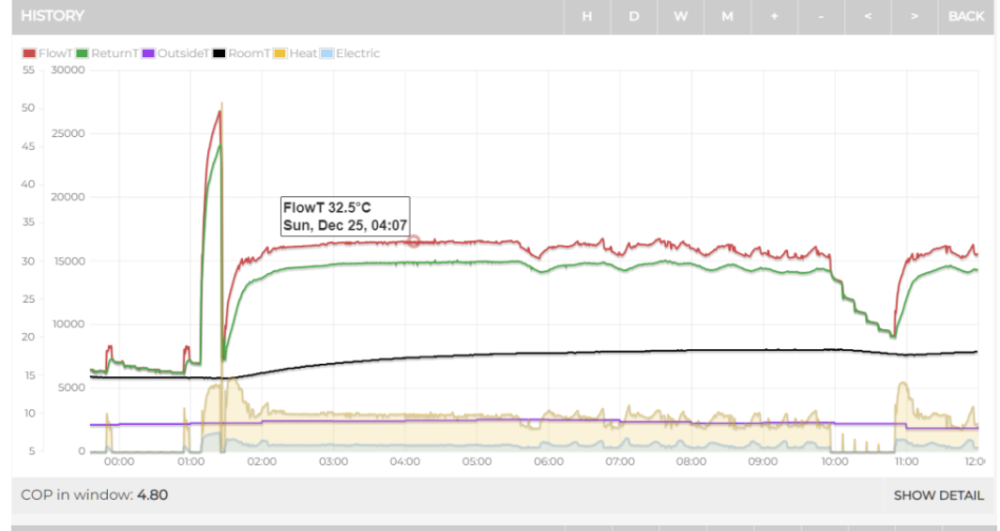
I think I have finally found someone, with whom I feel comfortable, to install a heat pump (with which I also feel comfortable). I haven't actually signed on the dotted line so wont disclose the details yet, but its looking extremely promising. Some on here may breathe a sigh of relief! Before it (a Vaillant) goes in I want to make sure I put in any monitoring gizmos needed to indulge my desire to understand it.. Many post graphs like this, presumably from openenergymonitor. Has anyone worked out the most cost effective/simplest way to extract the data from a Vaillant heat pump? It appears they do a modbus interface, but it might be just a simple to buy the current clamps/heat meter that openergymonitor recommend. Any tips would be welcome, I dont want to be flying blind.
-
Fair enough. At this level all sorts of 'second order' effects intervene. I doubt anyone has a comprehensive model so I guess the algorithm to optimise is, first minimise the flow temp then, if there is cycling, try tweaking it! Or alternatively do the first step, have a pint, have another pint! There comes a point where things are good enough!
-
I can't answer any of the above, and suspect some of it may be outdated religion. However there is one concrete thermodynamic argument namely that cycling inevitably means that the flow temp must be higher than if the pump were running continuously in order to deliver the same energy on average from emitters to house. This compromises efficiency. I can't quantity by how much however, because I don't have a model to estimate the rise in flow temp required. It's probably not too difficult to work out if one put one's mind to it, which I may do in an idle moment.
-
I had spotted this and wondered if it was an artefact of the calculation, but the explanation you give is entirely plausible. The difficulty I suspect is knowing with any certainty the cycling inefficiency. Some calculations can be done based on flow temp but that won't account for compressor start up losses. There is a 'degradation factor' which manufactures are expected to declare as part of the spec, but if not declared there is.a default value (0.9) and most specs I have found use this. Interestingly Daikin declare 1, which means no degradation, which may explain why their units perform so well in the bre results even though many of their models in any given range are just software limited versions of a higher output model (so might be expected to perform poorly at low outputs). What I don't know is whether this degradation factor of 1 is real and if so how Daikin manage to do better than others. Please do post what you find further. After the religious issue of unnecessarily throwing out working dhw systems, whole house sizing is probably the next most important issue to fix in the current heat pump retrofit deployment model, and proof that undersizing is beneficial would be extremely valuable.
-
That plus the overflow pipe you mention later pretty much nails it. No rats or other detritus from the loft to contaminate the tank, good pressure, no G3 and rectangular so fits with the shape of houses. Small & wall hung to replace a combi, or larger without the 10kW electric heater where there is space. Made of plastic so it can have mouldings to take fittings within the rectangular envelope. Still better to retain existing, industry permitting. But when existing fails I think I'd prefer this to unvented, and for the landlord use case either this or the upthread instantaneous concept by @Beelbeebubdefinitely better than unvented, unless of course there is a continental European practice that is better still. Eventually I think industry has to permit the retention of existing, the current situation where essentially the government pays for the wholly unnecessary replacement of a functioning DHW system, plus some MCS overhead, is wholly incompatible with mass heat pump roll out!
-
Not quite, this has a cold header tank above.
-
@Beelbeebub shows that instant DHW is possible. Maybe we can't expect to fill two baths or have two showers simultaneously, but really is this necessary? Good work! I'm now pretty much convinced that the best dhw system for a hp retrofit where there is already a cylinder is the one you already have (with a retrofit PHE if the hp cant get to 70C). It's clear that the 'perfect' system hasn't been invented so why change to an alternative set of imperfections? Nevertheless I have been trying in parallel to reimagine the vented cylinder. I'm thinking Rectangular footprint so it fits in a cupboard Fully sealed except the overflow Pumped hot water (with option for matched cold water to deal with combining outlets). Pump would need a small accumulator so that the tank could be below the outlets. No header tank Overflow to convenient drain or outside if available at user option So basically an insulated cistern. I'm struggling with: a. the fill mechanism b. keeping the vent hygienic to avoid the 'rats' objection Basically the full needs to be like a cistern, but with bottom entry for stratification. I'm not sure if there is a mechanical valve that does this and will work in a hot environment, it could perhaps be done with a level sensor and electric valve but mechanical would be better. Maybe a metal bodied torbek valve with a tube from outlet to bottom? Keeping the vent hygienic might be just making it small enough and putting a stainless steel mesh on it. Certainly that is better than an open, or even lidded, header tank in the loft.
-
Complex equation. During the heating season the heat is not wasted (assuming that the cylinder is within the heated envelope). Outside the heating season it is, possibly doubly so if you invoke cooling. However many use the 'waste' heat to create an 'airing cupboard' (also good for proving dough) and would be unhappy if this facility were removed. On the other hand you can add pipe losses, eg filling my kitchen sink has a COP of 0.5 because I waste as much in the pipes as I put in the sink, due to the circuitous route the plumbing takes. Point of use heaters, possibly with a small amount of local storage, are really not so bad for anything other than showers or baths, in fact if it weren't for showers and baths I doubt we would bother with dhw storage at all. In the community buildings that I have converted to ashp that's the way we have gone, because there is no requirement for showers/baths and it circumvents all the legionella faff. For baths you can wait a bit longer if the water is heated slowly (as our grandparents did when they heated a bathtub in front of the fire). It's really only showers that depend on significant amounts of dhw delivered at speed in real time. Aerated or 'eco' shower heads, a few tens of £ to purchase, reduce the water required and purport to give a satisfying experience. I do wonder whether working on the demand side would make the supply side a lot easier and be a good investment for both the country and individuals. Perhaps we are just aiming unnecessarily high with our 250l+ tanks and a 30-60 min recovery. Is this really necessary and how many costal cities/low lying countries is it worth sacrificing, for this luxury?
-
That's really interesting. I had begun to ponder some while ago whether differences in dhw practice might contribute materially to the UK VS EU disparity in heat pump deployment (obviously government vacillation and electricity/gas price ratios are the major contributors). You are now telling us that there is a potentially significant NI Vs England disparity. It seems 'we' 'expect' ideal DHW provision sufficient to allow two long haired teenage daughters and sundry other members of the family to shower each morning in quick succession for 10 minutes each. That's a level of luxury we have no right to expect, and regulations for all shouldn't be based on it. 'Teenage girls (or boys) block fixing climate change' is a headline I don't expect to see, but there may be a grain of truth in it nevertheless! Seriously though, is it possible that our dhw expectations are unreasonable relative to practices in other European countries/regions? Basically I am now concluding that the 5K subsidy is paying for MCS (about 1.2K according to one price list I have seen), a frequently unnecessary (with R32/290 heat pumps) DHW 'upgrade' and, sadly, in too many cases, price gouging, leaving a negative amount for the consumer. Until this changes heat pumps will remain niche and climate change will get worse.
-
Daikin specify 1.1 sq m min coil size for third party cylinders, both for their LT and HT models. Small compared to the normal HP specific coil but not small enough that most will be able to reuse an existing cylinder. For their LT only they also specify a max size (which I don't have to hand), no idea why unless it's a flow resistance thing. In both cases this appears in the installer manual.
-
All of which illustrates the madness of being forced by the industry to swap out a working system! There is, I think we can safely conclude, no perfect solution so the best one is probably the one you have already.