


JamesPa
-
Posts
1899 -
Joined
-
Last visited
-
Days Won
2
Everything posted by JamesPa
-
York Heatpumps - any experience?
JamesPa replied to Beelbeebub's topic in Air Source Heat Pumps (ASHP)
I had always read this as min op modulated down - max op, not as an adjustable higher end. Am I reading it wrongly. -
York Heatpumps - any experience?
JamesPa replied to Beelbeebub's topic in Air Source Heat Pumps (ASHP)
That's probably over optimistic, but two models with some overlap would be nearly as good. 5-12 and 9-16 for example. -
Most like likely the ashp controls and feeds the immersion and if so you may not be able to wire the feed from the diverter in parallel and joules won't get involved. You would likely need a relay so that the output stages of the diverter and ashp are isolated. I've seen a claim that the o/p from one diverter is DC in which case there definitely needs to be isolation (and care, DC can be nasty at moderate voltages because there are no zero crossings to extinguish arcs). Somebody on here has probably done it and if so can advise. Alternatively scrap the diverter and schedule the ashp to hear water around midday when PV is likely to be highest. You will benefit from the ashp cop, albeit offset by the fact you can't guarantee to hit sunny periods. Many on here say that's the best strategy but I don't know if anyone has modelled it.
-
Here you go. This is a time sequence in 1 minute intervals. Min is just the minute number, Temp the water temp, Power is how much power is delivered from the coil to the water (capped at 12kW corresponding to the HP capacity), Energy how much energy delivered from the coil to the water, temp rise the amount by which the water temp rises. This is a 200l cylinder with FT75 and a 0.8sqm coul. The coil is assumed to be copper so a coil with scale may do somewhat worse!. Its also assumed that the tank is all at the same temperature. Min Temp Power (kW) Energy (kJ) Temp rise 1 10.00 12.00 720.00 0.86 2 10.86 12.00 720.00 0.86 3 11.71 12.00 720.00 0.86 4 12.57 12.00 720.00 0.86 5 13.43 12.00 720.00 0.86 6 14.29 12.00 720.00 0.86 7 15.14 12.00 720.00 0.86 8 16.00 12.00 720.00 0.86 9 16.86 12.00 720.00 0.86 10 17.71 12.00 720.00 0.86 11 18.57 12.00 720.00 0.86 12 19.43 12.00 720.00 0.86 13 20.29 12.00 720.00 0.86 14 21.14 12.00 720.00 0.86 15 22.00 12.00 720.00 0.86 16 22.86 12.00 720.00 0.86 17 23.71 12.00 720.00 0.86 18 24.57 12.00 720.00 0.86 19 25.43 12.00 720.00 0.86 20 26.29 12.00 720.00 0.86 21 27.14 12.00 720.00 0.86 22 28.00 12.00 720.00 0.86 23 28.86 12.00 720.00 0.86 24 29.71 12.00 720.00 0.86 25 30.57 12.00 720.00 0.86 26 31.43 12.00 720.00 0.86 27 32.29 12.00 720.00 0.86 28 33.14 12.00 720.00 0.86 29 34.00 12.00 720.00 0.86 30 34.86 12.00 720.00 0.86 31 35.71 12.00 720.00 0.86 32 36.57 12.00 720.00 0.86 33 37.43 12.00 720.00 0.86 34 38.29 11.75 704.91 0.84 35 39.12 11.48 688.80 0.82 36 39.94 11.22 673.06 0.80 37 40.75 10.96 657.67 0.78 38 41.53 10.71 642.64 0.77 39 42.29 10.47 627.95 0.75 40 43.04 10.23 613.60 0.73 41 43.77 9.99 599.57 0.71 42 44.49 9.76 585.87 0.70 43 45.18 9.54 572.48 0.68 44 45.86 9.32 559.39 0.67 45 46.53 9.11 546.61 0.65 46 47.18 8.90 534.11 0.64 47 47.82 8.70 521.90 0.62 48 48.44 8.50 509.98 0.61 49 49.05 8.31 498.32 0.59 50 49.64 8.12 486.93 0.58 51 50.22 7.93 475.80 0.57 52 50.79 7.75 464.92 0.55
-
You were very lucky your installer didn't insist on replacing the cylinder. It seems to be essentially a given in the industry that this is part of the job. That's a throwback to older refrigerants that can't reach a sufficiently high temp. I'm currently looking through hp manufacturers specs with this in mind. Daikin specify, even for their HT model which can run at ft70, that the dhw coil must be at least 1.1 sq m in area, effectively ruling out re-using any (UK) cylinder not specifically designed for heat pumps. Oddly enough they specify exactly the same minimum area for their lt models, which makes zero sense. I have challenged them but they refuse to engage because I'm not an installer. The Daikin nominated installer I am speaking with described their HT models as 'pointless' and, based on the specs, I agree. It makes good sense in a retrofit to run dhw at a high flow temp, because the additional energy consumed is small in comparison to the upgrade cost. The reverse is true for emitters. So if you can't use the HT models with existing dhw cylinders, they are indeed pointless (except that they are generally black and quieter). I have yet to check whether the other manufacturers of HT heat pumps do something similar, I hope they don't. We don't need the gas boiler industry to obstruct heat pump deployment, the heat pump industry is doing a fine job of that on its own!
-
And this has been discussed ad nauseum - is this necessary if the DHW is completely enclosed, i.e. unvented? Just backside covering so far as I know.
-
With a retrofit where there is already a dhw cylinder and a hp that can achieve FT65 (or even FT60), why is anything else needed? Maybe a cheap timer on the immersion to run a weekly disinfection and some easy to do rad upgrades. No unknowns or risks so far as I can see.
-
Nevertheless a very good price baseline for supply and install only plus MCS, which is the proper starting point. It shows how low things can go if you cut out the unnecessary/marginal/optional parts that installers love to add on so they have somewhere to hide an enormous margin.
-
Is the price install only or unit plus install. if the latter a very good price. Did they accept your/third party heat loss calculations or had they already done them?
-
There is a list of departments here. It looks like the consumer desk is the one to go for: money@theguardian.com. Isent mine to alan.evans@theguardian.com, (environmental) which is on the same list.
-
The Guardian responded within the hour: Thanks for your email. I know that our consumer desk are currently working on various angles related to heat pump installation and the current difficulties surrounding it, so I've passed your email on to them and someone may be in touch with you down the line if they're able to use this information. If anyone has any stories to tell it looks like the consumer team are on the case.
-
Gas boiler lobby obstructing heatpumps
JamesPa replied to Beelbeebub's topic in Air Source Heat Pumps (ASHP)
I'm also a inclined to agree with that, a point I have made to my planning department. But who wants the hassle, easier just to slap in a new gas boiler from the get go, which is also cheaper. I can be bothered to fight the system which appears determined to ensure people do the wrong thing, most can't or won't. -
Gas boiler lobby obstructing heatpumps
JamesPa replied to Beelbeebub's topic in Air Source Heat Pumps (ASHP)
I agree on a practical level. But its wrong in principle that people must expose themselves to the risk of being required by law to remove their source of heating because the industry and the government have made it impossible. It's not that way for gas boilers, oil boilers or pellet burners. -
Too late for me, I have submitted it. But it's an excellent, albeit provocative, start to an article if the Guardian take an interest.
-
Here you go, the Guardian provides guidelines as to what to put in a pitch and I followed them. If someone else wants to adapt and improve and make a 'competing' pitch feel free. I'm not desperate to write this, I just want the subject aired. Dear Mr Evans I would like to pitch an idea for an area that I feel the Guardian needs to explore further, namely the obstructions put in place by the Heat Pump Installation Industry (and in particular MCS) and the planning system to the deployment of domestic heat pumps. The conclusions I have reached follow a journey of over two years during which I have been attempting, but have so far failed, to get quote for the installation of a heat pump in my house which is both technically sensible and reasonably priced (say up to £10,000, perhaps £12,000 after grant, still more than twice what I would have to pay for replacing my gas boiler!). I am prepared to write an article myself if that is the best way forwards, however I am not a journalist and would be equally happy, perhaps more happy, to contribute my experiences to another who was writing the article. It might enhance the article if there were some contribution/comment from some of the more innovative installers, Octopus and indeed MCS. I have summarised below the a summary of the constraints imposed by the installation industry and the planning system. Together these create a virtual closed shop of installers that is obliged to follow rigid rules which are in many respects not appropriate to the target situation, namely retrofits, and can easily more than wipe out the 'benefit' of the BUS grant. This protects the installer, but disadvantages the consumer. I believe I am well placed to contribute because 1. I have been actively trying to get a heat pump installed in my house for the past 2 years and have failed to get a sensible quote, or planning consent (which may be necessary in my case and is certainly necessary if I want to avoid the MCS overhead) 2. I have engaged extensively with others in a similar position though forums on BuildHub and The Renewable Heating Hub. The discussions have thrashed out many of the issues. There is of course considerable disagreement and dissent, but key, commonly agreed on, issues stand out. 3. I have a degree in physics and spent 25 years of my career in engineering, so can understand the technical issues 4. Redacted for this forum - as its probably enough uniquely to identify me I believe this story needs to be told now (say within the next 2-3 months) because MCS is currently reviewing its policies and the Government is currently reviewing PD rights in relation to heat pumps, however in neither case does there appear to be any way for the 'consumer' to make representations or be part of the review process. I hope that this might be of interest as I firmly believe that the Guardian needs to explore this somehow. ----------------------- Summary of principal constraints In summary the obstructions put in place by the industry are 1. The technical requirements imposed by MCS, frustrate innovation and make it very difficult to install a Heat Pump under MCS rules without unnecessarily replacing elements of the system other than the heat pump itself, even if the existing equipment is technically satisfactory and perfectly capable of working with heat pumps. In a typical retrofit this can add £2000-£5000 to the cost 2. The method mandated by MCS for calculating whole house loss is fundamentally flawed in many retrofit situations, because in many such situations the fabric details (on which the calculations depend) are unknown. This has a tendency to lead to over-specification further pushing up costs. 3. There is an overhead associated with the MCS certificate (for each installation) itself, approximately £1250 according to one installer Together these more than eliminate the value of the grant and expose the customer to unnecessary disruption. I would also argue that this tends to protect the installer, by providing a set of rigid rules which, if the installer follows them, pretty much immunises him from complaint. Given that MCS is justified largely on the grounds of consumer protection, it appears to be failing The planning system puts the following constraints in place: 1. Domestic Heat pumps can only be installed under permitted development rights if the installation is done to MCS rules by an MCS installer 2. My LPA at least (and I have the impression others) impose more stringent requirements on the noise specification if you seek express consent, than are imposed if you install under permitted development Together these obstructions create virtually a 'closed shop'.
-
You got a good deal, at least by the standards here in the South East. I posted above that I have pitched to the Guardian the outline idea for an article suggested by others upthread. Do you think your installer be prepared to share his/her views on MCS if the pitch gets anywhere. Ideally it needs both consumers and 'the industry' to speak up!
-
Oh well, I guess its rather weak to complain without actually doing something. I have just pitched the idea for an article as suggested above to the Guardian. I will report back if I get a response!
-
Id love to and I've been thinking about how to. The problem I keep coming up against is that, for the argument to come over as anything other than just another persons opinion, it needs a bit of engineering nouse on the part of the reader. So 95%+ of the population (and probably 99% of the Government) wont understand it. Meanwhile MCS continue to position themselves as a consumer protection organisation whereas in reality the only people they protect is their installers. Unfortunately its not as simple as MCS installers are more expensive and 'my mate the plumber could do it cheaper'. Its as much, if not more, about all the overhead operations MCS adds, eg unnecessarily replacing perfectly good DHW cylinders, upgrading pipes unnecessarily and over-estimating the required system size. They will just argue that this is 'necessary for consumer protection', which of course we know is nonsense, but Joe Public does not.
-
err - but one almost certain effect of global warming is that the Gulf Stream stops, possibly as early as 2025 (central estimate 2050). See here. This makes the UK colder not warmer (as well as all the other disastrous effects)! These guys really out to lunch at our expense.
-
Gas boiler lobby obstructing heatpumps
JamesPa replied to Beelbeebub's topic in Air Source Heat Pumps (ASHP)
Thanks. I have emailed NESTA -
Gas boiler lobby obstructing heatpumps
JamesPa replied to Beelbeebub's topic in Air Source Heat Pumps (ASHP)
Its easy to say that but.. installation under permitted development rights requires MCS, and seeking express consent may lead to unachievable noise constraints (currently it does in my case albeit that I'm still fighting my LPA) So not legally possible! Doubtless some installers will ignore the stupider excesses of MCS, but many hide behind them. The goal, remember, is 1.4M heat pumps retrofitted per year in the UK which we aren't going to get anywhere close to if installers are forced to do things, or can hide behind things, which are objective madness! Is their time numbered- they seem to be the darlings of Government. They are still involved in Solar Panels even though that's now an entirely mature technology. -
Gas boiler lobby obstructing heatpumps
JamesPa replied to Beelbeebub's topic in Air Source Heat Pumps (ASHP)
In a retrofit under flooring which cannot easily be lifted (amtico, solid wood etc) - absolutely no. Several £1000s of additional cost to insulate a few m of pipe. -
Gas boiler lobby obstructing heatpumps
JamesPa replied to Beelbeebub's topic in Air Source Heat Pumps (ASHP)
In short, yes according to MCS (not according to building regulations): From MIS 3005-I From MCS Helpdesk "Firstly, yes we can confirm ‘new’ installations means new installations in existing or new buildings. The reason for the clause regarding upgrading the insulation on existing cylinders is to ensure heat loss is minimised via existing pipework and existing primary feeds to promote higher efficiency of heat pump systems. Due to the unknown condition of the existing insulation, we cannot assume that the insulation is adequate enough to meet the same standards as new installations. If we relied on the existing insulation, we pose the risk of poorly performing systems. The difference between the first and second sentences is whether the existing insulation was factory fitted to Section 12 of BS 1566-1:2002 + A1:2011, rather than installed by the installer on-site and not compliant with the above standard. The reason the quality of the existing insulation can be satisfied by this sentence is that compliance with this standard provides enough evidence of higher quality insulation, in comparison to on-site installation. If the insulation was not factory fitted to Section 12 of BS 1566-1:2022+A1:2011, we require the insulation to be upgraded to BS 5615:1985. However, we appreciate your concerns on how this may cause major disruption with the need to lift flooring, but essentially, we cannot risk reducing system performance based on a lack of/poor existing insulation. I have fed your comments/concerns back to our technical working for comment as we are always looking to improve our standards in anyway we can. " This says,at least in my reading, that the primaries must be upgraded. I have called them, talked them through why this is utter madness, and have been told that the emails 'have been passed to the technical team'. I think I am due a further response but, as it stands installers who do not replace the cylinder would be right to insist on upgrading insulation on primaries if it doesn't meet the latest standards, even if that means lifting and replacing 30sq m of Amtico (just a random example - not what I have, but perfectly plausible) removing and replacing skirting (and making good), removing and replacing fixed furniture (eg sanitary fittings) and relocating primaries in notched joists elesewhere so they can pass through using drilled holes (I cant see how you can insulate piped which are bang up against the floorboards). all to insulate 5m of pipe. Rule c applies to any other connected pipework (eg the feed to the taps!)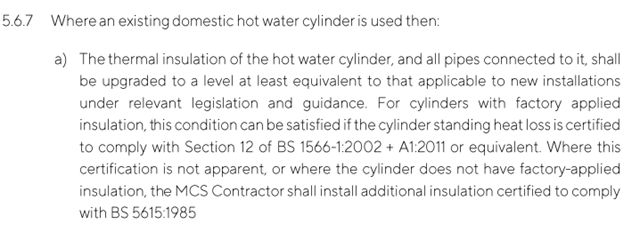
-
Tolerance in ASHP sizing? Drawbacks of oversizing?
JamesPa replied to embra's topic in Air Source Heat Pumps (ASHP)
The argument might be tipping in favour of oversizing! https://www.theguardian.com/environment/2023/jul/25/gulf-stream-could-collapse-as-early-as-2025-study-suggests -
Gas boiler lobby obstructing heatpumps
JamesPa replied to Beelbeebub's topic in Air Source Heat Pumps (ASHP)
Here is the quote from Part L I have italicised what I believe is the relevant text. 4.24 In a new system, all of the following new pipework should be insulated. a. Primary circulation pipes for heating circuits where they pass outside the heated living space, including where pipework passes into voids. b. All primary circulation pipes for domestic hot water. c. All pipes that are connected to hot water storage vessels, for at least 1m from the point at which they connect to the vessel. d. All secondary circulation pipework. I don't honestly think MCS have a scooby about how to write rules. You need to think about all the use cases, wrinkles, ways around etc. Its really difficult! You also need to scrutinise any text you refer to and potentially update yours if that text changes. That's why building regulations are drafted the way they are (short rules then illustrative guidance) and why people who write legislation are paid a lot.
