


JamesPa
-
Posts
1899 -
Joined
-
Last visited
-
Days Won
2
Everything posted by JamesPa
-
Agreed. Incidentally I would probably agree with your suggestion to remove the grant on hps provided that, at the same time, PD rules were changed so that MCS is not required and zero rating for vat applied also to self install. I would be willing to bet that if this were done the HP industry would suddenly discover it could do things more cost effectively.
-
Short term yes, long term no. So until you get a heat pump you should be encouraged to do what you are suggesting. But this doesnt fix the problem, only a heat pump (with continued decarbonisation of electricity) does. Hydrogen is just greenwashing, a back door way for the boiler and fossil fuel industry to keep more boilers in homes which in reality will burn gas or mostly gas. There is no cost effective way to make it without using fossil fuels.
-
Nope, I really have a problem with being told what I want or whats good for me by others In some cases yes, and in some cases (as @MikeSharp01 points out) no, it all depends on the customer situation. But that isn't actually the point, the point is about how its sold and the customer right to make their own decisions based on their own circumstances. Today we are invariably told that we must have a cylinder change to have a heat pump. That's not true in all (perhaps most) cases, but that's how its currently (misre-)presented. If, as you now seem to accept, the argument is based on lifetime cost then present it that way and let the customer make the choice. Its not for the installer or the heat pump industry to make this choice, its for the customer. Many customers will make the choice to take the upgrade, likely more comfortably than if they are 'told they must do it'. Others will choose differently for all sorts of reasons which the installer cannot know and has no right to know. Neither installers nor the heat pump industry in general have the right arrogantly to tell the customer what is 'right for them'. Even less do they have the right to hide their view of what is 'right for the customer' behind a technical falsehood.
-
Gas boiler lobby obstructing heatpumps
JamesPa replied to Beelbeebub's topic in Air Source Heat Pumps (ASHP)
Ha Ha Not really doable in a messed about with 1930s solid wall house. The next occupants may well demolish it though. -
My gut feel is that this really matters. It could make the difference, in a significant number of retrofits, between a two a week job and a one a week job. Also between a highly disruptive job and a job which is only minimally disruptive. The difference in price is well over 2K, it's where the excessive margin is hidden, and in fairness, the installation risk lies (which consumers pay for).
-
Gas boiler lobby obstructing heatpumps
JamesPa replied to Beelbeebub's topic in Air Source Heat Pumps (ASHP)
Now we need the manufacturers of HT heat pumps on board. Daikin for example specify a min coil area of 1.1sq m both for their HT and LT models which makes zero sense. I have yet to check others. MCS requires installers to conform with any cylinder requirements specified by hp manufacturers. -
Do they really say that. In which case what is the point of a HT heat pump. Using it at HT for space heating gives a lousy scop and upgrading radiators is cheap and low disruption Using it at HT for dhw barely affects the scop and upgrading the cylinder is expensive and high disruption. So the bang for the buck is to upgrade the radiators but keep the dhw cylinder. Ok I've oversimplified, but manufacturers of HT heat pumps insisting on replacing the dhw tank clearly aren't in the real world.
-
I understand the constraints however I'm not sure what your numbers are. Heat transfer at the coil is proportional to coil to water DT and coil area. So exactly the same amount of heat is transferred from the coil to the water with a 3sqm coil at ft55 and water temp 50 as with ft70 and coil area 0.75 at the same water temp (to be strictly accurate the first case will be slightly less than the second because of the temp drop along the coil, but for simplicity that is ignored) So, unless the minimum output from the hp increases materially between ft55 and ft70, a (high temp capable) hp that works at ft55/3sq m (the figure generally quoted in the UK for a 'heat pump coil) will work also at ft70/0.75 sq m. Are you sure you aren't propagating thinking that arises from older refrigerants than R32 or 290?
-
Which is one reason I am becoming more resistant to upgrading my own dhw at the same time as I fit a heat pump. I just am not convinced we yet have the best solution, my existing dhw is pretty new albeit vented and the extra electric cost is about the same as the G3 annual inspection. Sure I can afford to do it, but is now the time to do it. For the mass retrofit market getting over the idea that hp=new dhw makes the difference between fitting being a major job and it being a relatively simple one. An installer should be able to do 2 per week not 1 so no loss of profit.
-
I'm not sure your argument stacks up. If you are only heating the dhw to say 50 with a ft of 70 you have a decent coil to water DT. Same ratio of DT to coil area as a 55C heat pump and a 2.4sq m coil. So I'm not at all sure you are right. 3sq m is a throwback to older refrigerants so far as I can see.
-
Typical UK cylinder has a coil size of 0.6-0.8sq m, so for retrofit this is what you are faced with. Gas boilers running at 70-75 have been working with this coil size for decades, so why not a (HT) heat pump? It may not be optimum in all cases, but it works well enough for most. If the HT unit is run at a higher temperature (for DHW only, the penalty is quite small compared to the cost of swapping the cylinder) then the heat transfer from the coil to the water is more, so I don't get your argument (or Daikins). That may mean or may not equate to a larger flow-return delta T depending on flow rate. Totally agree. Why would anyone want an internet connected hot water cylinder
-
I assume thats the Mixergy one. Linux probably will be around in 30 years (and will still be working perfectly, just doing its thing - it seems to be bomb proof if my Linux based synology NAS is anything to go by), but mixergys back end servers defo not. Have you managed to get any concrete detailed info about Daikin performance. They are very cagy with answering technical info and keep telling me to ask my installer (who doesnt know). I get the impression from such little info as I can find that 1. all their units in any given range are identical apart from a sw limit on max output 2. modulation range is poor approx 2-2.5:1 with the top end unit in a range, thus even worse with lower end units in a range They also, bizarrely, specify a min cylinder coil area of 1.1sq m for both their HT and LT models, which makes absolutely no sense and wipes out the idea of running their HT unit at say 70 for DHW only to allow an existing cylinder to be retained. But they refuse to engage in explaining because Im not my installer. Daikin are well renowed in the a/c industry so Id expect their products to be good. However Im beginning to wonder. Have you or anyone else got any insight into this?
-
York Heatpumps - any experience?
JamesPa replied to Beelbeebub's topic in Air Source Heat Pumps (ASHP)
You may want to read my latest post in this thread which contains written confirmation from MCS that, where an existing cylinder is reused and it it unreasonable to upgrade insulation on the primaries leading to it, MCS will not insist that the insulation is upgraded unless the upgrade is required by Building Regs (which generally it isnt). MCS3005-D clause 5.6.7 could easily be interpreted that MCS does insist on this (crazy) upgrade, and I suspect many installers may hide behind it if pushed, given the assumption built into the heat pump industry that new heat pump = new cylinder. Of course your primaries may already be insulated and/or you may have a flexible installer. -
Gas boiler lobby obstructing heatpumps
JamesPa replied to Beelbeebub's topic in Air Source Heat Pumps (ASHP)
Update on the above, for once good news. MCS now accept that, where it is not reasonable to upgrade existing pipework to a retained DHW cylinder, and where Building regulations do not require it to be ungraded, MCS wont insist that they be upgraded. Here is the email I received from MCS today: "Thank you for your patience whilst I awaited a reply from our working group. As our working group is made up of volunteers, this is why it took some time to get a reply. Firstly, thank you for highlighting the ambiguity of the clause around using existing cylinders . As part of 5.6.7 clause a), we mandate that the cylinder and pipes in an existing system are to comply with relevant legislation. Below is a screenshot of the relevant requirements under building regulations around the insulation of pipework: [screenshot of regulations 4.24 and 4.25 in building regulation part L] MCS mandate that the above building regulations are adhered to when using an existing system as the clause states that the insulation shall be upgraded to at least the equivalent of what’s stipulated in 4.24 in the building regulation requirements above. However, 4.24 above uses the word ‘should’ in which MCS use this term as “prescribes and requirement or procedure that is intended to be complied with unless reasonable justification can be given”. Therefore, if it is unreasonable to insulate all pipework (in this instance due to the significant disruption of lifting flooring), then that would be accepted under building regulations and therefore also by MCS. Reasonable attempts should be made to insulate all pipework, however, if this is not the case, then it would be expected that the contractor properly assesses the effects of this on the system performance and efficiency and advise the customer accordingly. As a response to this query, MCS will make the necessary changes to clause 5.6.7 a) with MIS 3005 D in the next rewrite to allow for clearer understanding. " Thank you again for raising this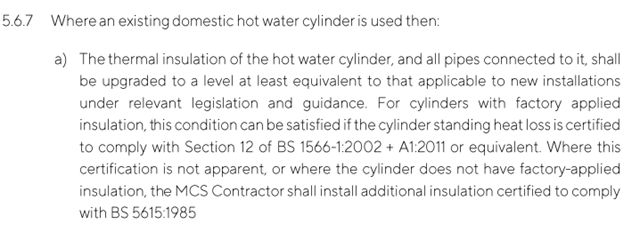
-
York Heatpumps - any experience?
JamesPa replied to Beelbeebub's topic in Air Source Heat Pumps (ASHP)
Fair enough. Daikin are same, all pumps in any given range identical except for max op. Mitsubishi 8.5 and 11.2kW models are different tho. Installer should be allowed to update if it's software controlled, but of course the min, which is critical doesn't change. -
York Heatpumps - any experience?
JamesPa replied to Beelbeebub's topic in Air Source Heat Pumps (ASHP)
I think you could get away with 6kW units. That's about the minimum you would want for dhw and they would modulate down to say 2kW below which a 10pc hit on electricity consumption won't matter much. But I suspect the volumes easily justify making a variety of units. The UK requirement alone is 1.4m (that's the number of gas boilers replaced each year). So I'm not sure the modular concept is actually essential. -
York Heatpumps - any experience?
JamesPa replied to Beelbeebub's topic in Air Source Heat Pumps (ASHP)
And size it correctly in the first place. Of course it does help if manufacturers make products which are bomb proof, but at some point the installation industry needs to take some responsibility. -
York Heatpumps - any experience?
JamesPa replied to Beelbeebub's topic in Air Source Heat Pumps (ASHP)
My conclusion is this: If it's sized correctly and has a decent modulation then no. If it's well oversized then the installer will put in a badly set up buffer costing even more to run. Some of the more innovative installers have clearly come to the same conclusion. -
York Heatpumps - any experience?
JamesPa replied to Beelbeebub's topic in Air Source Heat Pumps (ASHP)
Start up losses, wear, and it means you are running at a higher ft than is really needed. -
York Heatpumps - any experience?
JamesPa replied to Beelbeebub's topic in Air Source Heat Pumps (ASHP)
Agree. I was just observing that we can't trust the industry to do a good job. For what it's worth my house measured consumption was 7.5kw at the coldest point last winter, and most of the time sat at a steady 4-5kW. It dipped below this only at the end of the season by which time I was on part time heating anyway. So for my specific circumstance, as long as a hp gets to 4kW without cycling, a little above half the peak, that's ok. Other houses will be different of course depending on thermal mass, but mine is nothing special in heating or insulation terms so quite a few may be similar. 2:1 is easily achieved, but not if the unit fitted is well oversized! Also it's not binary, if the hp modulates down to 4 and the demand is 3 then the hp needs to be on 3/4 of the time. So long as there is enough system volume this shouldn't cause excessively short cycles. The excess power in this case is only 1kW so it will cycle only after enough energy is delivered at 1kW to heat the water above the overrun limit. -
York Heatpumps - any experience?
JamesPa replied to Beelbeebub's topic in Air Source Heat Pumps (ASHP)
Just like flow temp is on condensing boilers. And what did installers do with those....just saying! -
York Heatpumps - any experience?
JamesPa replied to Beelbeebub's topic in Air Source Heat Pumps (ASHP)
Yes. The interesting figure (at least to me) is max at -2 (or whatever your design min is) vs min at (say) 12. Above (say) 12 you are going to be on-off heating anyway, or more likely daytime heating only which will help with the numbers. So with the graph you present above 6.5:2.2 (120rps @ -2 vs 30rps @ 12, about 3:1 which seems quite common for the better models (at least those that bother telling you). Of course if the pump is massively oversized much of the available modulation ratio will be used up at the lower end, which is where buffers come in with all the problems they bring, and right-sizing is preferable. Its a pity that there isn't a requirement to specify modulation ratio in a useful way. -
York Heatpumps - any experience?
JamesPa replied to Beelbeebub's topic in Air Source Heat Pumps (ASHP)
I havent. Their 4.3-9.5kW model is sadly really marginal for my application (8.5-11kW MCS, depending on assumptions, 7.5kW measured, 45C flow temp) and larger models are, well larger ie 2 fan, which doesn't fit the space I have. But I've just noticed that the 5.52kW-10kW model is now available again so I will. If my interpretation of the spec is correct modulation ratio is not great though. I will ask as they seem to be using good components so it should surely be better. -
York Heatpumps - any experience?
JamesPa replied to Beelbeebub's topic in Air Source Heat Pumps (ASHP)
Standard practice in some industries for some time. Sell the same physical product at different prices with software imposed limits. The issue of course, as you point out, is that the minimum output doest scale with the max. Relatively few manufacturers seem to be open about modulation capability, a few more will tell you if you ask, and some won't tell you at all. Pretty disgraceful as it's a key parameter in proper system design (although much of this industry doesn't know about proper system design). -
Delta t will probably be higher initially and will reduce as the water heats up, unless your hp modulates the pump.
