


JamesPa
-
Posts
1899 -
Joined
-
Last visited
-
Days Won
2
Everything posted by JamesPa
-
For clarity @Beelbeebuband I are saying essentially the same, just slightly different terminology. Basically wrong type of valve. I don't know if it's possible just to change the head, @Beelbeebub may know.
-
Sorry but it's wrong and an installer who plumbed it this way doesn't know what they are doing! As various have said scheduling them at different times is a solution, but it really shouldn't be possible in any system with weather compensation or low flow temperatures for space heating and water heating to operate simultaneously as it defeats the whole design principle. Btw the comment applies also to fossil fuel boilers with weather comp (or that you want to run at low temp) There are of course various work arounds, of which not scheduling them simultaneously is one, but the householder shouldn't have to work this out for themselves. The common solution is a diverter valve (either-or) instead of the more common three way valve (ch or both), but you can also do it with two two way valves correctly wired
-
Mitsubishi settings for DHW and Home Heating
JamesPa replied to roadrunnerAlgarve's topic in Air Source Heat Pumps (ASHP)
Heatgeek advocate, with some logic, not over zoning (because it's ineffective and inefficient) and balancing rads for equal (or desired) room temp when left 'open loop'. A slightly refined version applicable to a two storey house with bedrooms upstairs, is to operate open loop downstairs (balanced for temp) and use trvs upstairs. Which strategy is best depends on your system, house and pattern if use, but keeping it simple is a good general guide. And you are right that to tweak the adjustment of heating systems it helps if it's cold outside! -
Mitsubishi settings for DHW and Home Heating
JamesPa replied to roadrunnerAlgarve's topic in Air Source Heat Pumps (ASHP)
Most likely the heat pump has shut down because the return temp exceeds the flow temp (+ some margin) that the weather comp curve determines is correct for the current outdoor temp. That's basically how they work. -
Mitsubishi settings for DHW and Home Heating
JamesPa replied to roadrunnerAlgarve's topic in Air Source Heat Pumps (ASHP)
Radiators must be sized according to flow temperature and ashp flow temperatures for space heating are almost always 55c or less. Sometimes this requires rads to be replaced, but often existing rads are oversized so only some or even none need replacing. The installer should have done these calcs annd if he didnt then he is bad. It's quite possible yours were already large enough for 55c but your installer should definitely have done the calcs. In the shoulder season even lower flow temps are fine provided the design is correct. That's how wc works, matching flow temps to demand. TRVs (smart or otherwise) are generally deprecated as a control mechanism for ashps. The way to set them ashps up is to balance the rads so the rooms end up at the right temp then use trvs as temperature limiters only, ie they shut off relatively rarely to deal with eg solar gain. So basically set them a degree or two higher than the desired temp and, over a period if months, adjust the wc curve so that it gives the right temp at most outdoor temp conditions. It's a different way of working which, once you get it right, many deem more comfortable. I still have gas and have recently turned my flow temp down to 55c resulting in a much more comfortable environment because the boiler is working less hard for longer, much like an ashp does. I have changed about half my rads (as I am preparing for ashp). The ones i havent changed are fine at 55, ie they were previously oversized, some of the ones I changed are now oversized at 55 because I designed them for 45c in prep for ashp. -
Do I need a HP specific cylinder?
JamesPa replied to Beelbeebub's topic in Air Source Heat Pumps (ASHP)
Whatever happens next, even if you need to play some more tricks to be satisfied with the dhw, this is definitely a result. Well done and good luck with the install. May there be many more who are not forced to replace their dhw cylinder! -
Arotherm Plus ASHP parallel heating?
JamesPa replied to vlp2024's topic in Air Source Heat Pumps (ASHP)
Whatever happens next, even if you need to play some more tricks to be satisfied with the dhw, this is definitely a result. Well done and good luck with the install. May there be many more who are not forced to replace their dhw cylinder! -
Mitsubishi settings for DHW and Home Heating
JamesPa replied to roadrunnerAlgarve's topic in Air Source Heat Pumps (ASHP)
... correct, and every other heat pump or fossil fuel boiler that features weather compensation or indeed operation at low flow temperature. It's unavoidable if you want to do either of these. WC has been mandatory in Germany (and probably several other eu countries) for a long while so it's nothing new. Think about the best time to heat water for you and maybe reprogram accordingly. -
Given that you can fix the problem by manually operating the diverter valve, you appear to have isolated it, and it doesn't sound at all ashp specific. Surely any plumber should be able to diagnose and fix
-
Hadn't heard that method before, can you explain the method in a bit more detail as I'm being a bit thick and not following?
-
Both building regulations and MCS rules have something to say about this. Under building regulations, in a newbuild, the answer is that primary circulation pipework must be insulated where it is 'outside the heated living space'. In a retrofit this applies to only to accessible DHW pipework. 'The heated living space' excludes 'voids'. MCS rules (specifically MCS3005 - D clause 5.6.7) prima facie go further than building regs in the case of a retrofit, and require distribution pipes to the cylinder (if the cylinder is replaced) to be insulated whether or not they are accessible. However I argued with them over this and they conceded that the ambiguous text should be interpreted to require insulation in retrofits only where accessible. Here is a screenshot of the communication from MCS which also includes the relevant extract from building regs. Here for reference is the relevant extract from MCS 3005-D
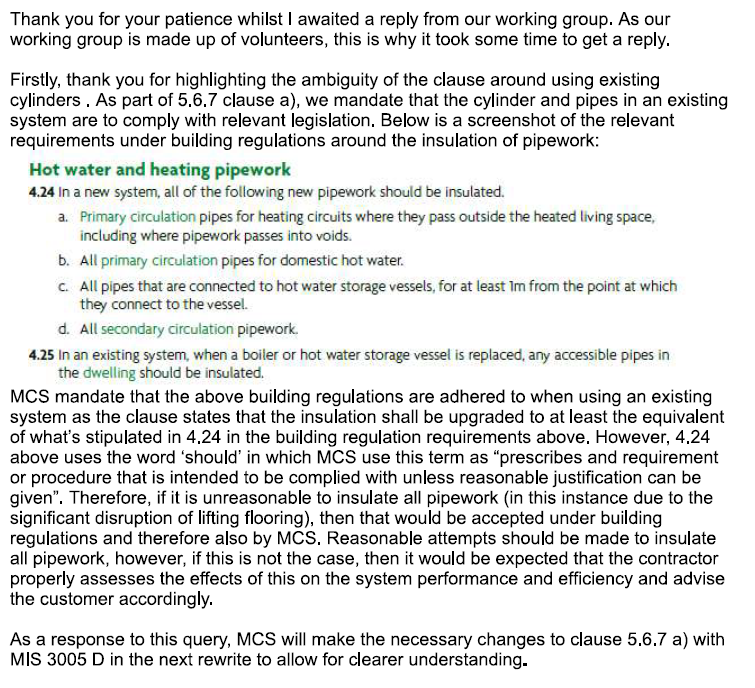
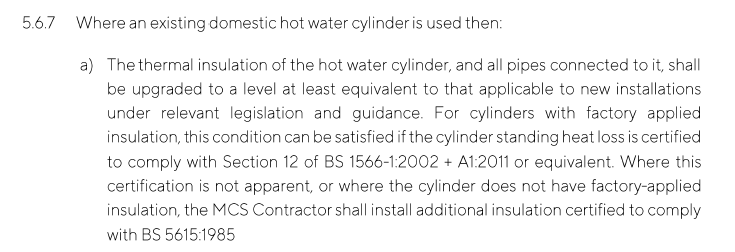
-
With the exception of the piv and underfloor insulation I have followed a similar path. I'm now at tha stage of enthusiastically wanting to fit an ashp, had potentially found an installer who would exploit the full flexibility of the rules to do a sensible job at a sensible price, but my local authority is currently making it either impossible or too risky. So I'm doing battle with them. If I can sort the la issue I now hope to install in 2024. Along the way I've had installers who want to install 2 16kW units in my 8kW house, and surveyors who cheerfully ignore all the fabric upgrades and double count losses between rooms when doing the whole house sizing. If I didn't have an engineering background I dread to think what I might have been suckered into buying.
-
That's really interesting. If the piv unit is making any material difference (which I presume it is otherwise why do you have it?) then it implies that tha ach it pushes is material in relation to the natural value. Thats another data point tending to confirm a low natural value rather than a high one. And your comment about kitchens/bathrooms is spot on, it just doesn't make sense to assume higher values for these rooms unless there is a specific construction difference. The mcs rules fortunately do allow some flexibility, but most of the mcs heat pump installers I have encountered insist on using the default, despite my protestations and evidence from my actual consumption.
-
If the choice is controlled by the system then I accept my argument falls. However upthread it was stated that the user could choose 'whichever they want'. Also if hybrid is grant funded is there not a risk of token heat pump installs. The rules would need to be very carefully written and policed otherwise you have the pump installed, claim the grant, then take it out and sell it . Also I can't see it's necessary for the majority of the UK housing stock for which 8kW suffices. The exception I might make would be retaining a combi for dhw only until we have a more sane solution for this use case, but then only where there wasn't a practical alternative.
-
Really doubtful about this being good use of public money for the reasons set out in detail in my post above.
-
Yes, but if you want to take that into account you do so by adjusting the design load and the same principle, that there are extremes beyond the design load, still applies. Basically its always going to be a bell curve and the decision to be made is how to deal with the extremes. Absolutely. I think air to air systems should be pushed alot more. They can be added fairly simply to houses without needing to touch the existing heating system. They also tend to offer higher efficency than water units. To the point that hitting the magic SCOP, where the HP is cheaper to run than a gas boiler (somewhere around 350%) is achievable. The occupant can then choose which system suits them at any given time. The problem is our regulatory setup which disincentives hybrid and A2A systems in favour of compete air to water replacement systems. I agree that A2A needs to be made easier and has a valid part to play. Combinations of A2A and A2W ditto. The regulatory barriers should IMHO be removed. Dropping the requirement for MCS design/install from the PD rules and retaining only the noise spec would be a good start, this should IMHO be done anyway. Finding a way to allow >1 HP under PD would complete the process. Beyond that however we need to be mindful of what we mean by hybrid. In most parlance 'hybrid' means a combination of a heat pump (A2A or A2W) and a fossil fuel source. I think we need to be very careful indeed with any encouragement for hybrid systems in this sense. The most likely use case is a retrofit and the most likely design is to retain the existing system, which is capable of heating the whole house, and simply bolt a heat pump on the side (I considered this myself). People are resistant to change, so the most likely use pattern is that the existing system is used frequently, and the heat pump used rarely. So while I tend to agree that regulation should not exclude this, at the same time I don't think publicly funded incentives should encourage it as its most likely pouring public money into a) keeping the fossil fuel industry alive and b) encouraging the wrong behaviour, neither of which is good use of public funds. Furthermore the vast majority of our housing stock needs about 8kW which is easily supplied by a fairly modest heat pump. I cant see the case for spending public money to incentivise supplementing an 8kW heat pump with a fossil fuel burner.
-
If its a heat pump with a backup 3kW resistance electric heater to cover the very few days when it's really cold, why not? There is some evidence to suggest this is actually more efficient than a heat pump sized to meet demand extremes.
-
Funny how 'fabric first' conveniently helps the fossil fuel lobby. Just like 'hydrogen ready'. Just saying of course.
-
I think, sadly, we have passed the point where we can do things 'first'. We need to do everything we can do as quickly as we can. Had we been serious about climate change when the experts first told is it was serious, we might have had the luxury of 'fabric first'. But we ignored them and in many circles still ignore them. If the 'green' message is too nuanced, the carbon lobby will simply exploit it, claiming division and using it to sow confusion in a largely ignorant (or Ill intentioned) political class and public. So to my mind the message is simple. Insulate your home, get a heat pump, get an electric car and fit solar panels. If you can only do some of them, then do those. End.
-
If heat pumps aren't the solution, what is the solution to heating your home without causing unsustainable global warming? If you have one please tell us! Its really, really 'cosy' in the places that have wildfires or heat waves due to global warming, not so cosy in the areas that have suffered flooding due to the same cause, and wont be at all cosy when tens of millions of human beings are displaced from their homes by a climate that's not liveable in. Heat pumps take longer to heat up but you leave them running for longer to compensate. Running costs of a heat pump which has been properly set up are currently broadly comparable to gas (that's, however, a political decision because relative energy prices are driven largely by politics not economics). They are much cheaper than any other form of electric heating. Many people with heat pumps report higher levels of comfort. They aren't perfect by any means, but neither is any other known way of heating homes. As to electric cars, imagine they had been there first, and then someone tried to sell you a car that you couldn't refuel at home, that is driven by a series of explosions and contains an explosive, oily liquid, doesn't accelerate anything like as quickly, and needs more expensive and more frequent servicing. Are you going to buy one, I thought not!
-
So its more or less bound to happen then!
-
That's helpful thanks. I'm trying to rationalise my gas consumption with (my own) loss calculations, as my most likely choice of ASHP (once I resolve the extensive issues I am having with my local planning authority) is sized quite low on the assumption that the figures from the gas consumption are correct. If 0.5-1.0 is a believable value for ACH, then (a) I'm prepared to believe it, as we do get a very small amount of mould in some specific places (which I need to deal with) and (b) it establishes a level of consistency between the measured and calculated heat loss, which is comforting
-
ASHP sizing - realistic values for air changes
JamesPa replied to JamesPa's topic in Heat Insulation
Sorry for posting this here due to it issues/finger trouble. I have reposted in the correct (ie ventilation) topic! -
What's a realistic value for air changes per hour in an older house (1930, solid wall) which has been fully double glazed (without tricks vents), has solid floor downstairs and carpet on floorboards up, and has extensive retrofitted iwi and no operational chimney. The 'standard' assumptions (for ashp sizing) say anything between 1 and 3 depending on room, but the only way I can make my calculated heat loss equal actual measured consumption is to assume 0.5 throughout, ie the figure that the standard assumptions give for a post 2006 house. To be honest, without mechanical ventilation (which my house does not have), I am struggling to imagine how the ventilation rate could be as high as the assumptions claim it is, but presumably they are based on something! Has anyone any idea whether 0.5ACH (or even anything sub 1) is realistic for a house like the one I describe, and if so do the standard assumptions in practice overestimate natural ventilation by a substantial amount in many cases? Any facts or other evidence that anyone has would be welcome. (Apologies to anyone who has already read this in the insulation topic, I had IT problems this morning and managed to mis-post this twice!)
-
What's a realistic value for air changes per hour in an older house (1930, solid wall) which has been fully double glazed (without tricks vents), has solid floor downstairs and carpet on floorboards up, and has extensive retrofitted iwi and no operational chimney. The 'standard' assumptions (for ashp sizing) say anything between 1 and 3 depending on room, but the only way I can make my calculated heat loss equal actual measured consumption is to assume 0.5 throughout, ie the figure that the standard assumptions give for a post 2006 house. To be honest, without mechanical ventilation (which my house does not have), I am struggling to imagine how the ventilation rate could be as high as the assumptions claim it is, but presumably they are based on something! Has anyone any idea whether 0.5ACH (or even anything sub 1) is realistic for a house like the one I describe, and if so do the standard assumptions in practice overestimate natural ventilation by a substantial amount in many cases? Any facts or other evidence that anyone has would be welcome.


