


JamesPa
-
Posts
1899 -
Joined
-
Last visited
-
Days Won
2
Everything posted by JamesPa
-
MCS-020 section 3.1 (b) (page 15) https://mcscertified.com/wp-content/uploads/2021/10/MCS-020.pdf contravention enforcement probably unlikely unless a neighbour complains about noise or visuals Precisely, on both counts!
-
You need to read it properly to understand it properly. The law actually says 'the MCS planning standards or equivalent standards'. So first of all you have to ask what does the phrase 'the mcs planning standards' mean, ie what is the definition of this phrase? The phrase is not defined in the legislation but it is defined in mcs-020 where it expressly says 'the mcs planning standards are:' and then lists three things, namely that it must be installed by am mcs contractor, it must be installed to mcs standards, and it must meet a noise criterion. So that is the definition of the phrase 'the mcs planning standards'. This must be the case because its only in this text that the noise standard comes in. That leaves only 'or equivalent standards'. There is no 'recognised' equivalent standard. So, if it were challenged, you would be left arguing that your own installation is 'equivalent' to which the response would be 'prove it'. You would likely have an mcs bod standing in court as an expert witness, because the judge wouldn't have a scooby. Good luck! Of course people do it themselves, following (or not) the noise rules and of course they get away with it just like people get away with many planning transgressions. That doesn't make it legal and doesn't protect you if your neighbour complains and your lpa decide to take the matter up. At best they could make things very stressful for a couple of years, at worst they could require you to move or remove it. It's a risk like any unauthorised development.
-
Exactly my experience. The contractors 'play safe'. (Almost) nobody complains about central heating so long as the house isn't cold and they can have infinite hot water on demand, and the grant conditions further encourage the behaviour because of the rule that the ashp must be capable of serving 100%of the capacity. So designers are highly motivated to over estimate the size and then throw in a buffer tank to reduce the likelihood of short cycling, and possibly also insist on unnecessary upgrades to pipework. Thus we end up with a greater number of overenginnered over expensive systems than we need. In some cases these perform so badly because of the overengineering that people complain about heat pumps being expensive to run. Basically the system, combined with human behaviour (both on customer and supplier side), leads to the unsatisfactory outcomes many experience.
-
You are fine then because nobody will complain unless you put it somewhere it's a blot on the landscape and paint it red to draw attention to it.. That doesn't mean it's lawful, but it does mean that it almost certainly won't be enforced in practice, just like any other minor planning transgression of which there are many.
-
It's there in black and white, it must comply with the 'MCS planning standards'. So the question becomes what are 'the MCS planning standards'. The definition of 'the MCS planning standards' (which appears in MCS 020) includes three things, the noise requirement, a requirement that it is installed to MCS standards and a requirement that it is installed by an MCS contractor. There is no recognised equivalent standard and to be equivalent it would have to cover all three things on the MCS standard. I can see no escape (I wish I could!). Of course, like anything to do with planning, it doesn't matter unless someone complains, but if they do your LPA would be within its rights to ask you to produce the MCS certificate to prove it's permitted development and if you can't you will have a battle on your hands which ultimately can only be resolved in court, very likely with MCS giving expert evidence against you to preserve their monopoly. Fancy that? I'm not defending it, it's an atrocious misuse of power, but neither can I find a get out that would be likely to stop a determined LPA taking enforcement action if it got your angry neighbour off their backs. As I say it doesn't matter if nobody complains because that's pretty much the only time LPAs take enforcement action.
-
I'm not surprised at all. As I have mentioned many times on this forum two 3hr surveys on my house have resulted in a recommendation of 16kW. I got to 10.5 kW using MCS assumptions and the correct fabric (surveyors ignored invisible fabric upgrades and double counted some losses). Actual measured is 7.5kW, which I can also get to if I assume 0.5ACH instead of 2-3. My typical consumption during the majority of the heating season is 4kW. If I were to follow the MCS 'experts' O would end up with cycling most of the heating season.
-
Ok, I admit that I had forgotten that the grant rules prohibit the use of jumpers. As you say if you have a good slab and want to take advantage of night time rates that's also a reason to oversize.
-
The argument is that while it's heating hot water it's not heating the house so the house fabric is cooling. The energy lost from the fabric must be replaced during the hours it is heating the house hence it must be larger. Personally I think this is probably over engineering, although I haven't done the numbers to prove It. It is true that the house cooks while it is heating hot water and the energy lost from the fabric must be replaced, however because it is cooler for a while the total energy required by the house is reduced. So the extra needed is in part (but I grant not fully) offset by the fact a bit less energy is lost from the house. This matters only on the coldest days, which happen a few times a year. Personally I'd put on a jumper or turn on the immersion if the problem actually occurred which quite likely it wouldn't.
-
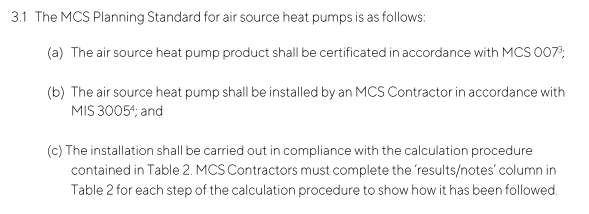
It's there in plain text. The Town and Country Planning (General Permitted Development) Order 2015 clause G1 ( which is the section dealing with heat pumps) https://www.legislation.gov.uk/uksi/2015/596/schedule/2/part/14/crossheading/class-g-installation-or-alteration-etc-of-air-source-heat-pumps-on-domestic-premises/made says (my italics) G.1 Development is not permitted by Class G unless the air source heat pump complies with the MCS Planning Standards or equivalent standards. The MCS Planning Standards are defined in MCS 020 as follows: That very clearly includes that it shall be installed to MCS standards by an MCS contractor. There are no recognised equivalent standards and, it seems to me that to be equivalent, it would need to include something like clauses (a) and (b) not just clause (c). Thus MCS becomes compulsory to benefit from PD rights. The key is the definition of 'the MCS Planning Standards '
-
Sadly all greenwash. It is of course your choice, but please don't be fooled into thinking that it is, or may become green. It isn't and won't. But every person they successfully convince with their lies is another customer for the fossil fuel industry retained for 15 years, which is a win for them.
-
Getting frustrated with heating suppliers.
JamesPa replied to MikeSharp01's topic in Other Heating Systems
Thats all very encouraging and the concept of separating commissioning/design from install is clearly potentially a sensible way forward. 11.2kW sounds a bit toppy from the info you have given, but... Mitsubishi publish comprehensive performance tables (probably the moist comprehensive and certainly the easiest to find/read) tables in their Ecodan_ATW_Databook. Suggest you search for the latest version (if you cant find it post again). The tables include min output as a function of OAT and FT (ie exactly what you need to do the design right!). From memory its about 4kW at 40C/12C, but you need to check for your design parameters -
Getting frustrated with heating suppliers.
JamesPa replied to MikeSharp01's topic in Other Heating Systems
Please keep us posted on how this progresses. I'm very much of the opinion hat this sort of separation of design (and possibly commissioning) from installation is the way forward in many circumstances. Fundamentally system design, and to an extent commissioning, is an intellectual/problem solving skill whereas installation is a high level craft skill. Some people are lucky enough to be good at both craft and intellectual subjects, but relatively few. -
That's my understanding also from reading the regulations (by which I mean the building regulations 2010 - as revised by later legislation, not secondary sources). Furthermore I'm not sure anything in the regulations says you have to have specific skills either, unless you are doing the work for someone else. What the regulations do is mandate what the installation must achieve. Furthermore a G3 certification alone (again on my reading of the regulations) does not exempt you from having to notify building control (and pay the associated fee). To be exempt from having to notify building control you must be a member of an approved certification body. Im not sure how BC can refuse to sign it off if it meets the requirements of the regulations.
-
Getting frustrated with heating suppliers.
JamesPa replied to MikeSharp01's topic in Other Heating Systems
Personally I think this is an important component of the market for the future. Design and commissioning, particularly for retrofits, is a totally different skill to installation. Some will want to and be capable of both, others would be better specialising. Separating the two makes perfect sense and there are parallels in other sectors. The only caveat I would add is that the designers/commissioners need to get their hands dirty from time to time. There is nothing like being bent double on your back under a sink grazing your knuckles to remind you that plumbing involves some on the ground compromise (ps my plumbing experience is DIY only). -
Getting frustrated with heating suppliers.
JamesPa replied to MikeSharp01's topic in Other Heating Systems
The few minutes is just to give a quote. Most will do a 3hr survey once you sign on the dotted line and then requote. thats pretty much a requirement of MCS. It will still, most likely, be wrong though. You could try doing the calcs yourself, doing a sense check against your consumption and presenting it to the Vaillant authorised installers in your area telling them that this is what is required and you are seeking a quote for this. You can acknowledge that they might have to check it according to MCS rules, but you can also explain that you wont be deviating unless they can prove absolutely that its necessary. It might work, or alternatively they might be turned off by what they regard as a 'smart-arse'. If your current boiler spends most of its time at 3.8kW thats like mine. My house has a design temp (-2) consumption of 7.5kW and the boiler spends most of its time at 4kW. Two MCS bods, each following the full 3 hr survey, have estimated 16kW. Three principal things they got wrong and the contribution to the error are They ignored fabric upgrades that weren't visible even though I told them about them repeatedly (~4.5kW) They double load by including room to room losses but not room to room gains (~1kW) They assumed ACH~2/hr. I dont actually know what mine is but I can get a 'spreadsheet calculation' to match the measured 7.5kW by assuming 0.5ACH (~3kW) -
Getting frustrated with heating suppliers.
JamesPa replied to MikeSharp01's topic in Other Heating Systems
That's a comment in two halves. Tha first I agree with, absolutely plumbing and electrics done properly are much, much more than a minimum wage skill. The second half not so sure. All to often I find myself doing DIY plumbing (in particular) or electrics (less so) because I'm fed up with having inane arguments, that have no basis in engineering or physics, with people who obviously haven't got a scooby and/or don't want to quote for the job that needs doing. However I grant it's chicken and egg. The cultural problem I refer to above is a severe disincentive for the most highly skilled people to get involved in either trade (and indeed many others). -
Getting frustrated with heating suppliers.
JamesPa replied to MikeSharp01's topic in Other Heating Systems
As I say three quarters of me agrees. However it helps to understand another perspective. We have a deep seated cultural problem in the UK (I'm not sure it's unique to the UK) that plumbing, electrics and most other engineering skills with a practical side are perceived as inferior to desk based roles in finance, and pay and/or are perceived to pay less. So, unsurprisingly, many of our more capable people, who would relish the change as an opportunity to develop new skills, choose to avoid them. -
Getting frustrated with heating suppliers.
JamesPa replied to MikeSharp01's topic in Other Heating Systems
About a quarter of me has some sympathy for the domestic heating industry. For decades they have been able to get away with just shoving in a 28kW boiler to serve a typical 8kW load, leave it set to the defaults, put trvs on unbalanced oversized radiators, and it all works as far as the customer is concerned. Granted it doesn't condense as it should, and the thermal gradients (in both time and space) are higher than they need to be, so its both less efficient and less comfortable than it could be, but energy was cheap and the customer is used to thermal gradients so doesn't care as long as they are warm. Better still they can sell lots of 'intelligent' upgrades which purport to save money but probably save much less than would be saved by setting the system up optimally. Then two things happen. Energy prices rocket and there is a push to switch to a new technology which means you actually need to think about the sizing, radiator balancing and sundry other variables, and worst of all the customer now cares about and is conscious of the efficiency. Its a massive shift, perhaps it's not entirely surprising that the industry has struggled. OK that's the quarter of me that has sympathy. The remaining three quarters says that the industry should, by now, have recognised this and managed the situation properly and more fairly and openly to the customer. On fairness many appear to have done so, but it also appears that others have not. -
Presumably also not rechargeable, unless they come with a small fission reactor.
-
As @JohnMo says you are almost certainly going to need to add some volume to the system when it's heating the office only (ASHPs typically specify a minimum system volume). If you happen to have an old dhw tank lying around you could probably repurpose this as a volumiser (basically a big tank that you plumb into the return). If not, and since you probably want to avoid the buffer tank in the final build, you would probably be better just putting an electric heater in temporarily. Have you got the heat loss calcs or estimated loss per square m yet?
-
In a modern French installation, 16A for power and 10A for lighting - you should be able to verify that on your consumer unit. A 500W heater uses 2.2A, so no problem The electrician could convert the lighting socket to a cable outlet if you want it 'fixed'. 1 hr job, 2 if he attaches the radiator to the wall, has a cup of tea and makes a few phone calls.
-
Quite so. If you only need 500W you dont need an electrician even for the panel heater. That's only 2.5A at 230V, which surely your sockets supply. It's less than half the rating of a UK lighting circuit (I'm not suggesting you run it off a lighting circuit, but with LEDs there is essentially no other load).
-
In an airbnb, I wouldn't think so. Never underestimate the ability of the general public to do stupid things!
-
ASHP Modulation split dwelling
JamesPa replied to jamesdiyer's topic in Air Source Heat Pumps (ASHP)
Have you got any figures for your current gas consumption to sense check the installers figures. They can get it terribly wrong. 14kW is actually a rather high figure (but of course I dont know what your climate is or the floor area so this statement could be nonsense!) -
ASHP Modulation split dwelling
JamesPa replied to jamesdiyer's topic in Air Source Heat Pumps (ASHP)
Thats going to be a pretty good conductor vs your walls and roof which are pretty good insulators. This being the case I seriously doubt you will maintain much of a temp diff between top floor and floor below, so you may well get the lowest cost by leaving the emitters on the top floor on, allowing you to reduce your flow temp to the absolute min. Otherwise you risk having to adjust your flow temp up to satisfy the demand of three floors from the emitter area of two. Unfortunately conducting meaningful experiments isnt easy because you don't have control of the variables (namely the OAT). I would be tempted to adjust the WC curve with all floors heated, doing this for a year until you are comfortable its as good as its going to get. Then turn off the emitters upstairs and see if you have to increase the flow temp up to compensate. If you do have to, you are probably better off leaving the top floor heated.

