


JamesPa
-
Posts
1899 -
Joined
-
Last visited
-
Days Won
2
Everything posted by JamesPa
-
Sizing ASHP according to heat loss calcs
JamesPa replied to flanagaj's topic in Air Source Heat Pumps (ASHP)
@flanagaj Prodave is right. Note however that there are quite a few ashps which are labelled ~5 kW that actually are ~8kW models down rated in the firmware. Avoid these. The most prominent/common one is Daikin, but there are others. -
Advice on bathroom heat strategy
JamesPa replied to SomethingSensible's topic in Air Source Heat Pumps (ASHP)
In my current house I have a Samsung Gen6 and if I understand the manual correctly it can supply 2 zones at different temperatures without mixing valves, but not at the same time, i.e. it would heat one zone at one temperature and then the other at a different temperature If you use a mixing valve you can have two temperatures simultaneously but your heat pump is running at the higher of the two so you are losing the efficiency benefits of running at a lower temperature. Without a mixing valve you can only have one temperature at any given time. All heat pumps and sofaik boilers work like thus hence the need for a 3 way diverter valve for dhw if you operate either a boiler or heat pump on wc. The best and simple way is to design all emitters to run at the same (low) flow temperature unless that is totally impossible, in which case a compromise, for which there is a cost, must be made. -
Advice on bathroom heat strategy
JamesPa replied to SomethingSensible's topic in Air Source Heat Pumps (ASHP)
Ok potentially complicated. You will have to negotiate both the BUS rules and the MCS ones. I would suggest you need to read both and work out how you are going to convince an installer that what you propose complies (I'm not at all sure it does, but maybe you can find a way through!). I would read the original regulations not guidance for this one as it's unusual so may not be adequately covered by simplified guidance. -
Advice on bathroom heat strategy
JamesPa replied to SomethingSensible's topic in Air Source Heat Pumps (ASHP)
Arguably yes (or no) but why bother having this argument? (you will likely have other arguments with your installer which it's more important to win) -
Advice on bathroom heat strategy
JamesPa replied to SomethingSensible's topic in Air Source Heat Pumps (ASHP)
Heat pump must be capable of heating the whole property to qualify for the BUS grant. @JohnMo is giving sensible advice imho, keep it simple, one zone, no system separation, use an electric element for the towel rail separate to the heating/cooling (towel rails are anyway pretty useless for heating in a low temperature heating system, not enough output) -
Very true. But in reality, for many properties, there are only a few days in the year that cooling is needed, providing you are sensible with curtains and windows, and only a few rooms are likely to be affected. Most people are more tolerant of over temperature than under temperature, so the precise control we are used to for heating isn't always necessary for cooling and its unlikely to be necessary to cool to the 20C most heat to. For example my (200sq m, 7kW heating load, 1930s) house faces south and there is a large patio door in the room we spend most time in. I have one fancoil in that room (in an otherwise all radiator system) and it makes sufficient difference (with the heat pump run above dew point) to get from horribly hot to pleasantly warm. The only other room where there is a material problem is the master bedroom, which has an oversized type 33 static rad that I plan to add a bunch of computer fans to in order to hopefully get some cooling (Andre Kuhne on openenergy monitor did exactly that and got a 4C room temp reduction, which is a worthwhile difference). I do wish I'd put in a couple more fancoils (TBH I didn't realise how good they can be) but I can live without. For me at least it's simply not worth spending the money to get more sophisticated given the few days it's necessary. Obviously it's very house and person dependent and the frequency of hot days may well increase, but I for me at least it doesn't merit a whole separate system. If I were building from scratch I'd just do UFH and/or fancoils and keep above dewpoint. Perhaps I'm just mean?
-
Buffer Tank Hot when Heating Mode Turned Off
JamesPa replied to James1234's topic in Air Source Heat Pumps (ASHP)
So ... IMHO you should carefully note what @JohnMo has said and also note carefully what I have said. Fundamentally someone is responsible for the design and someone is responsible for executing the design. They may or may not be the same person. Finally you have to factor in what you actually agreed to. As @JohnMo says the original design as done by Daikin is sound. The complications to be aware of are firstly: that may not be what you signed up to (who has the MCS licence) and secondly: is if you agreed (expressly or by implication) to a change. So you need to think about this. If you did agree to a change then think about whether you relied on their 'professional advice' (!?) when you did so. If you did agree to the design change and didn't rely on their professional advice then you may not have a leg to stand on, otherwise you could argue that the advice was faulty, but of course that's a matter of (professional) opinion. Unfortunately someone else looking at the system is just another opinion, which you will have to pay for but which can be easily dismissed by the opposition. Unless there is an agreement upfront to be bound by this opinion, you may struggle to enforce it. So my recommendation is to rely on contract unless you have no option. Thus the first call is what did you sign up to and (as @johnmo says) who in what you signed up to has the MCS licence, and what did they say? if the contract is violated then you have a clear case in the small claims court. They will likely fix it rather than go to court. If the contract wasn't violated then its one 'expert' vs another in which case its probably best not to waste your money and instead just 'plumb out' the buffer and live with the oversized heat pump. If, somewhere along the line, you consented relying on their 'professional opinion' then its in between, but probably closer to the latter (ie don't waste your money) than the former. Sorry potentially to be negative, but ultimately what is enforceable is contract and statute (eg building regulations). Contractors/manufacturers, of ASHPs and everything else in life, know and exploit this - often totally ruthlessly if they don't care about the effect on their reputation. They also exploit the fact that most people aren't smart enough or dont have the resources to work through the contract/statute, so they take liberties when it suits them . You need to be equally smart (or smarter) in nailing what they have breached, or be sanguine about it if they haven't breached anything. -
Buffer Tank Hot when Heating Mode Turned Off
JamesPa replied to James1234's topic in Air Source Heat Pumps (ASHP)
Curious given how different the design is to the one their guy originally specified! Basically Daikin are therefore saying design doesn't matter much. All you are requesting, essentially, is for it to be installed in accordance with the original spec from which the plumber deviated only, so far as I can tell, because of parts availability. -
Ah, placebo controls, don't you just love them. Absolutely ideal when you have people fiddling with things who don't think about what they are doing. I once considered implementing placebo controls in a community centre where successive users whacked the thermostat either fully up or fully down (but of course the building didnt actually respond materially before they left, and they didn't bother resetting it. In the end I opted for locked controls. Im not sure to this day if that was the right decision.
-
Sorry, I meant to write not be used solely for cooling, my finger trouble! Hopefully I didn't cause too much confusion. The point is that it is now legitimate for a heat pump installed in England under PD rules to be used for cooling, provided it is not used solely for cooling. Previously it was legitimate under PD rules for it to be capable of cooling albeit not used for cooling.
-
Why do they need to know the temperature, surely all they need to know is if they are too warm or too cool. Anyway if you want to measure temperature, get a thermometer!
-
OK so its a legacy thing then. Its a pity the misinformation is still around.
-
It is not, and the the best of my knowledge never has been, a requirement of either the BUS grant or planning permitted development that the heat pump be incapable of cooling Until recently it was a requirement under permitted development rules that it should not be used for cooling (which is not the same as incapable of cooling). However that changed (in England) at the end of May. Now the only permitted development rule related to cooling use is that it it must be used solely for cooling.
-
Buffer Tank Hot when Heating Mode Turned Off
JamesPa replied to James1234's topic in Air Source Heat Pumps (ASHP)
True but inexcusable. In most professions, indeed most jobs, you need to keep up with developments through ongoing training and, if you can't, or can't be bothered, you risk a performance improvement plan followed, if you don't succeed, by the sack. Why do plumbers think they are different? Presumably because, for 20 years, they got away (and are still getting away) with setting up condensing boilers in a way that they don't condense, thus adding 10% to our heating bills. -
Buffer Tank Hot when Heating Mode Turned Off
JamesPa replied to James1234's topic in Air Source Heat Pumps (ASHP)
I have 'thermostats (TRVs) in every room, thus satisfying those who (incorrectly so far as I am aware) claim that this is a 'requirement'. All but two are turned up to max and have their heads unscrewed to ensure that they have no actual effect. You can do exactly the same with 'thermostats'. The two that are active are: 1. a fancoil which adjusts its fan speed (but not the flow rate) depending on temperature 2. a TRV in the guest room as a courtesy to guests. Everything else is open loop. There is no buffer. Problem solved. An alternative good compromise advocated by many is TRVs in the upstairs bedrooms, open loop downstairs This misses the real problem with buffers, namely that they almost invariably are set up poorly and/or are insufficiently large to force stratification and thus mixing between flow and return occurs. This reduces the FT to the emitters for any given FT from the heat pump, typically by an amount equal to the DT across the emitters. Thus the heat pump must run hotter than it otherwise would. For a standard 5C DT this increases heat pump consumption by ~15%, a bit less with the low temperatures that UFH runs at. Where as a matter of interest? I found this Which does not say that there must be a thermostat in each room. There are similar paragraphs for UFH and fancoils, but nowhere a requirement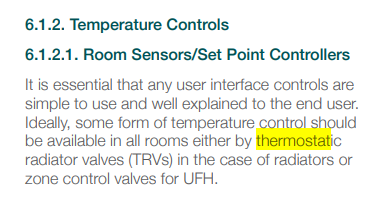
-
I have one fancoil in an otherwise all radiator/ASHP system, installed because I couldn't fit a radiator large enough in the available space. Its a wall mounted Mitsubishi Ilife 2 Slim, made in Italy (as are quite a high proportion of the available fancoils with stylish enclosures). Nice (but expensive) piece of kit capable of heating or cooling. There is a view that you can dispense with condensate drains if you keep the cooling flow temp above the dew point, which some heat pumps can do automatically. Obviously you get less cooling this way. Fan auto adjusts depending on load, so better to get a bigger model if fan noise matters (because fan will then be slower). Its audible, but quieter than eg my fridge. With 20:20 hindsight I wish Id fitted a couple more so I can get a decent amount of cooling. Hope that helps
-
ASHP without Boiler Upgrade Scheme?
JamesPa replied to timhowes's topic in Air Source Heat Pumps (ASHP)
That's indeed interesting. My contacts were about 18 months ago, perhaps they have changed? -
ASHP without Boiler Upgrade Scheme?
JamesPa replied to timhowes's topic in Air Source Heat Pumps (ASHP)
I would check this directly with Mitsubishi tech support (who are very helpful). If it is the case, which I frankly doubt, don't use ecodan, seriously. "It's mandated by the manufacturer" is an excuse some installers use to do what they want to do for their benefit, not yours, knowing you are unlikely to check. -
ASHP without Boiler Upgrade Scheme?
JamesPa replied to timhowes's topic in Air Source Heat Pumps (ASHP)
@timhowes Whatever else you do and whether you get a grant or not please do not: Get a buffer and more than one pump (including any pump in the outdoor unit). A 2 port volumiser in the flow is OK. Don't get or any other form of system separation, eg a phe or llh, between emitters and heat pump either. Get a massively oversized heat pump, unless your loss is say 3kW or less, in which case you have no choice and anyway it doesn't matter because of the low consumption. Get external controls (exception - those specifically designed for heat pumps IE havenwise, homely or adia) If you do any of these it's highly likely you will be back on this forum complaining about poor performance. The understanding and technology of heat pumps has moved on a lot in the past 5 years, sadly some installers haven't kept up and are still following outdated practices for their own benefit not the benefit of the householder. There are of course some specific circumstances where one or more elements of the above advice doesn't apply, but they are rare in domestic situations. -
ASHP without Boiler Upgrade Scheme?
JamesPa replied to timhowes's topic in Air Source Heat Pumps (ASHP)
Why do you want buffers and 3 pumps? Unless your house is very unusual no buffering and one pump (often included in the heat pump itself) is the way to go assuming you don't want to increase running costs by 15% or more for no benefit to anyone other than the installer. Also no fancy controls unless specifically designed for heat pumps (which currently means only homely, adia or havenwise sofaik). The bus can save money certainly, but not if you accept unnecessary components and/or a grossly oversized heat pump because any installation savings will quickly be consumed by increased running cost. My personal advice is take the bus, but not at the expense of being saddled with the wrong system. Shop around! -
ASHP without Boiler Upgrade Scheme?
JamesPa replied to timhowes's topic in Air Source Heat Pumps (ASHP)
You won't do the second but you can avoid the oversizing (well I did anyway). In brief. I had two full three hour surveys done both getting to 16kW. Fortunately I paid only for one. My own calculations using mcs assumptions got to 10.5kW. Difference accounted for by double counting of room to room losses and the fact the surveys ignored fabric upgrades that I made a point of telling them about. Measured loss based on 2years of smart meter readings (gas boiler) is 7kW, difference accounted for by air change rate assumptions. I found 2 installers who would use my readings to infer a lower ACH than MCS default, both anyway believe ACH is often overestimated. They aren't alone, I have since heard several installers make this observation. Result was 7kW Valiant installed by mcs installer, bus grant claimed, heat pump capacity matches actual house loss. In my second round of seeking quotes I provided the evidence of measured loss up front and also told them I wouldn't accept anything bigger (and also that I wouldn't accept any system separation). That filtered out the grant harvesters and left those who genuinely want to do the right job. I ended up with a local installer on Vaullants approved list (obviously other manufacturers also have approved lists, but by the time I got to this point I had pretty much decided on Vaillant). He was already very sensible but possibly recognised he might learn a bit from the experience. My second option was someone more distant but totally switched on, he didn't get the job solely because of distance, but nevertheless I would recommend them. -
Eon didn't ask me for proof of ev ownership or even the model, and doesn't require you the have a dedicated EV charger (IE the eon rules allow you to charge from a 13A socket). Can they tell the difference between your battery and a battery on wheels? will they bother?
-
For me (no battery, ev, ashp, pv) I can't better eon next drive and eon export. 7hrs at 6.7p, the rest very slightly more than the best fixed rate without tou. 16.5p export. So I charge the EV, do the washing and washing up, heat the dhw and bake bread at night whatever the season as the revenue from export exceeds the cost of nighttime import. This has the distinct advantage that it's simple to manage (like the one you are on). I don't even need a smart ev charger, just a 13A EV rated socket. With a battery and no EV I think I'd end up doing the same, but I can't make the business case for a battery work. I did a spreadsheet comparing the various options. The differences between the various tou tariffs weren't that large by comparison to not having a tou tariff at all, and the simplicity meant I didn't need any smarts other than the smart meter. Of course the numbers will depend on your own usage.
-
I went through this loop (being quoted a silly price to remove gas), albeit with a community centre (so possibly classed as commercial) not a house. In the end the gas pipe stayed in place for a couple of years until we could conveniently change 'supplier' to one who would remove it all for free (BG I think). Crazy I know but in the end it was removed and we didnt pay a penny.
-
ASHP installation - great new invention
JamesPa replied to JohnMo's topic in Air Source Heat Pumps (ASHP)
On paper, but many houses need circulation pipes, radiators replaced, My list was the things that (judging by what we hear here and on other forums) generally go wrong and mess up the performance, not a recipe for the whole installation. Fixing these is simple and my point is - why do we make excuses for the industry and try to shift the blame for the piss-poor performance of some to government, particularly given the farce of the condensing boiler roll out that the industry foisted on us. With a lower electric price, why wouldn't all the above stay in place, except 45 Deg. The lower unit cost allows the 45 degs to become higher, you can run a wider dT on heat pump and still have tolerable running costs. Completely agree. In fact I have long advocated engineering a modest reduction in the electricity/gas price ratio so that designing for (eg) 55C is possible from a running cost standpoint, and still offering a 45C design as a value-add cost saving upgrade. I have also long advocated reusing existing DHW tanks where there is one (again offering a new tank as a value add upgrade), NOT needlessly replacing pipework and generally simplifying rather than insisting on the gold plated (but sadly not always gold standard) approach we currently have. Finally I have long advocated allowing unvented DHW tanks heated by ASHPs and with an external (not internal) element to have external protection instead of the D1/D2 vent arrangement, a change in practice (not regulation - this can be done within existing rules) which would cut half a day or more off an installation in many cases. These changes alone could significantly reduce install time and disruption, with value added upgrades offered if the householder wants them, However I have been consistently shouted down on all of these ideas, with few practical alternative ones proposed. However to achieve 5p/kWh (suggested upthread) is unrealistic in terms of the subsidy it requires, and unnecessary. Perhaps a good compromise might be to (a) shift the policy costs from electricity to gas (its madness that electricity users pay for green policies) and (b) offer a limited subsidy for say 10 years for electricity consumed for heating by ashp (maybe instead of the grant). The risk of course is that just encourages the industry to deliver installations that perform even more poorly. That fundamental still needs fixing. not excusing, IMHO.
