


epsilonGreedy
-
Posts
3877 -
Joined
-
Last visited
-
Days Won
6
Everything posted by epsilonGreedy
-
Because it was a poorly insulated thermal sieve. There is no overnight damper on UFH so I maintain my point that, in anything less than a passiv house, electric UFH will need substantial top up heating at standard rates. The alternative is a much higher slab temperature target at E7 rates and hence an uncomfortably hot house at 5am. Legions of householders have experienced the inherent problems of E7 storage heating, the issues have been well known for 50 years. New builders considering UFH need to be alert to replicating the same problems with an over dependence on E7 heating cycles. In some respects the problem is exacerbated because a new build will shed less heat and short of throwing down 20 kingsize duvets each night there is no UFH damper option.
-
You know why. This is principally a new build forum here homes will vastly exceed the performance of a Victorian terrace. I suppose it is just possible that a leaky old terrace house will shed enough heat when the storage rads are charging at night to maintain a healthy 18 degrees because the vents are closed but because the house is small enough there is enough heat charge remaining to warm a house up at 8pm. With a non Passiv new build the spacing heating electric consumption is going to be closer to 50/50 E7/Standard rate surely.
-
I will simplify my point for you. It is misleading to indicate that a house can be heated exclusively from economy rate electricity as your own figures confirm. The further a house thermal performance shifts from Passiv to new build normality then more peak rate electricity will be required. Most normal human beings prefer a house at a toasty 22 degrees at 8pm and a couple of degrees cooler at 4am, E7 heating promotes the converse.
-
This is true for a superbly engineered product like a Plasson water connector but the examples in your photo look like PhilMacs. If so you will need some mechanical leverage to clamp the joints together to a longterm leak free status. Philmacs are also only compatible with plumbers with 4 arms because they flop together and can flop apart before you can wind on any clamping force.
-
I suppose it depends on how cold a house will get in the day when electricity costs much more. Who wants to cook on an old fashioned electric ring. How much would a 40Kw instant electric DHW heater cost. According to this site https://www.confusedaboutenergy.co.uk/index.php/domestic-fuels/fuel-prices off peak electricity is 51% more expensive than LPG.
-
Connecting a meter box: quick check please.
epsilonGreedy replied to ToughButterCup's topic in General Plumbing
Develop a good feel for when the pipe clunks fully home. Someone here recommended using a marker pen so you can see when the pipe is fully home. Put aside the required number of inserts before beginning and make sure none are left at the end. Pour a bucket of clean water before closing the stopcock and cutting through a pipe, so you can clean bits dropped on the ground. (Saves an embarrassing trip to the neighbour with bucket in hand). Measure carefully because the stiff pipe cannot be forced into alignment with a tight radius in the final 1m. -
Cost of digging a big hole in the garden. Safety regulations that impose limits on where the tank may be sited. Barely regulated supplier market with costly contractual lock-in conditions.
-
The spread in those fuel costs looks odd, I suspect assumptions made about standing charges create a disparity that would not apply to a typical new build with a larger consumption. Given a new build with a thermal performance half way between building regs and Passiv I assume an ASHP would have to charge up the UFH slab during the day at the standard full KwH electric rate. According to the House Builders Bible, 2017 KwH costs are: Electric Peak 16.0p Electric @ COP 3 5.3 Mains gas 5.3p LPG 6.7p Oil 5.1
-
Arrrgh can't make my mind up!
epsilonGreedy replied to gc100's topic in General Self Build & DIY Discussion
An enviable dilemma. When will the respective teams get the roof on? I ask because I can see Widget Ltd wanting to push on at speed when adverse weather is hitting your open structure. -
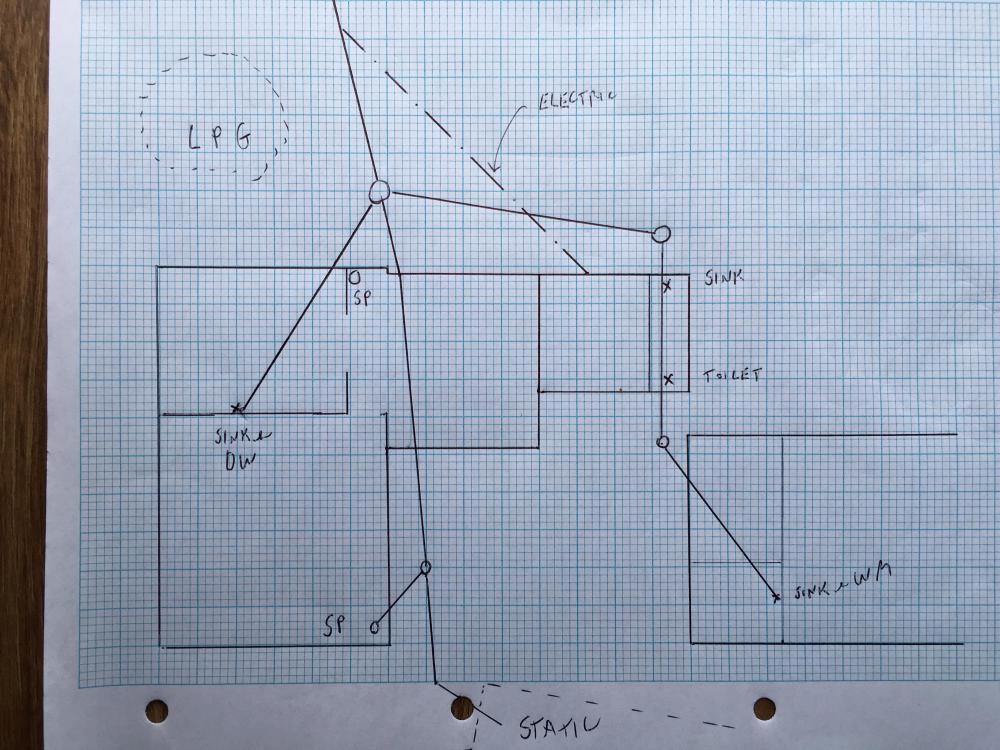
My floor beams arrive tomorrow then the underfloor drainage and floor goes in next week. Here is my plan for the drainage excluding roof rainwater drains. The site is gradient challenged which means the main horizontal runs are at 1 in 80. A surface water flood risk requires a raised FFL so plenty of drop below the block & beam floor for rest bends. On large square on the plan = 1m. DW = disk washer WM = washing machine SP = soil pipe.
-
I understand that horizontal drainage junctions below a ground floor are frowned on and require independent external rodding points for each branch. My current drainage planning would be simplified if one drainage pipe could drop down into another as a vertical branch, this would be in the void below a block and beam ground floor. There are two different scenarios: Ground floor toilet --> large rest bend --> 2.5m run of 110 pipe @ 1:60 gradient under floor void --> washhand basin drain drops vertically through floor void into 110m pipe --> 110mm pipe continues @1:60 out through cavity footing wall into garden. Kitchen dishwasher & sink --> rest bend --> 4.0m run of 110 pipe @ 1:60 gradient under floor void --> soil pipe from en-suit on first floor drops vertically through floor void into 110m pipe --> 110mm pipe continues @1:60 out through cavity footing wall into garden.
-
Thanks I can work with 300mm, in fact in the absence of any regulations I would have self imposed a minimum depth equivalent to a vigorous plunge of a garden fork. Some other reading got me thinking the minimum cover was 600mm.
-
I think there is a minimum cover depth for foul water drains and where that depth is not achieved a concrete capping is required. Does anything similar apply to rainwater roof drainage across a garden or patio?
-
League table of effluent trouble sources.
epsilonGreedy replied to epsilonGreedy's topic in Waste & Sewerage
No treatment plant in my case, all mains drainage except roof water runoff. The dishwasher drain is a source of worry as it is 2.5m away from the nearest external wall and 4m to an external wall in the most logical direction. Extending back from the dish washer in the uphill direction to an external wall and then a rodding point would require another 4.5m run. -
I am trying to finalise my black and grey water drainage plan this weekend in order to purchase parts for work starting the following week (12th August). The problem is I have too many options and what would help is confirmation of which effluent sources cause most trouble. Here is my guess based on renting an old house with a botched and extended drainage plan, the table shows worst to lease offenders. Dishwasher (Reason: Formation of what the Dyno-Rod guy called FatCrete from fatty food residue). Toilet (Reasons: Super soft, super thick modern quilted toilet paper & flush away "degradable" haha wipes). Washing machine (Reason: Gelatinous deposits formed from fancy modern washing liquids). Bathroom sink (Dentyl PH mouthwash which has an oil component that reacts with other soaps to form a white wax) Shower (Reason: Hair). Downstairs sink.
-
Sensible max trestle working height.
epsilonGreedy replied to epsilonGreedy's topic in Tools & Equipment
Lots of good advice in this thread, the problem is all contributions make sense. I like the idea of a general diy tower as that will be a useful longterm asset post build. An investment in whole house Kwikstage makes sense for a a slow paced diyMax selfbuild but feels ott for some 0.7m to 1.2m high trestle runs that will be shifted around near daily for block laying. I will look for a trestle option that supports a handrail. -
Which features of your house bug you?
epsilonGreedy replied to puntloos's topic in New House & Self Build Design
Early days for me: Hates. The wonky block I laid this week along a key pathway in the garage/workshop. It is 4mm out in the horizontal plane and it will irritate me for the next 20 years. Think I will cut it out this weekend. Copulating pigeons clattering about on the metal roof of the static caravan at 5am. Loves Building my garage wall in the evening to the sound of the village church bell ringing practice session. Checking my masonry at sunset with a line laser and thinking that ain't half bad. -
This makes me sick at heart
epsilonGreedy replied to ToughButterCup's topic in General Self Build & DIY Discussion
I am pleased you and @JSHarrisraised this observation, it took me about 12 seconds at the Guardian web site to suspect it looks like a partial building collapse that brought down the scaffolding. For all the speed readers here I should point out the building was being demolished. -
Sensible max trestle working height.
epsilonGreedy replied to epsilonGreedy's topic in Tools & Equipment
Is Kwikstage available for single story heights? The kits at my supplier are all 16ft high and the smallest unit is an 8ft run for £540 inc VAT -
Sensible max trestle working height.
epsilonGreedy replied to epsilonGreedy's topic in Tools & Equipment
Ok this is interesting as I had not considered a tower. In a single day I would be working along a 16ft and 12ft run down two sides of the garage. Even at my pedestrian block laying rate in one hour I would work my way down a 16ft long course. Would tower scaffolding support this horizontal working range without lots of reconfigs? -
I need to buy some builders trestles for the upper courses of my internal garage blockwork and I will be working off a newly laid level concrete floor. I reckon 11 blocks will get me up to a decent height for the roof joists. Lifting a 15kg block up to the 7th course caused a few painful twangs in my elbow tendons so I would like to keep the lift differential to 5 blocks or say foot to chest height. Working the maths backwards this suggest a max trestle working height of 1.25 meters. Does this sound reasonable? Size 2 or 3 from this supplier look suitable to me. http://www.cylex-uk.co.uk/reviews/viewcompanywebsite.aspx?firmaName=scaffolding+supplies+limited&companyId=19151781
-
Wash basin under a window ..... Phhhhhh
epsilonGreedy replied to ToughButterCup's topic in General Plumbing
The 1900 vintage French home I lived in had deep window reveals, the frame of the inward opening windows was flush with the interior wall i.e. no internal window cill. With such a deep inset it would take a breeze to drive rain inside. It was a classic French framing solution replicated all over France at the time, I often see the same window latch on TV programs . I guess a solution evolved that was right for the climate across France in the age before central heating and MVHR. -
If you are referring to sailing yacht owners then you are very wrong. Self builders and yacht owners share a natural interest is how things are made. In nearly 40 years of following yachting I have never heard a hint of a rumour that a brand or specific production run of yachts suffered from damp manufacturing conditions. Yacht owners can be highly partisan on internet forums and are not shy from criticizing other brands, yet in all the mud slinging never a mention of "that dodgy batch came out of that damp manufacturing plant". A fair criticism of the British in the 70's and 80's, there is no volume British yacht brand left today. The original BBC Howards Way sailing drama portrayed the all too typical have a go yacht production enterprise of the time. From what @jsharris has posted here I infer he had a brief dalliance with underfunded yacht production decades ago. My yacht popped out of its mouldings in Germany in 2004 at a truly massive manufacturing centre owned by a company valued at around a $ 1 billion at the time. The no.1 company is French and called Beneteau is worth £600 million. You and @JSHarrishave a dated perception of grp yacht production.
-
Wash basin under a window ..... Phhhhhh
epsilonGreedy replied to ToughButterCup's topic in General Plumbing
66 million french disagree. Having lived in France for a few years I developed an appreciation of inward opening windows in a period property, they promote fresh air because they can be left slightly open in mixed weather. Re. curtains... if you have external shutters then your curtains will be lightweight hence just a minor hassle to flip out of the way. -
This is easy to debunk. How does a radiator running at 60 degrees dry cloths draped over it? Hint: look up a definition of evaporation. Also Jeremy mentioned dew points which would be deterred by just a few degrees of exothermic temperature delta.

