


jayc89
-
Posts
1389 -
Joined
-
Last visited
-
Days Won
1
Everything posted by jayc89
-
Relocating boiler to under stairs cupboard
jayc89 replied to jayc89's topic in Boilers & Hot Water Tanks
I guess it's a should rather than a must... -
How will you be heating water? I'd still be tempted to go for some form of UFH if only for the cooling function in the warmer months.
-
Relocating boiler to under stairs cupboard
jayc89 replied to jayc89's topic in Boilers & Hot Water Tanks
Bump, any ideas? -
Air Tightness
jayc89 replied to richo106's topic in Mechanical Ventilation with Heat Recovery (MVHR)
I guess that's the benefit of parging before fitting insulation to the internal face of brick walls. -
Air Tightness
jayc89 replied to richo106's topic in Mechanical Ventilation with Heat Recovery (MVHR)
I'm in a similar boat. We'll likely reach 0.15 floor, 0.10 loft, but walls will be nearer 0.18, given our size constraints, due to being internal wall insulation. I plan on addressing airtightness as a matter of course when fitting the IWI, however I don't think I can justify a full MVHR system, so will likely replace windows with trickle vents and dMEV in certain rooms for ventilation. Not perfect, but I'm beginning to accept it as a "happy medium" for our property. It will significant reduce our energy usage regardless. -
I'm trying to figure out what to do with our boiler. It was fitted in a room that was originally meant to be our utility room, but our plans have since changed. I had an idea about moving it to a bricked up window opening in our "cupboard under the stairs". Behind this bricked up window is our kitchen. I don't want to route the pipework through the kitchen, and given the cupboard has no outside wall, I'm trying to figure if this is possible and if so, how... The room at the other side of the far wall in this picture is where the boiler currently is. Ideally all pipework could be surface mounted and reconnected, via a service cavity, to existing pipework in that room. I think that should be possible, with relative ease for the gas/water pipework, my concern is the flue.... The boiler is a Baxi Platinum, and it's dimensions are 45 x 76cm. The bricked up window opening is 90 x 95cm. I suspect it would be pretty tight to get the flue connected with enough room below for the gas/water connections. Coupled with this, the top of the window opening is slightly higher than the sloping roof, can a flue be routed below the boiler like that? Hopefully some experts on here can offer some advice.
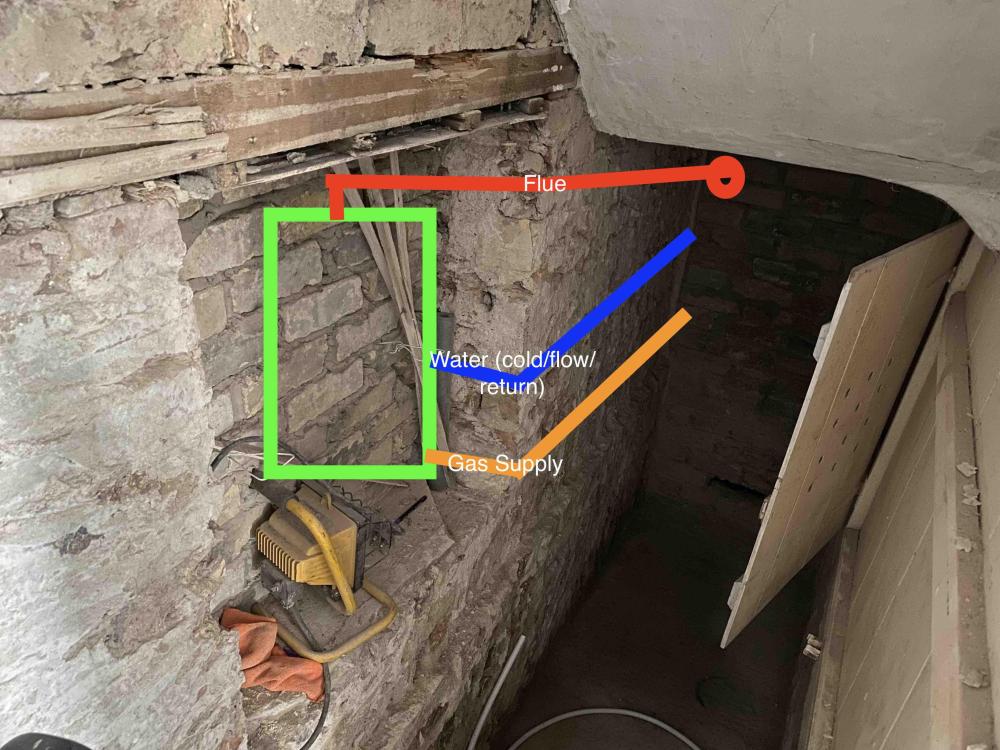
-
We have a similar problem, replacing the original clay tiles with a Limecrete floor seems to be reducing the moisture down there, it's been laid for a month now and the humidity seems to be gradually reducing (I guess that could just be the outside temp reducing too!) Following this thread with interest.
-
I'd love EWI. So much easier. The house is an old farm house in semi-rural Yorkshire, it has too much character to hide behind EPS and render.
-
Solid brick. The only insulation we have is under the slab and the perimeter upstand I quite religiously filled and taped any gaps in the insulation so it looks to be coming up the back of that. I'll check the external wall in this area again for any holes, gaps etc.
-
I was hoping to get around to our internal wall insulation this year, but time is getting away from me. It's unlikely I'll get it all done before the colder months set in. Thinking more tactically, I plan to roll out another layer of loft insulation and tackle the draughts over the next couple of weekends instead. We have a room that's back to brick, and lets in significant draughts, in some places you can see daylight through the brickwork. I'll repoint and parge these walls with something to hopefully mitigate this, and the other biggest draughts seem to be coming from around the skirting boards where they haven't been caulked yet. I'm not entirely sure how the air flow is reaching between the skirting boards as we have a solid floor and no historic air bricks in the area, no noticeable gaps in the outside brickwork either. Will standard decorators caulk do to seal these up, both to the top of the skirt to the wall and the bottom to the tiles, or should I be using something else? Hopefully it's just to see us through the winter, the skirts will be getting removed when I fit internal insulation next year.
-
The cheapest I've found is 150mm Knauf 44 rolls (9.18m2) for £39.95 + free delivery on eBay. I've seen some advertised for less, but when you add delivery (£50 from most places!) they come out more expensive overall. Anyone seen anything cheaper elsewhere? We already have some insulation up there, so I was planning on just rolling another 150mm across what we already have.
-
I'm planning on battening down the hatches in preparation for winter. I'm almost certain there's a problem with our loft insulation as there are a couple of rooms that are mafting (technical term) in the summer and freezing in the winter. Currently there are a couple of layers of mineral wool, but they look pretty worse for wear and have compacted down to not much more than 75mm in total... When we build an extension next year we'll likely go with blown cellulose over the ceiling joists but for now I'm thinking just an extra couple of layers of mineral wool to see us through the winter and hopefully keep our energy costs at a more manageable level. Totally coverage is approx 65sqm. Can anyone recommend the best place to buy cheap mineral wool rolls from? Or even a cheaper solution?
-
Chicken wire would do the trick. We did consider just stapling some chicken wire to the existing fence, which might help keep it in tact for a few years more too!
-
Sounds ideal, not sure how the neighbours would take to having a mesh fence at the bottom of their gardens though.
-
Our existing boundary fence is falling to bits, its approx 70m of picket fence that looks like it was put up 30 years ago and was never stained, so it's rotted. The other side of the boundary is 4 neighbouring properties. We plan to plant bushes, hedges, shrubs along the boundary so don't want to pay £££ for a new fence, just something to secure the boundary, and keep our dog in! Any suggestions for a cheap and cheerful approach that will be hidden (from our side) by greenery?
-
Discount Offers of the Week
jayc89 replied to Ferdinand's topic in General Self Build & DIY Discussion
Mrs keeps telling me to buy it. We must have spent > £300 on hiring one over the last 18 months -
We have a room that's back to brick, in some sections, around windows etc, you can see day light. We're unlikely to finish it off this year, so before winter sets in I'd like to to "something". As well as repointing the outside, I'm thinking of just a parge coat on the inside. Can you parge using lime (NHL) the same way you can with cement? Sloppy mix in a bucket with a stiff brush?
-
Do you have UFH in the screed? A lot of heat will be lost through the wall if you do. Was perimeter insulation previously agreed to between you and your contractor? If yes to both, I'd be getting it made right.
-
I've had a walk around now and there are a couple of areas that I'm not happy with, not massive, probably 5-6mm deviation in total. Can I use a concrete grinding disc to sort out the high spots?
-
Have you thought about using a Ring Chime as a wireless extender? We have a Ring Doorbell, at the front door, which is approx. 7m from our router. We also have a Ring Floodlight on the garage, which is approx 22m from the router in the opposite direction. The Floodlight wouldn't connect to our router, so I bought a Ring Chime Pro and plugged it in near the back door (approx 18m from the Floodlight), which works fine, interestingly, the Doorbell also chooses to connect via the Chime Pro which is approx 11m away from it, rather than the router which is nearer...
-
We have a "cupboard under the stairs" which was the original entrance into a cellar which has since been filled in. It's partially below ground level and is damp. We're going through a series of mitigations, one of them being fitting an extractor fan to induce some ventilation down there. With a bit of faffing I should just be able to get the ducting routed to an outside wall. I'm looking for one that I can leave on 24/7 but will only kick in when humidity reaches a given value. Most I've seen still work on some sort of timer, which I don't want. Can anyone suggest a suitable fan to use?
-
Wouldn't that trap any moisture in the screed? I thought the rule of thumb was 1 day for every mm of depth for traditional? Given it's been down for 24 hours now, is it good to be walked on so I could spray it with water? I know most places say leave it 48 hours before light foot traffic.
-
I finally got around to finish off the last part of the house that still required floor screeding yesterday. This morning it's looking pretty good - haven't walked on it yet. Should I be doing anything else with it? Water mist and/or covering with a sheet of DPM for the first few days etc?
-
So in a DIY installation, unused energy still goes back to the grid, you just don't get any payment for it? Heh.
-
I was thinking a DIY installation where, as I understand it, you're not legally allowed to export back to the grid?

