


SteamyTea
-
Posts
23264 -
Joined
-
Days Won
187
Everything posted by SteamyTea
-
I went to 3G/4G last year (July). Been pretty good. Works faster than the old landline and I have only had one warning text about going over my limit (on unlimited download), but I did download 79 GB of data in a month. I am still watching the Black Mirror videos. All that for a tenner a month, bargain.
-
Been my experience when it comes to networking. I shall try the remove then purge and see if it works.
-
I used to really like it, but the management paranoia when inspections are happening, and the constant threat of redundancy (end of every year, then end of every term) just made it too stressful. These days it is not good enough to get all your surviving students though the course. I made the decision at the end of last year to not go looking for teaching jobs anymore. Catering may be busy and stressful at times, but when the customers go home, it is all forgotten.
-
Like a lot of underachievers at school, I ended up as a teacher (well university lecturer).
-
I was at a school that did 'the classics'. There were kids there doing Latin and Greek. History was the main subject for most. I hated it, along with Chemistry (just a memory test). I I was 1 of 3 that did Physics in my year, pretty poor out of 20 of us.
-
At 'O' level I did English, English Lit, Math (the harder one, was it called Modern Maths), Physics, Biology, Chemistry, General Science, Geography and History.
-
Never even heard of it, but know what it does. The easy way to find out is to just give it a go.
-
I like them as they tend to be free. I think we are slowly coming to the end of paid for software.
-
There is a bit here about making Draftsight portable: http://portableapps.com/node/28290
-
I think I downloaded a copy of CATIA as a torrent once.
-
I did a SolidWorks course as part of my BSc. I can understand that for people with no drafting experience it is easy to learn (and there is a lot in it), but I found it hard to convert. I actually drew up my 3D model in TurboCad for the assignment, then just saved it as a SolidWorks model.
-
What I did in the end. sudo apt-get purge libreoffice wolfram-engine sonic-pi scratch minecraft-pi chromium-browser sudo apt-get autoremove –y Sudo apt-get clean -y But when I updated and ungraded it just loaded LibreOffice again. I need to look at it again as I may have missed something. That seems like a good work around. I may try that out. RTCs seem expensive for what they are and do take up the first 6 GPIO pins.
-
That is the bottom end of the temperature scale for a commercial kitchen.
-
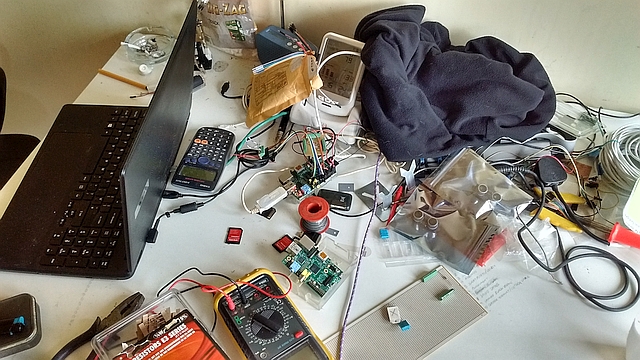
Right For a simple, and basic temperature logger the DS18B20 is pretty good. You have to set the RPi up to accept the 1Wire protocol, which is done though the raspi-config screen. The General Purpose In Out (GPIO) defaults to GPIO4 (this can be changed with a bit of trickery). One thing that the RPi lacks is a real time clock (RTC). I bought some cheap ones a few years back but they never worked reliably, so have ordered some new ones (still waiting for them). Hopefully this will sort the problem. If the RPi is on a network, it just gets the time from a Network Time Protocol server (NTP). This can cause a few problems on a reboot as it has not always updated. The code in Python is simple, I can post some up, but there are many websites that have examples. Just recently I have tried to put a bit of error correction in, but have hit a snag. If there is an error, it stops logging. So I shall go back to post processing the data (if you now what you are looking for, error are easy to spot). Or I can learn now to allow it to recheck say 10 times (2 seconds), then carry on. A few months back I found a bit of free FTP space and played about uploading data to that, it worked well (until I hit my upload limit). I used a bit of simple shell (sh) script. I have also looked into using email, and splitting large data files into daily files. This is a bit 'work in progress' as there are some quirks between different versions of Raspbian OSs and getting a reliable connection (more of that later). But it does give one the opportunity to upload from a remote location via a cheap old mobile phone. As data compression is easy to do from a sh script, any old 3G connection is perfectly adequate. I have only scratched the surface of shell scripts, but they seem a very powerful tool to use. Many of the commands can be used within Python, but as I am not a programmer and have little interest in programming, I like to use simple scripts that I can understand (and write/modify), and then just get them to do their thing when needed. My CurrentCost data logger seems very reliable these days, unlike the copy I got from the internet. It takes a few minutes to set up initially, but then just chugs along writing to a comma separated file (.csv). Once you have data in that format, you can do just about anything with it. Other project I am currently working on are using DHT22 temperature and relative humidity sensors. These are a bit harder to set up as they need a separate GPIO pin for each sensor, and they do not connect easily to the RPi. To get around this I just download some C (a programming language) from AdaFruit, follow the instructions and eventually get it working. word of caution though, don't by the much cheaper DHT11s, they have limited temperature range and are not that accurate, pay the extra for the DHT22s (think I pay less than £2.50 for them, will need to check). I have also made a bit of Python script that senses when a switch is open or closed and puts a time stamp against it. This is so I can sense, via cheap 240V relay (still waiting for it to turn up) wired in parallel to a load, when that load is on or off. This is for a heat meter for a solar thermal system, but could also be used monitor just about any load, as long as wired correctly and safely. This is cheaper than buying in a flow meter, but I have an idea on how to make on of those. At the moment I only log data, I don't use it to control anything (not really interested in that side of things too much). I have got LEDs flashing for a laugh as an alarm, easy step from there to getting something fully controlled. I bought a PiFace, which is a board that fits onto the GPIO pins and has 240V/5A relays on it. But never got around to using it. Something for a rainy day. Now problems I have had. Well one major one that I cannot fathom out. With the old Raspbian OS Wheezy, setting up a static IP address for both the local area network (LAN) and the wireless network (WLAN) was easy, just edit one file. Since I bought a Raspberry Pi Zero (a cut down RPi, but just as good as my Model A), I decided to use the later OS, Jessie. There is two versions of this, one with a graphic user interface (GUI), and one without. As the RPi Zero (RPiZ) is really used with a screen and keyboard, I decided to use Jessie Light (the non GUI version). This has made it impossible, for me, to set up a reliable wireless connection. It works fine on the USB to LAN adapter, but changes the IP address every now and again, which means I loose connectivity. To get around this, just this week I have set up one of my old Model As with the GUI version of Jessie, connected via the main screen to my wireless network, and it seems to be working fine with the static IP I put in. I have searched though the files that seems to be associated with the networking (think there is 4 of them), but can see no mention of the static IP address I typed in. But for the last few days it has been working reliably. A mystery to me. There are a few projects I would like to try out, one it to make a reliable, but cheap, wireless energy monitor. This can be either via a clamp on meter (plenty accurate enough for most things) or a sensor to read the flashing LED on the meter. If CurrentCost where still in business, I would just buy their kit, but they seem to have gone (annoying that they sold a million plus units to the energy companies, who then gave them away to customers, who never used them, there must be half a million of these boxed and unused). There are cheap transmitters/receivers for the RPi, just a matter of fitting a sensor to them, finding out a way to transmit the data and then read it (bit beyond me to be honest). But all the 'bits' are cheap, so can't be that hard. Maybe even 'reverse engineer' a CurrentCost one. I also have an analogue to digital board (ADC) that I have only used once, there is a fair bit of scope for sensing there, and they are cheap. I have a £100 LabJack, which is a great bit of kit for playing with, and works very well with the RPi. But it is really only for lab use, not a practical, or cheap thing to use for everyday monitoring. Right it is late, I need some sleep.
-
I am about to go to work, but shall get back to you on this and explain what I am doing.
-
Start a new Coughing Corner thread on this as I am currently doing the same. It is easy enough for us to swap code, improve it and test it out on each others RPis. That is one of the beauties of the RPi, it is cheap. Saves messing up this thread with my feeble attempts.
-

Modelling the "Chunk" Heating of a Passive Slab
SteamyTea replied to TerryE's topic in Boffin's Corner
Real world data is what it is all about in the end. I missed the opportunity to pick up some old storage heater bricks last week. They would have made a good testbed. I may have to pull mine apart and rig something up (just thought of that). I am waiting for some more ds18s to turn up at the moment. Chinese new year has got in the way. -
I am not sure why we have a mismatch between empty, or under occupied, housing and low employment rates. Not sure, without looking, if it is true or not. I think that what people want, and what they can afford is a problem. But that is social science (wild guesses).
-
I live in a small place, about 50m2. It is laid out badly, which makes the living room into a corridor really. It is dreadful to live in, even on my own. Was worse when I had a lodger. It is possible to survive in a small place (friend of mine lived in a 12 foot touring caravan for about 6 years), but is it a good idea? I don't think it is, because as soon as you have a space, it gets filled. With housing this generally means putting in more people. It cannot be right to have a family of 4 adults in a 50m2 house. How my neighbours lived for nearly 7 years. But what amazes me is that we are building the right number of houses, we just about build 1 house for every new person in the country. This is a bit I posted up about the trains. "I decided to go to the Office of National Statistics and look at house completions and UK population figures. Since 2004/2005, we have build and competed 1,882,200 homes. The population has increased by 1,999,26. Pretty good match really as they are not all one bedroom places. Looking at the figures from 1969/70 to last year, we have completed 10,186,740 homes, population has increased by 9,104,409, again a good match. We are really just whipping ourselves up into a frenzy about the lack of new homes being built. Seems to me that the housing market is working pretty well at the national level. Local level is a totally different issue as we all want to live in the country side or a coastal location but earn London wages. Maybe the real problem is not housing, or 'lack of building' but really regional wage variation." There is really no need to build smaller places, that will just lead to more mental health issues.
-
Modelling the "Chunk" Heating of a Passive Slab
SteamyTea replied to TerryE's topic in Boffin's Corner
I feel a case of Fourier coming on. I will have to start at the beginning I think. -
I worked for a large light manufacturer once, mainly industrial stuff. Had to deal with lighting designers quite often. The industrial side was OK, they generally wanted loads of controlled lighting. The domestic ones where just a shower, kids that liked to play and make up words to describe it.
-
Not for long
-
Thanks for the tip about Googling DP, I may be gone some time
-
Not much of a turnkey service they offer.
-
Wood Burning Stoves in the popular science press
SteamyTea replied to SteamyTea's topic in Environmental Building Politics
As you say, the direct comparison is not fair. Two way you could compare this is to look at the total energy yield for the given area between technologies. Another way would be to compare the amount of energy you can store from your short rotation coppice and then calculate the area of PV needed to supply the same energy at the same time of year i.e. winter time. So for a giggle, let us assume that that you can harvest between 8 and 18 tonnes of dry mass per hectare (https://en.wikipedia.org/wiki/Short_rotation_coppice) That will be between 0.8 kg/m2 and 1.8 kg/m2. If the usable energy content is 4 kWh/kg, then that is somewhere between 3.2 kWh and 7.2 kWh. I do not know the real energy content of short rotation willow (SRW) in real life, maybe someone else can waste time looking that up. Now a quick look at John O'Groats in PVGIS and using a 250W 1.6 m2 PV module, which is 156 Wp/m2, will give a yield of in kWh/month: Nov 4.46 Dec 2.69 Jan 4.01 Feb 4.86 Total of 18.02 kWh So a lot better than the best that SRW can supply (7.2 kWh).
