SteamyTea
-
Posts
23836 -
Joined
-
Days Won
200
Everything posted by SteamyTea
-

Self installed Air Conditioner
SteamyTea replied to Annker's topic in Mechanical Ventilation with Heat Recovery (MVHR)
Is it possible to get a small ASHP that does cooling, then just pipe in the wet side to a Water to Air heat exchanger (basically a car radiator) or a fan coil unit. That was no F Gas to worry about, easy plumbing and you can. Really just depends on how much space you have. -
Shall just replace 'leaky' with 'measured'.
-
Fill your roof with in-roof PV panels instead of pantiles?
SteamyTea replied to Alan Ambrose's topic in Photovoltaics (PV)
Jesus, the Aussie must have his testicles connected to his PV before the inverter to sound like he does. -
Fill your roof with in-roof PV panels instead of pantiles?
SteamyTea replied to Alan Ambrose's topic in Photovoltaics (PV)
Re the DC isolators and fire risk. Those isolators do not disconnect the load, that is on the AC side of the inverter. DC can arc quite a distance, even from a single panel. I suspect that a modern inverter with a built in DC isolator also has automatic load disconnection i.e. twiddle the DC isolator and that initially disconnects the AC load, then disconnected the DC generation. Or it has a (expletive deleted)ing huge gap between the contacts that snaps open in a micro second. As @Nickfromwales says, DC shocks are very nasty, the spasm muscles (heart) in one direction, AC does it in both directions, so two chances to get free instead of one. Never touch any live wires with your left hand, that creates the shortest path to earth, via your heart. Always flick the back of your right hand finger on a wire, even if it has been tested. 20W is enough to kill. Sounds stupidly low, but it is the same as a 1 kg mass hitting you at 20 m.s-1, and then it keeps hitting you for as long as you are connected. -
Fill your roof with in-roof PV panels instead of pantiles?
SteamyTea replied to Alan Ambrose's topic in Photovoltaics (PV)
I am too tired to look, but shall let you do so, report back if useful please. -
Fill your roof with in-roof PV panels instead of pantiles?
SteamyTea replied to Alan Ambrose's topic in Photovoltaics (PV)
Cross posts a bit. -
Fill your roof with in-roof PV panels instead of pantiles?
SteamyTea replied to Alan Ambrose's topic in Photovoltaics (PV)
Will have to ponder it, but thermistors in series may do it, one that gives an abnormal reading could trigger an alarm. May even work in parallel. Won't tell you which joint, but it can shut down the system for safety. But as I pointed out earlier, probably not a real problem if fitted carefully. Should be possible to fit a firebreak under the panels if a new roof. Extra cost, but extra peace of mind. -
Fill your roof with in-roof PV panels instead of pantiles?
SteamyTea replied to Alan Ambrose's topic in Photovoltaics (PV)
Simple thermistors and an alarm should do it. No need for a separate processor to interpret the 1Wires, that is just adding complexity in my opinion. -
Right. I want to develope my simple meter more, a winter project, now that summer is over and turnover has halved in 2 days.
-
Fill your roof with in-roof PV panels instead of pantiles?
SteamyTea replied to Alan Ambrose's topic in Photovoltaics (PV)
I think this is a rather over rated problem, it is similar to BEV fires, you hear about it because it is rare, not common. When I was in Australia, they had some huge fires. Many warnings were about getting leaves out of gutters. Apparently that is one of the major risk raisers. A properly installed system should have a very low fire risk, but there are a lot of panels globally. China alone makes about a TW of panels a year, so over 2 billion a year. A million roof top fires would be a failure rate of 0.05% on panels. I suspect that most problems are caused by wiring, then micro inverters, but that is after leaves. -
U values for windows and doors on new build
SteamyTea replied to Caroline's topic in General Self Build & DIY Discussion
I think that windows can be specified 2 ways. Just the glazing, and the mean value of the frame and glazing. Our expert @craig will know the details off by heart. As a general rule, a certain amount of thermal element 'swapping' is allowed. So if your windows are not up to regs, extra wall insulation can be included, somewhere, to compensate. I think there are limits imposed in this i.e. minimum standard. There is also a raft of contributory rules about security and safety that affect windows now i.e. one rule says no more that a set height, while another says no less than the same height. Never trust an architect to get the thermal elements of a building right, decide yourself if you want a better performing building or one to just the minimum building regulations (which these days are not too bad in paper, but still don't perform that great in the real world (mainly airtightness and thermal bridges). -
Tall upright radiator efficiency
SteamyTea replied to BotusBuild's topic in Central Heating (Radiators)
Yes, physics. The hottest part of the radiator, which is really a water to air heat exchanger, will be at the top, which is also the hottest part of the room, so less delta T. How much if a difference it really makes is probably pretty minor in the scheme of things. -
How does it work? Is it an optical one that reads the meter's LED pulses, or does it use an amp clamp/voltage sensor? Our Mike modified my RPi design to run on an ESP.
-
Circa I think. Approximately or around.
-
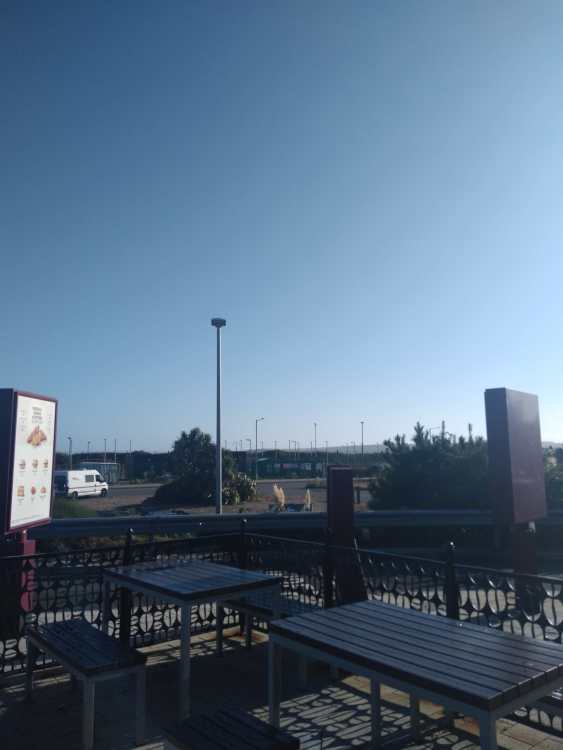
I have just had a look outside. Wish it had been this bright earlier, would have had a quieter day at work.
-
To reduce bubbles, maybe a teaspoon of soap powder in the water will make it 'runnier' Don't use washing up liquid as that is designed to bubble.
-
Nice to get a surprise like that when something performs better than you expect Is it the system performing better, or the weather is different? Having studied solar energy for over 2 decades now, something has just occured to me. I have never seen a systems performance compared to that systems normalised performance. It's a bit like a cars performance figures, there are standard tests (which are highly criticised) and real world performance (which are highly individual). Then there is weather.
-
Air pressure, sky temperature and cloud water density. You will need an aeroplane. Or just get some decent clothing.
-
A BME280 is a few quid, and 1 hPa accuracy. Does temp and RH as well.
-
Not with a theodolite.
-
I don't normally bother to read blogs, but enjoying yours. Keep it all coming. "it’s a kind of grunt and nod based language previously unknown to science" Zipf's Law. Basically the more often the word is used, the shorter the word is. So grunts are probably used the most. Tea helps everyone.
-
The curvature of the Earth should be taken into account. https://jerrymahun.com/index.php/home/open-access/31-i-basic/364-chapter-e-systematic-errors-2 (sorry about the silly old units) But at 500' (152.4 m) the difference is 0.006' (0.00183 m). So a couple of millimetres. Now at 304.8 m, the error is 0.00732 m as it is not a linear error. Nearly 10 mm. Light refraction needs to be taken into account as well.
-
@Pocster
-
Hertz? Not the smell of burning polymer that is the worry, it's the smell of burning flesh.
-
Like electronics, keep going till you smell burning.