SteamyTea
-
Posts
23836 -
Joined
-
Days Won
200
Everything posted by SteamyTea
-

Modern housing estate living
SteamyTea replied to flanagaj's topic in General Self Build & DIY Discussion
You are going to end up sharing a cell with Trump. "Gagging Order 2" -
Far East. When we moved to the West Indies we could cope quite nicely without A/C.
-
I would like to know more about different concrete mixes. Having been involved in composite plastics for decades, the holy grail was to choose the reinforcement with the right characteristics, then mould it with the least amount of resin. This was often misunderstood by many people, including engineers from different fields, but more usually supervisors on bonuses, this caused higher rejection rates and mechanical failures. Got composites a bad name as well. I blame Reliant Cars for much of this. Clever people at the development companies created fantastic systems, then let c***ish twats from Tamworth decide they knew better.
-
Calculating size of heat pump required
SteamyTea replied to rowan_bradley's topic in Air Source Heat Pumps (ASHP)
@CalvinHobbes Jeremy used a Sunamp that was originally heated from his ASHP. That got junked I think and he was given a newer one that he charged from his excess PV generation. Originally he had a small, vented cylinder that was heated from the ASHP, but as it was one of those dreadful ones with the F&E tank built in, it lost a lot of energy and overheated the plant room, which caused excess temperature in the bedroom. -
Modern housing estate living
SteamyTea replied to flanagaj's topic in General Self Build & DIY Discussion
I am 200 miles from @Pocster, though I would worry about him hiding a camera somewhere. Edit This site is a bit spooky, went to 'new posts' and it is about extending semi and damp patches. Filth, pure filth.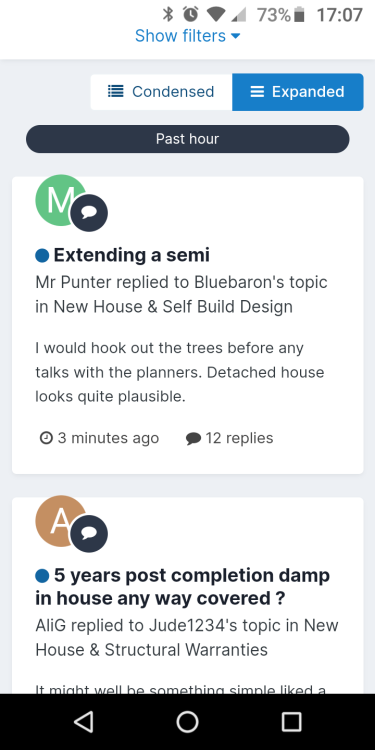
-
Which heating and hot water solution(s) in 2024?
SteamyTea replied to Jane W's topic in Other Heating Systems
Would be easy to fit MVHR as well. When I was a lad, the house across the road from us had forced air heating, I do seem to remember that their daughter told us that she could hear conversations easily in her bedroom. I don't remember it being a problem when I was in PA. -
Modern housing estate living
SteamyTea replied to flanagaj's topic in General Self Build & DIY Discussion
My house is 3 meters higher than the ones across the street. I can look directly into the bedrooms, and from upstairs, can see their beds. There is never any decent action where I am. -
I think, in the UK, because we have distinct seasons (caused by our latitude) AND variable weather (causes by being an island) we, the British, are very sensitive to our climate. We also have thermally dreadful housing stock, high incomes and low energy costs (I know there are extremes, but the median figures support this). Much of the 'energy saving' mentality goes back to the switch from solid fuel, to town gas, then naturally gas, and the energy crisis if the early 1970s (just as we were told gas would be the cheapest ever and electricity too cheap to meter). So no we sit in over heated houses, ventilated by cold draughts and rattling windows. I suspect that the reason that many people say they like a colder bedroom, or the window open, has nothing to do with temperature, more to do with humidity control. There was a campaign, in the 1980s to get us to turn the heating down, claims like 1⁰C lower on the thermostat can save you 20% on the bill. This is a statistical arguement based in heating degree days, and in some, limited cases may be true. But for most people it is not true, partly because a leaking house soon cools, partly because our heating systems are crap, and mainly because most people are scientifically illiterate and because of ingrained ignorance and prejudice, cannot set a thermostat to the right place. So what to do? Find a temperature that suits you, not what your friends suggest. I would happily have a place at 28⁰C at night, that is 12⁰C cooler that where I grew up. And even at 85% humidity, it is still dryer here.
-
Not for 16 quid a month and have all the benefits of portability.
-
It is how well the ASHP can dispell energy to a hot atmosphere. Say the refrigerant is effectively expanded until it hits -25⁰C and the OAT is -10⁰C, that is ∆15. Now say the refrigerant is at 25⁰C, and the OAT is 35⁰C, ∆10. Different refrigerant fluids have different temperature/pressure coefficients so can also have different CoPs between heating and cooling
-
Looks like a system that is designed to fail at every stage.
-
I Can Smell My Neighbors Cooking In One Of My Rooms
SteamyTea replied to Rehan Saeed's topic in Ventilation
How do YOU pronounce that? I used to work near a Shwartz Spices lovely it was, and then when I had to go up the M40, near Banbury, got the coffee smell. Now Portreath, that just smells of shit, because it is. Beach near St. Agnes, Trevaunance Cove, is the same. Activated charcoal filters are meant to help, personally I think they are easily overpowered. -
Which heating and hot water solution(s) in 2024?
SteamyTea replied to Jane W's topic in Other Heating Systems
Yes. And oddly, US thermal building codes became quite strict after the 1973 oil embargoes. Partly why the USA is the largest (by tonnage) oil producer in the world, they don't want to get caught with their pants down again. We had forced air heating, and A/C in our place in Pennsylvania, a big oil furnace and then an even bigger heat pump. Was a strange climate though, had 6 days to get spring and autumn out the way, then it was either -30⁰C or 30⁰C. Humidity was between 25% or 100%. Why we stayed in all the time and watched TV. -
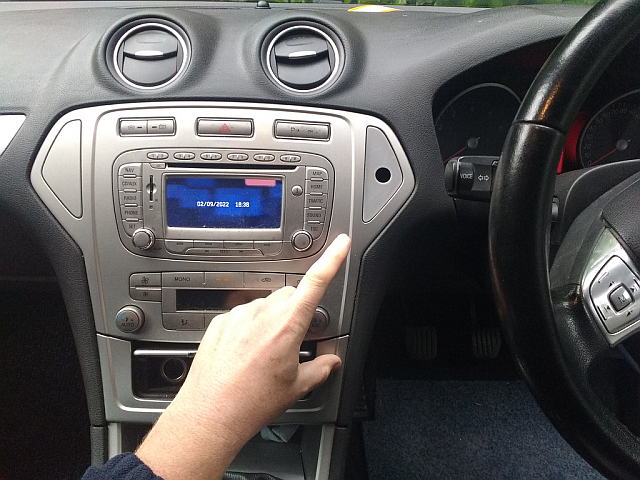
On my steering wheel I have 17 knobs, and one behind it. It looks just like yours. Just leave the (expletive deleted)ing gate open like the postman does. You got more knobs and slots on your radio.
-
Which heating and hot water solution(s) in 2024?
SteamyTea replied to Jane W's topic in Other Heating Systems
Because it can be done. But yes, probably not something I would do in reality. -
I Can Smell My Neighbors Cooking In One Of My Rooms
SteamyTea replied to Rehan Saeed's topic in Ventilation
I wish I was a teenager. I miss the ethnic cooking smells now I live down here, had a quick walk down Bierton Road in Aylesbury yesterday and I think there is more ethnicity than in the whole of Cornwall. Lovely it was. -
Which heating and hot water solution(s) in 2024?
SteamyTea replied to Jane W's topic in Other Heating Systems
Double the diameter of the ducts and you quadruple the mass flow rate, so could up that 10 40 W.m-2 for the same flowrate. I assume we use relatively small diameter pipework for ease of installation. -
Breathability in a conventional building; is it even worth it?
SteamyTea replied to Adaman's topic in Heat Insulation
This page on the Build Desk website explains it all quite well. https://builddesk.co.uk/wp-content/uploads/2013/01/vapourResistances.pdf -
Breathability in a conventional building; is it even worth it?
SteamyTea replied to Adaman's topic in Heat Insulation
The phase it comes out is important. If it comes out quickly in the liquid or vapour state then it is not that much of a problem, in the solid state it can cause damage to the structure. -
Breathability in a conventional building; is it even worth it?
SteamyTea replied to Adaman's topic in Heat Insulation
Porous or vapour open? Then there is absorbent as well. I wish I had more time and resources to study this area as the science is fairly easy, just getting the material data is hard. -
Anyone built themselves an outdoor sauna
SteamyTea replied to Adsibob's topic in Garages & Workshops
Not sure now as the Electrical Regs are updated quite often. There was a special section for 'hot boxes' in the 16th edition (the red book), saunas came under those regs back in the 1990's early 2000's. -
Anyone built themselves an outdoor sauna
SteamyTea replied to Adsibob's topic in Garages & Workshops
No. And you would not want to either. Get it wired up properly. Naked people, a few sips of vodka, a bucket of water and an electrical stove. Not a good mix. (I had to deal with two fatalities when, after a catalogue of errors, caused one of our saunas to catch fire. Remember I said about the thermal fuse and the timer, that was brought in after the inquests) -
One is a thermal source, the other is thermal resistance. Could combine the two, into a pie. Sing a song of sixpence, A pocket full of rye, Four and twenty blackbirds Baked in a pie. When the pie was opened The birds began to sing— Wasn't that a dainty dish To set before the king? The king was in the counting-house Counting out his money, The queen was in the parlor Eating bread and honey, The maid was in the garden Hanging out the clothes. Along came a blackbird And snipped off her nose. Sing a song of sixpence, A pocket full of rye, Four and twenty blackbirds Baked in a pie. When the pie was opened The birds began to sing— Wasn't that a dainty dish To set before the king?
-
Anyone built themselves an outdoor sauna
SteamyTea replied to Adsibob's topic in Garages & Workshops
They can only supply, safely, a 10A continuous load. 9 kW is a big sauna stove for a domestic. From the sizes you said earlier, a 6 kW at most. -
They will almost certainly be selling the same volume of electricity as they are buying in, so in accountancy terms, yes they are truthful. In reality, the electrons go to the closest load first, so in Physics terms, no they are not. As it is really about reducing CO2, it does not matter as it is the fraction of the whole that is important, not the sum of one component. You can see what is happening here. https://www.gridwatch.templar.co.uk/france/ It shows that other countries are taking/adding as well.