


SBMS
-
Posts
1075 -
Joined
-
Last visited
Everything posted by SBMS
-
Fabric and ventilation heat loss calculator
SBMS replied to Jeremy Harris's topic in Heat Insulation
Agreed, you need the input data (fabric data etc) to be correct - but the same is said for Jeremy's tool. From what I've seen the modelling software for MCS new versions is more accurate as it accounts for PSI values. The newer MCS standard also allows specifically for an Air permeability input (the below is Heatpunk's): There's a good guide that explains this: https://help.heatpunk.co.uk/books/heat-pump-task-and-system-performance/page/ventilation-calculations-in-heatpunk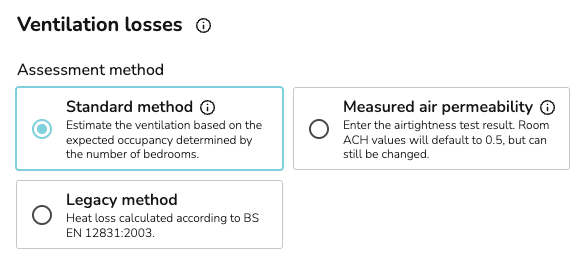
-
I ask because you said ‘my structural deck is IN the insulation’. It’s not. It’s above it. And in a warm roof it’d be under it.
-
Where do you think your structural deck is in your makeup?
-
Fabric and ventilation heat loss calculator
SBMS replied to Jeremy Harris's topic in Heat Insulation
I’d spend £300 on independent ‘MCS accredited’ heat loss and take that that to umbrella company for heat pump sizing. You’ll get the 300 back and then some if you get the grant! Prob end up nearly free. -
Let’s be super clear. It absolutely is a cold roof because your structural deck is on the cold side of the insulation. That’s the definition of a cold roof. You almost certainly cannot negate airborne moisture getting through. No matter how well you detail you will have 1mm gaps all over - eventually. Even if you detail it right on day one your timber will shrink and gaps will open up. So it’s not a ‘expert detail your way out of it’. like I said - If you have building regs on your build this is academic. You won’t pass with an unventilated cold roof. Why don’t you just ventilate it if you’re restricted in height? Not ideal or robust for flat roofs though…
-
Moisture gets through (diffuses) through all the imperfections I listed above. Your makeup is on a knife edge. Take the 25mm down to 1mm and it’ll still show as no condensation likely. Remove one or both those layers and you’ll see condensation. The 25mm isn’t magic. It’s only magic in ubakus because it models It as one homogeneous entirely diffusion proof layer. I don’t think it models air movement, only diffusion.
-
Not a vapour barrier - I was saying what Tony was saying in that you’re missing a roof covering which will be THE most vapour resistant covering in your makeup. in any event I think it’s because of the way ubakus calculates condensation. In theory if done as your makeup states: Absolutely airtight foil pir zero gaps at board edges, joist interfaces, fixings no service penetrations no ageing of tapes no screw penetrations no adhesive shrinkage no timber shrinkage no later on site adjustments no settlement movement in theory under the above then vapour transport is diffusion only. And diffusion through foil faced pir is negligible. Dew point is never reached at the deck - vapour cannot transfer from inside to outside so there’s nothing ubakus can see to condense. In practice - not possible. Also, not allowable by building inspector (for a reason - thousands of cold roofs built as per your makeup have failed) so probably a moot point?
-
You should put a very vapour resistant layer above the osb. Ubakus is calculating with no waterproof layer so it’s basic condensation analysis might assume any moisture can dry freely and quickly? it might also be because it’s assuming the 25mm pir under/over prevents any vapour transfer. On paper yes, in practice with imperfect airtightness, moving timber, gaps between pir this is totally unlikely. Even a 1mm gap over time will produce condensation and rot timbers… I suspect that ubakus doesn’t account for that. I bet if you switch that 25mm to 1mm it’s exactly The same. But remove the 25mm and you’ll see condensation. That’s ubakus simulating ‘gaps’ or vapour paths through the insulation (the timbers) which is your actually likely as built scenario….
- 77 replies
-
- 1
-

-
- flat roof
- condensation
- (and 2 more)
-
Sorry just seen the picture. You’ve designed a cold roof that needs ventilation?
-
I can’t see the other section orientation but the vented cavity shouldn’t be venting into the firrings void. The whole point of a warm roof is it is unventilated. But also, as etc says this wouldn’t be an issue if your cavity insulation carried on all the way up to meet the PIR…
-
Not necessarily true. Unilin approved a 150mm PIR warm Roof with 100mm of Rockwool. Showed an annual moisture accumulation of 0Kg/m2. I checked this myself on ubakus.de which showed the same. why is there ‘cold damp air’ in middle? Isn’t that warm side of insulation?
-
Fabric and ventilation heat loss calculator
SBMS replied to Jeremy Harris's topic in Heat Insulation
Use an MCS umbrella company? You can still get the grant but self install.- 204 replies
-
- 1
-
-
- heat loss
- ventilation
- (and 4 more)
-
Fabric and ventilation heat loss calculator
SBMS replied to Jeremy Harris's topic in Heat Insulation
@Great_scot_selfbuild @timhowes I too was nervous of my own calculations using the spreadsheet. It came out around 8.8kW. I then sanity checked and used the free and brilliant tool from Heatpunk that calculated 9.1kW. our MCS installer calculated 12.1kW and was nervous about suggesting a 12kW and was suggesting a 16kW (the range i am looking at is only available in 9,12 and 16. He was using the standard MCS spreadsheet which can overestimate and he had some slightly incorrect u values which was my fault. I then worried even more and so decided to get a heat loss done that was independent and mcs compliant for the installer. This cost £300 and it came out at 9.15kW using heat-engineer and he even modelled it in spruce and it came out at 9.36kW. Moral of the story is Jeremy’s calculator is good - but not foolproof and took me a couple tries to get right. Heatpunk is free, very easy to use and almost foolproof. Would Absolutely recommend you give it a try. and finally If you’re worrying or your mcs installer wants an independent one the company i used (it’s just one chap I think) was pretty good And fairly cheap. DM me if you want The name. -
Does aerobarrier negate need for airtightness detailing?
SBMS replied to SBMS's topic in Ventilation
Is it done after boarding or post plaster skim? -
2x air source heat pumps - Scotland
SBMS replied to BintyAndTheBeast's topic in Air Source Heat Pumps (ASHP)
I think that assumption is incorrect. The unit we are installing for example produces water temperatures as low as 5deg C. Put across a fancoil the outgoing air temp would be around 9-12 degrees. Traditional a2a fancoils produce 8-12 degrees chilled air so they are pretty much on par. This is notwithstanding others comments Yhat all pipes would need lagging to operate at this temp. But this is the same for a2a. An ASHP has the added benefit of slab cooling which is surprisingly effective because of its mass; and can cool at higher temps of circa 16 Degrees (therefore obtaining a better cop). This is the reason I went for the m series aquarea - It natively supports two zones to keep UFH above dew point but allows ‘proper’ air con like cooling in bedrooms for really hot days. -
2x air source heat pumps - Scotland
SBMS replied to BintyAndTheBeast's topic in Air Source Heat Pumps (ASHP)
Why is it a compromise out of interest? -
2x air source heat pumps - Scotland
SBMS replied to BintyAndTheBeast's topic in Air Source Heat Pumps (ASHP)
Fair enough but check if your installer is talking about the newer generation. The newer model is 33dBA at 3m for example vs vaillant’s 54dBA so not sure which spec sheets you were looking at with regards noise? -
To round it off maybe.. I think your position is intellectually coherent, but a section 75 claim is not a forum for debating where industry responsibility ought to sit. It is about whether the installer breached their contractual duty as one would normally understand it. It isn’t about whether the outcome is subjectively unacceptable, it’s about whether the installer failed to exercise reasonable care and skill in the service they actually provided. Notwithstanding the issue with poor sealing (which is unlikely to be the condensation root cause), In practice they’ll look at whether the door was installed correctly and in line with manufacturer guidance, and whether the opening and threshold construction were part of the installer’s scope or pre-existing building fabric. Your industry expert will look at whether a competent door installer should have identified the sub-threshold detail as unacceptable and either refused to install or required a thermally broken support. You’ve actually heard from a number of very experienced builders on here, a structural engineer or two and an actual industry expert that runs a door installation company. Whilst many have sympathised with you, none have agreed with your assertion and I think it likely that your industry expert will not find in your favour. I think it’s quite likely they’ll conclude the condensation risk arises from the underlying construction rather than a breach by the installer. It is though, a fairly low risk approach for you to take. Good luck and I am sure we would all be keen to hear back from you on the outcome.
-
I might be misunderstanding so just want to clarify… previously where this junction existed both sides were effectively warm? Ie one side was your internal house and the other side was a conservatory (heated?)
-
I think from this you’re hoping that because they’ve bedded it on silicone and packers that this is exacerbating the thermal bridging. It’s not. And I think it’s standard installation. What should have happened is your lower course of bricks should have been taken off and replaced with marmox, compacfoam etc. as others have said this isn’t the installer responsibility and they’ve installed as any installer would.
-
2x air source heat pumps - Scotland
SBMS replied to BintyAndTheBeast's topic in Air Source Heat Pumps (ASHP)
Your installer is incorrect and @JohnMo advice is best. We are installing a Panasonic aquarea (t cap) system That is pretty much exactly what John described. One heat pump outside (probably a 9kW would work for you). Inside then we have UFH on ground floor and 7x wall mounted fan coils (one for each bedroom plus landings). The fan coils are pretty much exactly what you would see internally with air conditioning. The fan coils provide heat from heat pump in winter. In summer the unit reverses and provides chilled water. This goes to the UFH slab to cool and to each individual fan coil. Each one is individually controllable. We have lagged our pipes feeding the fancoils so we can run this water very cold to produce very cold air (if needed). Others have said unnecessary and you can run above dew point but we are new build so easy to do now. Sounds like you’re doing a lot of work (ducting etc) so I would advise the same. Aquarea supports two zones and mixes to two temps so slab can be run above dew point. Aquarea also supports a ducted option with a large FCU and manifold exactly like air conditioning setup You want so You could do That instead of wall units. The aquarea ones are quite stylish though. I found a lot of installers only recommend what ‘they know’. I’ll be honest I’ve had to have Panasonic come out and walk my installer through it all because it’s not hugely common setup but is a lot easier, cheaper and does away with your planning issue. -
Im not sure I agree with your interpretation of the thermal imaging. That pattern could definitely be consistent with ground-contact brickwork below bridging cold up. Do you think then that this isn’t the culprit and it’s the frame threshold? Ie a manufacturer issue?
-
The installer is not responsible for the installation outcome in so far as its interaction with your existing building fabric. They are responsible for installing the door correctly - not for correcting or redesigning a thermally poor threshold detail that pre-exists the installation. Their response doesn’t seem great from a customer service perspective and as others have said they are responsible for foaming, sealing etc in so far as it relates to installation of their product. This will improve things for you no doubt. However, Unfortunately I think your camera shows the brickwork thermally bridging UP (not across the threshold which would imply no thermal break in the frame)… it’s a bit like fitting new tyres to your car.. you’d expect the fitter to balance your tyres and get the pressures right. But if your suspensions fundamentally out and the car pulls to the left: whilst it’s not the ‘installation outcome’ you’d like, It’s not the tyre fitters fault what they’re fitting onto isn’t fit for purpose..
-
Think I might do this. Not sure if dpm/dpc was taped…
-
You squirting this up behind the board you mean At the bottom? Is this needed if dabbed correctly? No one done airtight paint on the screed wall junction then?
