Mr Blobby
-
Posts
616 -
Joined
-
Last visited
Everything posted by Mr Blobby
-
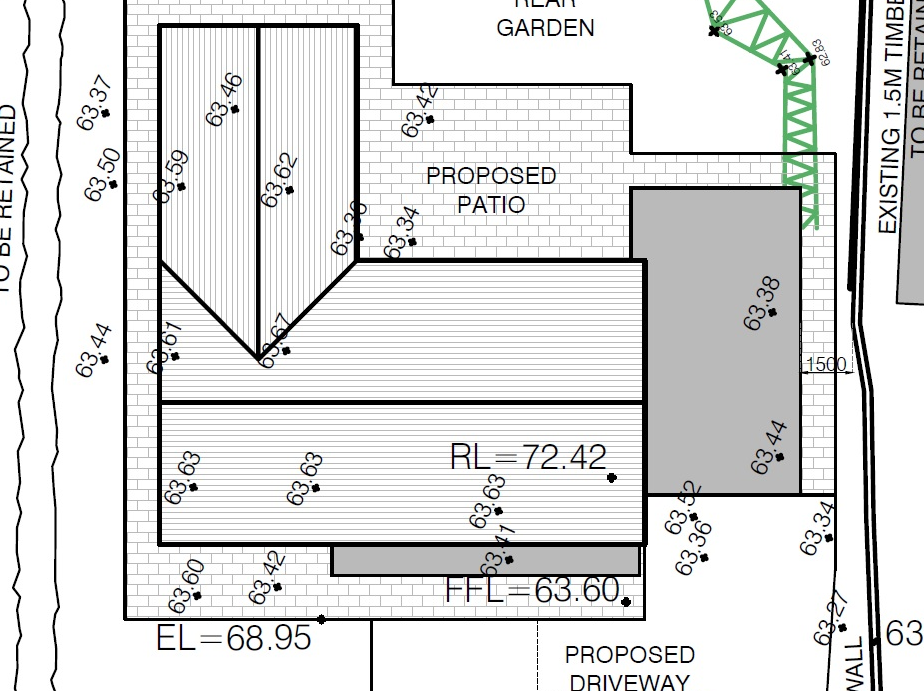
So things have moved sideways a little. Builder on site has suggested excluding the garage from the KORE slab to build the house first and then add the attached garage on a strip foundation afterwards. His reason is that this would leave room for a telehandler to get round the back of the build and remove the need for a crane. That side of the site also slopes away a little (about 500mm) and appears not to be on such a firm rock base as rest of site. Image in earlier post above shows garage attached to right hand side of house. On the face of it, building the garage on a strip foundation seems like a good idea. Is it? Has anyone else built a block structure with part strip foundation, part KORE foundation? Of course I will raise this with my SE but very interested in feedback here as I have no idea if this is a stupid thing to do.
-
Thanks for this. Others on this forum have attached the window to the outer leaf of a cavity bllock construction, which I like but I think would eliminate the cavity closers. Which is probably not an issue.
-
Where the cavities are closed, and the window is in the cavity then what do you attach the straps to? The inner leaf reveal?
-
My QS emailed me with scope of services, prior to engagement, to include cost estimates. He then refused to supply any cost estimate when asked to do so. I will be asking him to return some of my fee (fat chance) and referring him to RICS. Legally this would be either misrepresentation or breach of contract, take your pick!
-
but the RICS code of practice should stop this and doesn't, so its a lottery. I'll be complaining to RICS of course, not that it will do any good.
-
So just to finish this off.... At the start of the year the M and E tender package was really late (and still is wrong) and I was explicit in my requirement to build in May. The QS insisted I wait until the M and E was ready. No suggestion of excluding the M and E to tender to watertight instead. Which would have been perfect. When I told the architect in April to exclude the M and E from the tender he said the QS didn't want to do two tenders so we should continue to delay the tender and build. (ie serve the QS interests over mine) When I insisted in May the tenders go out, the QS insisted on inserting M and E that was wrong so the responses would be pretty useless. When I insisted again to request quotes to watertight the architect said the builders wouldnt like that. When I said a watertight approach would be best because I wouldnt accept 30% mark ups on M and E from builders for inflation the QS said a phased approach is not possible and builders are entitled to price in inflation risk. Just before the tenders came back I asked the QS in a zoom meeting with he and architect how much he thought the build would cost me and if he would give me the estimeate he promised in the engagement email. He refused and after some prodding he totally lost his shit. The architect is suspiscousy supportive of the QS 🤔 When the tenders came back the prices were ridiculous as expected with the M and E way overpriced and the specification wrong anyway. So a completely useless exercise. I asked the QS if he was going to provide some guidance on the wether the tenders were reasonable and offered good value. He said no. He said I should accept the lowest offer without scrutiny or question, which is conveniently from his local builder that he introduced to the tendering process. A builder that became available after the delay the QS created. So, the QS gave no cost quidance or estimate. He caused six months of delay. The tenders went out with incorrect M and E specification instead of build to watertight. His only guidance is to accept the lowest offer from his preferred bidder. He put no price to anything. He provided no value at all, just advised me to accept the lowest tender without any cost analysis or estimate of builder's profit margin. ... and that pile of zero value shit and months of delay to my build cost me £3,750. My advice is don't get a QS. Mine was a charlatan. A waste of money that has delayed my build start from May to August.
-
Yes, they have this detail already.
-
Good point. Will do.
-
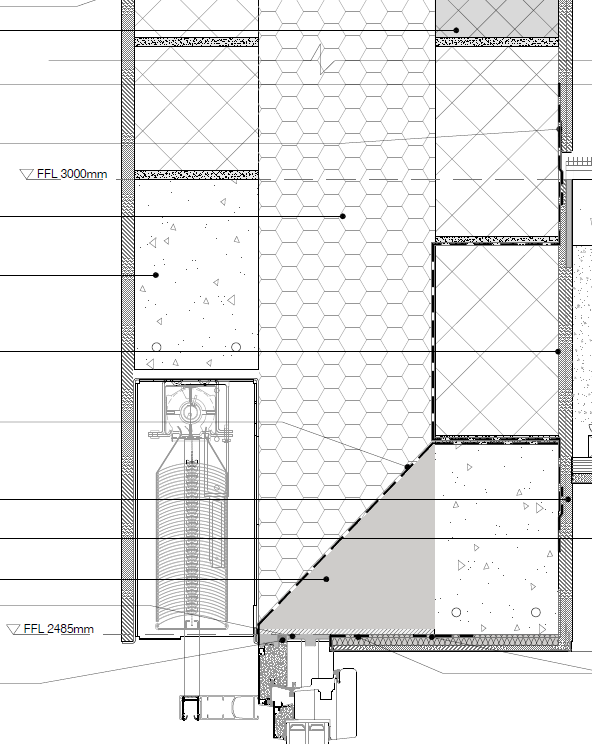
Do you mean 'you would not use check reveals' I can see how the guide rails wither side of the window would need to be at the width of the blind wich is likely the width of the window? So we think the blind box would go in the outer leaf, which would need to be 140 block to match the (modulo P) blind box depth. The outer leaf would be constructed higher than the inner leaf to accomodate the blind box height. Like this: So the wndow formers on the South/west windows with external blinds would be different heights for inner/outer leaf of course. AFAICS check reveals wouldn't work at the sides because the blinds require the full width of the window?
-
I'd really like check reveals. Architect is less enthusiastic. Not sure if check reveals would work with external blinds 🤔. Anyone done this?
-
What about cavity closers to make the formers like this... https://www.eurocell.co.uk/data/downloads/eurocell cavalok brochure_lr.pdf Good idea or oversold crap?
-
Not internorm then! I'd assumed that the former would be some kind of temporary window frame to build around, is that about right?
-
Good point. I think here in Northern Ireland choices are limited. We also want external blinds so easiest to order with windows I think. I'm open to suggestions. Anyone have Gaulhofer aluclad upvc with external blinds? Or are the Gaulhofer external blinds available only with the timber framed windows? Are these window formers really a thing?
-
I'm told that Internorm have a 6 month lead time for aluclad upvc and that I should order windows now before building my block house even starts. But what about sizing the windows? How is that done if there's no house to measure? My architect tells me that formers are used to create a dummy reveal for the bricklayer's to build against to get the window sizing correct. I've not seen this before, is this correct, and anyone got any pictures? (have told architect not to assume that internorm are the only horse in the race)
-
Just checked Balloo. There's a 3t limit on the holiday offer so that's £308 for the week. Which would normally be £531. update... Balloo can't deliver tomorow. boo 😒 That's a good price but this is not a 6 day job is it? Darling wife wants a trip away.
-
Are you suggesting I drive the digger myself? That would be entertaining 🤪
-
I think you're right. A local grave digger dug the NIE trench for me. I'll try and get him back on site. Hopefully nobody's died this week and he'll have some free time.
-
Which is what I would like to do. but this is my concern too, if some of the hardcore base is on rock with some of the hardcore base on clay soil then would there be catastrophic soil heave on part of the foundation. Not an engineer so may be worryaing about nothing I fear this is probably the only way to be sure but the ground is mixture of hard clay and stones, not easy to dig at all. May need to get a digger in. To get an idea of the layout, here it is with some topo levels. The site is pretty flat, dropping away at the back of the single-storey garage, where it may be less likely to be on rock but also far less load on the foundation. If that makes any difference 🤔
-
So what's the choreography here? Can't place order with KORE until SE has been on site. (theres about 450 drop at one corner of build) SE won't come out until excavation has started Can't start excavating foundation until the KORE slab is ordered I'm stuck in a loop...
-
Should have got Hilliard Tanner to sort this out... sleep walked into the architect directing his SE to do the work without me knowing. Oh well.
-
So now that the demolition is done (and from having issues getting earth rods in) its pretty clear that our site sits on a layer of rock about 400 below the surface. Before the groundworks tidy up the site and excavate down for the KORE slab, however, the amount of rock and soil condition is hidden from view and largely guesswork. And there's my dilemma. I think. Do I need to get a ground survey done now to see what I'm dealing with, or press on with the ground works and excavation for the KORE slab, breaking the rock out to go down the depth required for the 500 hardcore? Generally speaking, is it a problem to have a KORE slab on (hardcore then) rock? My architect insists I don't need any sort of ground survey and neither does the SE need to come visit the site until after ground works is under way. Am I worrying about this too much?
-
Which size, they all seem to be 15mm on the small end. So would I need something like this too... https://www.screwfix.com/p/flomasta-compression-adapting-male-coupler-15mm-x/69358#product_additional_details_container
-
So after demoloishing the old house I have a half-inch copper pipe in the gorund that I would like to rig to a temporary stand pipe. Nothing fancy that has to be signed off by the water company, just a plastic pipe to a bib tap. Being totally clueless about pipe sizes and fittings, what do I need to connect the half inch copper pipe to a few metres of plastic pipe (so that I can bury it to the boundary) and then a bib tap for the other end of the plastic pipe. So I need the connector, the plastic pipe, and a bibtap. Which products do I need to do this?
-
Why grout in place with cement slurry? Is it conductive? Does it make a big difference?
-
Thanks for this, an obvious (now that you have told me) way to avoid a crappy hockey stick and meter box in the cavity. After speaking with NIE, they said no to an external meter box which I was surprised about. And of course they don't allow kiosks. So the plan is (and NIE's standard advice it seems!) to build an extra leaf of block on the side of the house and outside the insulated foundation at about 1500 wide by 1500 high and about 400 deep. The permali box will be recessed into this.