Kelvin
-
Posts
4081 -
Joined
-
Last visited
-
Days Won
48
Everything posted by Kelvin
-
Gravity fed or pumped chamber to drainage field?
Kelvin replied to flanagaj's topic in Waste & Sewerage
Ah right the thing they call the +O module. Ask them for the technical specs it will possibly have some details on how quiet it is. Presumably it also switches on/off to pump the water. To some extent something switching like that can be more annoying than a constant hum you might get used to. Depending on where the tank is you could screen around it with something. -
Gravity fed or pumped chamber to drainage field?
Kelvin replied to flanagaj's topic in Waste & Sewerage
If you mean the Graf One2Clean with the blower unit then it can be sited remotely from the treatment plant by up to 20m (from memory) You could also build it into a small shed of some sort to deaden the sound. They do a green plastic housing for it which is what we have. It’s not noisy but you would hear it if it was close to your garden sitting area or an open window. It’s a gentle hum that comes on and off. Like I said before what makes more noise is when the air ram pump is emptying the water assuming you fit an SVP at the tank (which is their standard install) You can hear the water bubbling out of it. -
All sounds contentious so it’s going to be a hard few months. Without a physical barrier there is likely going to be damage. Heras fencing will just get moved and will likely be banged against your house. I can almost guarantee that they will use your wall to lean stuff against. Site boarding fence as close to your wall as you can get. That should still give them space to work and protect the wall.
-
What a pain in the arse.
-
Norrsken - Let them airtight tape or do it myself?
Kelvin replied to boxrick's topic in Windows & Glazing
It’s not hard to do yourself and you will take great care over it. How confident are you they will. It will take you a while though so plan it in if you’re doing it yourself especially if there are any follow on trades that need it done before they can start. -
Quite a few of the wells and hill water sources around us have dried up too. None of the boreholes have though. We sit in the Strathmore valley so has water running into it from everywhere so it’s not very likely we’ll have problems. Our burn, which runs down into the valley, also never stopped flowing but it was the lowest we’ve seen it. I reckon for as long as it runs with water our borehole should have water in it. My reason for wanting to measure it is to inform our water usage. We’ve got our water usage down below 100l per person recently. We have a water softener for example that uses a lot of water when it regenerates. I’ve switched it off during this dry spell. I don’t necessarily need to measure it to change our water usage of course.
-
Buildings have protective sheets attached to them for months, years in some cases. If the scaffolding is going to be on your land then it’s going to be very close to your house so won’t they have to fit a scaffold sheeting down it anyway like they do when it’s on the street? It’ll be the scaffolders that will hit your house if it’s so close so be mindful of that. I still think dust sheet from your fascia, scaffold protection, and try and get in site type boarding/fencing which is typically just painted OSB. Then agree how any damage will be remediated in writing.
-
If it hits 60m it will stop pumping. I agree, all the holes near us are deep (80m+) and if they run dry it won’t just be us in trouble. I had that very conversation with my neighbour the other week and we agreed fretting wasn’t worth it. A week later I was chatting with a builder who has a 120m deep hole and it has run dry this summer for the first time in 10 years. It also wrecked his pump. Ref the probes. I didn’t know any better. I thought water probes at different levels connected to a control board were standard as the two quotes we got included them. None of our neighbours have them and their pumps are a metre from the bottom of the hole. But then some of those boreholes were put in by a guy that works on his own.
-
Is the existing fence coming down and the scaffold will be on your land? I’d just fix a dust sheet to the fascia and weight it at the bottom.
-
Consumer Unit - First Floor Location?
Kelvin replied to Duncan62's topic in Consumer Units, RCDs, MCBOs
The general principles are that new dwellings should be designed to allow people with restricted reach etc to be able to access and operate the facilities in the house. While the regs don’t specifically say you can’t as far as understand it, it would seem to not meet the general requirements of accessibility if it was on a first floor. Why isn’t there a location on the ground floor? -
Scaffold protection sheets the full height of the scaffold. Have them pay for a temporary fence to run the full length of your house. Assume it will get damaged and agree now in writing what the remedy will be. Patching a repair might not look acceptable to you and replaced cladding might not match well.
-
We had two analysis done one when it was first drilled and after it was commissioned and another 6 months later but haven’t since then. You can buy water test strips. I have a comprehensive kit of them so test it every month. We can measure water use and water pressure as we have a DAB pump that has a Home Assistant integration. The DAB pump alerted me to a leak a while back as it notified me that system pressure was falling and it was repressurising it periodically. Turned out to be a crack in the body of the external tap. The only other thing I’d have liked to have added to monitor is where the water level is in the borehole as that has changed from when it was first drilled and particularly during the long dry spell. We have water probes at different levels in the hole connected to the control panel at 10m, 20m, and 60m with the pump at 80m. After 9 months we had to rewire it to disable the probe at 10m as it kept setting the alarm off. The original water level was at 1.2m bgl so this has dropped several metres.
-
Yes of course. Apologies, I wasn’t very clear. What I meant is the Zappi is installed at the meter on a short cable run rather than elsewhere in the house. The transformer is on the next pole adjacent to the pole I’m attached to. There seems to be a nominal 3V difference between what the inverter shows and what the Zappi shows. Measuring using my multi-meter and it matches the inverter.
-
The mains cable is only 23m from the overhead line to the meter cabinet and this is being measured at the meter tails. I’ll set up Shelly and have it measure the V at the CU to compare. I have a 12kW inverter and I had it set to charge at 8kW although I’ve settled on 5kW for normal use.
-
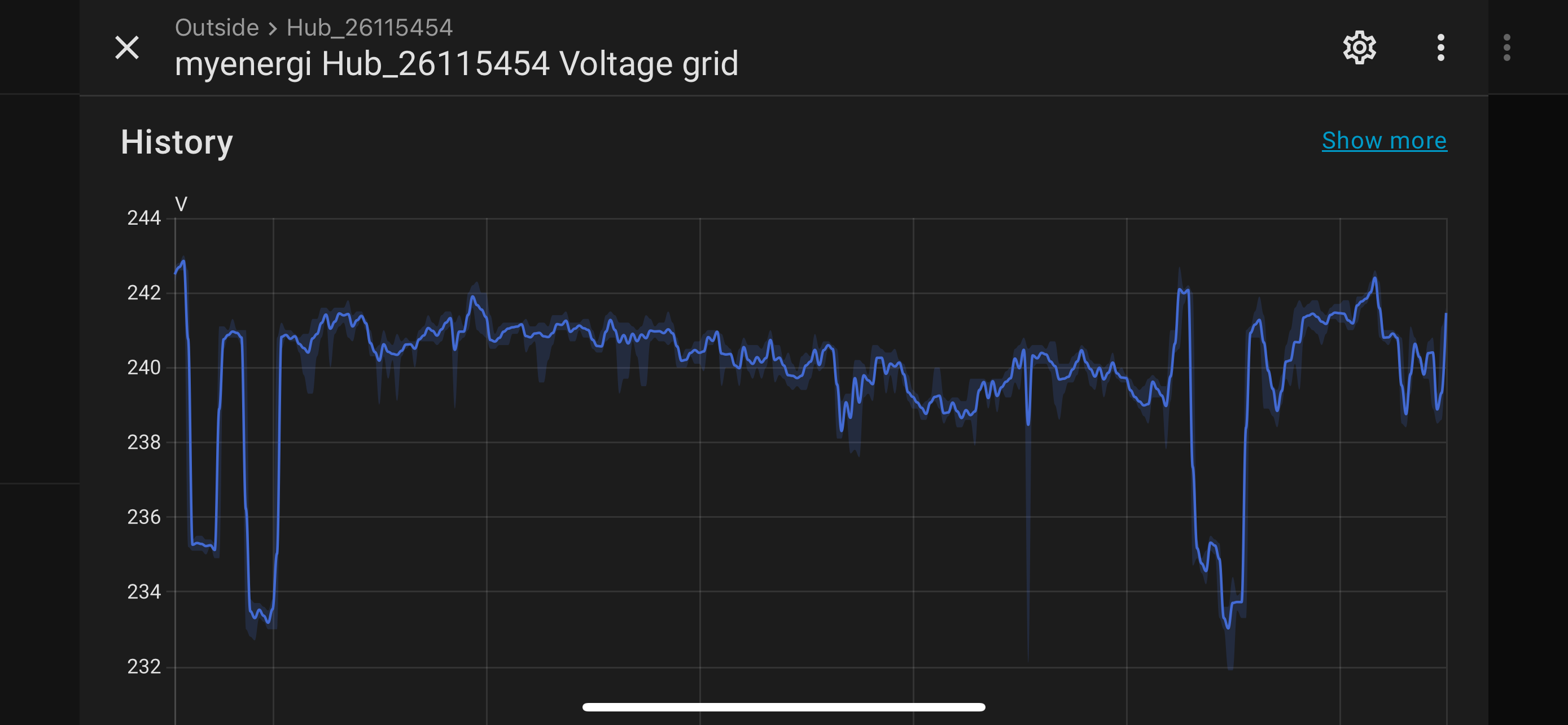
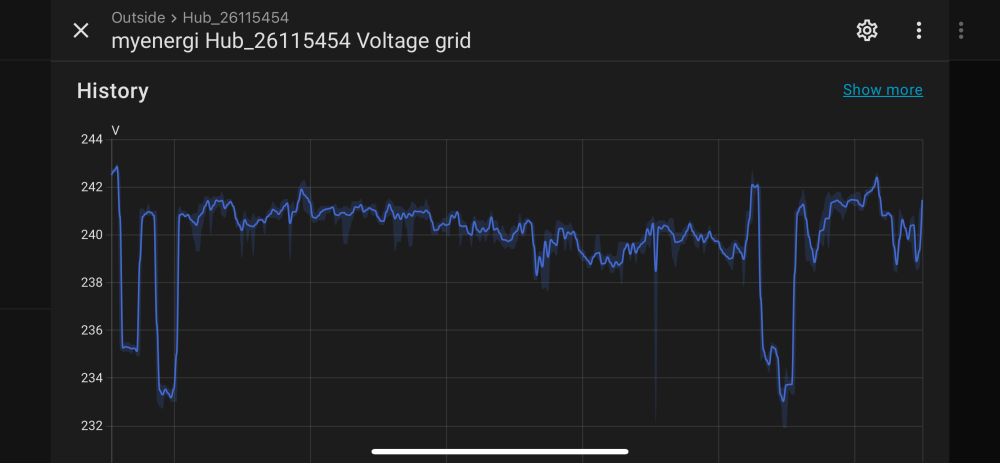
The AC voltage at the inverter is slightly higher than what the Zappi is showing. The Zappi is reading this at the meter. The drops (sag) is me initiating charging the storage battery as I was testing being able to control it and automating it from Home Assistant. I’ll check it again tomorrow as it will be a slightly better day for solar generation.
-
Solved this in a different way. The Zappi tracks the voltage as a diagnostic in Home Assistant.
-
Yes Home Assistant refers to readable outputs as sensors. I rummaged around in my box of stuff and came across a Shelly energy meter so that should allow me to monitor it.
-
Openreach new fibre connection
Kelvin replied to flanagaj's topic in General Self Build & DIY Discussion
Yes they may have well said ‘noted’ I will have a similar challenge I expect. There are two potential routes to getting the fibre connection into our house. One is down the road boundary some 60m and across the drive to a duct I already have (or I extend the duct to the road boundary. The alternative much shorter route brings it in within a few metres of where they will likely terminate it on the road. The contractor said they were looking to put a kiosk on the verge by our boundary. It’s also conveniently near a 12ft gate into that part of our plot. I could dig a trench from there to behind the retaining wall and they fit their external junction box to that wall (no different to fitting it to a house wall) We then take the cable from there into another duct I happen to have behind the wall that goes into the garage and they fit the ONT inside the garage. I can’t see that being acceptable though. -
Neither of the two types I have provide a voltage sensor.
-
It’d be more than annoying if it was shutting my system down due to over voltage. I might start tracking mine. While the inverter displays it as a sensor it doesn’t track it (just real time) and I can’t see that it’s exposed in Loxone or Home Assistant which is a pain.
-
I’ve checked it in a few different houses in various parts of the country and never seen it above 250V.
-
Ours varies from 245V to 240V typically. Last night it peaked at 245V at 4am and it’s currently 242V with minimal PV generation. These values seem typical and yours seem on the higher side.
-
dimensions on planning as opposed to reality?
Kelvin replied to mjc55's topic in Planning Permission
I had a chat with our BCO about this although it was more about escape window height off the floor. We were inside the regs but I asked him if the cutoff was a hard line (1200mm as I recall). He said he applies some leeway (not everyone does) but at some point he has to say you’ll need to change that. Therefore you build to your plans and the regs. Build slightly outside of that and you might get away with it and probably will but what if you don’t. Could be a disaster for a relatively minor benefit. You can also make a non-material amendment as mentioned above. -
I used the 38mm diameter black hockey sticks. The white ones are smaller (32mm I think) In hindsight I should have just continued the ducting in the ground up into the kiosk for house supply as the cable was 35mm2 so only just fitted but it took several goes.
-
Buy a kiosk (would suggest a 3 phase kiosk even if single phase supply) and mount it on a concrete pad. Fit it with three ducts (supply in, cable to house, and a spare) For the ducts Have the meter installed in it, a small CU and some sockets. That’s your temp supply. When it comes time for your permanent supply you remove the small CU and sockets, fit an isolator and run your house supply from it. Or get a small brick kiosk built as you suggest. Make it quite big. I’ve ended up with two kiosks as the EV charger supply is installed directly into the meter cabinet but this needed a small CU and because of the large isolator there’s no space in the original kiosk so had to fit another smaller one. Just think carefully about the cable run from housing to the house. You want it to be as straight as possible and as close as possible to wherever the CU in the house is going to be. I got that massively wrong with ours and placed the kiosk too far up our boundary but this was a year before we’d even finalised exactly where the house was going. It caused me a bit of grief when we came to pull the cable up to the kiosk from the house. Took my wife and I a full day!