


Kelvin
-
Posts
4085 -
Joined
-
Last visited
-
Days Won
48
Everything posted by Kelvin
-
To contract or not to contract
Kelvin replied to Jimbo37's topic in New House & Structural Warranties
This is how I’ve agreed the groundswork. We have the various stages written down and I pay after each bit is completed. We don’t have a contract in place. -
Just to add. My other reasons for questioning including a softener is that they waste water via the regeneration process and I’d be flushing the salt solution into our sewerage treatment plant. I know they are supposed to be able to cope with it.
-
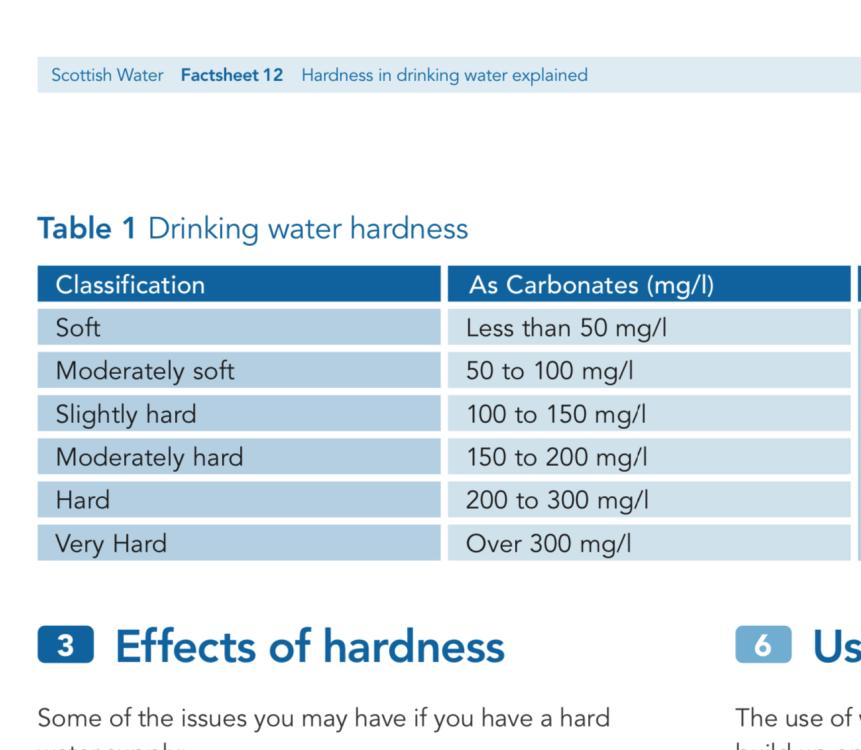
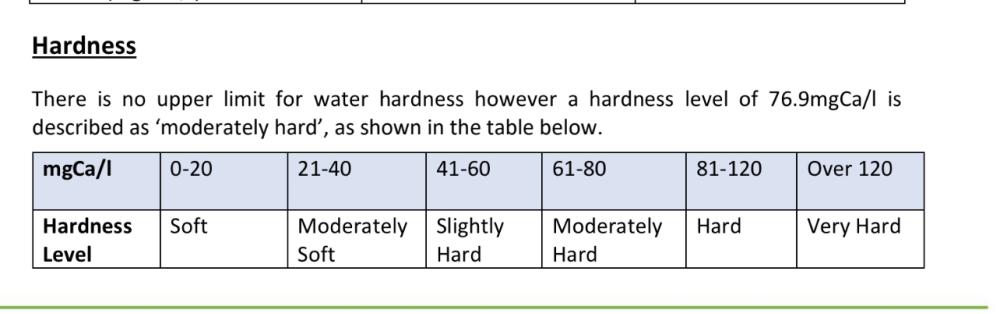
What’s confused me is this. Scottish Water consider it moderately soft. It was the first water company that said it was moderately hard. They have a different scale below. https://www.scottishwater.co.uk/-/media/ScottishWater/Document-Hub/Factsheets-and-Leaflets/Factsheets/250221SW_FactSheet_12_2020V8webPages.pdf
-
Our water supply is going to come via a private water supply borehole. The water analysis says the water is moderately hard at 76.9 mgCa/l using a scale the first private water company provided me. I’m currently looking at the treatment plant requirements. I’ve had three companies provide designs and quotes. Two of them have said it definitely needs a water softener. The third has said the hardness level is below the minimum level where they’d recommend a softener. Therefore I need to decide whether to fit one or not. The cost isn’t too bad at £515 for the equipment. The slight complication is that the treatment plant is going to be in the detached garage so my plan would be to have two water supplies to the house one for the softened water that feeds the plumbing and a raw water supply to a single tap in the kitchen for drinking water. Clearly it’d be easier if I didn’t fit the softener. So the question is should I fit the water softener or not? I think I should but value other opinions. As an aside. I got three quotes as I said. The dearest quote was £23,000 ex VAT! from a well known Scottish private water company. They charged the farmer £18,000 to drill the hole (it’s deep at 147m) The other two were under £10,000 as a like for like comparison for the same treatment design and pump.
-
Quotes for ASHP install. BUS ?
Kelvin replied to Post and beam's topic in Air Source Heat Pumps (ASHP)
In England yes and you can see why it’s being abused. The process is slightly different in Scotland. -
I hope so. We had more a bluey grey in the previous house, RAL 7043, and it faded very quickly.
-
Our larch is getting treated with the clear SiOO:X stuff which will hopefully silver very uniformly. We’ll see. But the anthracite goes with the silverisation colour really well. Inside is clear lacquer everywhere other than the front door and coupling vision panel which will be dusty grey.
-
Yeah it’s kinda like British Racing Green. Even considered doing the metal garage the same colour for the agricultural look but it’s also going to be anthracite. 😂
-
Had we been braver we would have gone with moss green (RAL 6005)
-
7016 is anthracite. My sample definitely isn’t anywhere near black as I also have a black sample.
-
Contact appliances direct. They sell A2A systems and can arrange installation. The quote I got was pretty good but unfortunately they don’t offer installation in Scotland.
-
Check your maffs. 22kW/230V = 95.6A This is the reason the sparkie has said he needs 3 Phase as 3 x 7.2kW could be used simultaneously even assuming you applied diversity to everything else.
-
All you need to ask the electrician is to show you his working to calculate your load.
-
Sure but I’d question the ‘need’ for 22kW charging at home. The vast majority of home owners won’t be able to accommodate it because it requires 3 phase and that’s not typically readily available. 22kW isn’t fast enough for en-route charging either so there’s not much advantage there. It is less expensive for companies to install a 22kW AC charger vs a fast DC charging point so there’s some advantage for destination chargers to offer it. I’m not suggesting that future EVs won’t be able to charge at 22kW AC but I am struggling to see that the demand for this is being driven by folk wanting to install it at home.
-
I’m unconvinced by this argument. What you need to install is very much dependent on the miles you drive every day. The average daily mileage in the UK is relatively small and getting less with each passing year. Therefore the vast majority of people don’t need to charge their cars every day. You also don’t charge to 100% generally either. Therefore a typical 2/3 car household could easily survive with one 7kW charger given that you probably can get away charging each car 1-2 times per week. We’ve done 29,000 miles in ours in 18 months and get by with the slow mobile charger. Sure multiple 7kW or a 22kW would make life easier but I don’t agree that not fitting either would necessarily mean visiting DC chargers more frequently as we don’t do that today. Batteries might get bigger but it’s more likely they won’t for your average EV if say solid state batteries become the norm. They could offer similar density to current batteries that are smaller and lighter making the car smaller and lighter improving efficiency and range for a smaller footprint. We’ll still see larger batteries in the luxury end of the market. Of course by all means future proof your house. I made the decision not to install 3 phase due to cost but did put in ducting to the kiosk that could accommodate it in the future.
-
You might be fine. It depends in whether they need to do any reinforcement works which can be really expensive. That said there was a post on here a while back about a change to policy whereby the poor self-builder doesn’t need to fund the reinforcement. Worth searching for it.
-
In the example above it’s apparently an unofficial pole that BT purloined so who is going to come after him. If it’s an official pole/stay then you’ll probably need to pay for it or maybe not depends on the company.
-
I’ve had several suppliers say they’re putting prices up this year. They delayed as much as they could last year. Now it might be a ploy to get me to sign up with them of course. I’m still being told that folk are mega busy. No one has stopped by my plot looking for work that’s for sure. Maybe I need to wear tighter workwear.
-
It’s used mostly by self-builders and renovators. You don’t tend to get many of those side by side so. It might well age but avocado bathrooms are back in fashion
-
Sure but it’s all part of your due diligence when buying the land. You spot the random extra cable ask farmer what it is he tells you it’s a BT cable you find out history and advise your solicitor about it and put it into the offer. It’s what I did anyway. It’s easy to miss something of course. I missed a random pipe that enters our field at the burn because it was overgrown with gorse. From the deeds (when I eventually got them) it described it as a source of spring water for the drovers to use for their animals that I needed to maintain. Obviously no requirement for me to do that as we’d bought the plot and it’s use changed so irrelevant. However once I cleared the gorse I could see it was now an overflow pipe for the drain on the road. I’ve since found out that the farmer diverted the course of this spring water many years ago so it doesn’t come anywhere near us now.
-
Your problem is that they have been there a long time and you purchased the plot knowing they were there etc. It’s something that should have come up during conveyancing. You could have made it a condition of sale that he dealt with the cable
-
To be clear. The Buildhub forum is open and google searchable so anyone could find this discussion. It’s a tiny risk but just be aware of it.
-
This situation happens a lot round us and there are a lot of accidentally knocked over poles. It’s easy to do on a building site after all. Just be absolutely sure on the facts around pole ownership etc. Also be mindful that this site is open and google searchable…
-
Flat roof top coat EPDM, GRP, Liquid Polyurethane?
Kelvin replied to Warrentdo's topic in Flat Roofs
We’re using Alwitra Evalon V -
Yep and exactly what ours is going to be 😂


