garrymartin
-
Posts
553 -
Joined
-
Last visited
-
Days Won
7
Everything posted by garrymartin
-
 Agreed, but we don't live in that same world. The number of dwellings required has increased significantly, as has our understanding of the environmental impact of them being built and being used. We need control. Despite my disagreements with the opinions of my Planning Officer and the Inspector, I'm very supportive of the planning system as a whole. The problem is that much of it is still unclear and remains inherently open to interpretation. What is needed, IMHO, is unequivocal tests against policy items that seek to remove interpretation and opinion. Take my favourite paragraph as an example; "Significant development should be focused on locations which are or can be made sustainable, through limiting the need to travel and offering a genuine choice of transport modes. This can help to reduce congestion and emissions and improve air quality and public health. However, opportunities to maximise sustainable transport solutions will vary between urban and rural areas, and this should be taken into account in both plan-making and decision-making.” I think the principle of that paragraph is sound - don't build large developments in areas that aren't or cannot be made "sustainable". The problem is that although "Major development" is well-defined as 10 or more dwellings, "Significant development" has no such definition. Can a single dwelling really be classed as significant development? If not, then in language terms, the remainder of that paragraph should not be applicable, but it is routinely used to refuse permission on very small (less than "major") developments. Even "sustainable" - the golden thread that runs throughout the whole of the NPPF *isn't actually defined* within the document itself!
 -
I understand where you are coming from, and the sentiment remains valid, but the facts are somewhat different. The LPA *does* make it clear that approvals won't be given outside of defined development boundaries except in specific circumstances. As the plot is outside of the development boundary, it is classed as being in the "open countryside" despite it being the garden of an existing dwelling. It doesn't meet the specific circumstances where approval might be given. I knew this and the LPA and I agree that this is in conflict with policy. However, they couldn't demonstrate meeting their legal requirements concerning Self-build and their 5-YR (4-Yr now) plans are failing. Hence, the "tilted balance" is applied and although building in the "open countryside" would amount to harm, it has to be balanced against the positive aspects of the proposal. The balance is whether the harms "significantly and demonstrably" outweigh the benefits. I don't feel they do, but then I guess everyone applying for permission and appealing a refusal would think that... 😉
-
300 new planning officers proposed through charging higher stamp duty rates for second properties and foreign buyers I believe - something like that...
-
This is an interesting one for me, but also a worry. My own Local Authority in their new Local Plan (currently at Regulation 19 stage) will be pretty much mandating near-Passivhaus levels of building performance. But if that's not mandated at a national level, I fear it will mean the volume housebuilders will concentrate their efforts, at least initially, outside of my Local Authority and when that Local Authority is then well behind on their targets, will effectively hold them to ransom about their *local* requirements for building performance...
-
I believe 50mm is the minimum separation (not 100% sure) unless the network cable has the same protection characteristics as the mains cables. 300mm is recommended though.
-
Awesome response Alan - can't disagree with anything; great ideas! On a personal note, following my dismissed appeal, evidence is a key one for me. The Inspector made several observations that were clearly opinions and yet used that to substantiate their decision. They clearly don't know that "demonstrably" in relation to harm is not about opinions but means they actually have to provide evidence to support the observation.
-
6. Force development companies to start building on their "land banks" or compulsory purchase them and return them to other housebuilders / councils / small developers.
-
I don't think the intent was sockets at skirting level, but running cables behind the skirting. In order for that to be compliant, I pointed out that they would need electrical sockets of some sort at that same level to create a "safe zone".
-
There is, but they are distances measured from the floor level so the ceiling height is irrelevant.
-
The Conservative Government scrapped mandatory local targets and introduced *advisory* local targets. The Labour Government plan to reintroduce mandatory local targets. Planning and Housing related elements start at page 36 in the manifesto at https://labour.org.uk/wp-content/uploads/2024/06/Labour-Party-manifesto-2024.pdf
-
We have 2.7m ceilings in our architect brief. Not only do I think it looks better, it also allows a dropped ceiling from the 2.7m where you either a) want to install something (Fan Coil Unit in the entrance space to bedrooms anyone?) or b) want to differentiate a space (open plan areas, lighting features). Russell is spot on. Also, I wouldn't personally choose to run behind a skirting, but if you do choose to do that, you must "create" the safe zone by installing some sort of electrical socket in line with the skirting void. Having said that, it is likely to look terrible if you do! 😉
-
CAT6A is not that more expensive, and I'd look to use it for data and HDBaseT/TV locations as a minimum. CAT6 would be fine elsewhere, especially for signalling-type activities in home automation. I put the CAT5 cabling in my existing house 25 years ago and I'm happily running 1Gbit connections over it today. It was the best standard available then, although I certainly didn't *need* that cable performance back then. Had I put something else in that was cheaper though, I doubt it would have lasted 25 years.
-
That would be my first guess - the cable termination is passing power but not data. The other thing to be aware of is that there are different PoE standards and power levels, and they can be affected by cable length, but I would expect "half the house length" to pose any significant issue to any of them.
-
In years gone by... 😉 3 kW per house as peak load in a village might have been fine, given not everyone will use 3 kW at the same time, but there is no way that sort of capacity is going to support a move to more extensive use of electric vehicle chargers, renewables and low-carbon technologies such as ASHP/GSHP, and the supply company should certainly know that - i.e. at some point they will have to put network reinforcements in place. Stand your ground on your supply requirements if you have a robust case and remind them that it is their responsibility to reinforce the network to support those requirements.
-
Hello! And, err... our appeal was dismissed :-(
garrymartin replied to garrymartin's topic in Planning Permission
I understand where you are going with your commentary, but that statement is just not true. In many rural areas, bus services have been stopped due to cuts. Is that an effective way to stop any further rural development? All of this is a planning balance judgement, and different groups are treated differently. For example, Traveller's Sites don't *have* to be in a sustainable location; it is accepted that they will primarily use a private motor vehicle because the locations where they are typically sited (and where people are typically happy for them to be sited) generally have poor access to services. It is allowed despite this because it is important for Traveller's children to be able to get to School etc. and the private motor vehicle provides one of the few ways of enabling that to happen. -
Proposed network initial cable plan
garrymartin replied to CalvinHobbes's topic in Networks, AV, Security & Automation
You've got the right idea - run an excess of cables as it is inherently cheap compared to trying to run an extra one once all the finishing is done. You don't need to terminate them right away. I'd expect a requirement for more than one PoE camera externally to be honest, but I don't know your situation. As @SuperJohnG notes, run a couple to an external location at the front and back of the house for external WiFi access points you may want/need in the future. Don't install just one at each TV point though - I'd recommend at least two and probably four. You only really need one cable for decent access points - they can take their power and data over a single cable with PoE, so I'd run cables to ceiling locations in every major room where you might want great WiFi coverage. It's easy to connect multiple switches together and you are unlikely to need the high-speed switching backplane that would differentiate a single 48-port switch and connecting two 24-port switches, so I'd probably advise looking at a 24-port switch to start, with the requisite number of PoE ports in it to provide power to your PoE devices such as cameras and access points. I work in IT and have hard-wired TVs, cameras, a NAS that has 4 x 1Gb connections, and various other physical devices including my Mac Mini and a desktop PC that are also hardwired, and I don't have more than 24 active ports. I do have 3 PoE access points though that provide WiFi connectivity for a whole host of devices, including all the laptops, tablets, phones and home automation devices. -
Hello! And, err... our appeal was dismissed :-(
garrymartin replied to garrymartin's topic in Planning Permission
Dave, I can't tell you how frustrating it is to have the only reason that the proposal is refused to be on sustainability grounds when I almost exclusively work from home, have shopping delivered, rarely access public services in person, have only a very small number of friends that could currently walk, cycle or get public transport conveniently to where I live, plan to build to Passivhaus Plus standards, and build in some of the most environmentally friendly ways. My wife does not work, my son is at University in Manchester and my daughter works for a company based some distance away, so is either working at home, travelling to their HQ, or to their store in London. It drives me mad. -
Hello! And, err... our appeal was dismissed :-(
garrymartin replied to garrymartin's topic in Planning Permission
The catch-all is generally that it must be "safe" and therefore walking along an unlit A-road with no footpaths, although not illegal, would generally not be regarded as particularly "safe". There are more or less universally accepted distances for walking and cycling concerning access to local services and employment opportunities. For walking, 800m is generally considered the maximum, and for cycling it is 5km. -
Hello! And, err... our appeal was dismissed :-(
garrymartin replied to garrymartin's topic in Planning Permission
Agreed. There should be a choice of sustainable transport modes, so a non-sustainable location does not become a sustainable location just because you add an electric vehicle charge point. Otherwise everywhere would potentially be sustainable. However, in this case, it can be demonstrated that cycling is a viable option for sustainable transport, providing access to the whole of Droitwich Spa (a town, with excellent access to services and employment opportunities) at less than 5 km distance, and adding an electric vehicle charge point "encourages" the use of another form of sustainable transport - that of ultra low or zero emission vehicles. There's no point this being a valid form of sustainable transport according to the NPPF and then completely discounting it as a choice in location planning decisions. Words are also very important. Notice the use of the word "or" in the following from the Campaign for Better Transport guide - "Sustainable transport and the NPPF – a guide for local councils and communities"... "It will not be sufficient for sites to be located on the road network and accessible by car. They must also be accessible by walking, cycling or public transport." -
Hello! And, err... our appeal was dismissed :-(
garrymartin replied to garrymartin's topic in Planning Permission
Or an ultra low or zero emission car sharing scheme... 🤣 -
Hello! And, err... our appeal was dismissed :-(
garrymartin replied to garrymartin's topic in Planning Permission
Just found this little nugget in the conditions of an outline application that has been approved by my LPA... 🤪🤣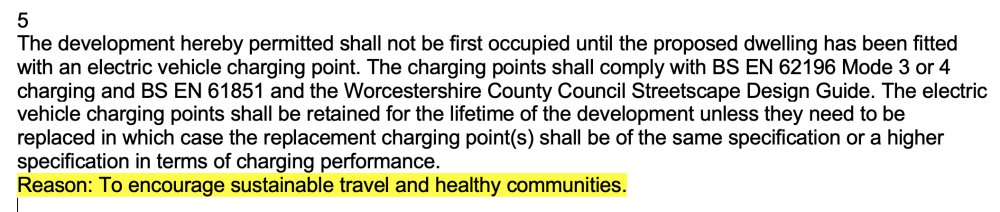
-
Hello! And, err... our appeal was dismissed :-(
garrymartin replied to garrymartin's topic in Planning Permission
If he responds... 😉 They were very carefully crafted questions that make it difficult to respond in a wooly way that would be open to further interpretation, and he'll know exactly why I'm asking them! I have the details of what will almost certainly be my MP, as well as the details for the Green Councillor that covers the area where I currently live in Worcester, and the Conservative Councillor (who also happens to be chair of the Planning Committee) for the area that covers the plot. I intend to write to all of them to a) explain how a very sustainable development has already been refused on grounds of sustainability (!!) and b) to ask for support for any subsequent application. As you rightly note though, they're likely very busy right now so it's on my list of things to do in the coming weeks/months and possibly after engaging a planning consultant (feelers out to one of the best ones in our area right now). -
Hello! And, err... our appeal was dismissed :-(
garrymartin replied to garrymartin's topic in Planning Permission
The Local Plan is the 2016 version currently, so considerably out of date. Although the formation of the new Local Plan is at the Regulation 19 Stage, the Inspectors have asked for so many clarifications and additional evidence that it's looking like it won't be in place until at least early 2025. I did provide some input but to be honest, unless you are a powerful group (i.e. large developers, housing associations, government functions, etc.) the commentary is pretty much brushed aside and changes aren't made. It is comforting that the Inspectors are giving the LPA a tough time though. 😉 -
Hello! And, err... our appeal was dismissed :-(
garrymartin replied to garrymartin's topic in Planning Permission
Reminds me somewhat of a tweet that caught my eye yesterday. "If you aren't willing to look like a foolish beginner, you'll never become a graceful master." -
Hello! And, err... our appeal was dismissed :-(
garrymartin replied to garrymartin's topic in Planning Permission
I'm certain they will be when we get to the other reserved matters, but for the initial outline application with only access as a reserved matter, I don't think they can add anything to be honest.