


vala
-
Posts
248 -
Joined
-
Last visited
Everything posted by vala
-
Thank you both for all this extra information. having no zone valve at the manifold will definitely simplify things for me and will make 1 less cable to get through to where the downstairs UFH/buffer and s plan wiring centre will be. i'm going to draw up a schematic for my system with regards to the S plan and I'll post that up. Hopefully it'll be correct or require little amendments! I'm definitely understanding more and more with regards to this so thank you all!
-
I'm just going off the wiring diagram from them and trying to adapt it to suit my project. On that it includes zone valves. also next year when the ground floor UFH goes in, then the zone valves will be needed to ensure the flow only goes round which ever circuit is calling for heat? Its also never been mentioned in any of the previous posts to not have them hence why I continued with having them.
-
According to the Wunda page the heating source is also for the boiler/zone valve. I'm assuming this is where the need for a S plan wiring centre comes into play. I could run a pair of cables from here to 1 and 10 on the S plan so its the same as the grey and orange as the zone valve? And then a pair of cables from the S plan (from 1 and 10) goes to the buffer stat? So this way I connect the zone valve, buffer stat and boiler together?
-
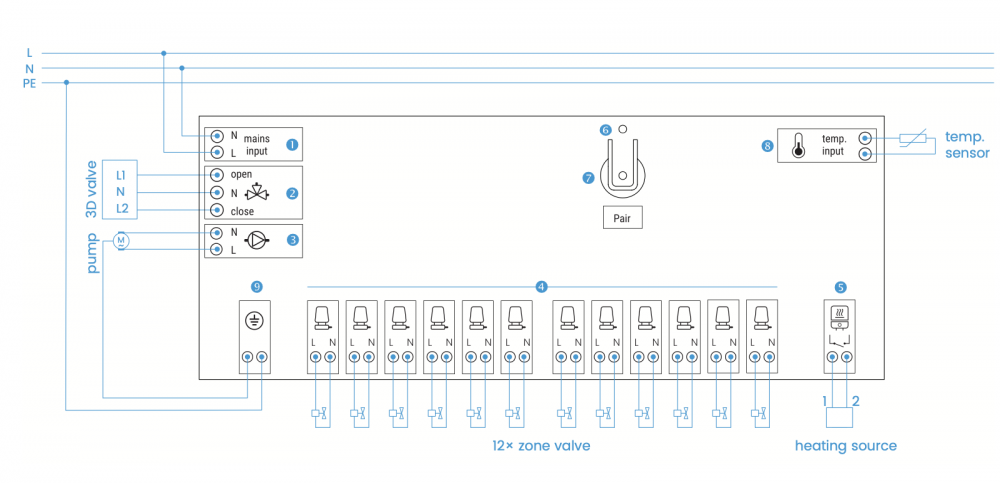
@RHayes thank you for this. I'm trying to get it noted down in the order of 1-10 and noting what will go to where. Getting a bit lost as the Wunda wiring diagram I have for the smart connection box doesn't have a switch relay, so although I can put the live into 1, I only have a neutral and an earth left (for 2 and 3). This is the diagram for the Wunda wiring centre I'll be getting? I have a feeling maybe the folder of wiring diagrams for different systems they supply may well be for there non smart wiring centres?? With regards to the thermostats the smart ones that Wunda supply are all wireless. There's a 'HubSwitch' which connects to my router in my AV cupboard which will over wifi pair with the smart connection box. I do feel I'm getting closer to understanding all this, just am a bit concerned with the amount of cabling I'll have to feed down various conduits etc, as if there's to be just 1 S plan wiring centre I'll have to install this downstairs where the ground floor UFH manifold etc will be. So I'm hoping the zone valve cabling can be extended. Or that I could have a S plan wiring centre for each of the manifolds.
-
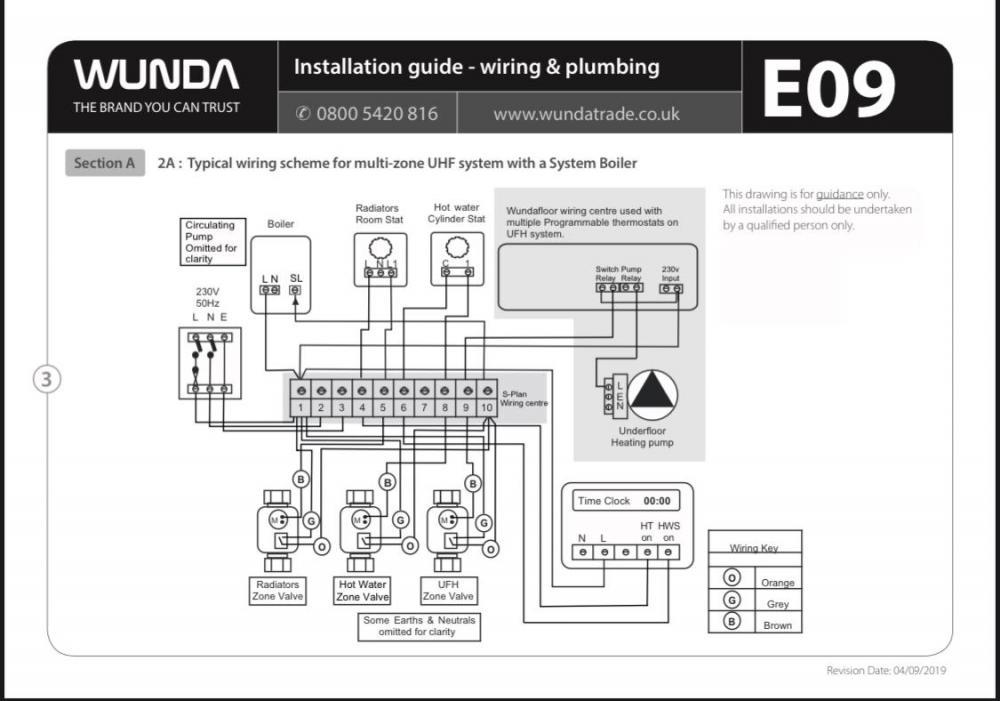
I was under the impression when I come to install the ground floor UFH, this would have its on S plan wiring centre along with its own Wunda wiring centre etc??? not wanting to contradict your diagram as its extremely helpful however I came across this page from Wunda whilst looking more at the diagram I previously posted, it shows the common and 1 (call for heat?) going into numbers 6 and 10. is this what you've suggested just amended to suit the combi boiler wiring diagram I posted up, as I don't have any timers etc for HW?
-
I spoke to Wunda and Wilo about this and they confirmed for my application the Wilo pump they spec will draw the flow over the 8.5-9m run of pipe work I have between buffer and manifold, as the vertical distance doesn't exceed 6.2m.
-
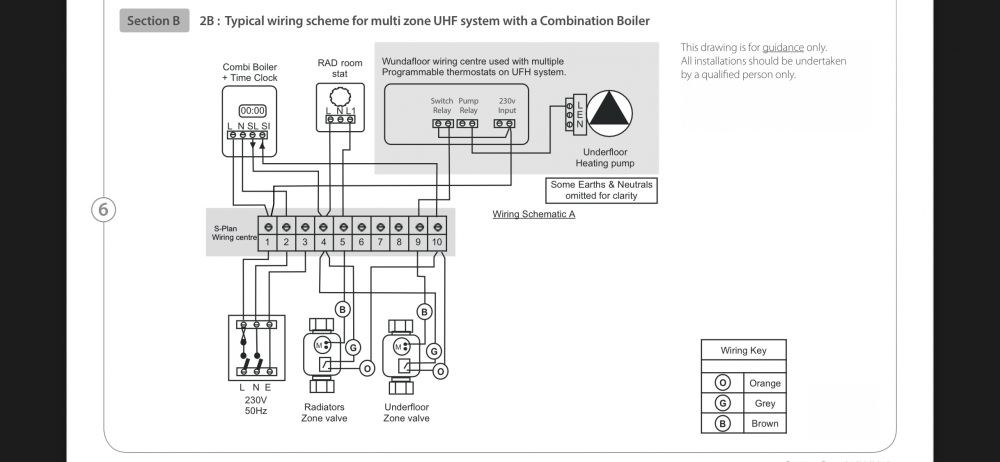
This is exactly what I was concerned about after speaking to my electrician yesterday. in the summer months the buffer will continue to heat, and cool down even though there's no demand from the UFH. So going off the wiring diagram off Wunda which most matches my set up Does this mean the 3 core from the boiler still goes into the s plan wiring centre and then the cylinder stat from the buffer vessel also goes into the boiler? and from Wunda's wiring diagram I can omit the rad stat. so when there's a call for heat from the UFH, the draw will be from the buffer vessel (via the zone valve opening and the circulating pump on the manifold also being live), and only if there's a call for heat AND the buffer vessel stat is low will the boiler kick in?
-
Tbh at present I don't believe I have currently a s plan wiring. Cables from my boiler go to a receiver for the wireless thermostat. There's only 1 thermostat currently for the whole house. Also I can't see a zone valve anywhere. thermostats for the UFH are all Wunda smart ones which pair with the wiring centre so no cables between them. boiler is an oil fed external combi boiler so DHW water comes straight from that and the temp is set on the control panel on the boiler.
-
Reason for the buffer tank is to reduce short cycling of the oil fed combi boiler, as these run either off or at 100%. Where I'm a bit lost is how an S plan wiring would fit in. From my research at present into them it appears all the connections I could make direct to the Wunda wiring centre, I would now have to go through an S plan wiring centre first. The next zone for the heating in the house will be the ground floor UFH which I'll get onto next year but again that will have its own Wunda wiring centre so again this confuses me with introducing the S plan wiring centre.
-
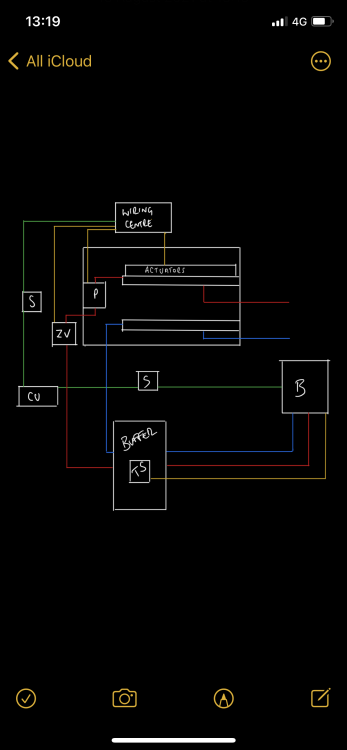
So I spoke to Wunda and Wilo and they confirmed my query with regards to the distance from the buffer to the manifold pump. I'll be using the standard Wilo pump as specified on the Wunda manifold. I think that's it plumbing wise so now onto what wiring I need to get done. I've got a feed from my consumer unit to the wiring centre which has a spur inline. I've looked into an S plan wiring centre however this is where I start the get confused with what wires to bring up. As my boiler is external I want to get the required cables to their relevant location so I can go ahead and get closing up/plastering various areas. I've done a crude drawing which shows my plumbing and wiring circuit but I would gladly accept any help with working out how and why to include this s plan wiring. This is the drawing I've done
-
Just remeasured the approximate distance from buffer tank to the manifold and its more like 8.5-9m, so am I correct then in thinking I can't just rely on the manifold pump? Am I right in now thinking I can utilise an additional circulating pump after the buffer, or maybe swap out the Wilo that comes with the Wunda manifold for something larger? The reason I thought about using the circulating pump after the buffer was a response by @Nickfromwales in a thread I read which showed this diagram, I thought I could substitute the GSHP for my oil fed combi boiler. However if the alternative of swapping out the pump on the manifold for something that can circulate the flow from the boiler to the manifold I think I'd be more inclined to go that way. With regards to the flow and return connections on the buffer tank, is there any negative to having the ground floor and first floor separate without having to insert a tee when the time comes?
-
The manifolds along with the entire UFH system is from Wunda, so the manifold has the blending valves and pumps on. I'm speccing the Wilo pumps. If there is to be no circulation pump straight after the buffer, and just using the pump on the manifold, would it be wise to have 3 flow and return connections on the buffer tank? This would be the flow and return to the boiler, and then a flow and return to the upstairs manifold and one for the ground floor manifold (once we get round to installing this). Then a connection fitted for the cylinder stat which will be wired to the boiler?
-
Hi all, After taking advice from members on this site as well as doing more research into my UFH project I've decided to included a buffer tank. I need a bit of help with the order and components to be used and was hoping I could get that from members of this forum. The order of plumbing I have is a 22mm flow and return from my external oil fed combi boiler to the buffer tank which will be in the understairs cupboard which I also plan on insulating. This cupboard will also be the location for the ground floor UFH manifold system when we get round to refurbishing the ground floor. From the buffer tank the 22mm flow would go to the first floor manifold via a heating recirculating pump and 2 port zone valve. I planned on putting the heating recirculating pump just after the buffer tank under the stairs, and the 2 port zone valve would be upstairs by the manifold. Approximate distance from the pump to the manifold looks like it will be 7-8m. I thought this would be best as when the ground floor UFH goes in, I can tee into the feed just after the pump and go to the 2 port zone valve for downstairs UFH. After the 2 port valve the flow goes into the manifold and then the 22mm return back down from the manifold to the buffer tank. I was planning on getting a 100L buffer tank from Newark Cylinders however I need to give them more details with regards to number/size/use of connections so the tank can be made up. Heating circulating pump I was going to go with a Wilo Yonos Pico 25/1-8. 2 port zone valves I haven't found one yet, but a quick google brings up many options. Does this sound correct with regards to the plumbing and components to be used?
-
The loop lengths on the first floor equal approximately 304m. I expect downstairs to be slightly bigger so maybe 660m in total. 50L still ok? Or go with a bigger tank? As mentioned I can get something no more then 1200mm high and with a diameter of no greater then 750mm under the staircase (same location for the downstairs UFH manifold.
-
Is there any point in fitting a larger buffer tank? Only thing I can think of as a negative is that if its say 100L, the boiler may heat the water in the buffer tank, but this would not get distributed round the UFH loops quick enough, for it to then cool gradually in the buffer tank? Am I right in this thinking, hence why 50L has been recommended?
-
To clear this in my head... heat source to buffer pump is already built into the Worcester external oil combi? buffer to UFH - can you recommend one? manifold pumps are already on the wunda manifolds (I've specced the Wilo ones)
-
There's no radiators in the house. Renovating the whole place and we've stripped the first floor to install UFH up there. Rads downstairs will be replaced next year when that floor gets renovated, however once we make a start on upstairs UFH (end of August), the downstairs ones will come out. Temporarily I'll get some electric ones to do us for the time being. There is a space under the stairs (which is where the downstairs UFH manifold will be going), and I can get something with a diameter no bigger then 750mm, and height including any pipework of no taller then 1200mm. However would the water from the buffer need to be pumped to the manifold upstairs? Do they contain pumps or is that something I'd have to fit inline for the first floor UFH manifold?
-
Following on from a thread I previously made I was hoping I could get some help in sizing up a buffer tank for my UFH system. My boiler is an external oil combi boiler (12/18) and the UFH system is just on the first floor. I'm also hoping the buffer tank could be fitted in the loft potentially above the UFH manifold. How do I go about working out what size tank is needed?
-
Peter, What size buffer tank would you suggest? I'm thinking it could maybe go in the loft, however would need to check the weight when full up there. Thanks
-
Noted. Is there any other way without going for the buffer tank? Never planned on having one so not really got a location lined up for one. And I assume the reason for the short cycling with UFH is, as you mentioned mainly due to the flow temp needing to be much lower than the boiler would put out? I'd have to look at the spec to see how low in temp I can run the oil boiler, its a Worcester external greenslave. Maybe more insulation throughout the house? I can up the insulation between the joists to 100-120mm if I rest the insulation straight onto the batons, rather then stick a bit of ply in. Loft space has 250mm of insulation throughout, all internal walls have been redone with rock wool and soundboard. And all pipes will be lagged.
-
Would an option to not using a buffer be to down rate the boiler? Its a 12-18kw combi, but I've no idea what size it is. I assume 15kw as I'm led to believe they normally come set in the middle.
-
In the bathroom tiled, rest of the first floor will be carpet (which with underlay the tog will be 2.5 or less).
-
Hi Peter, I'm just going off what the staff at Wunda said. Insulation under the pug mix will be 70-80mm PIR boards.
-
I assume then this would be mean the towel rail temperature would be based on what the boiler is set to? Although not 100% confirmed with Wunda (drawings are being done at the moment), the technical staff noted flow temp will most likely be around 45-50deg as its a pug mix install. If this is overkill, is there another option other then going for an electric towel rail?
-
I will have UFH throughout the house off an oil fired combi boiler, is there anyway I can have a heated towel rail other than an electric one?


