


SuperPav
-
Posts
224 -
Joined
-
Last visited
Everything posted by SuperPav
-
Thanks we could in theory yes, but the problem is I'd need a pad at that corner going down 2m to below the invert level. And knowing my luck, it'll hit the sewer. Ironically this is in practice much riskier for damaging the sewer, even though ST would probably love the idea. An alternative along similar lines would be some piles, but again, the chances of hitting the sewer are quite high - not fancying them odds.
-
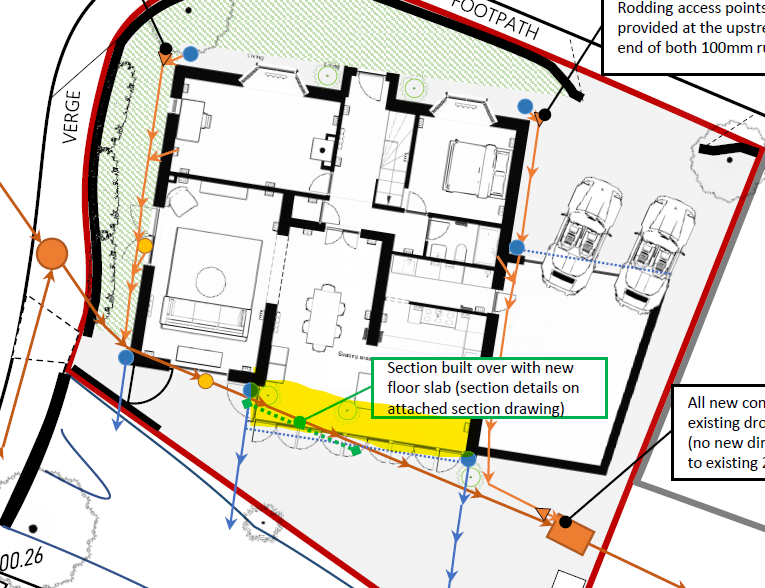
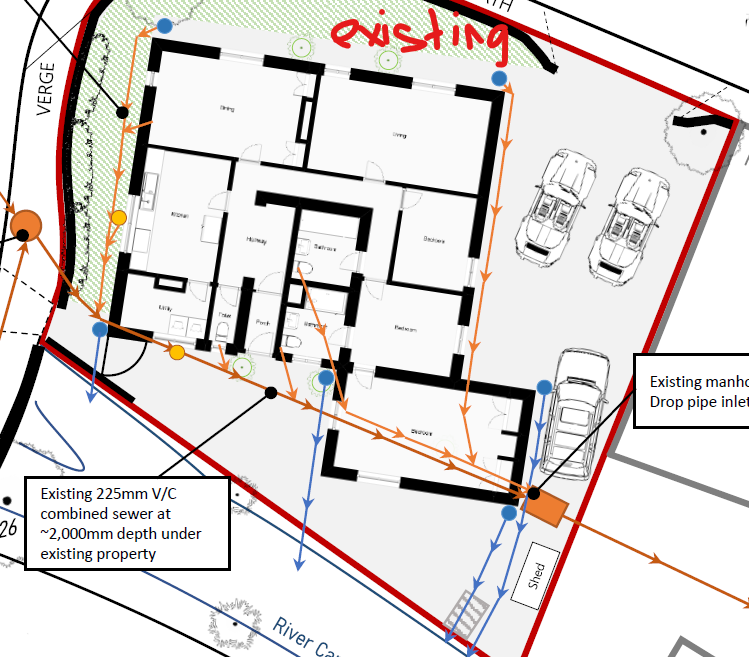
Complicating things further... Have just been told by Severn Trent that we can't build some of the extension footings there to the current depth 1200mm as that area is above the sewer (IL ~2000mm). They want the footings taken down to below IL which is going to be fun, I suspect might even hit the water table before then! It's literally only supporting the floor and glazing (highlighted in yellow). Could do a warm insulated raft (if they allow) but that seems overkill for this section, and I'm not sure how to deal with the external threshold (patio paving/channel drainage) as the insualtion upstand would be in the way? Any creative ideas here? Or am I overthinking it and just need to fork out however much the builders will want to try and dig the footings down to 2m with associated shuttering etc. Really can't be affording this at the moment though... Proposed: Existing for reference
-
Depending on the details, I'd prefer to amend under the original application and avoid withdrawing/refusal. If this isn't possible, then go to refusal. Resubmit via your freebie (assuming a HH application) and use your second application supporting statement to specifically say how the new proposal addresses all of the reasons for refusal of the first one. There are very few times I'd recommend withdrawing. Usually if you're trying to speculatively get some permission (unsuccessfully) on a plot you intend to sell. Although in reality you won't be fooling anyone who understands the process.
-
This may be a very dim question but.... if I wanted to fit some air source wall mounted aircon/heater units in our new build at some point in the future (split system running off 1 external unit), is it possible to essentially run the refrigerant lines as part of first fix to prep for this, or are they all proprietary fittings? Growing up in a hot EU country with concrete houses, all the rooms would have refrigerant corrugated conduits cast into the concrete for this purpose, but normally only running very short/straight runs to the nearest outside walls. In our case running them through internal stud walls means a conduit would be too convoluted to then be able to fish a refrigerant hose through hence the question of whether its possible to lay actual hoses down as part of first fix, and then get the end fittings put on and connected when we eventually buy and install the units?
-
Fencing/separation in and of itself is not a change of use (and has been judged as such in previous court rulings) so the fence is largely immaterial to the "use". If you want to use the land for recreation, I'd be tempted to just do it, but equally be respectful to it being its own, separated plot even if there is no fence. I wouldn't install anything on it which as above is "residential" specifically something like a garden shed. Kids playing equipment, depending on size etc. and a picnic table would be a bit of a grey area but you could always move/remove if required - if you treat the land as a parcel that you go to for recreation rather than a de-facto extension of your garden, then you should be alright, and it would be for the council to issue an enforcement notice against the change of use, which you could appeal. As above, for 28 days of the year you can virtually do whatever you want to be honest, so just keep a record of those.
-
Resurrecting this as about to get cracking on these. Where the foundation is running just for the benefit of glazing (i.e. no structural wall or loads on the foundation), am I best laying out the foundation so that the glazing bears on the inner edge, central, or outer edge? The glazing thickness is approx 100mm. As there is no wall going here, I have a bit of flexibility to get the best detail for thermal efficiency (which I guess means putting the glazing/doors on the inboard edge of the footing, to maximise efficiency from any thermal break/upstand by keeping the footing outside of the thermal envelope?)
-
Thanks all, the beam wouldn't be encased in masonry, but would just be used instead of a lintel/steel. # I've already got glulam going up as the ridge beams so supplying them isn't an issue, they can just make up a section cut to size, it just struck me as odd that more people don't use it given it's quite easy, particularly where directly attaching other timber members (e.g. floor joists). Will probably end up just using an RSJ with a timber in the web as above, more to not confuse the builders than anything else!
-
I am (bizarrely) really struggling to find much about this on google, maybe it's just not a very clever idea. Is there any reason not to use a (suitably sized) glulam beam as a lintel above a door opening in a masonry construction? Inner leaf thinjoint celcon, outer leaf 140mm stone, the lintel would only be used for the inner leaf. We've got a few openings (up to 2.4m max) which need to be in the ceiling, with posijoists at right angles to them so I can't just use a box section lintel and sit the posijoists on top as I don't want the lintels dropping down below ceiling level.. The alternative we're currently planning on is to use a 254mm steel with timber bearers in the web and face fix hangers to it, but if the cost is similar, I'm just thinking why glulam wouldn't work, for either the thinjoint leaf, the stone leaf or both? Older houses obviously all used timber lintels with stone, but is that movement just considered excessive for modern construction?
-
Hi all, I've found a fair few results by searching for MVHR sizing, but they all seem to relate to a new build and meeting ACH requirements. We are (extensively) redeveloping a bungalow. All the upstairs will be newly built and so will the rear glazing/extension. However, the rest of the building will remain as the 1950's solid stoned wall bungalow. We've decided on MVHR primarily for central ventilation, with the heat recovery an added bonus. The house will be approximately 180sqm. (4 bed, 1 kitchen, 2 1/2 bathrooms), 2 adults and a baby. No new-build ACH requirements from a building regs point of view, but we need to achieve the necessary background ventilation as none of our windows will have trickle vents. With an eye on the budget, I'm keeping an eye out for reasonably priced MVHR units on ebay and suchlike. However, beggars can't be choosers, so my question is around how critical "right-sizing" the unit is: So the scenarios I'd like to understand are: 1) If we buy a unit that's a bit too small (e.g. rated for 150sqm) 2) If we buy a unit that's a bit too "big" (e.g. rated for 200-250sqm) What are the implications?
-
At a very high level, yes that is correct. You'll need planning permission for the height. Please note this will be a full planning application, so I'd be really tempted to see if you can get away with 2.5m overall height - sloping site/ground may help here as it would make life much easier and cheaper for you. Building regulations normally won't apply as under 15sqm floor area - exception being if there is any sleeping accommodation.
-
Once you've built up enough mist coats (maybe 4-5) - you should be able to put on a proper thick final coat without it peeling off.. It's a fine line though. Brushing also seems to be the least likely to lead to peeling while applying - rollering is the worst as it essentially is pulling the paint off the surface. A sprayer might actually be good for that last thicker coat.. You could also just run a medium grade sander over it (e.g. 180grit) - this has the effect of flicking off any bits which are loose, while also roughing up the plaster and any good paint for slightly better adhesion for subsequent coats. Either way, you have my sympathies here!
-
That's an adhesion issue. Is it going onto fresh, very smooth plaster? I had very similar failure on the underside of a staircase, nearly drove me insane. The only way around it was to get back to the plaster by scraping, and roller on LOTS of very very light watered down coats. I even went as far as roughly scouring the plaster with a bit of wire wool and brush. Any attempt to put anything remotely thicker just led to little flakes peeling clean off the smooth bits. I guess the same applies when spraying - lots of thin coats.
-
Short of selling a kidney...
SuperPav replied to wbc978's topic in General Self Build & DIY Discussion
The £80k seems ridiculously cheap. The £70k seems very high and you should be able to bring this down significantly. Then start going through all the details and make the build as simple and cheap as possible: 1) Can you re-use the existing foundations and foot print? If not, then can you build outside of the existing foundations so you don't have to dig any up. 2) Can you re-use the existing services without moving gas, electric, water mains? 3) Can you re-use existing drains/sewers (if connected to mains) 4) Simplify the design. Reduce number of windows, doors, large bits of glazing. By all means keep one "feature" but simplify everything else. 5) If you have more than one bathroom, maybe you just do one at the moment (run plumbing to the second one, but don't tile/buy suite etc.) 6) If there's space on site, you have more flexibility with regard to buying stuff such as roof tiles/insulation e.g. off ebay and keeping it on site so you can keep an eye out for bargains. 7) Learn to do at least something as DIY. Plastering/tiling/carpeting, whatever, just pick one or two things which you could do later. Lastly (Rest of the forum, cover your ears): downgrade from medium specification to "low" from a reputable timber frame company - this can still be a lot better than your average developer new build. The reality is £220k is not a lot to play with these days, even before you consider you're including in this the land purchase! -
We're just about to start the build - about 6 months since I got quotes and bill of materials sorted. Timber is now up 30% (which includes posijoists as well) compared to then. Given we were pretty tight on budget already, I can this getting really quite difficult... The thing that really shocked me is for the past few years, 3x2 CLS in B&Q and Homebase was between £2.35 and £2.50 for a 2.4m length. Over £4 now!
-
Above advice is good and you would probably win at appeal if suitably constructed. The other thing to challenge here is what does the enforcement notice relate to? Use as a terrace, or the actual structure, and if so which elements? We'd need to see the details of what's there and what was originally constructed, but I would be willing to challenge this with them via appeal on the following grounds: If it's just a flat roof that is used as a terrace, then the fact that it was being repaired need not mean there ever was a break in its use a terrace. They presumably haven't got an issue with the actual bathroom and flat roof, so which element are they asking to be taken down? What do they expect to see remaining? I would personally stick a CLEUD (and encourage your neighbour to do the same unless they're the ones who complained?!) and appeal the enforcement simultaneously as both should really be done before the enforcement notice takes effect.
-
Getting an extension on a proposed extension(sorry) is in itself normally relatively straightforward. But before you do anything, a few details: 1) Are there any *pre-commencement* conditions attached to the permission? (anything along the lines of "before work starts....."). If yes, do NOT start before discharging these, especially if you answer yes to the below! 2) Is there any current CIL liability attached to the permission. If so, have you or are you planning on applying for self-build relief? If you've applied for CIL reliefe, do NOT start before notifying the planning department with a notice of commencement otherwise you risk losing your relief! The above are quite important in terms of any recommendation we can make... If the current permission has no CIL liability, I would suggest you're better to "start" rather than renewing the application, as the new one is likely to attract CIL. To be honest anything that is evidenced as starting works the development is acceptable. Ref your question "is starting demolition" enough, yes it is if essential to carry out the permitted works. I'd submit a building notice for the works to Building Control, and tell them you intend on demolishing the current extension on xx date. Then crack on with that.
-
You have my sympathies and this seems ridiculous. I had to deal with a slow/incompetent planning officer during a pre-application. Sometimes it is genuinely out of excessive workload/poor holiday timing/honest mistake etc. so I can see how one individual can let you down unintentionally. As a department, however, they are responsible for putting in place the necessary controls and resource to ensure that this doesn't happen systematically. All I can advise is to make a FORMAL complaint submission, outlining very clearly 1) What has been done unacceptably, and 2) what remedy you want. In my case, I essentially complained that they were impossible to get hold of and didn't respond within the councils own recommended timelines, and beyond that within a reasonable amount of time. As this was a paid pre-applicaiton, I requested in black and white: that the officer is immediately replaced with another officer to make contact with me within 3 working days by phone, and that I am refunded 50% of the application fee as I have not received a satisfactory service. I got a call from the head of the department apologising, and asking me if I do want to proceed with it as a true" formal" complaint or accept the above proposed actions. I just wanted the thing to progress so withdrew my official complaint. Got a new (very good) officer on the case within a day, and got 50% of my fee refunded. Never dealt with Edinburgh council so god knows what it's like but after a quick google, I would try the general complaints/customer care process for the council, if the Planning Department are impossible to contact directly. https://www.edinburgh.gov.uk/contact-us/comments-complaints Edited to add: Appeal against non-determination is the correct way of dealing with this, but pragmatically, will take so long that you personally won't gain anything other than moral high ground.
-
Thanks both - so that's a no to getting it wet! Enough bad smells in here as it is.... It's a combination - the stuff between the rafters (very compressed, thin) seems to be the old stuff, the top up stuff on top I think is from about 2010, and is much fluffier. Still itchy, mind, but feels more effective and mildly less itchy. Good ideas, thanks I might try to keep the "better stuff", and try and somehow cram it/stuff it into bags (uncompressed it's just unmanageably bulky).
-
So I'm stripping out the loft insulation (50 and 200mm rolls of earthwool/fibreglass) from our bungalow as the roof needs to come off (approx 140sqm @ 150-200mm thickness on average). The plan was to keep this, and reuse however much of it I'll need for the new timber frame garage walls and roof, but I'm baulking at the bulk of it and as the roof is coming off the entire footprint, I can't keep it dry while the roof is off (and until the new floor/roof is on). I wanted to avoid chucking it as I suspect it will take up several skips on its own (which will cost me nearly £500), and I'll then need to spend £500 on new insulation for the garage, so I'd be £1,000 down. It also doesn't seem particularly environmentally friendly... My questions therefore are: 1) Would leaving the insulation out in the weather (to get wet) in the footprint of the building for a month or so and then letting it dry out be at all a go-er? 2) If not, any clever ideas for how to compress it? It seems even chucking hardcore on top of it in a skip doesn't compress it as much as I'd hoped... I guess an alternative would be to find someone who could reuse it to just take it away, but I'm not sure how feasible that is given it'll probably take up a full 20ft container's worth of volume.
-
11mm across the aperture I can sort of understand (all other manufacturers ask for 10mm). 11mm *on each side* seems excessive when it's going into smooth stone blocks in the outer leaf. I was also under the impression (certainly from Rationel's installation instructions) that the Compriband between the sash and outer leaf goes in after the window is in place through careful poking with a glazing/putty knife?
-
Planning refused: entrance deemed too grand!
SuperPav replied to albion2021's topic in Planning Permission
I am not a 'professional' planning consultant but have had some successes with shall we say, less favourable LPAs and some quite painful applications. Based purely on what I can see in the thread, the grounds for rejection are "valid" in so much as I wouldn't recommend appealing it. It does to a certain extent depend on the dialogue you've had with the LPA throughout the planning process. The fact that this is the only thing the application was rejected on at this stage is quite positive as it's easily overcome. My recommended strategy would be: 1) Call the planning officer, get their exact preferences and reason for the preferences for the following: Location of access and track, appearance of entrance & gate, appearance of track, appearance of fencing. 2) Call the highways officer and tell them that the LPA prefers to use the other access for the above reasons ^. State that it is an existing access, and that therefore you don't expect them to have any concerns with re-using it to serve just a single dwelling, but thought you'd check with them before amending a resubmission. Assuming they OK this, proceed to point 3. 3) If you feel very strongly about one of the factors in point 1), then pick ONE and keep it as you wish, but revert the others to the LPA's recommendation. Personally I would probably revert them all to the recommended proposal unless it really really ruins the actual dwelling for you. 4) Resubmit the application as a freebie, with a properly drafted supporting statement which identifies that the grounds for rejection have all been addressed through collaborative engagement with the LPA and Highways Agency. This should use language that essentially says "approval is now a given" while giving all the credit to the LPA for coming up with it. If it is AGAIN rejected on some spurious grounds, you have a very strong case for appeal, and I suspect it'll go your way if handled properly. Once the above is done, forget about the access, focus on the dwelling, nail that, and then worry about access later. It's always easier to tweak/adjust the appearance of that later on, whether with a full application or using PD rights or "the ask for forgiveness method". -
I did a search for this but couldn't find anything. We're about to finalise our window order for Rationel TG window order tonight. Most windows going into new stonework, but two going into existing. Openings all framed with smooth cut stone quoins/head and stone cill. House is stone outer/brick inner leaf with rubble infill (350mm total thickness). The new/upstairs will be cavity wall of 140mm stone, 100mm cavity, 100mm inner block. The plan is to install new windows in 18mm plywood boxes, set back just under 100mm from the outer face. Window sections 123mm deep. The boxes will be built in as the walls go up to ensure square/accurate sizing. The supplier is saying that the opening size must be 22mm larger than the window frame (11mm clearance on all sides). This strikes me as ridiculously generous, especially for windows going into new apertures. The plan is to fit with compriband between window and outer leaf, backfilled with foam, and avoid sealant if possible. Windows also supplied without cills (to sit directly on stone cills). We have a big concern with the gap that 11mm clearance will leave visually. The windows are alu clad flush casement, will be finished in a light grey, and against Cotswold stone, so a 11mm black compriband will stand out somewhat. Also at that size of gap, it won't even be easy to fill with colour matched sealant. Anyone on here know why such generous tolerance is being allowed for especially on an exterior without any render/applied finishes? And has anyone got away with smaller as we most likely will chance it here! Thanks!
-
We're going up a storey on our bungalow, which is 340-350mm solid walls (Costwold stone outer, brick inner tied with rubble infill). Obviously the downstairs will never be particularly high performance thermally. The upstairs is 100mm celcon thin joint inner leaf, 100-110mm stone outer, with EPS beads full fill in the residual cavity. Realistically, probably around ~0.22 U Value. My question is where we're building up off the existing wall, the current plan has been to lay a single 65mm course of Marmox thermoblock on top of the existing inner brick leaf after removing the wallplate, then a coursing layer of 65mm celcon bricks, then sit Posijoists on top of that. This is OK but is causing a few issues around openings with lintels, and can't very easily raise the whole thing higher as we've got some strict planning restrictions. It would be much easier if we could lose the Marmox course, as that would allow us to have two courses of 65mm celcon bricks, and over full height openings we'd just use 140mm concrete lintels on end to match the two courses. Joists can just sit on that then, nice and simple. Would also be cheaper as we can lose the Marmox... Obviously this creates a thermal bridge to the upper inner leaf and joist ends, as they're sat right on top of the inner leaf of the solid wall. My question is how much difference/impact would a thermal break here really make? The alternative would be to lower all the "full height opening" lintels to 140mm below current wall plate level, and then build up from them as per the rest of the wall...
-
Thanks, I've pretty much resolved myself to asking the builders to just dig out the 7m trench and fill it, over budget before we even started! I guess I just can't get my head round why a double garage opening is sufficiently accommodated by a thickened edge to the slab without any footings, as surely the loadings on that edge from a vehicle driving in and out would be far greater than from a fixed piece of glazing. With regards to putting beams across the span, there are footings that run nearly central to the span (existing wall there which is being taken down), so I could bear a beam onto it, with resultant split spans being approx 3.2-3.6m either side, would that just be a concrete lintel at a certain depth, with the slab bearing on top of it? Also just realised there's an actual Foundations sub-form on here, oops. Mods, feel free to move if more relevant!
-
Having done two refurbs, the unpopular answer is: chuck it in a skip/grab lorry, pretty much regardless of what it is. Sadly it is usually cheaper and quicker to throw away and buy new, if you're paying someone to do the demolition/dismantling. Unfortunately this doesn't always sit well with me, which is why I'm currently in the process of manually removing a load of worthless 60's concrete buff tiles off the roof, and these will be reused to clad the side (not visible) wall of the new extended garage. It would be much quicker to chuck them all in a skip from the roof, breaking all the tiles in the process, and then spend £900 or so on getting nice shiny new ones. But other than the marginal cost saving, I'd like to think it's a bit more environmentally friendly to avoid new tiles, and the disposal impact of getting rid of broken old ones.
