Adsibob
-
Posts
3604 -
Joined
-
Last visited
-
Days Won
10
Everything posted by Adsibob
-
I fitted Hudson Reed thermostatic shower three way valve at my old place. Lasted about 2 years before i needed to replace one of the cartridges which was bloody fiddly to do. 18 months after that it needed replacing again. Never again! Now considering crosswater which is a bit more than Hudson Reed, but has a 15 year guarantee if registered on the tap itself and a 5 year guarantee on the o-rings, diverter and cartridges. Going to install a water softener too, so hoping taps will last.
-

5mm acrylic lucite vs steel for baths
Adsibob replied to Adsibob's topic in Bathrooms, Ensuites & Wetrooms
Just had a look at their website. Looks like an interesting concept. I think i remember using something similar at an Onsen in Japan. In terms of practicality though, how do you actually get in and out? They are very deep! -
5mm acrylic lucite vs steel for baths
Adsibob replied to Adsibob's topic in Bathrooms, Ensuites & Wetrooms
Probably, but other than drape a sheet of polysterene or cling film over the top of the bath whilst you're in there, not sure if you can do anything about that! -
5mm acrylic lucite vs steel for baths
Adsibob replied to Adsibob's topic in Bathrooms, Ensuites & Wetrooms
The bath is going in a nook in between two walls. One wall is a solid brick wall (no cavity) that is the original wall of the house. The other wall has not been built yet. We were going to go for a stud wall that is 100mm stud plus 12.5mm of plasterboard on one side and/12mm hardie backer on the bathroom side. But my builder has suggested using a thinner wall structural support for the wall, so instead of 100mm studs he had suggested using something that is only 50mm thick. Not sure what, I assume a metal rail as I thought the thinnest timber stud would be 70mm. Anyway, his idea was that we could still fit the 1700 bath by inbedding the lip on one end by 3cm or 4cm on the side where the solid brick wall is by just chipping away a 1cm channel from the solid wall and by using a thinner stud wall on the other side and then building up the wall's hardie backer and tiles over the rim of the bath. I thought this was madness, but then realised (by asking the person who lives there now) to measure the gap between the walls around the 1700 bath we installed at our last place and he told me it's only 165, so they must have overlapped the edge of the bath by 2.5cm on each side there. -
I had specified a 1700 x 750 steel bath for our bathroom, but some of the walls in our old 1930s semi are not plumb and could do with some insulation, so we don't quite have enough space for a 1700. Two options: inbed 4cm or so of the bathtub each side into the wall - I know it's pretty standard to tile over the bath tub, but not sure about the hardiebacker board being fitted over the bathtub as well; OR go for a smaller bathtub although I'm reluctant to do this as I'm a tall guy so even 1700 is not that roomy for me, and it's actually really hard to find an affordable steel bathtub in the 750 width in anything other than the standard lengths which tend to be multiples of 100mm. I really don't want to drop down to 1600. I have found bathtubs made from 5mm acrylic lucite in both 1650 lengths and 1675. But I have no experience of this material. There is a Pura Bath that comes with a 25 year warranty so presumably it is fairly hard wearing, but does it feel as sturdy and solid as 3.5mm or even 2.4mm steel? And if I fill the voids around the tub with insulation, will it keep the heat in the bathtub nicely? Anyone have any experience of lucite or Pura?
-
We are installing MVHR, yes. All glazing in the house will be trickle vent free, and I will try and tape any other gaps, but I still struggle with this concept of taping, as with a poured screed on the ground floor and new insulated plaster board and plaster going on all the inside of the walls and ceilings, 20mm of external insulation plus 5mm of external render outside and new flooring on first and second floor, and all voids filled with minderal wool, I struggle to see where air leaks will come from. I'm not building to passive haus standards, so whilst I do want the MVHR to run well, I still struggle conceptually with this taping requirement. Screed on ground floor will be 60mm deep. No space for 120mm kingspan unfortunately.
-
It's a huge renovation project (it would have been easier to knock the house down, but being semi detached that wasn't really an option). I had considered increasing ceiling height, but it complicates things upstairs as we have a first floor extension that council planners have limited in height quite severely, so that would need to be on a different level if we raised the ground floor ceiling height. I think we will end up going with Kingspan Kooltherm K103 in most of the ground floor and cheaper stuff in the utility room and hallway, but I need to check what the price difference will be.
-
Spoke to the Structural Engineer. Any suggestion of losing the slab or combining it with the screed was a no. He has already specified that the slab be reinforced with steel mesh so can't really make it any stronger. It may be that your experience is not of London clay, but unfortunately we have metres of it beneath our house, squelching with water. We are already having to do some underpinning because the council planners insisted we sink our extension into the ground to reduce the height of it. Engineer said that if I want to lower the slab to make more room for more insulation, I will have to do more underpinning - at £1k plus VAT per linear metre, it's just not an option. It will also delay our works increasing our rental costs, which are significant. So I'm back to my original quest which is to find the best insulation I reasonably can that will fit in the 100mm of space I have for it.
-
My project is incredibly structurally complicated - we have about 12 RSJs and 7 or 8 columns, and we're dealing with a property that is almost 100 years old and has a fairly random pattern of differing corbel heights as its foundations. You'll therefore understand why I'm confused by the suggestion that I (a layman with no engineering expertise) can second guess my structural engineer and tell him that he has to do away with the concrete subfloor. He has specified it for a reason.
-
If I only have space for 100mm of insulation in between my slab and my screed, am I better off combining two types of insulation. Eg. 70mm of PIR and 33mm of aerogel such as Thermablok Aerogel https://www.thermablok.co.uk/our-products/thermablok-aerogel-magnesium-floor-board/ This aerogel product has is 0.015W/m2K so about 30% better than PIR such as Thermafloor TF70 which has 0.022 W/mK. An alternative to those two products, which would save labour, would be to just use 100mm of Kooltherm K103 Floorboard which is 0.018 W/mk.
-
Are large format tiles harder to work with?
Adsibob replied to Adsibob's topic in Floor Tiles & Tiling
Okay, fair point. What compressive strength polystyrene would you recommend. Is 70kpa enough for a very firm floor? -
Are large format tiles harder to work with?
Adsibob replied to Adsibob's topic in Floor Tiles & Tiling
@Bitpipe this sounds very interesting indeed. I will look into it. I like a firm floor, but young kids so a bit of give might be beneficial. How does the firmness compare to say a firm suspended timber floor? -
Are large format tiles harder to work with?
Adsibob replied to Adsibob's topic in Floor Tiles & Tiling
he’s actually only qualified in the last 3 years and his specification complied with NHBC guidelines which say blinding must be “sand or other fine material”, as far as I can see that wouldn’t include polystyrene, although I agree that that would give better insulation: https://nhbc-standards.co.uk/5-substructure-ground-floors-drainage-and-basements/5-1-substructure-and-ground-bearing-floors/5-1-16-blinding/ -
Are large format tiles harder to work with?
Adsibob replied to Adsibob's topic in Floor Tiles & Tiling
I had understood that a resin floor is the same more or less as microcement and has the same installation difficulties regarding making sure it doesn’t crack when the UFH comes on. But would be delighted to be corrected as we were keen on microcement until we found out about the risk of cracking with UFH. The tiles we are going for are about £75 a square metre as we are getting a bulk discount - getting all tiles for entire project from the same place. I imagine a resin floor will be similar cost wise as the tiles plus the tiler’s costs. -
Are large format tiles harder to work with?
Adsibob replied to Adsibob's topic in Floor Tiles & Tiling
Architect tells me the sand is to make sure any imperfections in the slab don’t puncture the DPM. The area we are tiling is about 7.5m by 9.5m. And yes I do mean 1200 x 2400. The tiles we are going for are a cement effect tile. The alternative is to lay microcement, but so that it didn’t crack my understanding is that first the screed has to be fully cured before laying the microcement (so 55 days for 55mm to fully cure) and the underfloor heating must never to exceed 26 or 27 degrees at the floor. Is it me, or does that sound a little onerous/ stressful. Can the builder do other jobs whilst the screed is curing? When can one walk on the screed? -
Are large format tiles harder to work with?
Adsibob replied to Adsibob's topic in Floor Tiles & Tiling
Sorry, I’m confused. What is the build up for a large format 6mm tile? 6 for underlay plus 20 of adhesive, so including the tile itself 32? Or does the 20 you mentioned originally include the 6mm underlay? -
Are large format tiles harder to work with?
Adsibob replied to Adsibob's topic in Floor Tiles & Tiling
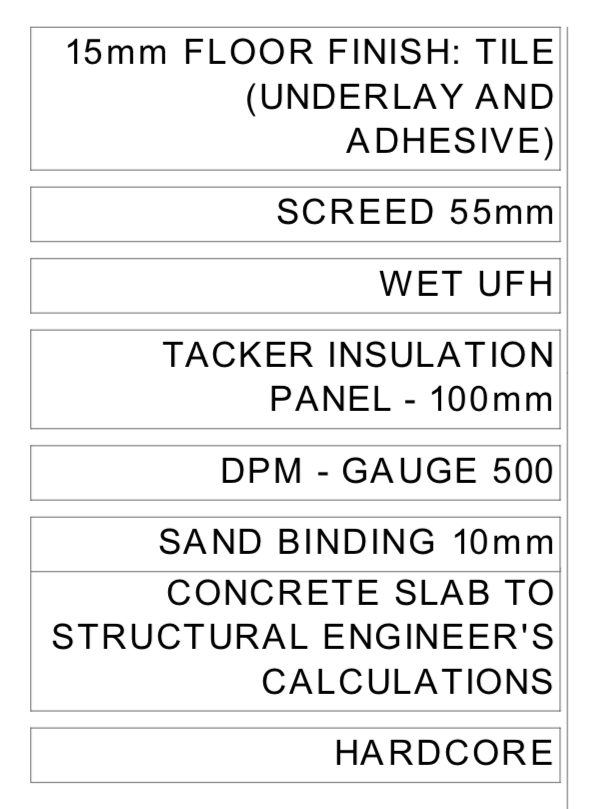
Thanks @nod i had only allowed 15mm, for a 6mm tile and 9mm for the underlay and adhesive Attached is a diagram of my proposed build up. I might be able to borrow some mm from the screed and have thinner screed or I could have slightly less insulation. Or potentially increase the floor level, but it is potentially complicated to do that as they have already laid the foundations of the extension. What would you recommend: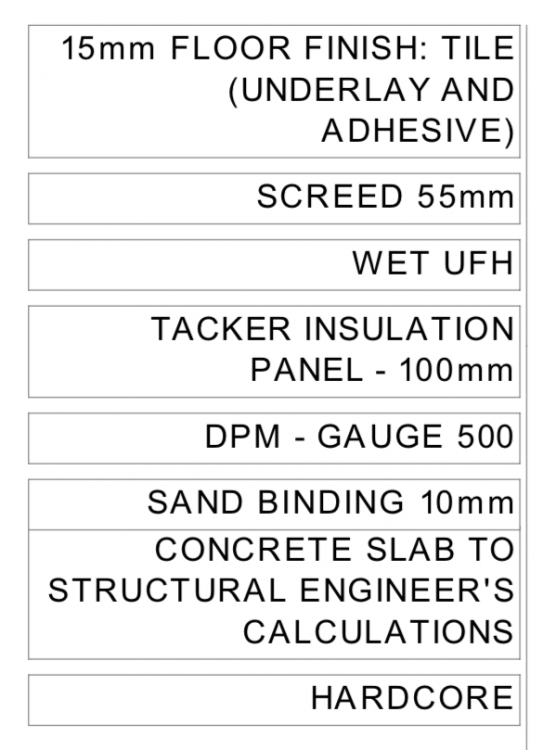
-
We are considering large format Italian porcelain tiles by Marazzi for an open plan kitchen dining area. Probably in the 1200 x 2400 x 6 size. I agreed a price with my builder which just said I would buy the tiles and he would lay them - the contract doesn’t mention their size. Will this size tiles cause him any difficulty? Does it require special equipment to cut or lay? Most of the room is rectangular in shape, so it should be fairly straightforward, but there is a slightly curved diagonal wall that cuts into one corner of the room, so that might be a bit fiddly. @nod you seem to be in the tiling business, so would be great to hear your views. @Bored Shopper I think you might have laid some large format wall tiles based on a thread I was reading, so interested in your views too - as well as everyone else’s of course!
-
Thoughts on my draft floor plans?
Adsibob replied to freshy's topic in New House & Self Build Design
@freshy this is starting to take shape! Looks good. Might be helpful to see the outline of the rooflights on the floorplan. Nice use of jack and jill bathroom, but is this really necessary? Who would use the communal entrance to it from the landing when every bedroom has it's own ensuite? When I had suggested a jack and jill, it was so that you could get away with one bathroom less. I like the walk in wardrobe behind the beds and I like how you've sited the beds in the middle of the rooms in the other bedrooms. Have you thought about making the study open plan to the hallway, or do you need it to be quiet so you can take calls etc? -
Thanks @Russell griffiths . The tiles I'm laying are only 6mm thick. I will query with the architect why he hasn't allowed 21mm overall.
-
I think you are right and my architect has listed them in the wrong order. It should go below the concrete slab on top of the hard core.
-
My understanding is that it is to level the roughness of the concrete slab but 10mm might be overkill. Would 5mm be ample?
-
Thanks @Faz . So coincidentally, the two heating zones for that floor almost fall exactly either side of the beam that is too high up. So maybe we just give up on having heating on that strip. I still think there will be some cold patches there though.
-
Our floor build up on our ground floor was meant to be as follows: FFL: Porcelain tiles, underlay and adhessive (15mm) Screed containing 16-18mm wet UFH pipes (55mm) Tacker insulation panel (100mm) DPM Sand binding (10mm) Concrete Slab Hardcore For reasons I won't go into, a structural concrete encased beam has ended up in the floor about 150mm higher than was intended. This means that there is no space to lay underfloor heating over that area unless we raise the floor. The area is a narrow but very long rectangle, spanning 7m in length (basically the whole width of the house) by about 25cm in width. We cannot raise the floor by more than about 55mm. If we do this, Architect thinks we would have space to lay (just over this narrow 7m strip) about 30mm of insulation and 25mm of screed. We would keep to the above build up for everywhere else in the floor and also add some polystyrene to the sides of the concrete encased beam to minimise cold from that. Overall this accounts for maybe 4% of the overall floor space, so whilst it's incredibly annoying I'm trying to remain calm and find a solution. I need to look into the exact type of insulation, but it would be something high end that could. Not sure if Aerogel would work. Also not sure if this is as strong as tacker insulation or if the compressive strength of the insulation is irrelevant. Does anyone see a problem with the above solution, apart from the fact that the floor over that strip will have a bit more heat-loss? Is there an issue with screed being 55mm deep in most of the floor and only 25mm deep over that portion (i.e. on the narrow strip the underfloor heating pipes would be 30mm higher and closer to the FFL than the rest of the floor, which would mean they would have to transport the water against gravity for that small jump). If that's a bad idea, would it make sense to lose screed on the rest of the floor or is that also a bad idea? Should I just have a cold patch with no underfloor heating on this bit of the floor? It's in the middle of an open plan and otherwise well insulated space in a 1930s conversion and extension.
-
Hi @shuff27 that makes sense. I bloody hate LPAs! Look forward to seeing the next version!