Adsibob
-
Posts
3609 -
Joined
-
Last visited
-
Days Won
10
Everything posted by Adsibob
-

How to measure the remaining HW in an unvented cylinder
Adsibob replied to Adsibob's topic in Boilers & Hot Water Tanks
For those that have WC and UFH that is basically on all the time in winter during the day, circulating water in the UFH with a pretty low delta T, just wondering what the floor feels like underfoot. For example, in my house, the water temperature is higher than one would have in a constantly on system; I think I run mine at about 41C for tiled floors and 34C for wooden floors, so that the heating is quite responsive. This means when the heating has been off for several hours the floor cools down and feels cold, but once it's been on for 90 minutes or so it starts to feel warm, which is quite nice particularly on tiled floors. In a constantly on WC system: what is the average temperature of the water (i know this fluctuates depending on the weather temp, but what's the range?); and what does the floor (both tiled and engineered wood) feel like? -
Yes, in a signed witness statement, deployed in litigation.
-
Yes, I agree. Also goes to the implied term point I just posted. Threaten a lawsuit!
-
Postscript: you can also make arguments about implied terms, such as it was implied that the surveyor would be competent and that the survey would be accurate. And that you were signing off on the basis of that implied term, which is such an obvious statement that it goes without saying.
-
Reading the t and c you posted, I’m now of a different view to what I was previously. You have signed and agreed to the “specification” on the survey. Although not a bulletproof argument, you can certainly argue that “specification” does not include dimensions. A dictionary is an important tool in contractual interpretation and the dictionary definition of specification is: “a detailed description of the design and materials used to make something” So that is all you have signed off on. Although they may try to argue another, broader definition, ie one that includes dimensions, such as: “an act of identifying something precisely or of stating a precise requirement” (which is another dictionary definition I found online, and such could arguably include definitions), there is an important principle of English contract law called the contra proferentum rule. This holds that where a contract has been drafted by a business and is signed by a consumer, without the consumer having the opportunity to negotiate the wording of the contract, then any ambiguity will be construed against the business. The public policy rationale behind this rule is that it is unfair to read the ambiguity in favour of the business who drafted it. It’s a strong consumer protection.
-
Surely it can be dismantled and cut, reassembled and then refilled with gas?
-
Unfortunately I experienced this kind of survey error a few times. On the most part, we managed to work around the mistake, but it did cause me to look into the legal position significantly. Unfortunately, unless you contract with someone specifically to survey something, e.g. when you commission a measured survey, I think your legal position is weak. The window company will rely on their Ts and Cs which will say that you are signing off on what they supply and they can only supply what you sign off on. So it's his mistake, but the paper trail will exculpate him. Towards the end of my build, after having had this error twice, I started to check each surveyor's measurements. It was laborious, but did sometimes spot fairly significant mistakes. I would try to put pressure on the supplier to meet you half way on the amelioration costs. Luckily the product they have supplied is too big, not too small, so there shouldn't be any materials wasted really, just a question of cutting the glass down and remaking the unit.
-
@tw18 I highly recommend you install: 1) a Shelley smart plug (or if you pump is wired directly into the mains with a fused spur) a Shelley Plus1PM on the cable powering the pump); and 2) a Shelley motion sensor in each place you want to trigger the pump - we have three, one above the kitchen sink and downstairs loo sink and one underneath the vanity unit in our website bathroom. You connect them to your WiFi and then you configure them via the web portal to switch the pump on for 60 seconds each time the PIR is triggered. It took a day or so of trying different sensitivity settings on the motion sensors before it was working really well. Saves us energy and heat loss but still gives us instant hot water. In response to @ProDave’s question, all of your HW taps will still work even when the pump isn’t triggered, they will just take longer. So if that bothers you, just add more sensors, but at £75 a pop, three was the right balance for us between practicality and budget.
-
Indeed. What is particularly odd is that the warranty claim has now been approved (we are still arguing about the timing and delivery costs, given they are expecting me to post the package to Netherlands) and in the paperwork produced by their RMA department the failure is described as a “software failure”. If that’s the case, why can’t they reinstall the software remotely and fix it that way? Or failing that, get me to reinstall it.
-
I've heard back now from Ubiquiti, and yes that is what they are going to do. Subject to availability. The UK Store is showing it as out of stock at the moment. If they don't have it, query whether I can demand an upgrade? fingers crossed even a luddite like me can do this.
-
So following @Thorfun's suggestion, i logged a ticket with ubiquiti, which included uploading a very large system log file which I had to download from my UDR or ubiquiti account. About 5 days later, I get this response: The ubiquiti hasn't suffered any knocks or damage, so i cannot for the life of me think what has happened. Normally hardware like this should last years. The only abuse I can think of is that when I've had to reset it, which is pretty much never until this problem started a couple of weeks ago, I would pull the power cord out the back of it, rather than switch it off by flicking a switch. This is quite annoying. Apart from the hassle of processing the return and being without internet in the meantime, I query whether upon installing the new one I will have to go through the whole set up again - I had this more or less professionally done, for free, by a mate of mine who is super geeky with this sort of thing. But he now lives in California!
-
Drying and re-insulating a 2.5 year old damp cavity wall
Adsibob replied to Adsibob's topic in Heat Insulation
That’s a very good idea -
Drying and re-insulating a 2.5 year old damp cavity wall
Adsibob replied to Adsibob's topic in Heat Insulation
Ffs. Wind has blown part of the tarp/dpc off. Didn’t want to fix the clamps on too hard, for fear of damaging the membrane. Ffs. @Pocster please post something funny to make me laugh.- 44 replies
-
- 1
-

-
- damp
- cavity wall
- (and 1 more)
-
Drying and re-insulating a 2.5 year old damp cavity wall
Adsibob replied to Adsibob's topic in Heat Insulation
Yes, as it happens. That obviously compounds the problem, but the main issue is that there is almost a third of brick the entire length of the parapet wall which is very exposed even from rain falling perfectly straight in no wind. -
Drying and re-insulating a 2.5 year old damp cavity wall
Adsibob replied to Adsibob's topic in Heat Insulation
Yes, except that it only goes across the capping by two thirds. Here’s a photo which my architect took at the time they were building, but never showed me until recently when I did an “audit” of this f@ck up: you can see the roofing membrane goes up the parapet but only two thirds across the brick. A third of the brick is therefore exposed. on top of that, plastic tiles were laid, but these didn’t overlap each other, leaving grout joints which eventually cracked (see previous picture) and also they didn’t extend across the whole brick, leaving the edge of the brick exposed. then on top of that layer of tiles, another layer of roofing membrane went on, but again this didn’t go across the whole tile, just two thirds of it (see previous picture). Really odd that each trade (the tiles were laid by one trade, the roofing membrane by another) didn’t think about this at all, and my architect who was meant to oversee this just photographed the mess, but didn’t think to raise it.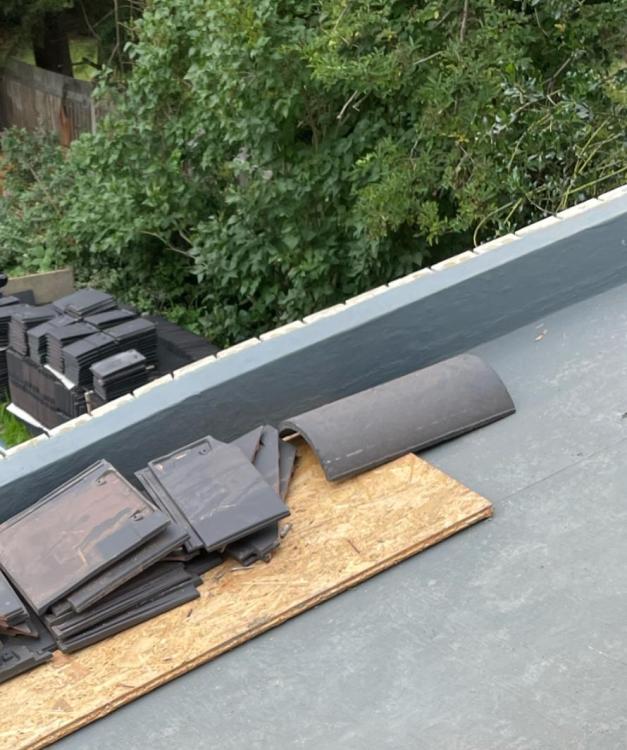
-
Drying and re-insulating a 2.5 year old damp cavity wall
Adsibob replied to Adsibob's topic in Heat Insulation
If you look back at the previous page, there is a photo, but here it is again: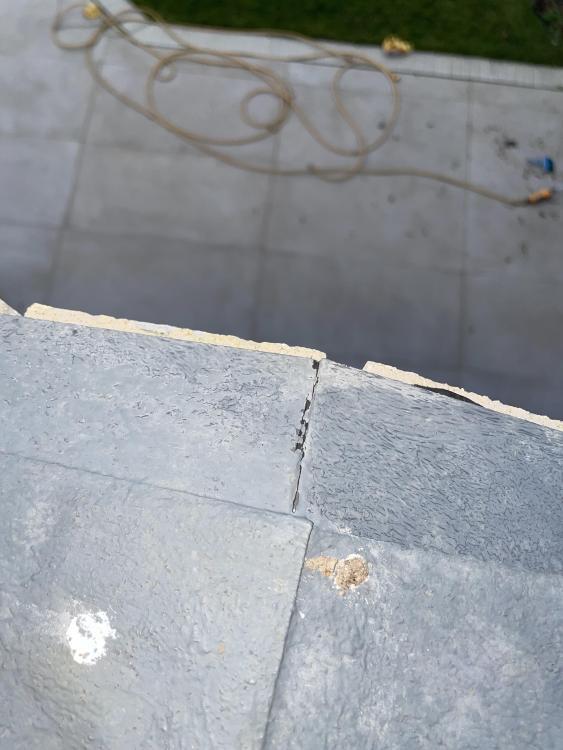
-
Drying and re-insulating a 2.5 year old damp cavity wall
Adsibob replied to Adsibob's topic in Heat Insulation
Yes, going to do that in due course, but I can’t get those installed for a while and this will at least confirm that the problem is indeed the top of the parapet wall. -
Drying and re-insulating a 2.5 year old damp cavity wall
Adsibob replied to Adsibob's topic in Heat Insulation
After a fairly dry January, with no leaks for most of the month, I saw that it is forecast to rain almost an inch of water on Thursday, followed by an almost as wet Friday. Could procrastinate any longer, so got onto the roof of my rear extension, temporarily removed a strip of seedum (which I imagine will need to come out to install the copings in due course) and clamped on the DPC: let’s hope this stops the leaks (which only occur after heavy and persistent rainfall) otherwise I’m pretty clueless on how the water is getting in.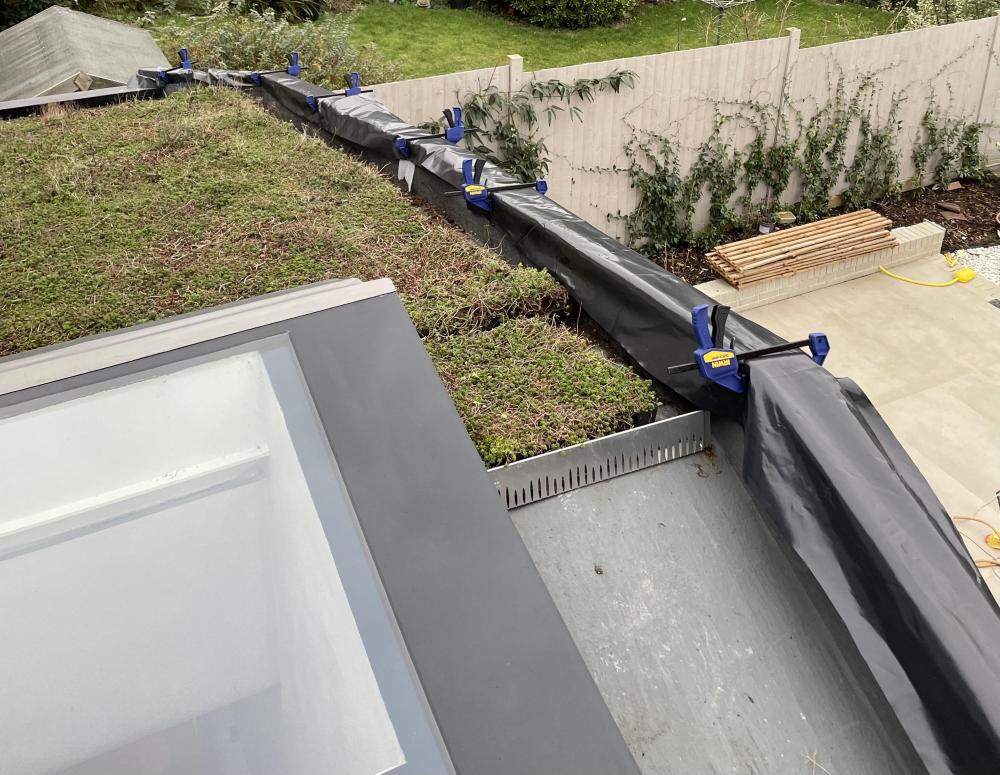
-
How to measure the remaining HW in an unvented cylinder
Adsibob replied to Adsibob's topic in Boilers & Hot Water Tanks
Nice. Particularly the bit when he says: “don’t know if it will work”! -
How to measure the remaining HW in an unvented cylinder
Adsibob replied to Adsibob's topic in Boilers & Hot Water Tanks
What is batch charging? -
How to measure the remaining HW in an unvented cylinder
Adsibob replied to Adsibob's topic in Boilers & Hot Water Tanks
Well this was my thinking entirely. And I thought I could do this: But I was obviously rubbish at it. The system I have works well, but the lack of compatibility between Tado and Viessman and my ignorance of the 4 pipe system being needed to get low temperature heating and my apparently viessmman approved engineer’s failure to point this out to me really f&cked me up. -
How to measure the remaining HW in an unvented cylinder
Adsibob replied to Adsibob's topic in Boilers & Hot Water Tanks
Cheers, I will PM you. -
How to measure the remaining HW in an unvented cylinder
Adsibob replied to Adsibob's topic in Boilers & Hot Water Tanks
This is all fecking complicated. I'm starting to think I should have swallowed the £2000 design fee I was quoted in 2021. Looking back at my emails, the chap I was speaking to said: one zone per floor, Weather Compensation, low temperature heating. I'm not sure what his solution would have been to the two towel rads though. Times like this I wish I was Marty McFly. -
How to measure the remaining HW in an unvented cylinder
Adsibob replied to Adsibob's topic in Boilers & Hot Water Tanks
So how much is an esbe valve and pump? And how many of these would I need? Is it one per manifold? Or one per loop? -
That makes a lot of sense. Of our 6 rooms with extraction, 4 are adjacent or very close to the MVHR machine, so pretty short runs. Whereas most of the other rooms of the house which all contain supplies, are further away.