Adsibob
-
Posts
3609 -
Joined
-
Last visited
-
Days Won
10
Everything posted by Adsibob
-

How to measure the remaining HW in an unvented cylinder
Adsibob replied to Adsibob's topic in Boilers & Hot Water Tanks
Thanks for this @Lofty718, but just to flag that I do also have two towel rads on their own zone, which will always need hotter water than the UFH temp water, but presumably they could be heated by the same water that heats the system boiler? -
How to measure the remaining HW in an unvented cylinder
Adsibob replied to Adsibob's topic in Boilers & Hot Water Tanks
Are you saying it's possible they do modulate Veissmans after all, they are just not certified as such? -
How to measure the remaining HW in an unvented cylinder
Adsibob replied to Adsibob's topic in Boilers & Hot Water Tanks
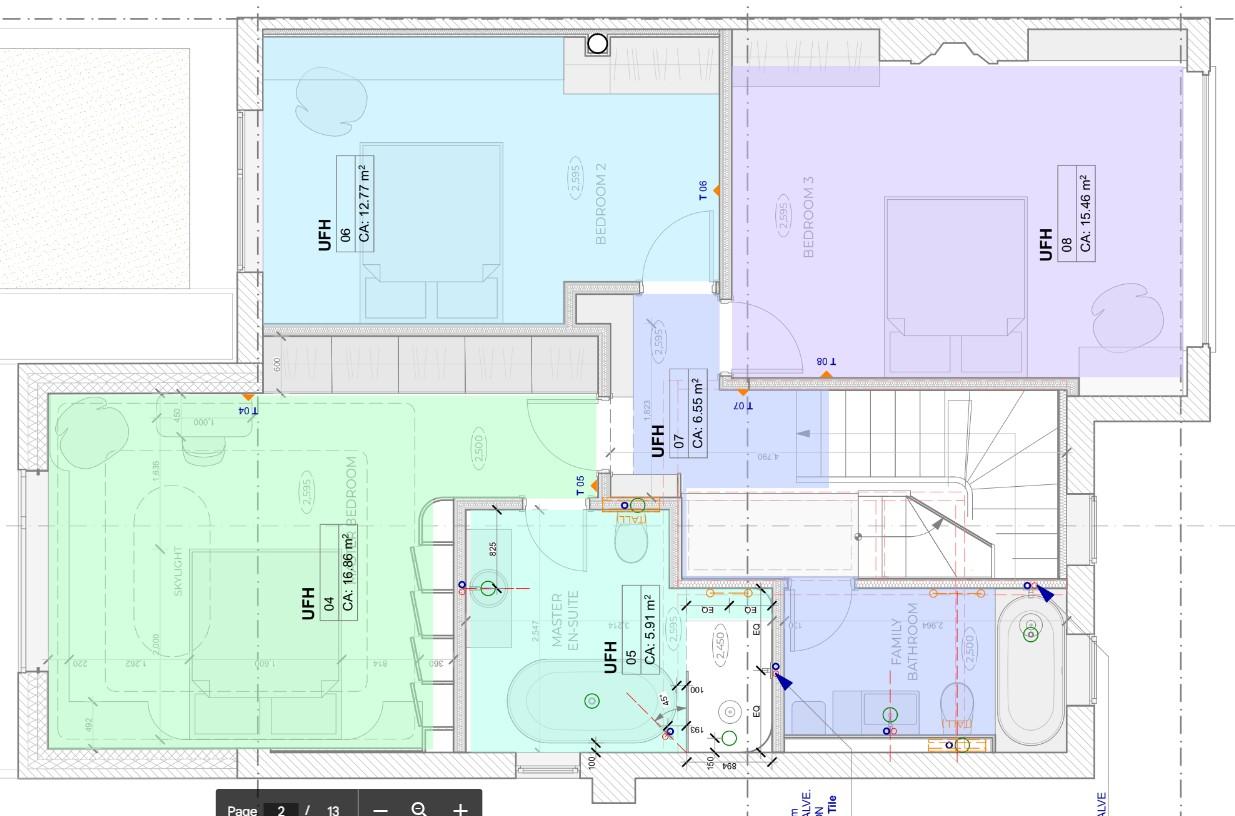
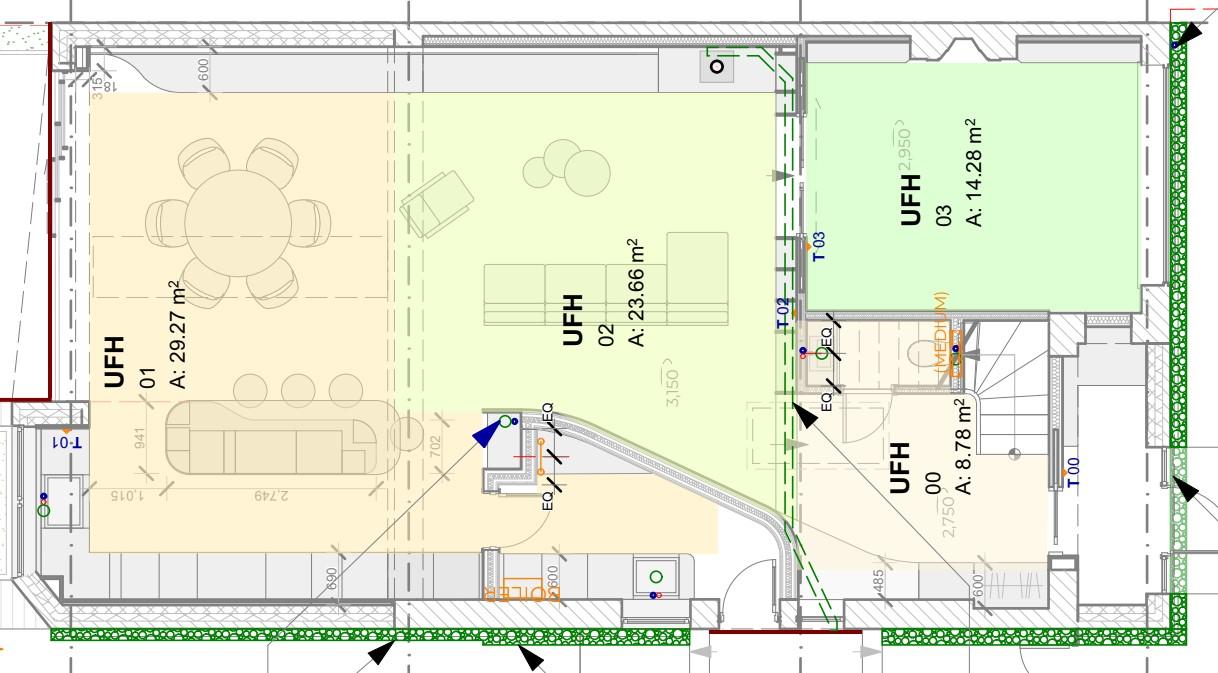
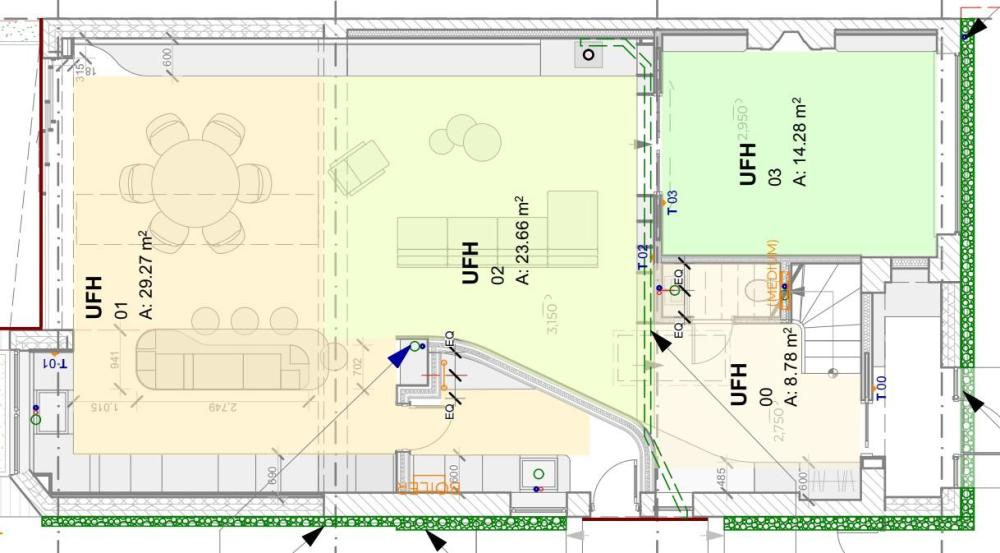
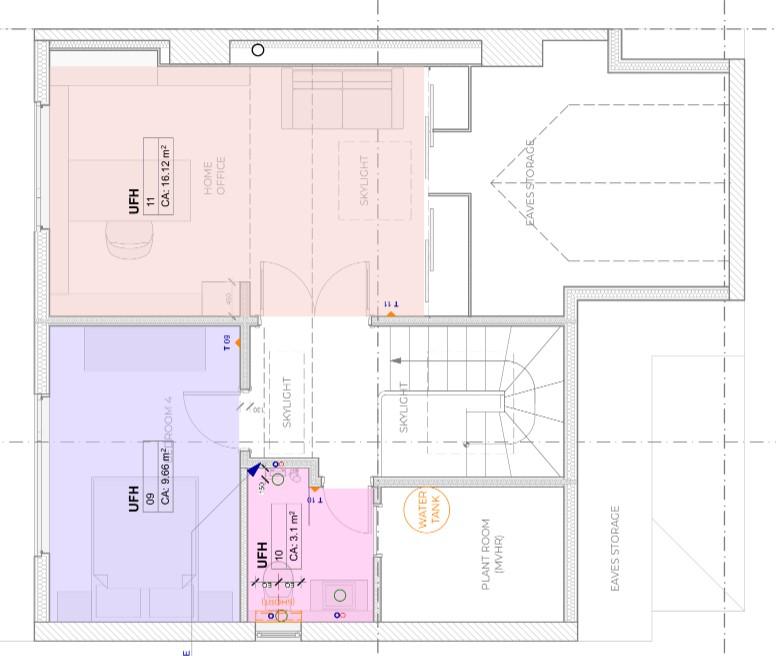
I have pasted below the plans of my house which show the different zones. Under each plan I have noted details of the construction, as these aren't always accurately set out on the diagram. GROUND FLOOR (4 zones) There are 4 zones on the ground floor shown above, each with its own overpriced and misrepresented piece of junk tado thermostat. When you look at the above ground floor plan, the two thirds of the ground floor to the right is original construction, solid brick walls, upgraded externally with 40mm of EWI Kingspan Kooltherm K7 and a layer of silicone render on top of that (shown in green). There is a mistake in the plan in that the rear extension forming the third of floorspace to the left of the plan, show the EWI extending all along the flank wall, but in actual fact only about half of that extension wall is covered in EWI and render, the rest is brick. We have 2G windows throughout. The rear extension has large sliding doors which are West facing, and there is also a large 2G window above the kitchen sink that is west facing, so plenty of afternoon/evening sunshine. Whereas the front of the house is east facing so gets morning sun. The original house was a 1930s semi, with the Northern side (top of diagram) being attached to the adjacent building. Funnily enough, they have had their front elevation done with the same EWI we have, using our builder after they saw ours. But only the front. Our front room (UFH zone 03) rarely needs any heating. I think part of the reason is the neighbour's EWI, but the other reason is that room, as well as UFH zone 00 is raised upper ground floor (about 210mm higher), with much more concrete under the 100mm PIR floor insulation, onto which the UFH pipes are tacked. FIRST FLOOR (5 zones) The hallway and family bathroom are the same zone. Orientation is same as described above, so UFH zone 7 is getting morning solar gain, whereas zones 04 and 05 are getting evening solar gain. Zone 04 also has a fairly large skylight. Not much solar gain for the ensuite bathroom or family bathroom, as windows are small. The entirety of the external walls of the first floor are covered with the same EWI buildup as described above, despite this not being shown on the drawing. SECOND FLOOR (three zones) This is a loft conversion so largely a modern construction, but the side walls and front wall (top and botoom and right) are mostly original construction from the 1930s, with only the dormer cheeks being new. There is a combination of wood fibre insulation and PIR backed plasterboard in the roof build-up, but it still only just passed building regs as we didn't have space to put more in. We went for wood fibre to increase decrement delay. The three skylights in the roof give quite a bit of solar gain. Our adjoining neighbour has also done a loft conversion, so we get protection along the northern wall, which is all adjoined by their house. On the eastern wall (right) and parts of the southern wall (bottom) we have the same EWI. The house is VERY airtight. I haven't done a test, but the detailing was pretty good and builder was good about using Tescon Vana tape on all windows and doors. CONTROL/ZONING So as you can see, I have a whopping 12 UFH zones, each with their own Tado. Then there is a 13th zone, just to control the two towel rads we have on the first floor. These are simply switched on and off by a command to alexa to switch on a smart plug. I have the Tado extension kit to control the HW cylinder in the attic space. There are four UFH manifolds in total: two on the ground floor (one for zones 00 and 03 which are on the upper ground floor; and one for lower ground zones 01 and 02) one on the first floor one on the second floor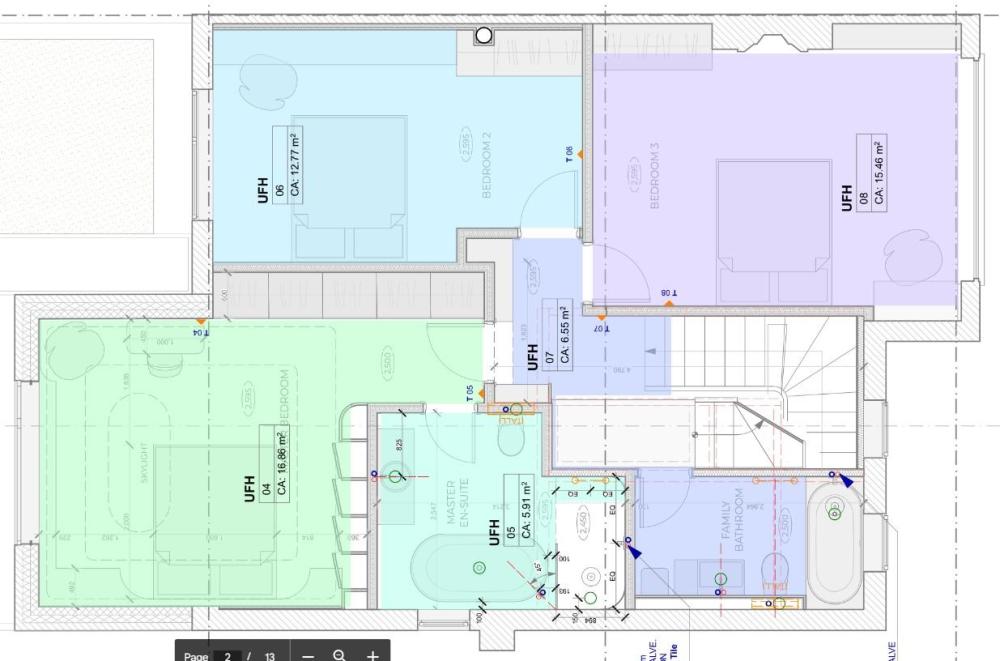
-
How to measure the remaining HW in an unvented cylinder
Adsibob replied to Adsibob's topic in Boilers & Hot Water Tanks
Thanks, I will do this and report back. -
How to measure the remaining HW in an unvented cylinder
Adsibob replied to Adsibob's topic in Boilers & Hot Water Tanks
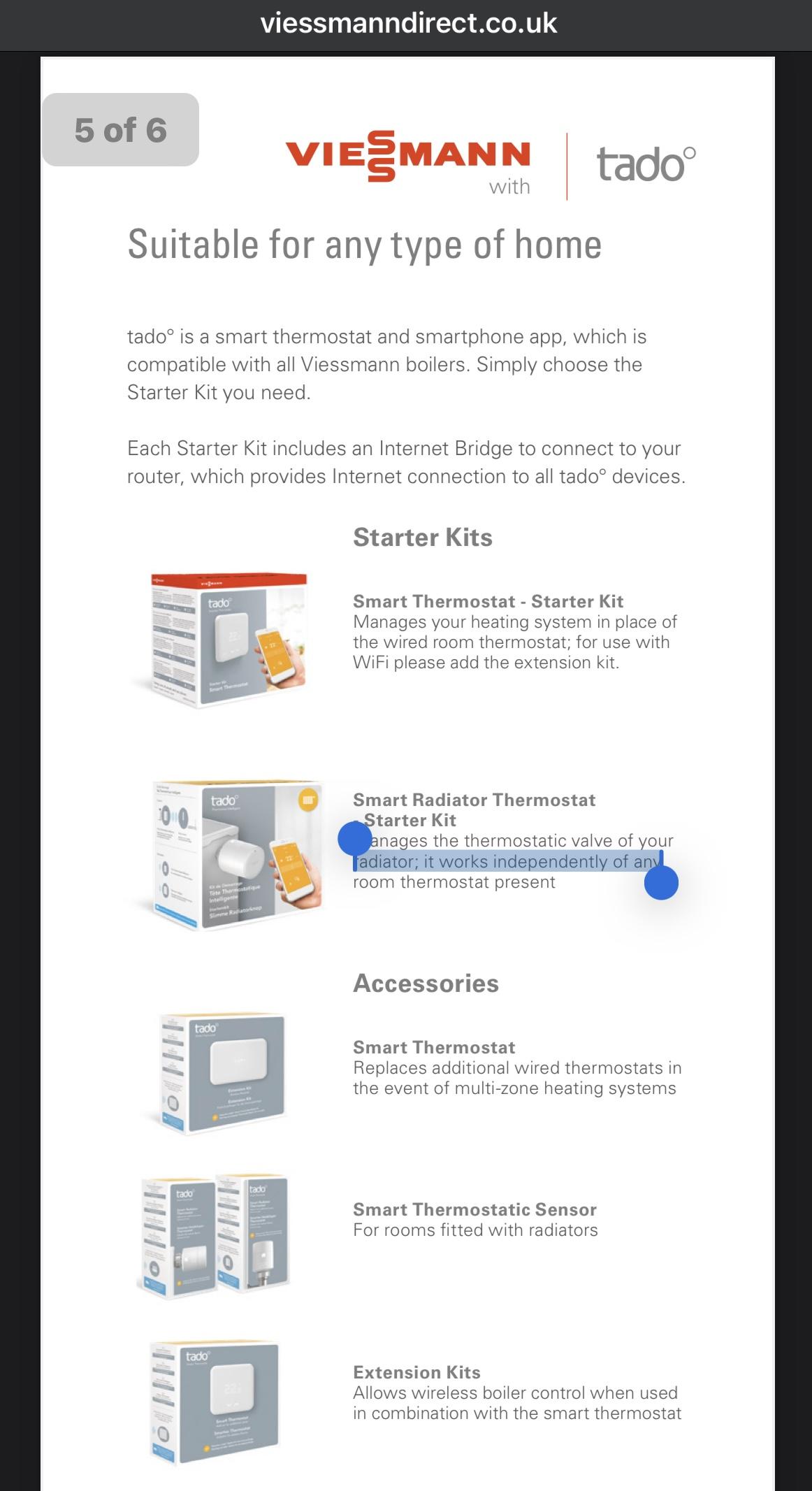
Well, I think they are stretching the interpretation of “compatible”. I’d hardly describe it as “compatible with all Veissman boilers” when there is actually very limited functionality compared with other fully functional thermostats. -
How to measure the remaining HW in an unvented cylinder
Adsibob replied to Adsibob's topic in Boilers & Hot Water Tanks
I still find it incredible that I spent so much money on a complete lie. This is from a shop specialising in Veissman kit: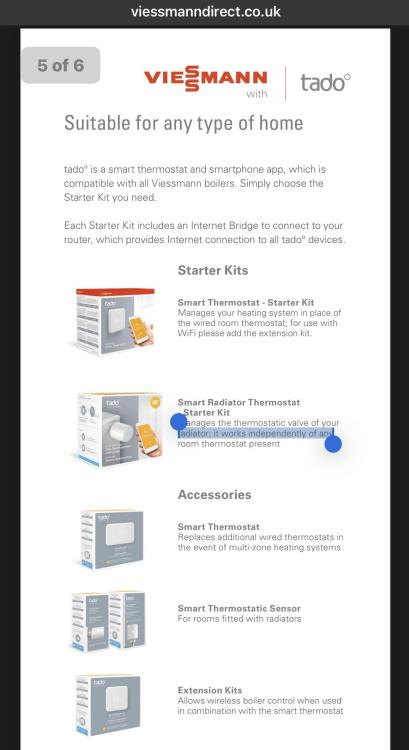
-
Spotted something a little odd on my energy bill this month: “You’re on our cheapest gas tariff of its kind. You could save £114.22 a year by switching to Loyal Octopus 12M Fixed.” I’m not sure in what world these two sentences do not contradict each other, but it has reminded me that a couple of months ago I posted on this forum to ask if I should fix my energy rates and somebody said wait. Can’t remember if it was @ProDave or @Mr Punter or somebody else, but just wondered what forum users are doing in terms of tarifs, fixing etc. I’m keen to stay with Octopus so don’t mind paying a small premium for that, but still need to reduce bills as much as possible (and yes, for those that have kept up with my other thread, I’m getting my Veissman system upgraded…).
-
Installation cost
Adsibob replied to Mr Blobby's topic in Mechanical Ventilation with Heat Recovery (MVHR)
If that includes balancing and commissioning, and they are confident of not damaging your plaster work when they put the vent terminals in, that’s a pretty good price, at least for London. Which terminals are you going for? I’ve got cheap ones in my bathroom and kids bedrooms, expensive lindab airy ones elsewhere. Quite a big difference in audibility. Would recommend plumping for lindab airy if you can. -
How to measure the remaining HW in an unvented cylinder
Adsibob replied to Adsibob's topic in Boilers & Hot Water Tanks
Thanks. What is high flow temp ufh? I installed slightly thicker ufh pipes (I think they are 15mm diameter) at 150mm distance from each other. Is that high flow? -
How to measure the remaining HW in an unvented cylinder
Adsibob replied to Adsibob's topic in Boilers & Hot Water Tanks
Thanks @Lofty718. Following your and @SimonD’s recommendations I’ve reached out to an engineer that specialises in Veissman. Had a chat with him this morning and his preliminary view was that weather compensation and covering to a 4 pipe system would be worthwhile as it would save me money, significantly more than the cost of the upgrade. The only thing that he said against weather compensation was that it would only not be of benefit in a house that only needs heating for a couple of hours in the evening and a couple of hours in the morning. In those circumstances, he said an on/off system MIGHT make sense. He emphasised that he would still err on the side of weather compensation, but I do find this interesting given four days a week the house is empty from 830 to 5ish and we don’t run the heating at all between 10pm and 5am. Maybe that’s enough is to justify weather compensation though. I am slowly coming around to the idea of removing all/most zoning, and converting to weather compensation. Still hampered by my own ignorance. I think what’s still holding me back is: 1) what is load compensation ? 2) I need to understand this further: particularly in light of the two matters below: First, we have a daily situation where it makes sense to have very different temps in different rooms: our master bedroom, has slightly more heat loss than our other bedrooms, because it is more exposed/has greater surface area ratio of external walls to volume of room storage. We like this about the master bedroom, because it keeps it nice and cool at night, usually around 18C. We would only turn the heating on if it falls below 17.8C and that only happens in very cold winter weather that lasts for more than a day or two. You mention balancing allows different temperatures in different rooms, so presumably I could still keep this room really cool because it’s on a separate loop. Second, about once or twice a week in winter we run a wood burning stove. How would we switch off the heating in the rooms that benefit from the stove without zoning and thermostats? -
How to measure the remaining HW in an unvented cylinder
Adsibob replied to Adsibob's topic in Boilers & Hot Water Tanks
Any idea how I find that info? Playing around in the display, I found readings for burner modulation, flow temp and flue gas temp, but not return temp. -
How to measure the remaining HW in an unvented cylinder
Adsibob replied to Adsibob's topic in Boilers & Hot Water Tanks
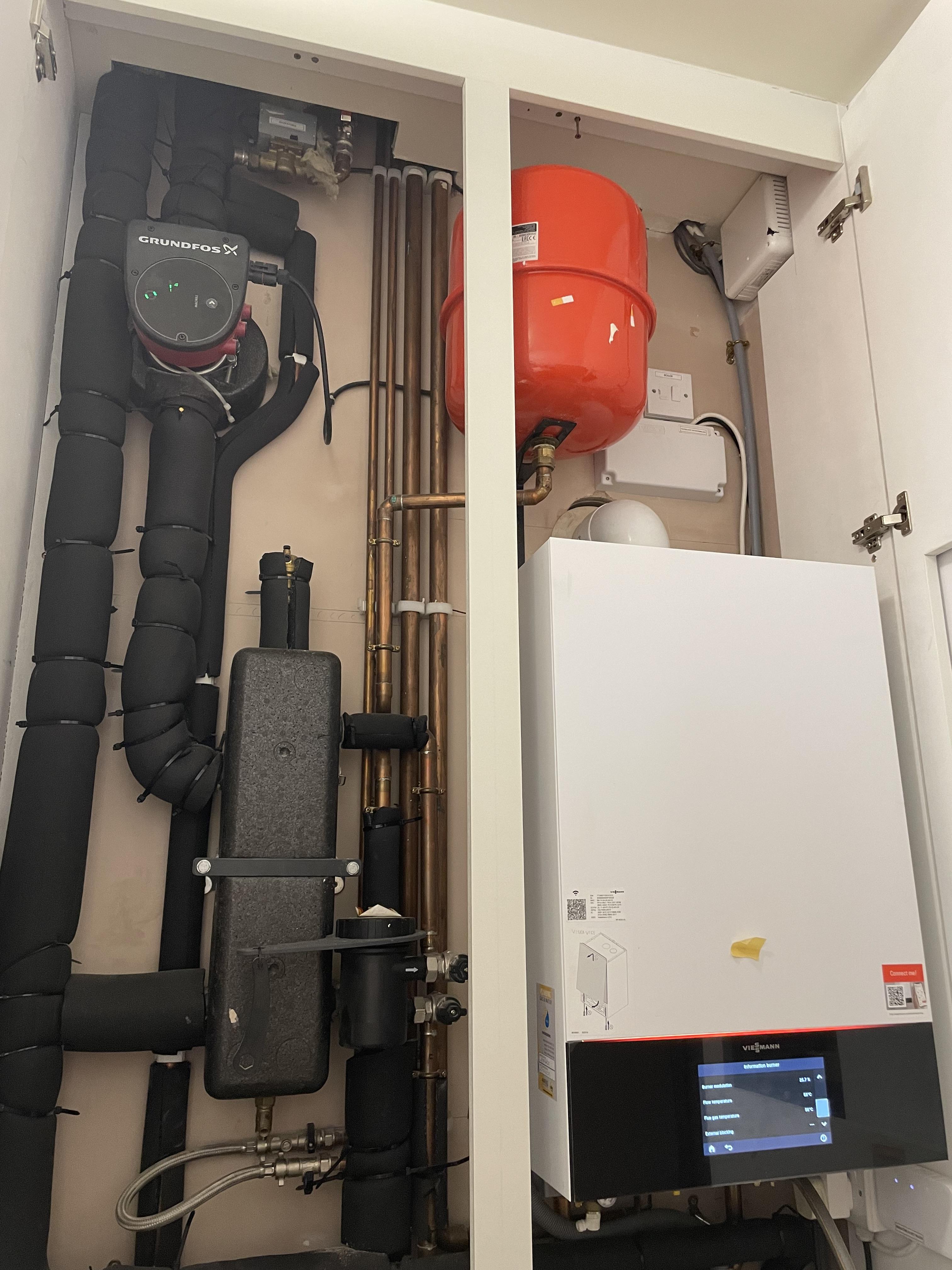
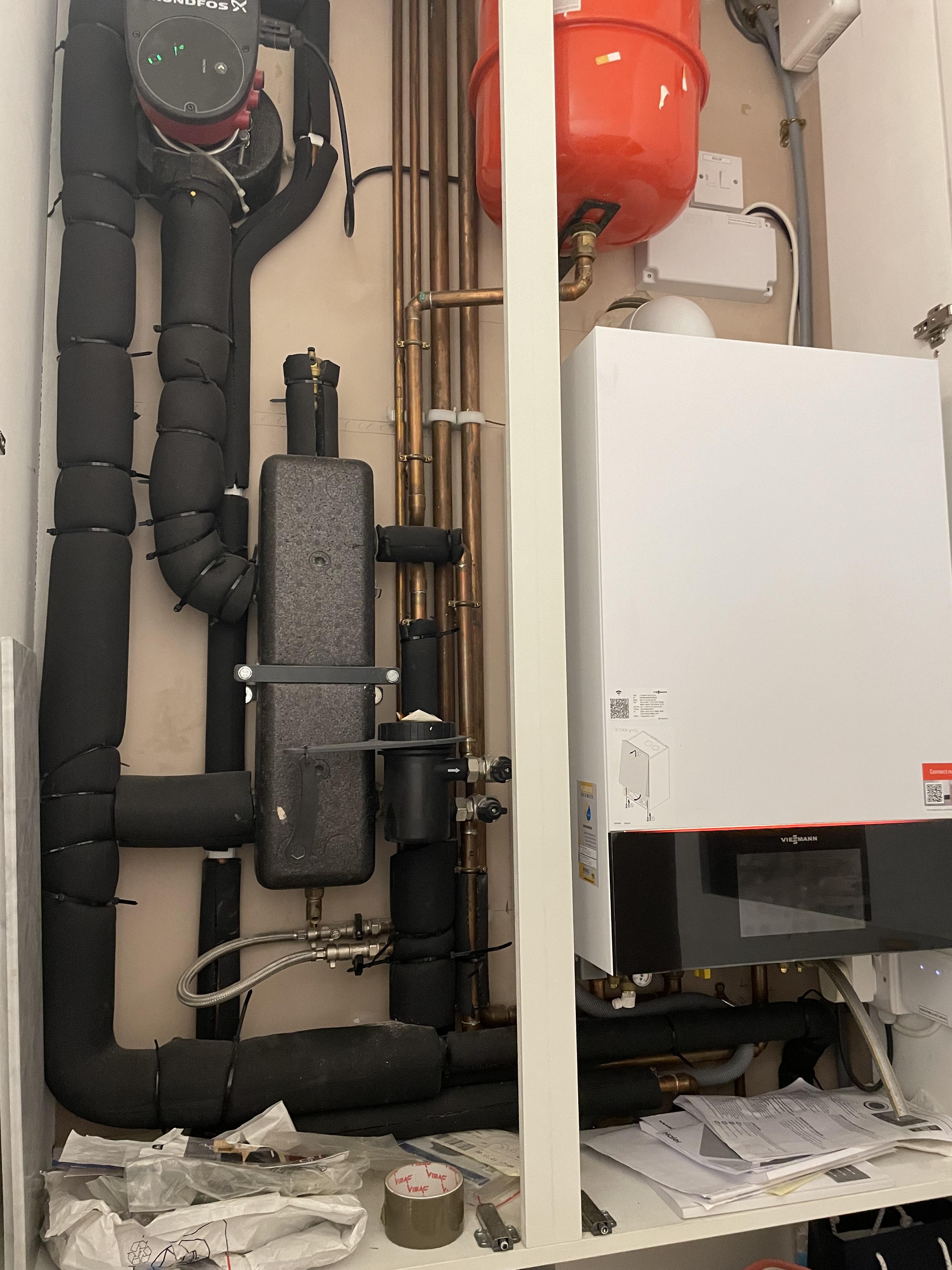
Right next to each other. Here is a as photo, boiler on the right, LLH is the anthracite polystyrene clad box immediately to the left of the magma clean, which is immediately to the left of the boiler.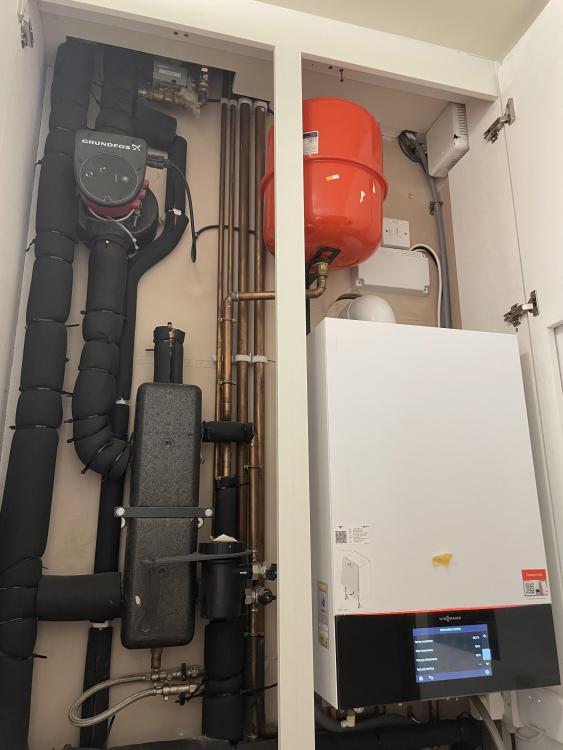
-
How to measure the remaining HW in an unvented cylinder
Adsibob replied to Adsibob's topic in Boilers & Hot Water Tanks
I presume you mean at the boiler, rather than at each of our four UFH manifolds? -
How to measure the remaining HW in an unvented cylinder
Adsibob replied to Adsibob's topic in Boilers & Hot Water Tanks
Re the comments on weather or compensation rather than room stats, I’ve mentioned this elsewhere on this forum, but I don’t see how that is meant to work in a house which has some rooms which are east facing, other rooms which are west facing and one fairly large room which is neither. Solar gain, even in winter means that our east facing room is warmer in the morning and cooler in the evening than the west facing room. Yet each of two rooms on opposite sides of the house is used as a bedroom for each of our kids. They don’t have the same temperatures without heating on, and we require heating at slightly different times because they have different schedules. So having each room on its own zone with its own stat and timer is very helpful. Similar issues at play in respect of many other rooms in the house. Each room, without heating has its own micro climate - apart from the different orientations, the house is a mixture of constructions, with some of it built in the 1930s and upgraded now, and some of it built from scratch now. The house is on three floors to make matters slightly more complex too. I’m not sure how one could retain the control we have now, without individual room stats and timers in each room. Maybe the answer is load compensation, I’m not sure what that is??? -
How to measure the remaining HW in an unvented cylinder
Adsibob replied to Adsibob's topic in Boilers & Hot Water Tanks
That’s helps put things in perspective. Thanks! Reflecting on all this, I know my situation isn’t terrible, because I imagine we use a fair bit of hot water and we like the house fairly warm, yet our bills aren’t crazy. But it remains rather disappointing because I suspect that if I’d have everything done properly, I’d be saving something on my bills, but the question is what? I did look into a professional design, but it was quite expensive, circa £2k, and the two companies I spoke to seemed to be wedded to the idea that I should get a Veissman storage combi boiler which didn’t sound right for our usage case and in circumstances where we had space for a 300L cylinder in the loft. So I thought I would just do as much research myself and then specify the model of the boiler I wanted, and the size of the cylinder and the heating zones, and that I’d leave the detail of how to set that up to the professional. I can’t now remember how the low loss header came into the equation. I think it was an alternative to buffer tanks as (a) I wasn’t sure we had space for a buffer tank; and (b) the installer didn’t think a buffer tank was necessary, but I was worried about short cycling. I am not really sure how I feel about raising this with the installer. I could make an argument that he was incompetent in that he did not install according to best practice, but I never told him I wanted a specific set up. I just assumed he would install it in accordance with best practice. On the other hand, the following analogy appears apt: When I get in a black cab in London (as opposed to a clueless Uber) and I give the cabbie an address, I expect him to take a reasonable route. If he doesn’t know the route, I expect him to ask or to look it up in an authoritative source. Within my fare, I’m paying for the petrol consumed as well as for the cabbie’s time, and so I’m entitled to get a reasonable route that is reasonably quick and reasonably petrol efficient. Am I not entitled to the same in respect of my boiler and UWC install? In that case, whether it’s his fault or mine, probably comes down to how inefficient the system is compared to a 4 pipe system. If significantly less efficient, then it’s probably not a “reasonable” install. But if it’s costing me no more than £75 extra a year in gas, it’s probably not terrible. -
How to measure the remaining HW in an unvented cylinder
Adsibob replied to Adsibob's topic in Boilers & Hot Water Tanks
Far. Boiler is in utility room on ground floor. Tank is in the converted loft on second floor (although pretty much directly above it, so maybe 6m away. -
How to measure the remaining HW in an unvented cylinder
Adsibob replied to Adsibob's topic in Boilers & Hot Water Tanks
Sorry Marshian, I’m not understanding your response. I (now) understand that PDHW is best design, but in the absence of this I’m trying to understand how much worse of my current setup is, given I had understood there were efficiency benefits of using a low loss header. -
How to measure the remaining HW in an unvented cylinder
Adsibob replied to Adsibob's topic in Boilers & Hot Water Tanks
To at to my previous post, my understanding is that for a boiler to go into “condensing mode” the return temperature should not be higher than about 55C and a low loss header can assist with this. So I’m just trying to figure out if the benefit I’m getting from the low loss header might be cancelling out the efficiency deficit of not having PDHW. -
How to measure the remaining HW in an unvented cylinder
Adsibob replied to Adsibob's topic in Boilers & Hot Water Tanks
@SimonD thanks. Please could you explain what is wrong with my current setup and how much more efficient heating the cylinder would be if I did this work? Just trying to understand the cost benefit analysis. -
How to measure the remaining HW in an unvented cylinder
Adsibob replied to Adsibob's topic in Boilers & Hot Water Tanks
-
How to measure the remaining HW in an unvented cylinder
Adsibob replied to Adsibob's topic in Boilers & Hot Water Tanks
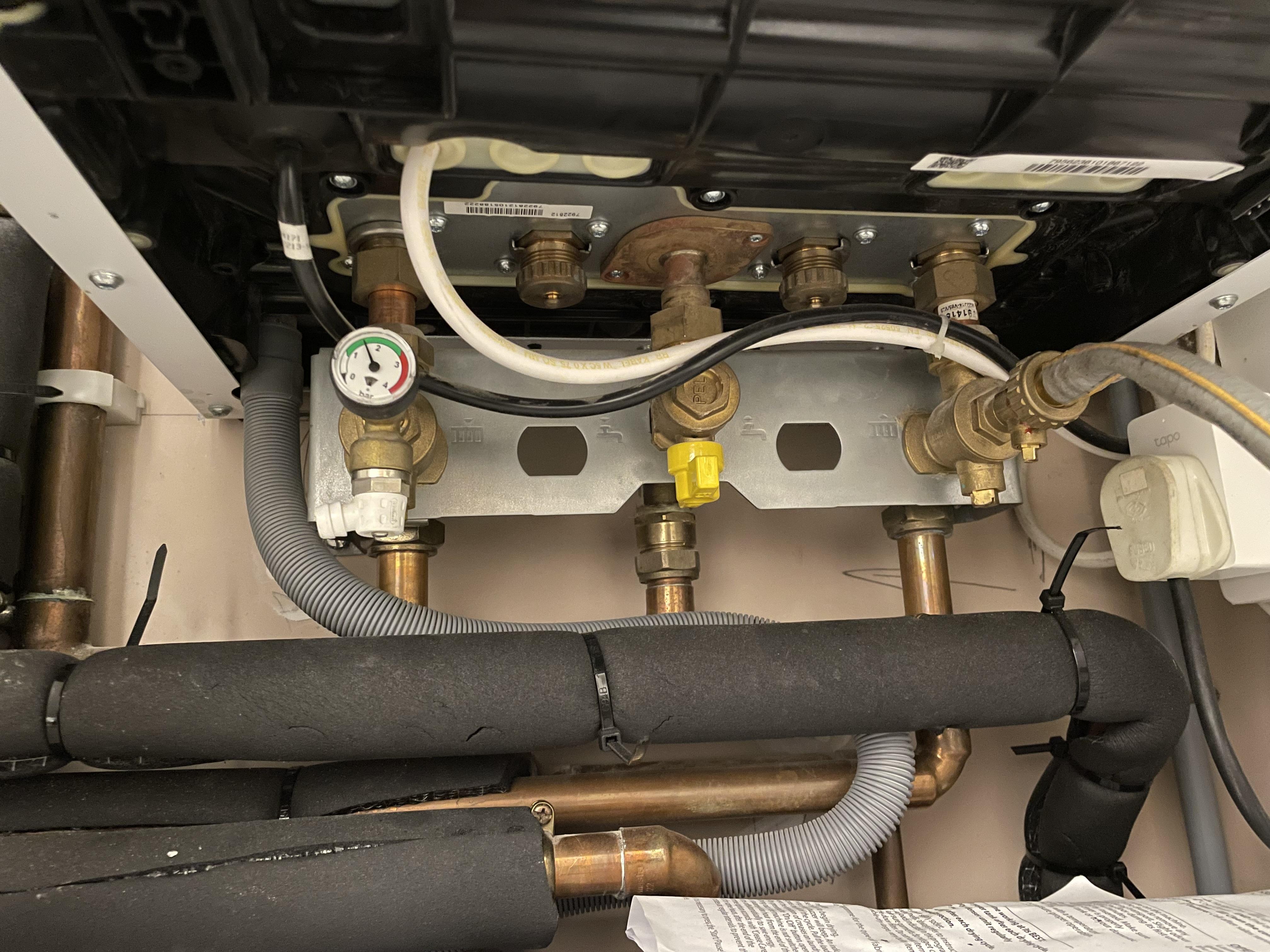
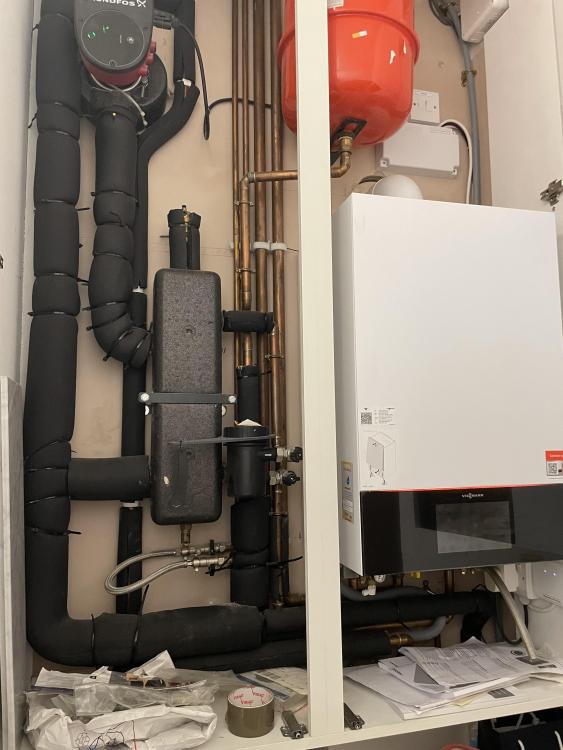
From what I can see, it’s two pipes, plus a gas pipe: I also have a low loss header, not sure if that impacts your views (see next post)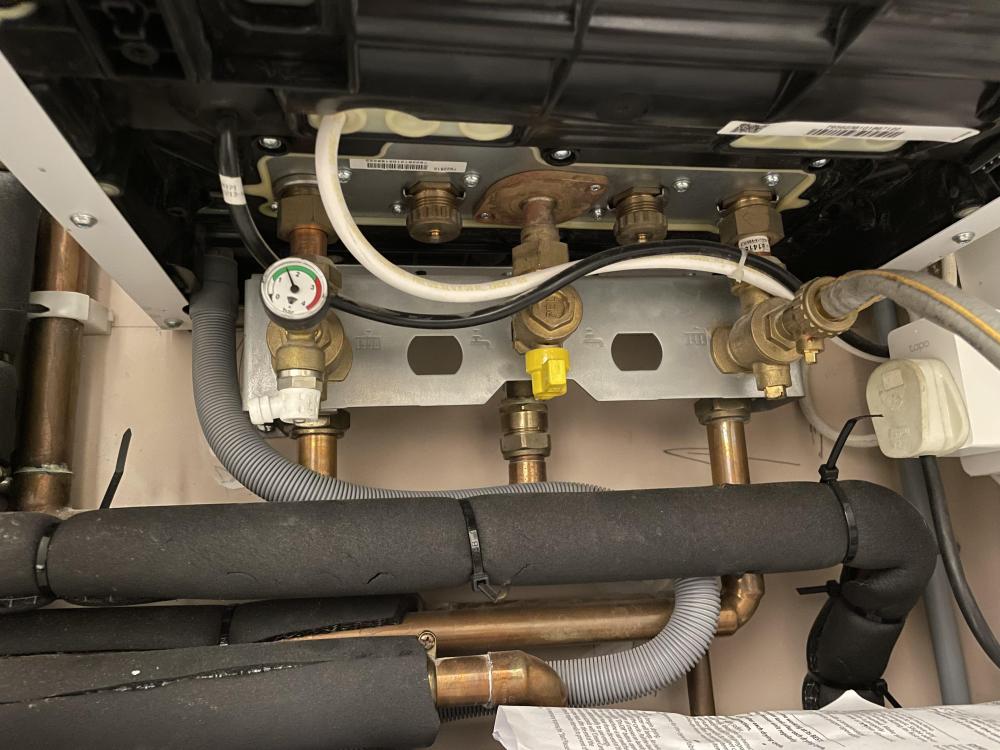
-
How to measure the remaining HW in an unvented cylinder
Adsibob replied to Adsibob's topic in Boilers & Hot Water Tanks
But the HW control is separate to the UFh controls. And whereas the UFh controls are zoned and use low temp water, the HW control doesn’t. So if you could recommend a smart controller for the Hw I’d be grateful. -
How to measure the remaining HW in an unvented cylinder
Adsibob replied to Adsibob's topic in Boilers & Hot Water Tanks
If this is accurate, then this marketing piece is one of the most misleading adverts I’ve ever fallen for. Shame we don’t live in Australia or the US otherwise this would be a great class action. -
How to measure the remaining HW in an unvented cylinder
Adsibob replied to Adsibob's topic in Boilers & Hot Water Tanks
Other question I have is whether load compensation is that relevant for a house that is only heated by UFH? The boiler sends hw to the manifolds and its mixed there. There are very rarely higher deltas between desired room temp and actual room temp of 2C, 2.5C at most. -
How to measure the remaining HW in an unvented cylinder
Adsibob replied to Adsibob's topic in Boilers & Hot Water Tanks
Are you sure about this? I wasn’t aware. If it’s true, that’s pretty cheeky of Tado. I kind of assumed that smart meant smarter than a bog standard controller. I’m not going to change the UFH tado thermostats, but if you think there is a benefit to changing the HW controller, I’m happy to consider it. Is there something that can be controlled away from the house that also meets the requirements you mention?