Adsibob
-
Posts
3604 -
Joined
-
Last visited
-
Days Won
10
Everything posted by Adsibob
-

GRP - how to deal with non-standard angles
Adsibob replied to Adsibob's topic in Roofing, Tiling & Slating
If I were to leave the plywood as is, i.e. without expansion gaps, is it still worth applying fibreglass tape over all the seems? Any reason why this can't go on top of the seams rather than underneath it (which would require removing the plywood? -
GRP - how to deal with non-standard angles
Adsibob replied to Adsibob's topic in Roofing, Tiling & Slating
Thanks @Bakersdozen. So I've got some further info from site today. The plywood that has been used is WBP Plywood. I asked my builder why he didn't leave expansion gaps and he said that there are a couple of expansion gaps but mainly it's been laid "board to board" because WBP is resistant to expansion or shrinkage. Googling WBP seems to back this up (e.g. this website says: "because the WBP plywood layers are bonded with the grains running against each other the WBP plywood is highly resistant to expanding or shrinking, it is less likely to split when nailed at the edges, and the sheet strength is consistent in all directions." I don't know whether the WBP used is EN314-2 (class 2) or En314-3(class 3). In an ideal world class 3 would have been used, but given the plywood deck will be protected by the GRP only has only had one or two days rain on it, which has since fully dried (they patched up the tarp tent protecting it and dried it with an huge industrial style hair dryer), I'm hoping that even class 2 will be okay, or am i being naive? -
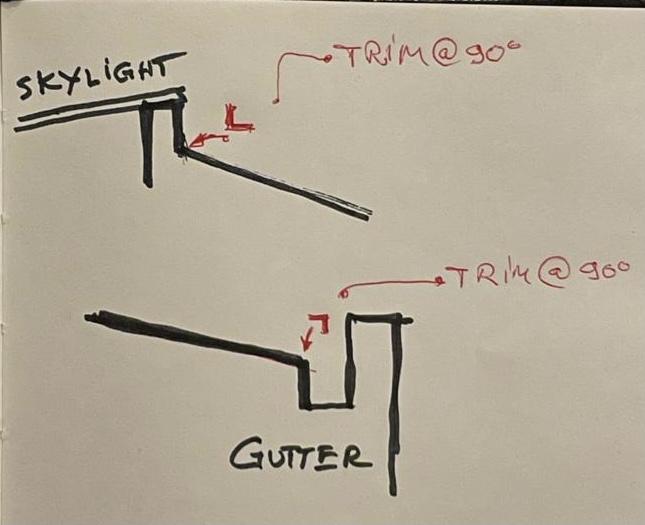
The shell of my ground floor extension has been built. It has a gable roof, more or less, with an 18 degree fall. I say "more or less" because it is rather bespoke and has some unusual features so as to conceal a gutter and skylight behind a parapet wall. My builder has done the external deck with weatherproof ply, I think it's 18mm thick. We were then going to cover this with GRP before putting down trays for a seedum roof. Engineer has specified the rafters for this, structurally no problems. Because the roof was quite bespoke, my architect - who designed it - mentioned that it might be worth running the design by a specialist. I did and the specialist (who is a RICS surveyor and building engineer) made some tweaks which were quite sensible and also recommended we outsource the GRP and Seedum installation to a specialist roofing contractor that could give us a 20 year guarantee. Also sensible I thought. That contractor has now come and surveyed the roof. He has put the cat amongst the pigeons with the following: He does not think that the "non-standard" angles we have where our concealed gutter and skylight connections are will work with GRP. As the cross section below shows, we have an obtuse angle that is probably about 110 degrees just to the right of the skylight and reflex angle that is probably about 250 degrees just above the gutter. In both cases, I think the plan had originally been to use a 90 degree trim and bend it slightly to fit the angle, even though in both cases it would be out by about 20 degrees. The GRP contractor doesn't agree. He says: I have not quoted for a GRP system due to the angles as the preformed trims are all set at 90˚ and will not work with this angles of the upstands / downstands. If GRP trims are forced into position there is a risk of them cracking when thermal movement occurs. Instead he has quoted for the following: The Triflex product is a latest generation PMMA resin system that forms a monolithic membrane that is elastomeric when cured and is the same waterproofing that we use on curved garage roofs. Triflex resins are more expensive than GRP but in my opinion Triflex is the correct product for this project. My architect is quite surprised by this, because he thought GRP was very tough. Reading up on the forum, i see that others like @nod and @SteamyTea think it's tough too (e.g. here and here), although @markc did think it would crack if severely twisted. Does the forcing something designed for 90 degrees into a 110 degree situation, or perhaps even a 120 degree situation, count as severe twisting? If so, can't I lay the trims without twisting them and just have a slight air gap because it won't be flush due to the mismatch of angles? If GRP is really out, then the problem with using the Triflex PMMA resin, is that it's more expensive in terms of materials, but also the Contractor reckons the way my builder has built up the ply wood won't work as a base for the resin and will need to be redone. He says: the current roof deck is plywood that has been exposed to moisture, the correct roof deck board for this type of installation are 18mm tongue and grooved OSB3 It did get a bit rained on when a tarp tent that was meant to be covering it leaked (turned out it had a few holes on it) but my builder dried it with an industrial sized hair dryer and it's marine grade ply anyway, so I'm not too worried about the moisture as i think it's just cosmetic damage - though if anyone thinks I'm being naive, please do shout! We asked him what difference T&G OSB3 made vs Plywood and he said that the problem with plywood is twofold: (i) it could chip; and (ii) as it is not T&G it should have really been installed with a special tape under the seams. I'm guessing he means glass tape, but I'm not sure. So if we now want to go down the Triflex PMMA resin route, we would probably need to do the plywood deck again, either replacing it with T&G OSB3 or taking it up, putting down the tape and relaying it. It's about 22 square metres, though because of our first floor extension that sits on part of this roof and the rooflight, it's not just two simple rectangles of 11 square metres each, a bit more fiddly than that. Another option is possibly to add OSB3 onto the existing ply simply to save the labour of taking up the existing ply. I'm sort of leaning towards finding a way to make the GRP work rather than start from the beginning so that we can get the 20 year guarantee, as we're low on cash and already very behind on the build and I'm sure if I tell my builder he's done the plywood deck wrong he will just blame my architect for not specifying OSB and we'll just get into a game of pass the buck. But I'm not leaning that strongly as it's not exactly a nice direction to lean in either way! Any tips or advice greatly appreciated.
-
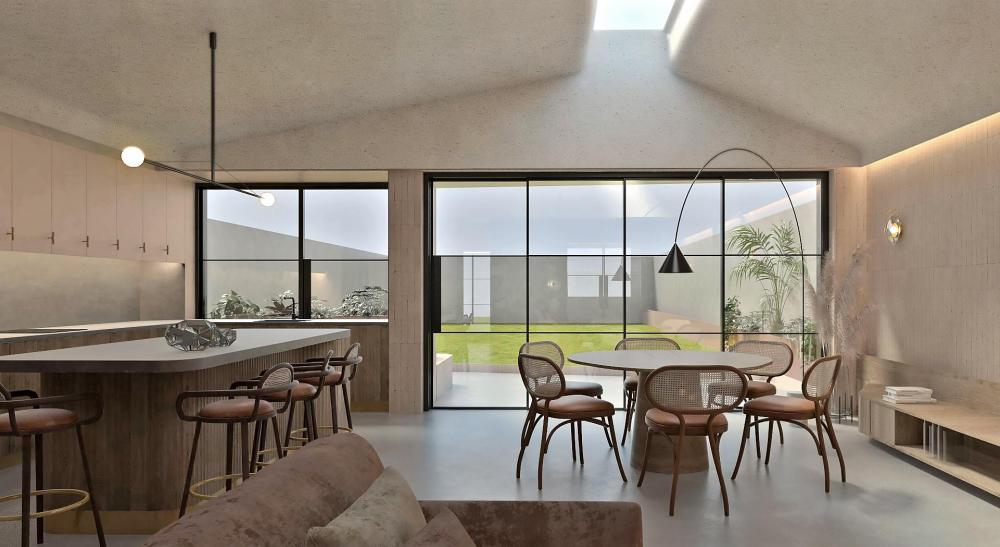
Yes, that is how ours was; we knocked down the wall between the kitchen and dining room and then lived in it for a couple of years whilst we waited for planning. Now we have knocked out the entire back and done a full width extension. The only way we got permission was by having the extension with the roof sloping downwards as it approaches each of our two neighbours’ houses. Hence the slightly unusual ceiling.
-
Here are some digital renders of the open plan kitchen diner we are doing with our 1930s semi

-
Thanks all. I should have updated you earlier. I think it’s all sorted now. Builder contacted the council after I got a little contractual with him, and he paid the fee for the licence (peanuts) plus an exorbitant deposit of £1600 in case he damages the Council’s pavement. I put my legal knowledge to use and did some research and came to the conclusion that the Council is probably exceeding their powers by demanding such a high deposit and such a high insurance cover, rendering their scheme amenable to judicial review. Unfortunately, I don’t have the time or energy to apply for judicial review, so I have just left it for the builder to resolve. To cover myself I wrote a polite, but firm letter to the Council attaching copies of the relevant clause in my contract and the emails between them and my builder confirming they had received his payment. So fingers crossed it’s all done, but I think the problem might resurface in a couple of months when the licence “expires”. This red tape is unbelievable. oh, and having the hoarding 1m in would only have been a temporary solution for us because we are digging up the driveway in a couple of months.
-
I’m sure the quartz we had at our last place stained. Isn’t it a mixture of resin or some other agregarte and ground up rock, so the resin/aggregate part can stain? Or is it just a question of what cleaning agents to use on it?
-
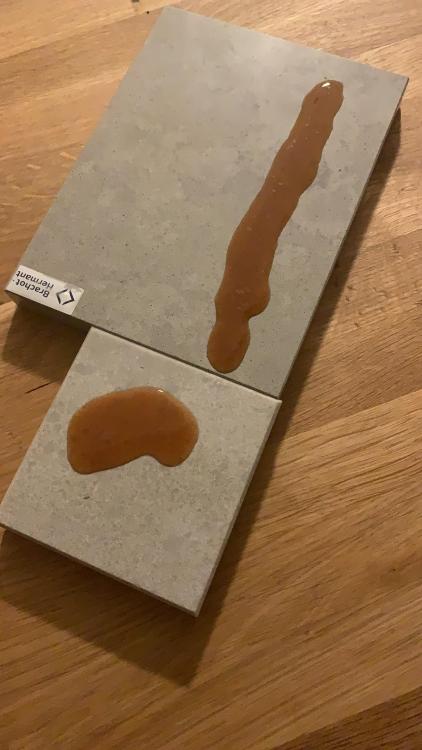
Yeah, I’ve also been messing around with the samples. See photos attached. It survived the blackberry/ketchup/soy/honey and used tea bag 8h test, but the jury is out on the 24h tea test. My wife is convinced the sample has slightly browned where the tea was, but I’m not sure (it’s the Primordia colour, which has a very subtle and tiny undertone of beige/brown). (the other sample is Unistone by Brachot Hermant, which we are also considering.)

-
Yes or no?
-
Architect has done a wonderful scheme but-
Adsibob replied to DragsterDriver's topic in Surveyors & Architects
I think it’s in most architect’s DNA to go off piste sometimes. We were extremely clear with what we wanted, but the first couple of plans the architect did go off on a tangent when he thought he was improving matters. He might have been for another client, but not for us. But I’m this case it looks like more than just a tangential problem; sounds like he’s in another dimension altogether. -
I struggle to see why one would need 3mm or even 4mm accuracy for such maps vs 40mm.
-
Help settle an argument- room layout
Adsibob replied to Crofter's topic in New House & Self Build Design
I think you mean melted tv. -
Following some helpful recommendations on this thread by @PeterW and @dpmiller, I have found a Trojan Supercast bath that fits all our requirements... bar one. My better half has pointed out that with two toddlers we should really be looking for a bath with handles. I asked the supplier if they could supply the bath I've found with handles. He said he couldn't and that if I fitted aftermarket handles, it may well be fine but he washes his hands of it in terms of warranty etc as it would invalidate the 25 (or 30) year warranty. Has anybody fitted aftermarket handles to a reinforced acrylic bath such as the trojan supercast? Which handles did you use and how did you get on?
-
Best spec for high pressure hot water to multiple outlets?
Adsibob replied to sendu's topic in Boilers & Hot Water Tanks
This really is very helpful thank you. I assume I would make the secondary loop itself 22mm as well? -
Best spec for high pressure hot water to multiple outlets?
Adsibob replied to sendu's topic in Boilers & Hot Water Tanks
Is it possible to restrict the flow using narrower pipes. I'm having a secondary loop for the hot water to the bath and basins (but not the showers). For for the basins could I just use a narrow pipe to join the hot water secondary loop to the basin, and supply cold water with narrower pipes as well? -
Best spec for high pressure hot water to multiple outlets?
Adsibob replied to sendu's topic in Boilers & Hot Water Tanks
Thanks, that's helpful. The taps are supplied with restrictors but these can be removed to increase the flow rate. The only area where I would actually want to do that and get as much flow as possible is the bath filler, as it's a HUGE bath and possibly the rain shower. I'm assuming I will lose some pressure anyway from the 2.8 to 3.2 bars coming in to the property at ground floor and the location of the UHWC which is about 6.5m or 7m above that on the second floor, so in actual fact I won't get the flow rates advertised for these taps/showers at 3 bar, but slightly less. Is the calculation simply 0.65 to 0.7 bar less to account for the 6.5m to 7m height travel? -
Best spec for high pressure hot water to multiple outlets?
Adsibob replied to sendu's topic in Boilers & Hot Water Tanks
I’ve purchased a bath filler with a 33L/min flow rate (at 3bar) and thermostatic valves for the showers that can do 30L/min (also at 3 bar). Guest WC basin mixer and kitchen tap are both rated at 24L/min each. So as long as i fit wide enough pipes, I’m not sure the limiting factor will be the taps? -
Best spec for high pressure hot water to multiple outlets?
Adsibob replied to sendu's topic in Boilers & Hot Water Tanks
I think I was just trying to understand the relevance of the flow rate of the tank. Is what you are saying that if my main water supply only gives me 20 to 25 L/m, i won’t see a difference between a 55L/m tank or a 130L/m? In both cases I will just get 20 to 25 L/m? But what if I have three outlets open at the same time? Won’t the 55L/m limit on the Telford Tempest kick in then, and limit my flow per outlet to 18.33L/m ? -
Best spec for high pressure hot water to multiple outlets?
Adsibob replied to sendu's topic in Boilers & Hot Water Tanks
That's helpful thanks. I've actually just found a 400L horizontal one. But what I'm confused about is that the flow rate is only 55L/m. That's less than half the flow rate adverstised with a Megaflo from Heatrae Sadia which apparently can do 130L/m. My understanding is that the main difference between the two technologies is that with an indirect unvented system, the Telford Tempest would need a separate expansion vessel whereas the Megaflo has some sort of air gap built in, so more efficient in its use of space and easier to install. But why would the flow rates be so different? Or is this all academic if the flow rate I'm getting from the street is about 20L/m to 25L/m with pressure of 3 bar? -
Best spec for high pressure hot water to multiple outlets?
Adsibob replied to sendu's topic in Boilers & Hot Water Tanks
Can anyone recommend a 400L horizontal unvented cylinder? I think the largest horizontal one Telford does is 300L. -
The CO alarm point is a good one! Hadn’t thought Of that
-
I'm still on the fence. I've fallen in love with the Bora corner stove and had managed to get the manufacturer to sign off on the length and layout of our rather long air supply pipe, but it's not DibT certified, but maybe it doesn't need to be and this is just a lot of hot air from the HETAS engineer. He did try to scare me though, by saying "it's not just smoke that will leak, but carbon monoxide too". Now considering: Spartherm Cubo L Spartherm Seo S Rais 600 Max Rais Q-Be all of which are DibT rated (i think!), but still need to find out if they are all Defra approved for smoke control zones (as I live in one). Maybe I should just go with the Bora corner stove and set the MVHR with a bit of positive pressure and just find a non-HETAS approved installer.
-
Now that I understand there is a gold standard, that sort of makes sense. I emphasis the “sort of” because now I’m confused about whether I should just stick with the Bora and make sure I’m running a mild positive pressure, and for a pressure alarm if necessary, or ditch the Bora completely and try and find a Dibt compliant stove that meets my needs. Generally it’s very frustrating to have specifically requested Stovesonline to recommend an MVHR compatible stove, and for them not to have mentioned this gold standard until now. It would have been nice to get the steer on that. Really feel like they’ve lead me down the garden path. It is also confusing because this means that the majority of stoves marketed as direct air supply stoves suitable for use with MVHR are not.
-
So my saga to find an appropriate stove for a house with MVHR continues. I had settled on the Dik Guerts Bora Corner Stove. It is marketed as suitable for using with a direct air kit and after much persistence the importer was able to confirm that the air supply can be up to 11m long with up to 4 bends in it. That's plenty as we only 2 bends and 7.75m. So Stovesonline are pushing me to purchase it. I'm still prevaricating because it's so expensive and such a big decision; they reassure me that for extra peace of mind I can have a free survey with their recommended installers. So an engineer from a company called Bespoke Fire & Flue Services comes along to my house to survey it; it's all fine except he tells me that the DG Bora is not certified for use with MVHR! I was initially rather annoyed but then started to doubt him as he said that actually "no stove is fully air sealed as you'll always get leakage when you open the door to light or refill it". I went back to Stovesonline to query this. They have now come back to me to say there are three levels of air tightness when it comes to stoves: "DIP Test" ceritifed, which is a german standard adopted by passivehaus; "100% direct air sealed" which is what the DG Bora is. "direct air feed" which takes the majority of its air from the direct air supply, but not enough to be suitable for MVHR. I have googled DIP Test and passivehaus and couldn't find anything. It's possible I misheard what Stovesonline were telling me. Maybe the dip it in water and test for air bubbles??? Anyway, stovesonline are telling me that: the DG Bora meets the second category the reason Bespoke Fire & Flue Services didn't recognise the DG Bora as MVHR compliant is because they are HETAS certified and the DG Bora hasn't been tested to HETAS standards that doesn't mean the DG Bora wouldn't pass if tested, and they are still recommending it for me just that I should specify my MVHR system to run with some "positive pressure" in the room where I'm installing it. So part of me wants to trust what Stovesonline is telling me, but part of me remains confused. Curious to hear other's experiences of air sealed stoves and MVHR. Did you go for the "DIP Test" certified one, whatever that is, or did you just go for a stove with an air supply. Do you have any issues with MVHR sucking smoke out of your stove when you open to light it or to refill it?
-
13 zones on one floor! Wow, that must be a big floor. I’m planning 3: one zone for front room and hallway, which has easterly facing windows, one zone for bank of the house which is an open plan kitchen diner and has westerly elevation and one zone for middle of the house which has no windows but should be warmer anyway with less heat requirements due to wood burning stove that will be used occasionally.