


Oxbow16
-
Posts
442 -
Joined
-
Last visited
Everything posted by Oxbow16
-
Why do flue lined chimney breasts not require ventilation?
Oxbow16 replied to Oxbow16's topic in Stoves, Fires & Fireplaces
Thanks for the reply. In our cases we both have old houses, so are referring to flue lining old chimneys with 316 or 904. They are quite thin steel and can't imagine they would be all that insulating. But regardless of how insulating it is, there is still a chimney void - quite large I'd imagine in some old houses - that is unventilated. Anyone know why that is not considered a problem? Cheers -
Hi I was discussing this with someone yesterday and we were both puzzled... It's normal practise to ventilate an unused fireplace/chimney, with a vent brick or grille at the fireplace and some sort of vent at the cowl. Yet if that same space was being used, but with a flue liner going through it, why does the remaining space around the outside of the flue not need to be ventilated? Especially considering the fluctuations of temperature going on inside the space... Could anyone explain? Many thanks
-
How to detail PIR at the wall cavity / wall plate in this situation?
Oxbow16 replied to Oxbow16's topic in Heat Insulation
Nice idea. But the room is only 1.5m wide. Any smaller than that and I'll have to bath in a bidet! -
How to detail PIR at the wall cavity / wall plate in this situation?
Oxbow16 replied to Oxbow16's topic in Heat Insulation
Nice idea but there's not enough headroom in the bathroom unfortunately. It's going to be cramped enough as it is with the 100mm insulation (50 in between/50 perpendicular). It's on the outer leaf. I'm going to see if I can pick some up tomorrow and will report back on how well it fits etc. Thanks for the suggestion. I'm all for saving money etc., but in this instance I'm going to use the right stuff. Thick it will be a lot easier to work with as well, given my situation. Thanks @Radian for the info and suggestions. I'll keep it in mind and am also intrigued to look into it, having until now always just assumed that CWI is a no no in our location. Around here all you tend to hear about is folk having it removed, not installed! That being said, for this particular wall only 1.5m in height is external. There's a single storey extension against the front of the house, so most of what used to be external wall is now internal, leaving just that 1.5m section as external. Many thanks to everyone fot he replies -
How to detail PIR at the wall cavity / wall plate in this situation?
Oxbow16 replied to Oxbow16's topic in Heat Insulation
Great responses – thank you very much. I’m going to close the cavities with the rock wool socks as kindly suggested A couple of questions please: - How compressible are the socks? The cavity seems to range from 70-80mm. Obviously I want to make sure they will stay in place and not drop into the cavity, and I presume it is just the compression that achieves that. OTOH, I don’t want something so thick it won’t compress enough to fit. So what would be the ideal size for me? - Are they bendy and manoeuvrable enough to allow me to thread them under the rafters? If not, what’s the best way to fit them? In answer to some of the other points... Yes, I think so, so long as they are flexible enough to be manoeuvred. Whatever the case, I'll be sure to not block the soffit vents. In fact, that's half the reason for doing this as they were previously blocked with vermiculite. We live in an area where cavity wall insulation is not recommended (driven rain/very wet). With no cavity wall insulation, will the rock wool sock be enough to achieve this decoupling? I've also got some Gapotape which I can put onto the end of the PIR so that the Gapotape and sock butt up against each other. Would that be enough? Yes, that's exactly what we're doing Space is very limited unfortunately, so using PIR to make the most of the space we do have. Thanks a million -
Sorry to be back so soon with another insulation question. I've taken a ceiling down to re-insulate from below. The rafters are 100mm, so I'm putting in 50mm PIR, and leaving a 50mm airgap behind for ventilation (soffits are ventilated). Cavity wall with no insulation. Access is a bit tight to the top of the wall and wall plate, but I'm hoping that with a bit of persusaion the PIR will go in there fine. My question is, should I be aiming to get the PIR pieces down to the wall plate (cut at angles so that they sit on top of the wall plate)? This would close/cover the wall cavity - is that a problem, or does the cavity need to remain open? A few pics to help visualise, Many thanks


-
Thanks for the replies
-
Thanks for the reply and for sharing your thoughts
-
Hi Back again with another insulation question. I've came across a couple of examples of people pushing PIR further into the void between rafters (but not so far as to impede the airgap behind for ventilation) rather than flush with the rafter face. Looking into it, I found this was done on purpose to create a gap between those between rafter pieces of insulation and the perpendicular insulation installed beneath to the underside of the rafters. These airgaps apparently create reflective radiation and increase the effectiveness. Just wondered what people think of this principle and whether it is right or not? And if the idea does have merit, what would the minimum amount of air gap needed be to have any worthwhile effect? Would 5mm/10mm do anything? Many thanks
-
Many thanks for all the replies. No, we don't have damp problems in the house. But we do often have very high humidity. That might be in part due to where we live (Wales, lots of trees are around and water), and also might be due to the house having previously had cement render and modern plaster on the walls (has recently been removed and replaced with lime). I think what I am going to do is add PIR to the skeilings between rafters, with another layer perpendicular. That's because space is limited in and beneath the skeilings. For the loft proper, I'll stick to normal insulation, which will be a combination of vermiculite between joists (because that's what is already there), and perpendicular mineral wool. VCL... In the bathroom, which will ALL be insulated with PIR, I'll use tape on the PIR to create a VCL, seeing as it is a moist environment. TBH, it won't get used for showers/baths more than once or twice a week, but I'll still aim to do it in case things ever change. For the rest of the rooms upstairs I'll tape up the PIR in the skeilings, but more to keep it as airtight as possible. Those rooms are all part skeiling, part ceiling, and as I'm not doing work to the ceilings (apart from adding the insulation in the loft) the opportunity to put in a VCL isn't there. Plus, I think I'd rather some moisture get into the (well ventilated) loft space than have it all trapped in the house. Does that all sound like a good plan? Many thanks
-
@saveasteading - thanks for all the info. TBH, I'm thinking more the VCL at ceiling level rather than at the roof. IE - between the joist insulation and plasterboard. Or in a warm roof, the VCL between the plasterboard and insulation. I've seen many cases in which people are using PIR and then going to great length to tape up all joins and gaps. You're info about roofs is also very interesting (and we do actually have sarking boards in one area of the house), so I'll file that for future reference when work on the roof is being considered. But for now it's more about the ceilings... @Mr Punter - that's a good point actually. And now that you come to say that, with solid walls there's an argument that you shouldn't use normal emulsions because they trap moisture and don't allow the walls to breathe. Knowing that, I should have figures out the effect of paint on the ceilings for myself! But with that in mind, again, why do folk go to great lengths to tape up all joins etc with foil tape, and/or recommend and put in dedicated VCLs at ceiling level? Thank you both very much
-
Hi I've got some work to do to a ceiling (and the insulation above), which I might have more specific questions about later. For now, I've been left a bit confused as to when - more generally - a VCL is or isn't needed, and the potential problems with not having one. Would I be right in saying that the majority of houses don't have a VCL? Victorian terraces, 1950s/60s bungalows. LA and ex-La houses, etc. etc. - do they have VCLs? If they don't, then I'm guessing that's why it's so important that roof spaces are adequately ventilated. But by that reckoning, if an adequately ventilated roof is capable of dealing with problems from household moisture, and resulting condensation, why when I read info about doing work to ceilings and roofs (including loft conversions) are VCLs almost always recommended? Taking that premise a step further - if an adequately ventilated loft can deal with household moisture without a VCL, then could adding a VCL be detrimental by trapping more moisture into the habitable parts of the house rather than letting it escape to the roof space where it can be dealt with? Which brings me nicely onto my last confudlement. We live in an old solid wall house (albeit with more modern extensions), and so have been learning about the need for letting the walls breath by using lime, etc. Is the same not true of ceilings and roofs? Are there merits to having breathable ceilings/insulation/roof space in old houses? If so, what further confuses me is that while I can see the need for different approaches to different types of wall (modern materials with a cavity VS stone walls without a cavity = different approaches needed) are there any major differences between old and new roofs? Putting thatched roofs and the like aside, are old and new both principally the same insomuch as they have a hard roof covering and timber supports? It's all left me scratching my head, so I wondered if anyone could help explain please? Many thanks
-
Should windows be installed with any kind of DPC or similar?
Oxbow16 replied to Oxbow16's topic in Windows & Glazing
But I can still tick it off my list? I should add, three windows were installed int he old part of the house (solid walls), one in the newer part (cavity walls). Many thanks (And enjoy the game!) -
Should windows be installed with any kind of DPC or similar?
Oxbow16 replied to Oxbow16's topic in Windows & Glazing
That's what I like to hear It's off the list Thanks for confirming -
Should windows be installed with any kind of DPC or similar?
Oxbow16 replied to Oxbow16's topic in Windows & Glazing
Thanks @craig Ours is an old property, but the window spaces were enlarged - I think in the 70s. It wasn't done sympathetically. They just took away the old stone and then built up and squared up with bricks, breeze blocks, and whatever they had to hand by the looks of things. All very haphazard looking too because they rendered over the outside and plastered inside after, so paid no attention to aesthetics. So there was the thick black bituminous stuff around the wooden windows, but that was cut away by the installers. And they did not do anything other than use foam and leave us to make good (which was the arrangement). So from what you said, would I be right in summarising that it's not bad enough for me to be asking them why they didn't use a DPC or anything, and I can just move on? Many thanks -
Another question if I may please.... Do you think the removed lead in the photos would be suitable for the flashing? It's 240mm and Code 4 (I think), but a bit chewed up on one side from where I removed it from the cement fillet. It's also a but curved and bent. I can get a better photo of the lead if that would help assess? My thinking was to have the soakers done in new Code 3 - as suggested - and re-use this if possible. But if not I'll get new for the flashing too and stop being so tight
-
Thanks for all the additional comments and replies. Really helpful stuff. Definitely won't get him to do it then. Might have some more questions in the future about exactly how to do it, but will make a new thread should that need arise. Thanks again everyone PS - What a lovely looking roof/wall
-
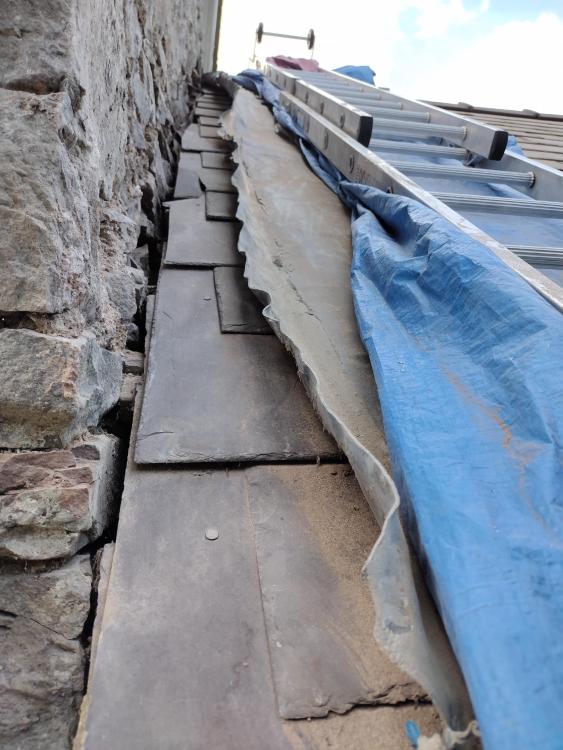
@makie - do you mind if I just clarify, seeing as you responded before I posted photos... Now that you can see the job, do you think it would still be ok for the soakers to tuck long lengths of lead in beneath those slates? Most likely without removing or lifting any of them? And just to add, for the soakers he'll be re-using the lead you can see in the photos. Many thanks
-
I did read about hidden gutters but wasn't sure how appropriate it would be given the way the wall bends. It bulges out as you get toward the apex. Would that not be a problem and make a hidden gutter difficult? The other issue is that there are sarking boards and I'm not sure how close they get to the wall. I'd also need to check how much depth there is until your on top of the purlins, although I suspect there would be enough... Thanks :)
-
Thanks, but just to be clear, for the soakers in his proposed install it wouldn't be showing. It's more than he would b putting in long lengths of lead underneath all the slates. True that there would be flashing visible, but he's got 150mm for that. So with 100mm or so up the wall, there'd barely be any on the slates. Not to mention that due to the lay of the land that part of the roof isn't all too visible anyhow. Ta
-
This is all I've got at the moment, but here's a couple of photos showing what's there....
-
To be honest, I think he is planning to try to save time and money. RE the soakers, from what you guys have said, and having watched more videos - taking slates off, cutting individual soakers, and putting them in piece by piece and slate by slate, will be a lot slower and more work than not removing any slates, sliding in a couple of long lengths of lead beneath them, and calling it a day at that. I should have added that the wall is an old stone wall. Not only is it not flat faced, but it doesn't run a straight line either Iit curves a bit). So stepped flashing is not an option. Thanks again for the help.
-
Hi I recently had some new windows fitted. The old ones were wooden and very much on their last legs with plenty of rot. Think they were installed in the 70s. Th new ones are aluminium. The fitters simply removed the old, put in the new, and foamed the gaps around where the windows meet the walls. I really don't know much about windows, and have been looking into this but not finding any answers... Should there be any kind of damp proofing, barrier, or anything along those lines between the walls and windows? Or have they done it right? I note that the old windows had a kind of thick type of felt above them and bedded into the walls, but this was cut away during the fitting. Can anyone please tell me if I'm worrying about nothing or whether there should be something there? Many thanks
-
That certainly concurs with all I've read and watched. Thanks for confirming. So that I'm clear though, and just to help me understand it, what would be the problem with having long lengths of lead running under the slates, to act as soakers? Thanks for the super quick reply




