


Oxbow16
-
Posts
442 -
Joined
-
Last visited
Everything posted by Oxbow16
-
Hi all Got plenty of caulking and filling coming up... I'd not heard of backer rod until recently, and having read up a bit on it it seems there's many others who are unaware of it. The big name stores don't seem to sell it either, which made me wonder how commonly it's used... So, any fans of backer rod here for use in channels, chases, etc prior to caulking? On a more technical note, there's a fair bit of online chat RE open vs closed cell. Apparently, open cell is more pliable/flexible and better for squeezing into gaps but not good if it gets wet. Also, they say closed sell off gases when cut or torn which can cause problems and even cause the caulk to bubble. But that's mainly from US sites/forums. Here in the UK, there's not much talk of it and the shops that do sell it seem to just sell "standard" stuff (which is closed cell). Does anyone know anything about this open/closed cell business? Cheers
-
Thanks everyone for all the help today. I've gone for the 356 with the x3 speed settings. It has lower vibration that the 355, which is a big bonus for me. I managed to pick it up for £112 with a 35 piece accessory set AND a T-Stak case. Very impressed I was! And I've also hopefully got a further 20% off using Topcashback, which would make it a ridiculous £90 all in if that cashback pays out. It was from ebay. The Topcashback 20% is for today only. The eBay 20% voucher is until the 27th. If anyone wants details as to what I got etc let me know and I'll post them up. Cheers
-
Thank you all for the further replies. The DeWalt it is I think It might be a Ford but it'll still get me from A to B, I hope! Now just need to decide between the 355 and 356 variant. Seems the main (only?) difference is the three speed settings of the 356. Is it worth paying more for that? Any other differences between the two models? Cheers
-
Thanks for the quick replies. Interesting to hear the variance of opinion and as such any more opinions and views most welcomed What does that make the Festool then?
-
Hi I've been after a multitool for a while... I only have two cordless tools, a drill and an impact driver, both DeWalt. No plans to buy more any time soon, apart form the multitool. So my first thought was to stick with DeWalt. But having looked into it some more, the Milwaukee gets great reviews and is apparently all round better, including from a vibration pov. But I'm only a DIYer so it won't see loads of use. Which would you get in my position? I wouldn't want to get the battery/charger etc for Milwaukee and so would need to use it with the DeWalt batteries and an adapter. Any thoughts much appreciated. Many thanks
-
Any thoughts form roofers or those familiar with slates? Sorry to bump, but keen to know more about the slates and the situation we're in... Many thanks
-
An update.... What I'm most keen to know now is how bad the flaking is on my slates. It's actually worse on the upper section of the topside (the sections covered by the slates above). I'll attach some photo examples, and wondered if anyone familiar with slates can say whether they look bad and if so whether that is likely caused by the lack of ventilation, or perhaps just because they're old. I should add that the battens all seem fine. Would they not show signs of mould or rot if lack of ventilation was a problem? Cheers Link to photos. Sorry, they're not the best. Can take more if needed https://drive.google.com/drive/folders/1qlaU8o5W_reDlT86soxY7D3n9w5GTaO2?usp=sharing
-
Hi all (Background first - the room has a vaulted ceiling (so no loft), is not currently heated, and is only used by one person. There's no kitchen.) I've stripped some slates off my roof over the weekend to do a repair. Most of the slates are quite damp on the underside (a few are even wet, I'd say). They are also a bit flaky - still sound, but with a thin-ish layer flaking off the surface. This is both on the underside and on the top where the slate was covered by the slate above. First and foremost, is this normal and to be expected? If it is, then great I'll replace the bad ones and get on with it. If it's a sign of a problem, what's the most likely cause and - dare I ask - remedy? If it is a potential problem, there are a few factors which might be contributing and which might also solve the problem once put right. The trouble is, with the slates back on I'm not going to know in the future whether there's been an improvement. Here's those factors: - There is currently no ventilation. The make up from inside is: plasterboard, rockwool/glassfibre, no air gap, sarking boards, felt (1f), battens, slates. I'll be putting in ventilated soffits and vented ridge, a 50mm airgap between the sarking and top of insulation, and replacing the insulation with PIR. But will adding ventilation beneath the sarking boards and felt do anything to help ventilate above the sarking boards and felt? - Only horizontal battens were used. No vertical counterbattens beneath. So any water that makes it passed the slates has no path down to the gutters. That being said, the felt was pretty much all dry and and the battens look fine. But I didn't know if this was significant from a ventilation point of view (or whether there even needs to be ventilation between the sarking boards and slates?). - There has been a section of plasterboard ceiling (10 foot wide 3 foot long) missing for the last year or two, along with 10" a hole in the sarking and felt. So from inside you can see the underside of the slates through that hole (the hole is from a removed flue). Given that the hole is only 10" and the removed plasterboard 10x3, could this contribute to the much larger area outside where the slates are damp/wet underneath? Sorry for the length of the post. Any thoughts - as ever - would be most welcomed and appreciated. Many thanks
-
Interesting then why the roofing shops sell BZP and why it isn't standard to just use the better protected and longer lasting hot dipped. I should add, that Samac said their nails are "electro galvanised", but later added that they're "mechanically galvanised". Not sure if that refers to yet another type / category? They also said that they are Service Class 2. Cheers
-
I'm not sure if I'm overthinking this... I was under the impression hot dipped galvanised is far superior, and best for any outdoor use... I need to do some roof repairs and bought a pack of round wire nails made by Samac, for fixing sarking boards and battens to rafters. The Samac nails are sold in several roofing stores so I presumed they were exactly what I need. But it turns out they are zinc coated. And one reviewer on Amazon says he used them outdoors and they rusted quickly. Hoping to get started on that part of the roof tomorrow. Do I need to go and buy some different nails (if I can find some locally)? Or go ahead with what I've got? There doesn't seem to be a price difference between the two, so if hot dipped are better, I'm confused as to why so many roofing stores only sell zinc coated round wire nails? Is there a downside to hot dipped? Many thanks
-
Hi all Hoping to do this repair at the weekend, so any thoughts as to whether I can use either of these torch on felts as a substitute for 1f (and use it in the same way as 1f - i.e. nail it only) would be a great help... Ta
-
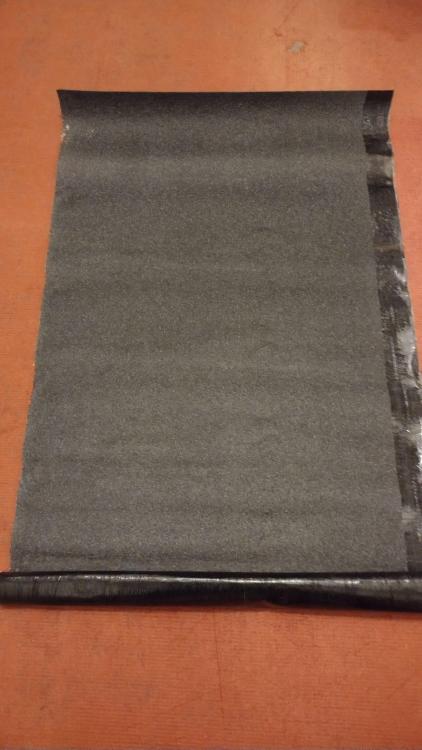
Hi I've got a repair to do to my roof. The roof has sarking boards, with 1f felt on top, battens, then slates. I'm repairing a hole in the sarking and felt from where a flue was removed. The whole area to be repaired amounts to approx. 1.2m x 1m. I was kindly given some felt to use for the repair. I was told it was 1f but I've collected it and it's actually torch on. In fact, I was given two different rolls. One is this stuff: https://www.jtatkinson.co.uk/iko-glass-torch-on-app-universal-underlay-16m-61020216 The other felt is thicker and I'm guessing is used for the top layer in a torch on system? Photo below of that one.... My question is whether either of these can be used instead of 1f for the repair? I'm only looking to nail it, as you would with 1f. Or do I need to make a trip to the BM and fork out for a roll of 1f? Many thanks
-
Hi Been away for a few days, but hoping to do this tomorrow/Friday. Just got a couple more questions if you don't mind. Can I just pack the mortar in against the compacted soil? Or do I need to do something to the soil prior to using the mortar? And is it best to work when the compacted soil is wet or dry? Many thanks
-
Anyone else with any thoughts on re-using these slates? Should I look to buy better ones or do they look ok? Cheers
-
Thanks for the reply. I haven't got the old slates off yet, so not sure what the difference in nail hole placement will be. I'd take a guess that the new nail holes will be around 50mm lower than the existing. Ta
-
Hi all I bought some 24x14 slates for a repair. They mostly already have four holes. Are they still ok to re-use? I know I have to make new holes when fitting them. Just to add, the new holes will be lower as they're going on a roof with 20x12s. I'm just using these at the abutment, where I'll cut them down to 20" in length, but needed the 2 extra inches to reach the wall. They are a bit thicker mind, but being at the end I'm hoping they'll be ok (unless anyone thinks otherwise?). There's also one slate with a diagonal crack/line visible on both sides. It rings ok when tapped and seems sound. Is it ok to use? Speaking of ringing, one clearly rattles when tapped, so won't use that. The rest do ring and reverberate in the hand, but it's quite a low ring. I've got other slates from another yard that ring higher and longer. Is that normal? A link to some photos: https://drive.google.com/drive/folders/1dKah_oULvamtboKW9kKQ4Bcr-sDWaoMF?usp=sharing Many thanks
-
That's fair enough and makes sense. In a lot of ways I'd prefer to use 3.5, so all the better if that's the most appropriate. Regarding repointing though, once I've finished I'll leave the "trench" as it is so that the mortar can set. But at some point (not sure how long to leave it?) I'll back fill the trench and re-instate normal ground levels, after which the work won't be visible or accessible and so I'm not sure repointing be an option in the future? Cheers
-
We do live in a wet area generally. and since the "trench" has been exposed, water has pooled in it after rainfall and takes a while to go. I guess the ground is very compacted there which prevents the water draining away. So due to the amount of rain we see and the fact that the ground is so often wet, I had wondered if NHL5 would be better suited? Perhaps for the extra strength too seeing as it is beneath a two storey wall? On the other hand, I appreciate it is also a balance of getting the most breathable option. With all that in mind, would you still say 3.5 is best? Funnily enough, I have been reading that in some brands there's little difference between 2, 3.5 and 5. And that across brands there's so much variance that a 2 by one company is close to/the same as a 5 from another. Which I guess make a mockery of it all if true!! Many thanks for your help
-
Would NHL 5 still be too weak do you think? Would you use that strength and add cement as well? Many thanks
-
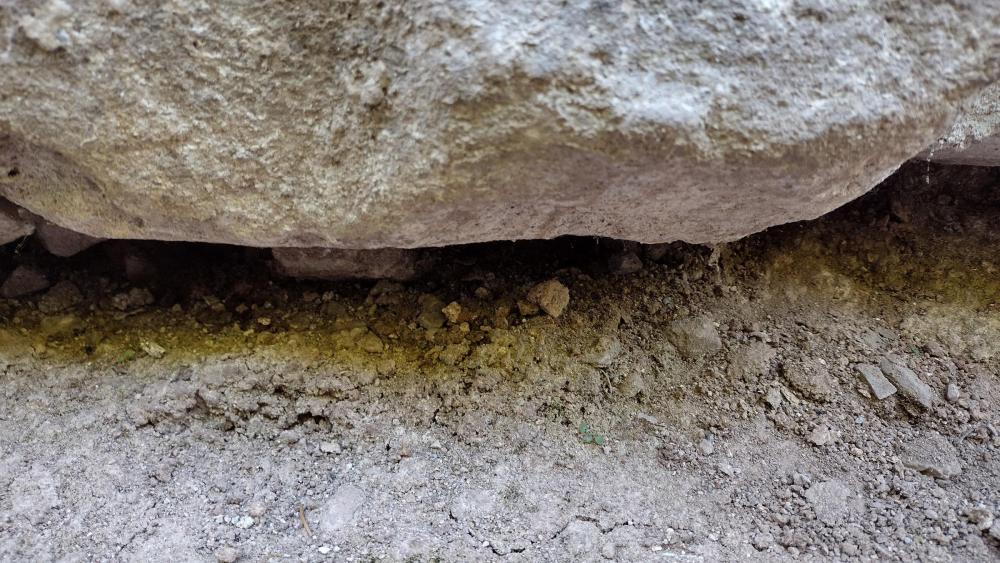
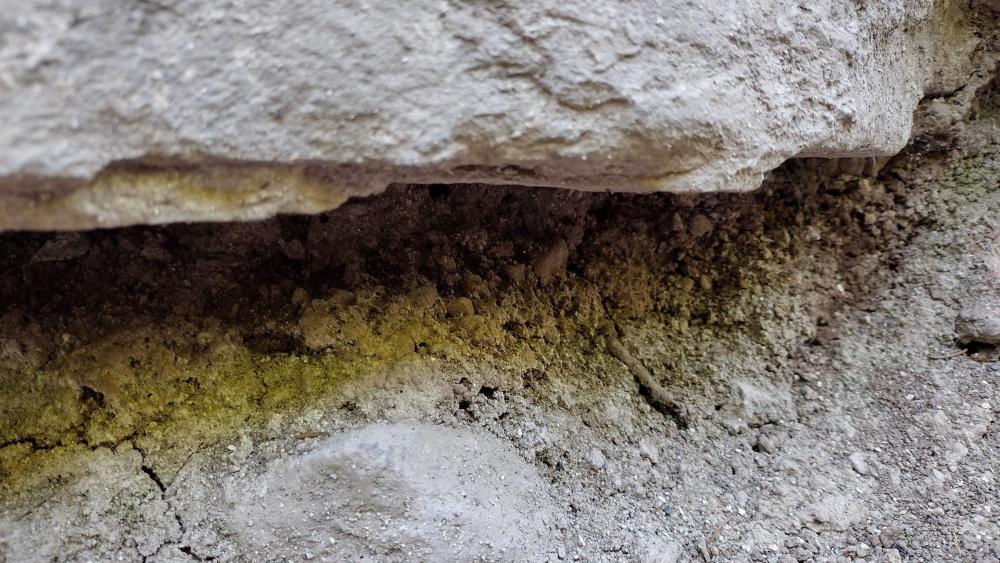
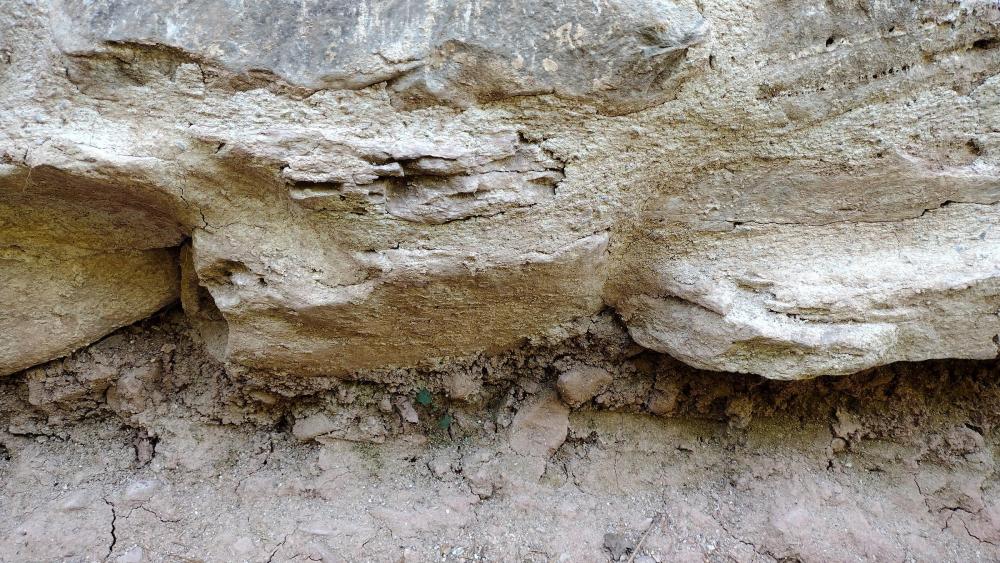
More photos
-
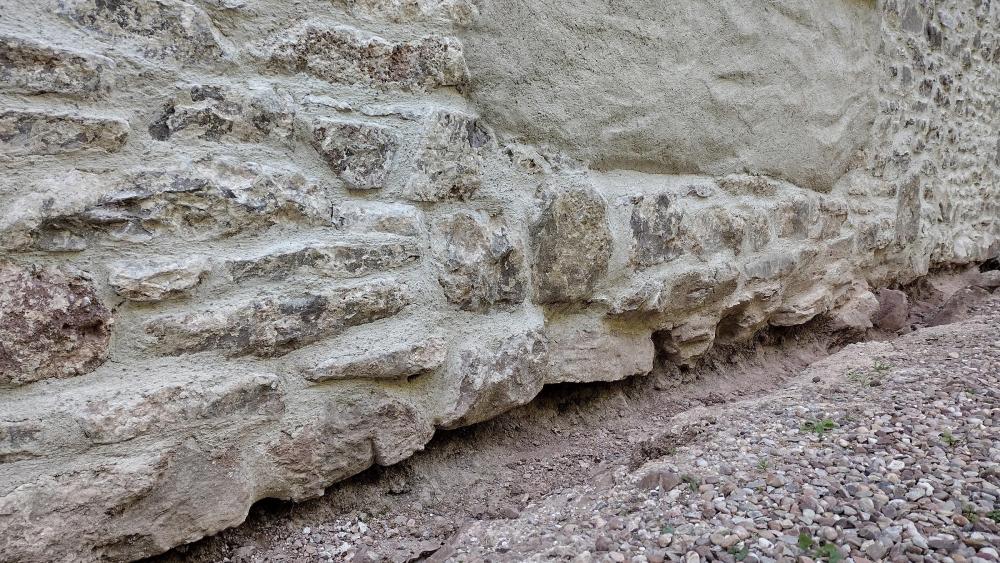
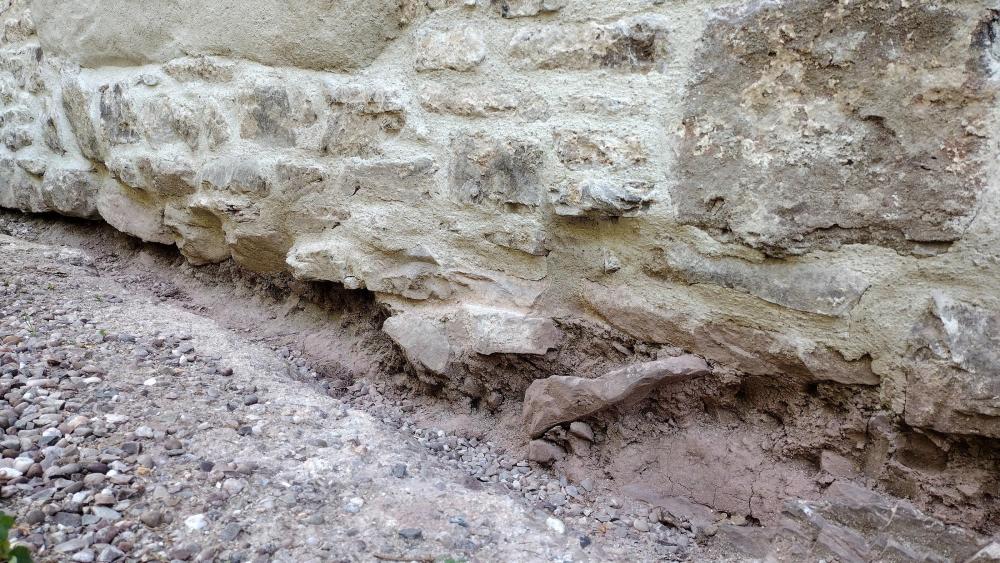
Hi We had the roughcast render hacked off the stone wall of our house, and the pointing replaced with lime mortar. There are no foundations. At the time, I pulled back the gravel at the footings of the wall, creating a bit of a trench. There's hard compacted soil beneath the bottom stones. But in some places, there's quite a deep void until you get to the soil (a horizontal void). In the "worse" places, I can get my hand and wrist in there to around halfway along my forearm. Should I look to fill these horizontal voids before all the gravel gets pushed back into place? Or is it enough to just let the gravel fill them? If I do fill them, what would be best to use? I was thinking NHL lime (3.5?) but also using stones under there to help bind the mortar and to prevent having to use too much of it. But that's a total guess and I'm all ears on what I should use, if indeed anything. Aside from doing what's right for the building, it does seem that mice are quite keen to scurry their way into the wall (and house) through these deep voids. I've got them blocked with plastic at the moment to stop that. I'd want to make sure whatever I do stops mice getting in. Pics below, showing the deepest and shallowest sections. And just to be clear, when the gravel is put back to how it was, these voids would be below ground level. Many thanks
-
Angle Grinder - Wattage, Button/Trigger, and Recommendations?
Oxbow16 replied to Oxbow16's topic in Tools & Equipment
OK, fair enough. Perhaps that explains why you can't find/buy them. Thanks for the heads up and for explaining. -
Angle Grinder - Wattage, Button/Trigger, and Recommendations?
Oxbow16 replied to Oxbow16's topic in Tools & Equipment
A little off topic from my original questions, but does anyone know what the thickest diamond disc would be for 9"/230mm angle grinder? I've not found anything thicker than 2.5mm so far. At sensible prices, the thickest I've found for all sizes are: - 4 1/2" 115mm = 8mm thick - 5" / 125mm = 6.4mm - 9" / 230mm = 2.5mm Cheers -
Haha - I think that's far enough and not even in the realms of OCD to be honest! But either way, it's available in grey too so all is good
-
Thanks The stuff I've got is a bit different from Leadmate, Flashpoint, and the like, by all accounts. It's a bit more general purpose, but I've been told by Geocel that it's fine to use for lead flashing. Did get me wondering though whether I should ditch it and buy something specifically designed for lead flashing only. The one that I've got is Geocel Trade Mate Roofers Seal: https://www.screwfix.com/p/geocel-trade-mate-roofers-seal-black-310ml/32561 Anyone ever used it? Cheers



