


Oxbow16
-
Posts
442 -
Joined
-
Last visited
Everything posted by Oxbow16
-
Fantastic responses - thank you all very much! A bit tied up right now, but will respond more fully soon. Until then, thanks again
-
Hi folks First up, in case anyone hasn't seen it there's an extra 10% off at Screwfix until midnight tonight... So I've been thinking to get a new cordless drill set as my old Ryobis are completely passed it. These two options have really caught my eye and with the additional money off come in at just over £160 which seems a really good price. They're only for home DIY use. https://www.screwfix.com/p/dewalt-dck2060l2t-sfgb-18v-3-0ah-li-ion-xr-brushless-cordless-twin-pack/337kv https://www.screwfix.com/p/makita-dlx2336s-18v-3-0ah-li-ion-lxt-cordless-twin-pack/896hy Some of the things that my inexperienced eyes have noticed: - DeWalt is brushless, Makita isn't - DeWalt has LED lights on both units, Makita just on the impact driver - Makita has lower torque and speed - Makita possibly has more overall fans, although DeWalt do have a fair share and I have read of people switching from Makita to DeWalt and being happy. Seems more the other way round though. - Both items get great reviews on Screwfix, but the companies get bad reviews on TrustPilot Before I toss a coin to decide, I thought I'd ask the people of the forum your thoughts. Cheers
-
Also, I was just thinking... I guess there are actually three options actually. A lot of direct air stoves / kits only allow for partial external air and are not room sealed. As such, the options are: - Room vent (or no room vent if 5kW or below) - but either way, air pulled from the house - Wood stove with partial direct air (so pulls air from outside and inside) - Wood stove with full direct air / fully room sealed. Cheers
-
Hi all A bit of background: I live in the Brecon Beacons surrounded by a lot of trees and a stream, all of which I presume lends to the high relative humidity (RH) in my house. It often sits in the 70% region and sometimes even creeps above 80%. In times of high RH, opening the window is counter productive and causes it to rise. We use a dehumidifier when it's at its worse. We have a wood burner in one room, which does not have a direct (external) air feed. It's not been in long, but it does do a good job of reducing the RH. We'll soon be installing a further two wood stoves. I totally see the sense in direct air in as much as it will minimise drafts, and negate the need for a vent which would let copious amounts of cold air into the house... But when it comes to humidity I can't get my head around it. No direct air to the stove means more air changes and air circulation in the house (I think?), which could be looked upon as a good thing. But then again, it also means more air coming from outside, where the humidity is higher, so perhaps it isn't such a good thing. And maybe that's all too basic a way too look at it anyhow. I wondered if anyone out there has a better understanding of the science behind this and could explain which option is best and why, when it comes to humidity? Many thanks
-
Giving this a little bump in case any Dowling owners (or anyone with opinions on their stoves) stumble upon it... Cheers
-
Many thanks for the replies. That would be the problem.... Mains cold is 4bar and the hot will be somewhere between 0.1 and 0.2bar. So well 20:1+! That's a good point and well worth considering. Although that being said, we never really want a powerful shower so even with a unvented/combi system we'd want it turned down a few notches to save water and energy. So as to what I'm going to do, I'm still undecided.... Does anyone have experience with PEVs and/or care to comment on how reliable they are? Are there any scenarios with an unvented or combi system where a PEV might be useful? The product blurbs all say "suitable for unvented and combi systems," but from what I understand both of these have equal pressure, so why would anyone use one with those systems? Does it change things if a shower/mixer tap is being used rather than anything thermostatically controlled? Thanks again
-
That is odd. And I see the totals don't add up either. IE - in your quoted section. 2 votes for each (so 4), but total is 7. And as it currently stands, 3 votes for each (so 6), but total voters is 9. Maybe there's a hidden Brewster's Millions option for "None of the Above"?! If you've not seen that film I guess that won't make any sense! That seems sensible. In my case hot is from the tank, but good to know these things nonetheless. That's interesting, I wasn't able to find any. Do you have any links/suggestions by any chance? Cheers for the replies
-
Thanks to whoever voted Any the thoughts / votes from anyone? Cheers
-
First - an apology for monopolising the forum with all my plumbing questions! I'm hoping this will be my last and I'll move onto something else (like choosing a woodburner, which is the next thing on the to do list)... My situation... We've having a bathroom refit and will have a new bath with shower mixer tap. We've got an oil boiler and vented system. We're eco minded and are happy with a very weak shower. In fact, that's our preference. So we don't want to install a pump, shower power, new unvented cylinder, etc. etc. There will be another shower in the house too. The cold is currently mains. I've narrowed it down to two options: 1. Put a pressure equalising valve under the bath so the hot and cold have matched pressure. 2. Run a cold feed from the tank in the loft, so both hot and cold are gravity fed. (The tank is 40 Gallon actual / 60 Gallon nominal). Some relevant points for both 1 and 2: - Is a 40/60 gallon tank large enough to run the cold and hot from? - The tank isn't far away from the bathroom ceiling, so wouldn't need a long run of pipe to get to he shower mixer tap - The pipe from the loft would be coming down the tap end wall of the bath, so would need to be chased in / tiled over. However, the mains cold goes up to the loft on the wall too, so there's already a pipe being chased in there... - The mains cold comes up from the room below where the bath will be (tap end) - The bath panel will be removable, so accessing the PEV wouldn't be an issue - Future proofing... Hopefully the boiler has years left in it, but if/when it goes we don't know what we'll go for next. Are PEVs useful in unvented and/or combi boiler set ups (when used with bath shower mixer taps)? I've read very opposing answers to that question! - I presume performance will be similar in both set ups, so if there's likely to be a big price difference between the two then that might help decide. I'll add a poll for the sake of it. A vote, or a thought on any of the above, would be most welcomed. Many thanks and have a great weekend everyone.
-
Have you ever seen mice have a nibble on vertical plastic pipes?
Oxbow16 replied to Oxbow16's topic in General Plumbing
Well, according to Mr Google a stoat can get through a hole half an inch in diameter! Some say an inch to be fair... Estimates vary! On the to do list is to go around the house blocking an holes I find. But as some sections of the house will have work on it soon, those sections might as well wait until after. On a side note... There's a small hole in the kitchen ceiling from where a pipe was leaking when we moved in. It's still there as we've yet to decorate in there. Below the hole is a step leading into the living room, and I often sit on the step whilst chatting to my partner (she's the cook in the house). I was sat on said step a few months back, innocently eating my shredded wheat, when a mouse fell through the hole and almost landed in my bowl! Didn't quite have to change my pants, but wasn't far off. Anyways, methinks I'll get all the plastic changed for copper then while he's here and everything is drained. Especially seeing as there's not much of it. Thanks for all of the replies -
Have you ever seen mice have a nibble on vertical plastic pipes?
Oxbow16 replied to Oxbow16's topic in General Plumbing
Thanks for the quick replies. @ProDave - were any of your neighbour's plastic pipes off the ground and/or vertical? -
Hi folks We live in the sticks and sometimes have mice in the house. I even saw a stoat once in the loft! Most of our pipework is copper, but there are a couple of bits that are plastic which I'm going to have changed to copper while the plumber is here doing other work. It's not worth the risk imo. The obvious bits to change are at ground level and in the kind of places mice like. But there's also a run from the top of the cylinder in the airing cupboard, which then comes down behind the cylinder and joins copper beneath the floorboards. Have you ever seen mice have a go at pipes in that kind of position - i.e. vertical-ish and above ground? Here's a couple of pics. You can't see it all cos the cylinder is in the way, but hopefully it's enough to get the gist. Many thanks
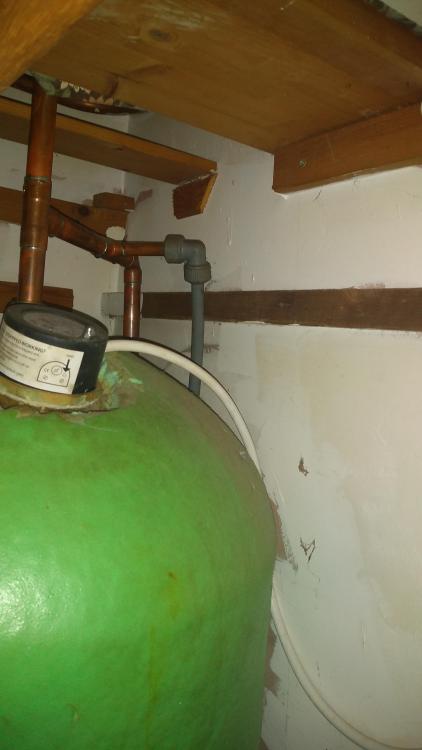
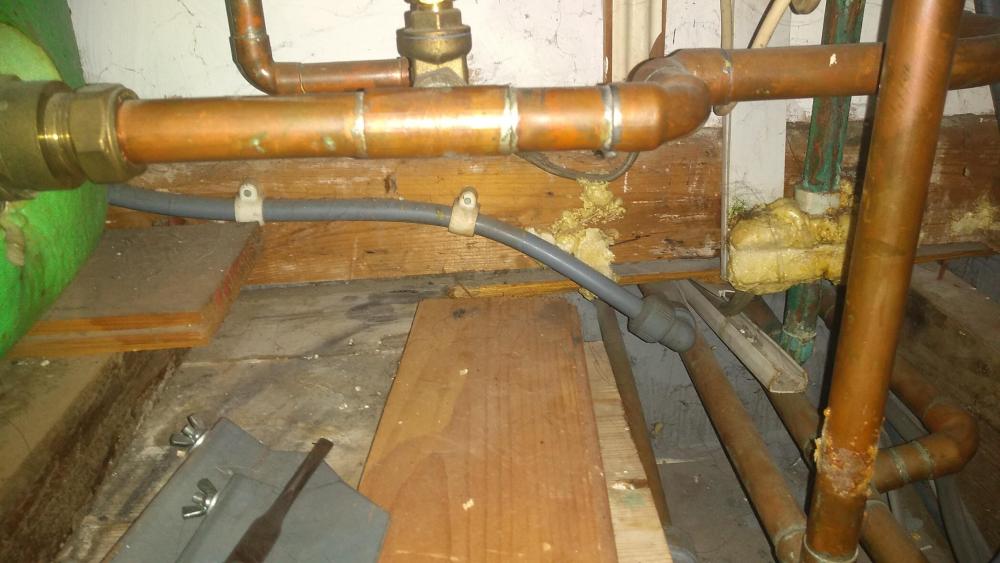
-
Is 22mm pipe worth it when using a 15mm pressure equalising valve?
Oxbow16 replied to Oxbow16's topic in General Plumbing
Thanks @Conor - that's really helpful. The length of pipework will be around 5.5m, with a fair few twists and turns along the way. The outlet is 22mm. I think based on what I've learnt that 22mm might be useful, so think I'll go with that. One thing I didn't consider though is the shower hose itself, so will be looking for a wide bore hose.... Cheers -
Hi all Making some final decisions on the plumbing for our bathroom refit. Background: we'll be having a shower mixer tap on the bath, hot water is gravity fed, and cold is mains. So I'll be having a pressure equalising valve (PEV) before the shower mixer to balance the hot and cold. I know the shower power will be pitiful, and am happy with that. But I don't want it to be any more pitiful than it has to be! So... If the pipework from the cylinder to the PEV, and from the PEV to the tap, were all 22mm - would that perform better than 15mm pipes? I ask because the connectionson the PEV are all 15mm, and I don't know if it's a case of "the weakest link in the chain, as it is with so many of these things. Logic suggests to me that 22mm pipework would still be helpful. But I'm an armchair plumber, so it's over to you guys. Cheers
-
True, and I do like to be as cost effective as possible! But for the various reasons, the house is going to have to be done in stages and so there will definitely be another drain down at some point after the bathroom refit. Possibly a further two. Thanks for the link. Do you find these third party ones ok? I read in quite a few places to stick with Honeywell if possible, or a known named brand if not... @Onoff - thanks for sharing. When it comes to the plumbing work though I don't like to get involved. I'd be happy replacing the head myself, but not the valve. Thanks everyone for the replies and help.
-
Tbh, we're not really DHW type people! It hasn't been used for two years or so. When I go around other people's houses I still can't quite get my head around being able to turn a tap and get hot water. After the bathroom refit, it will get used maybe once a week or so - for a shower - but that's more because I've recently been learning how things can seize up and/or fail if not used regularly. Appreciate the concern though
-
Hi The bathroom refit planning continues...! We're going for a back to wall toilet. The boxing in will continue up to the ceiling, with a door above the toilet and internal shelving. We want the boxing/cupboard to look as much like the joining walls as possible, and will paint them the same colour so it looks more wall than cupboard. What's the best thing to use? It won't get wet as such, but will obviously be in a moist environment. I was thinking ply to begin with, but just seen you can get moisture resistant MDF. Or are there better options than those? Many thanks
-
I've been chatting with Nuie today and they are adamant that these two are incompatible: https://www.nuiebathrooms.com/products/taps/beaumont/i303x/ https://www.nuiebathrooms.com/products/showers/rail-kits-traditional/a3211/ Which has left me very confused! I know that in the rail kit I wouldn't need the wall outlet piece, but aside from that? They are saying they'll have different fittings from each other. And then went on to say that because the slider rail sits high on the wall, there won't be enough pressure from the tap as when hand held. That doesn't make sense to me either, unless you're sitting in the bath when showering!!! Anything thoughts from the helpful forum folk?
-
Hi all Thanks for all the very helpful replies and help. To be honest, I have asked on other forums too. And I've also had a plumber visit since originally posting (boiler service). There's a real mixture of replies, with some saying just the head needs changing (which includes the plumber), and others adamant that the head is fine and just the valve needs replacing, as per most of above. I guess that's the internet for ya! What a great detailed read that is! So in there it says 45 degrees rather than 90. @Nickfromwales - appreciate I'm being tight, but money is indeed tight at the moment. And as there's no telling when we might have to upgrade things in the future (if ever), I'm reluctant to spend more funds than necessary on something which might become redundant in the future. Of course, if it has to be changed than so be it.... Thanks again everyone.
-
Well, that was just in the nick of time! I was about to go and run through what Joe explained above. It is indeed a Honeywell. So does that mean Joe's experiment wouldn't work (mainly moving the spindle to see if it changes the valve)? Hmmm, no where near that amount. Not sure why I chose to use a clock face when I could talk in degrees... It's been a long day!! So you're saying the spindle should turn 90 degrees? I'd say mine is more like 25-35 degrees.
-
Hi @joe90 That's a shame that the vids won't work? You don't know what you're missing! I wonder if they would work on any Apple devices? Do you mean the little bit sticking up on the metal plate, that goes into the bottom of the head unit? If so, then yes - I can turn it reasonably easily with my fingers. There's not much range of motion. Maybe 5 minutes maximum on a clock face, but probably less. I've stayed away from doing anything in there with the power on in case I do something stupid! I'm also not sure how it works when the head is off. Are you saying to keep the head off, turn the power on, call for water / heat, and then turn the valve into the two different positions to see if it diverts the heated water as it should? I think I can give that a go if that's what you're asking Cheers
-
Hi plumbers and DIYers I made a post about my 3-port valve a couple of weeks ago, but have finally been able to take a look and thought best to start a new one than tag on. Hope that's ok. Recap: We've had a problem whereby our boiler will only heat the radiators, even when set to hot water only. Pretty certain the problem is with the three port valve. With the electricity off, I've removed the head and taken a video to show what happens internally when I move the lever. As you'll see, it slips and clunks. Does that mean that the gears are knackered or is it something else completely? Is it fixable or time for a replacement? Or is it normal? Must say the vids I saw had smooth looking mechanisms... If it is time to replace the head, should I just do that or do the whole unit? The spindle moves quite freely by hand, as per the third video. It only moves from say 12 to 1 one o clock, but I think that's the normal range isn't it? Is there any other way of telling what condition the T pipe piece is in? Money is really tight, and if just the head needs replacing I'd be confident doing that myself plus the part would be a bit cheaper. But in a few weeks we are having plumbing work done in the house which will involve a drain down. So if it is a much better idea to change the whole thing then that would be the time to do it, and I'd bite the bullet on the extra £££. Hopefully the videos can help shed some light: https://drive.google.com/drive/folders/1uDVtF8t8_L7f5pekzgGtGM89wzy4q7nN?usp=sharing Much appreciate any replies Cheers PS - Hollywood here I come!
-
Many thanks for the replies. No, we're keeping our existing standard oil boiler (Worcester Danesmoor) and gravity fed system. We prefer to use as little water and energy as possible when showering, so weak pressure at the shower head isn't a problem for us. Not possible without major re-plumbing work and - I would imagine - £££. As it stands, the two outside taps are at toward the end of pipe runs, not at the start... Any thoughts on whether it's a bad idea to let Dwr Cymru do the reduction? Cheers
-
Hi (again!) Another plumbing query... We've got high water pressure where we are (8bar). We've got a lot of plumbing work coming up and initially we were going to have PRVs installed. The house is split into two, so we'd need a couple of them. But then someone recommended that I contact the water company (Dwr Cymru) - which I did - and they have agreed to come out and reduce the pressure. I thought this would be best as it is free and would save on the cost of the x2 PRVs and associated plumbing work. Since then, someone on another forum has recommended that I cancel Dwr Cymru and have a plumber do the work internally instead. He says it is much better to have control and to be able to adjust the pressure as and when necessary. What do you guys think is the best option? Dwr Cymru could potentially rock up any day next week to carry out the job, so any thoughts would be most appreciated. Cheers
-
Many thanks for the replies. I see on closer inspection that in many/most cases it is the hose itself which goes into the mount, not the handset itself. And the hose ends vary. If I were to buy both of the above, I'd have two handsets and two hoses and I'm sure between them I can make things work! Hopefully they'll all work though, leaving me with some spares for the future. I think what threw me was one of the other mixers I was looking at: https://www.aqva.co.uk/Bathrooms/207313 I kept thinking how different the handset end of the hose looked on that, and couldn't figure how it would be compatible. Until I finally realised that the muppet who put it together for the photo has put the hose on the wrong way round! Then it made sense! Or at least I think that's the case, or else I'll be the bigger muppet! Cheers


