


S2D2
-
Posts
427 -
Joined
Everything posted by S2D2
-
It is oddly vague, but based on how SCOP is calculated and the balance point being specified as -7 I would expect 4.2 (stated in manual, 4.1 on product page...) to be pretty close to the average performance short of them straight up making up figures. All heat pumps have reduced COP as the temperature differential increases so I guess it's just referencing that? It's not like A2W where there are lots of variables affecting this, it's a closed system so should perform as expected? I believe @Radian's have a SCOP of 5.15 so the real life performance staying close to this at low temperatures is encouraging. I was almost convinced, then Octopus went and added 50% to export rates with Flux so a bit more thinking needed.
-
Early modelling suggests I'd have a 31% higher financial yield from my system per year on this tariff compared to standard variable and outgoing export, a nice little upgrade. Based on 30 min smart meter and PVGIS data, maybe 25% in reality based on the limited data I have so far. Nice to see a PV+Battery targeted tariff at last. Massively system and usage dependent of course, most of the benefit for me comes from the increased export rate.
-
The FAQs say prices change when the standard variable prices change, so presumably it's like Cosy where it's +/-some percent of the standard variable but the numbers didn't come out nicely enough to say it. I've been put off cheap overnight tariffs due to losing the outgoing export rate, so this looks well suited to my setup where the battery isn't large enough to shift everything to overnight charging but could get us through the peak rate window.
-
Looks good, it removes the need to forecast PV generation when charging battery overnight as the daytime export rate is matched. Time to run some calcs on how much it could save.
-
I notice the old versions of this model used to have higher power options (with an f-gas coolant) so 400g is presumably the upper limit set by some regulation. Payback if as advertised is around one year with the PV, I'm tempted.
-
400g charge apparently, so bigger than a fridge freezer. No joins allowed internally, but still not worth the risk you reckon?
-
I did get confused by all the other units that were easy fit but required an fgas engineer. As far as I can tell the difference with this one is the use of R290 which is not covered by fgas. Indeed having seen the installation manual now the install without a vacuum pump just floods the pipe with a bit of coolant which you then bleed out to the atmosphere. Apparently it's not much worse than CO2, none of the fgas nasties. Still highly flammable mind. Would the flushing install method reduce the CoP due to a tiny bit of air still in the system or would it just limit peak power output a bit?
-
I was assuming based on this being sold as "including everything you need" that one side is pre-gassed and one side is evacuated then the two mix when you lock the connector in. I'm struggling to find the install instructions for V3 though so I could be way off the mark. Thanks for the feedback both, it sounds like it lines up with expectations which is encouraging!
-
Thanks both, I read this blog with great interest at the time and now that you don't even need a vacuum pump with the DIY model I'm considering jumping in. I guess the newer electriQ models still don't give you any sort of CoP estimate @Jenki? Do the Daikens @Radian? I have a load of smart meter data so could estimate it once installed, I just wondered if anyone else had done the same before I trust their claim of 4.1 CoP when there's so many A2W installs falling short of the manufacturer's claim atm, albeit not all the manufacturer's fault.
-
Octopus energy launch 'their own' Heat pump
S2D2 replied to Post and beam's topic in Air Source Heat Pumps (ASHP)
I think current installs are Daikin, based on the prize draw t&C's: > The prize will be the installation of a Daikin heat pump (model EDLA-e or EDLA HP) -
Does anyone have any experience/thoughts on the electriQ heat pump which claims to be suitable for DIY install: https://www.electriq.co.uk/p/eiq-12wminv/electriq-12000-btu-panasonic-powered-smart-wall-mounted-split-air-conditioner-with-heat-pump-5-meters-pipe-kit-and >Does not require installation by an F-Gas registered engineer or specialist equipment for typical installation – everything you need is supplied. With a SCoP of 4.1 it's a tempting alternative to just exporting the excess solar and burning gas to heat the house. Provided the SCoP stays above 3 in reality that is, I'm unsure how much the data sheets can be trusted on this?
-
Is it? I thought it was around 15p/kWh? https://www.energy-stats.uk/wholesale-energy-pricing/ https://www.epexspot.com/en/market-data?market_area=GB&trading_date=2023-02-09&delivery_date=2023-02-10&underlying_year=&modality=Auction&sub_modality=DayAhead&product=30&data_mode=table&period=
-
This is the max, it's mostly the old usb external 2.5" HDD, 5W total when this is spinning and about 2W the majority of the time just for the Pi.
-
I've probably just been lucky, and I don't go near any sort of video storage on the card that would really hammer it. It was swapped for a larger capacity after six years but until that point had managed it's own failures very well, nothing I log ever had an I/o error. Any data I actually care about is covered by Syncthing, the rest just isn't important. Couple of hours to recover everything makes setting up anything more robust a bit pointless as it wouldn't repay itself. If the failures were annual though yes, a better system would be needed. I agree it's a price to performance trade off, if you get to the point where your system needs an i5 you're not going to be spending £35 on the finished article and drawing 5W. The laptop is a good step up price/performance wise if required, but personally I still wouldn't touch anything mission-critical with it, depending on your definition of that.
-
Rpi3 here going seven years without skipping a beat, never had an SD card failure. Does everything I ask of it and all for <5W. Now if only the zero w's were in stock more often...
-
They may be able to provide a firmware update if it's a known issue, or it could just be some fluke that you won't see again. The induction hob isn't a major issue, it's still supplying the vast majority of the load from the inverter, it just gives a very small amount of "unexpected" import/export.
-
Seems reasonable, 20° is a very low slope so will be in view of summer/midday sun. Indeed if you have a 0° slope you'll get 100% of South facing energy by facing them North 😉
-
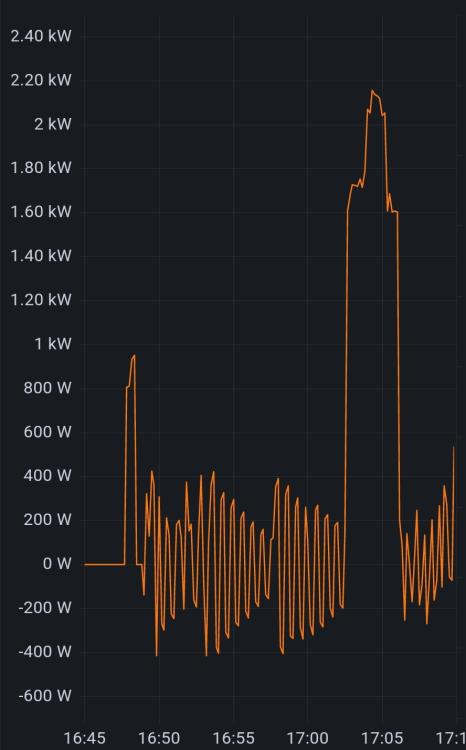
The induction hob switching can confuse the inverter, here's my grid usage when pulling an average of 900W to the hob but oscillating around this point as the inverter tries to keep up: This would probably explain your messy spike just before two, but it does not explain why the inverter didn't pull from the battery at all for the spike just after two. If your installer is slow to respond you can try the inverter/battery manufacturer directly.
-
Yes, this CT clamp detects the import/export power to a given accuracy. The arrow is to ensure it is installed the correct way as reversing the clamp will reverse the polarity of the reading. Are you cooking with an induction hob, or just a simple resistive load like an oven?
-
New member - stuck for what to do next to warm the house
S2D2 replied to Sparrowhawk's topic in Introduce Yourself
You've outlined the priorities well, it's never going to be pretty so chase your biggest issues first: Boiler/rads - new gas boiler and rads will solve the health-affecting 11°C indoor temps, even if it does cost an absolute fortune to run. Make sure the replacement is also suitable for the finished, insulated product. Then, you have until next winter to reduce that cost by improving insulation/airtightness: Loft is easy/cheap, fill your boots Remove cavity draft: ducting air bricks properly and sealing other external penetrations. If you're completely happy the cavity draft is gone, EWI is possible, but rewire and graphene bead fill in the cavities may be a more reliable way to add insulation and reduce any remaining hard-to-fix airflow issues. Ground floor starts to get into the serious disruption but absolutely needs doing, windproof but breathable is most reassuring to me for timber joists. When the drafts disappear and the house starts to feel stuffy you know you're on the right track, PIV is the cheapest ventilation solution or upgrade to MVHR if you're so inclined/like to close internal doors. Forget the house being super cheap to heat unless you want to move out and go for serious levels of disruption. Adding the insulation you can will get you well into comfortable and affordable heating, passive houses are just chasing the diminishing returns after that point. Finally, cost all that up first, include your time if DIYing and check there isn't another house that you could move to that would solve the issue for a lot less hassle. Probably the answer is no, but that will at the very least give you the conviction to crack on. -
Solar+Battery - more PV AC coupled vs less PV hybrid?
S2D2 replied to DragonQ's topic in Photovoltaics (PV)
Solax (and I believe GivEnergy too) provide a local API on some inverters so you can get whatever fidelity the inverter sees. I'm logging 10s data from mine without issue, plenty scope to see kettles on etc. -
Sadly yes, it uses around 5W idle and 105W when firing. Using smart meter data so accurate reading too. No idea where that's going. I've always thought it was a lot but the specs have it rated at 115W so it's performing "as expected", just inefficiently. It is 9 years old now though. You can probably just ignore it then, only 1-2% max in your case which may only become relevant at the extremes of flow temp.
-
Using some extremely questionable extrapolation from smart meter data I looked at a random heating cycle on the boiler to give a reference point: 45 degrees flow temperature 4kWh gas consumed Firing/pumping for 0.65 hours at 100W, so 0.065kWh in electic, or ~0.2kWh in gas money ~5% of consumed energy (in cash terms) is the electricicty consumption at this flow temp I'll have a go at tweaking the flow temperature to get a flow temp -> efficiency function which could then be combined with the above graph for an overall optimum. As a side note, there are a massive number of assumptons here, my boiler is not in the heated envelope so I'm assuming that electrical input energy is lost. Maybe the pump instead loses energy to the flow water? I have no way of telling.
-
Something I've been meaning to look at for a while, but never got round to, is where exactly the optimum lies from a cost perspective. From that graph alone you'd assume a boiler running 24 hours a day at the lowest temp to meet heating demand, but actually my boiler uses 100W extra electricity when firing/pumping, so that would be 2.4kWh a day, or around 7kWh in gas money. Clearly there is likely to be a point of diminishing returns but I haven't done the sums yet.
-
Can you use Hybrid battery inverter without solar input?
S2D2 replied to BMcN's topic in Energy Storage
Isn't the usual trick taping a plastic bag to the drawstring and attaching a vacuum at the other end?


