


JohnMo
-
Posts
13294 -
Joined
-
Last visited
-
Days Won
200
Everything posted by JohnMo
-
For a new build the price is just about the same with no grant. You can buy a heat pump for £2k including the vat (reclaim it later) cylinder is pretty much the same as a boiler one. The rest of the heating system should be the same. If you use the grant you really should be paying zero cost. Get rid of the grant and prices will normalise, just like they did with PV. Retrofit, slightly different story, but a decent time of use tariff your running costs shouldn't be much more than a typical S or Y plan gas system, when running a high temp heat pump system. High temps being run only when at or close to design temp. Then the system needs very little changes in the most part.
-
Believe Viessmann and a few others, state no glycol to be used in their manual.
-
Here is one sensible review on glycol https://renewableheatinghub.co.uk/do-air-source-heat-pumps-really-need-glycol/
-

Vaillant senso comfort connector
JohnMo replied to Post and beam's topic in Air Source Heat Pumps (ASHP)
So a tool-less connection that needs a screw driver - so not really tool-less when you take it apart. It's a bit like a Wago connector. Instead of a lever arm, your connection uses the white bits to release the friction clamp. Your wires either need a solid crimp on end or if you cut the current ends off the wires, then do a tidy twist in the wire strands push in the white bits you should be able to insert the wire. It is unlikely the connector is broken unless it was something you did into it. -
Zehnder Q350 + ComfoPost CW12
JohnMo replied to BartW's topic in Mechanical Ventilation with Heat Recovery (MVHR)
MVHR cooling is pretty ineffective due to limited flow rates. Heating is limited to about 10W/m², based on passivhaus air flow rates. Anymore more heat causes any dust particles to burn. To that with an ASHP isn't cost effective due to por CoP. So in real terms post heating with ASHP and MVHR flow rates isn't really likely to achieve 10W/m² either. Best option keep your money in your pocket. We get -9 here, I haven't got any heaters in the MVHR, it's doesn't seem to suffer. Heating WC (weather compensation) curve is just set to compensate or those against WC your CH thermostat compensates automatically. -
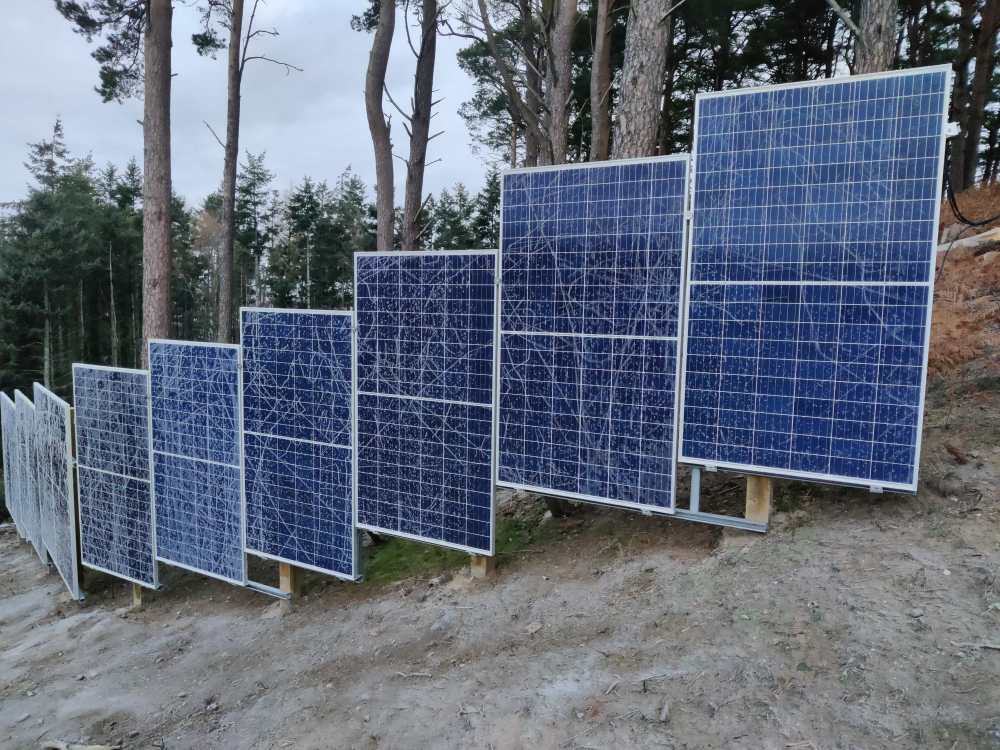
They can be mounted directly to or between the posts if you wanted. Would look tidier than on rails as well. But still need clamps of some sort - pretty cheap though. Optimisers may not be needed, my vertical panels don't have any, and don't suffer, depends how you get shade. Overall generation is slightly lower over the year, but not that much, certainly better than nothing. Just had a look at the price of composite fence panels, and PV works out about the same price. Both would be maintenance free after install. Vertical panels don't need cleaning either.
-
Depending on how you actually mounted them. But if you were buying fence panels anyway but instead installed PV, the PV per m² is possibly cheaper than fence panels. So buy back is an electrician (if you need one).
-
But then you would be doing MCS anyway and this discussion wouldn't really exist. Then you are never likely to get much payback either. Not that I could see an installer doing a fence either.
-
You should only be paying £60 to 70 per panel. I added 2x horizontal panels in June (in a less than ideal position) and one panel has already paid for itself.
-
Boost function tripping electrics.
JohnMo replied to Lmiln25's topic in Mechanical Ventilation with Heat Recovery (MVHR)
Maybe it's a volt free contacts that does boost? And a numpty got his hands on it. What is your MVHR unit - make and model? -
Any recommendations for a replacement expansion vessel?
JohnMo replied to Beau's topic in Underfloor Heating
They are possibly also saying radiators are rubbish and don't last, also don't understand why all the black sludge is in the heating system. -
Any recommendations for a replacement expansion vessel?
JohnMo replied to Beau's topic in Underfloor Heating
If your water is inhibited not sure why you would have an issue. -
As long as they are deep enough not to have a drill through them, for the bottom stud wall rail fixings. That was my concern.
-
I started using it a couple of years ago after a recommendation on here. Works first time every time. Says on the packet how many turns are needed for different thread sizes so super easy and no guess work. One my best purchases - makes life easy.
-
Last bits I bought were from City Plumbing - great prices generally and got good service.
-
300mm centres works fine, your delta T is going to be closer to 4 when running. But if you have balanced to rooms in Loopcad, all you need to do is set all the flow meters on the manifold fully open and let the heat pump get on with settings flow rates. Coupled with thick screed don't expect the reaction times to be quick, it's a very slow and steady system. You may find you actually don't need the UFH upstairs except for bathrooms, unless you like bedrooms really hot. Bathrooms, I did those at 300mm centres, but a bathroom cannot be too hot, most of the floor space is taken up with showers, toilet etc, so reduce spacing to 150mm. Can you not get rid of the dedicated hall loops downstairs? Generally reduce the number of loops? Not a fan of going under internal walls. Can you reduce the manifolds to one upstairs and one downstairs? Some of you loop lengths look really short. Not sure I would want UFH in a gym? I am 192m² ground floor area and have only 7 loops, you are on 40+ and six manifolds?
-
Unlimited hot water with 4 bathrooms - is it possible?
JohnMo replied to Indy's topic in Boilers & Hot Water Tanks
With lower storage temp, depending on shower mixer make, you may have to tweek the settings at the back of face panel to get shower feeling comfortable - basically re commission the shower mixer. -
Not really a fence but would function as one, has been hit several times with 80mph storms. Photo was taken on very cold day. Now getting 15p per kWh exported, for my non MCS system.
-
Swop dryer first. We have battery and costs for electricity has dropped lots, as it allows to be all cheap rate 24/7. You need to do the maths for your circumstances, only you can tell if it's worth it.
-
I've had good service from duct store
-
But a good one👍
-
So what is feeding the small air? Where is the fresh air coming from?
-
For me I would do another house tomorrow, not sure the wife would let me. I really enjoyed the whole process. But I compartmentalise stuff and once it's done, I just move on the next thing.
-
But did you have a comment to make on glycol? Sorry but to answer your comments. What complexity I am just using the default settings for the ASHP. There are no apps, they are not needed and add nothing, it doesn't need updating and fiddling with. It just sits there and gets on with it. There are no fancy valves, only a 3 port diverter for DHW heating. In fact the system only consists of ASHP (with it's controller in the side of the ASHP), diverter valve, cylinder and UFH manifold. No additional pumps (other than one in ASHP) no mixers, no UFH manifold actuators, no fancy stuff at all. But using an ASHP, so an advantage in running cost with variable flow temperature. Thermal stability of the house and reaction time of the UFH are pretty closely matched when running variable flow temperature. But can quite easily make the system work at a set flow temp and a thermostat, but house temp fluctuates more, due to the heat pump having to play catch up, to heat 19.2m³ of concrete. With WC flow temp changes preempts how the house will respond, all very simple, nothing complicated, it actually allows a much simpler system. Yes I live in Scotland, not many places get the -20 anymore, still get variable seasons in 24hrs.
-
Your heat pump circulation pump will come at 3 or 4 degrees like it not to perform frost protection to look after itself. The only freeze protection needed is from a prolonged (several days with no electricity and sub zero). Oil boilers themselves never have (almost all) never run with glycol or anti freeze valves.



