


JohnMo
-
Posts
13292 -
Joined
-
Last visited
-
Days Won
200
Everything posted by JohnMo
-
Atamate_SDAR+Paper+2019+(1).pdf Some reading for you
-

The best ever ladder advert !!!
JohnMo replied to Ferdinand's topic in General Self Build & DIY Discussion
Will become the ladder of choice for some. -
BC not interested in MCS for solar installation as long as you have the correct electrical certificate. ASHP, not sure. The MCS noise certificate can be completed by anyone. You have express planning so any rules around permitted development aren't applicable. So the only thing they should be interested in is a noise certificate.
-
Form factor makes a huge difference, to insulation levels needed.
-
Daft question - if MBC say are designing the house to passivhaus spec, what is the architect adding to the party? So then you use a normal architect with MBC. Architect does the broad design stuff, MBC the details of thermal bridging, airtightness etc
- 15 replies
-
- 1
-

-
- passivhaus
- technical
- (and 1 more)
-
Issue is really one of commissioning and downstairs setup. @Post and beam is bouncing off a thermostat downstairs so heat doesn't get a chance to percolate through the house, running a lower flow temperature at warmer outside temps will help. Downstairs heat up rate reduces or ideally matches house heat losses, then everything has a chance to stabilise. Upstairs rads backfill where needed. If OP wants a two zone system. Installer will simply say I priced for the system you have and expect another £1k+ to make the changes. Will most likely need a buffer, electronic mixer additional pump and maybe additional controls.
-
You don't want to be doing stuff in sub soil. You need top soil Strim and weed killer now. Early spring as annual weeds grow weed killer again, leave a week then prep for grass etc.
-
Before you even consider MVHR how airtight have you made the building? The alternative in dMEV. 24/7 running fans in wet rooms with automatic boost only when needed. But to do this you need either trickle vents in dry room (only dry rooms, not wet rooms), these can be in windows or through walls. Ideally these will close or open based on sense humidity. Doors would be under cut to ensure a ventilation flow even with doors shut.
-
24 panels on a new build roof. 2 strings of 12, or 3 strings of 8?
JohnMo replied to jimseng's topic in Photovoltaics (PV)
Your voltage and amps limits are the limits to each MPPT. The invert will take two strings only, via one to each MPPT. -
System boiler size dilemma...any advice?
JohnMo replied to Rick734's topic in Boilers & Hot Water Tanks
Not quite correct. The calculation gives you your boiler size. If you need 13.7 for central heating - 13.7 x 24 is 329kWh for your daily heating. To complete the central heating and allow 2 hrs for DHW, you divide 329 by 22, that is 15kW. This is your boiler size.required for central heating and DHW. The above assumes you have done your heat loss calculation correctly. Using the Jeremy spreadsheet is good if close to passive, but can be quite a way off if you are not. I would use the info posted by @marshian to get a best guess. Your calculation doesn't seem to include much in the calculation, cannot see floor or wall or roof U values or ventilation losses, hence saying using the approx information above by @marshian. -
Did an image search - nothing found. Looks like a simple manifold without individual loop control. If it's working do not touch it. If it's broken chuck it, in favour of better control of a modern manifold. Would suspect the tube is the week point of the system.
-
24 panels on a new build roof. 2 strings of 12, or 3 strings of 8?
JohnMo replied to jimseng's topic in Photovoltaics (PV)
Almost impossible to get in the UK winter, coldest day and PV max output so wouldn't consider that. You only have 2x MPPTs so unless you buy a second inverter or different inverter, you are stuck with 2x strings. Two strings is fine from the info given. The 370v is just nominal. More panels give a quicker time to start up voltage and a longer day before inverter trips off. -
Always best not to change original plans, changes can have big knock on effects.
-
Simple way is to flow higher temperature in weather compensation, but reduce floor output by reducing the flow through floor loops. On a day where you normally flow 25, increase flow to 26+ but increase dT across each loop (reduce flow) to 4+. Play with settings to get outputs of radiators where you need them while maintaining UFH output stable so as not to overheat downstairs.
-
Simple way is make the finished floor level higher to compensate. Add more insulation and sail over the foundation and add a lintel. But does that add other complications we are not seeing?
-
And?
-
But think about this logically - if inside of house is 21, and you are flowing 25, 25 less 3 is 22. If your floor temp is 1 Deg above room temperature your dT cannot be any different. Your return temp cannot be lower than the floor temperature ever. But as asked previously are your room temps accepted and at target temperature upstairs now you are living in the house. Is this a question you seem to avoid for any reason or have you just missed the previous questions?
-
Paslode nails. Which ones?
JohnMo replied to flanagaj's topic in General Self Build & DIY Discussion
We got a full structural design for whole house including the steel, walls internal and external, foundations, all house structural components and review and final approvals of any third party supplied equipment, including windows, roof, glass balustrade. Without the above you don't have a structural design for the house, just a lump of steel. -
Paslode nails. Which ones?
JohnMo replied to flanagaj's topic in General Self Build & DIY Discussion
If it's for anything structural stuff, your structural drawings notes, should set out the requirements explicitly. How many nails at each junction, type surface finish and length. Your structural notes should have something similar this - if they don't go back to your structural engineer and ask why not!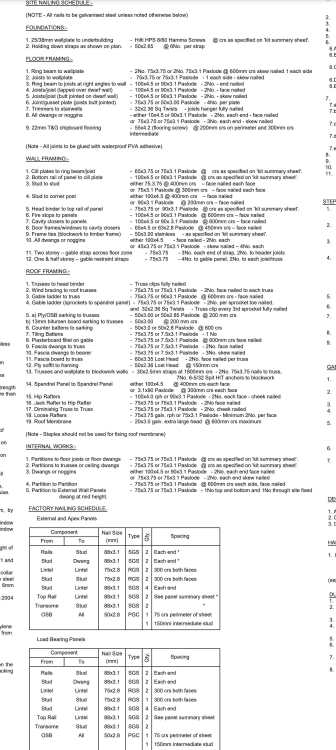
-
It maybe doing plus 5 and minus 5? If you are getting 5 degs of overshoot, set the target lower and decrease hysterisis?
-
Very unlikely to be WC as that doesn't normally work on dhw, as it aims to meet a setpoint. I would look at any hysterisis values in the controller. Is there an target plus x degs hysterisis programmed? From the above images, you looking for the stop temperature differential.
-
Help with new heating and hot water system!
JohnMo replied to bigp26's topic in Boilers & Hot Water Tanks
Should read 'either' NOT 'neither'. Too late to amend after spotting mistake. -
System boiler size dilemma...any advice?
JohnMo replied to Rick734's topic in Boilers & Hot Water Tanks
Don't, most plumbers are knot well.versed into efficient heating design, and it's their day job. Doing heating well isn't something done in the UK for various reasons. Simple take away if it sounds complex it's often complexity for complexity sake. The most efficient systems are sized well, run low and slow, have limited outside influence. With a boiler or heat pump if you allow 2 hrs for DHW heating per day that will be ample in most cases. So if house needs 5kW to heat it at the design day, that is 5 x 24, so 120kWh. To heat house in 22 hrs you divide 120 by 22, so 5.5kW boiler size would be needed. -
Help with new heating and hot water system!
JohnMo replied to bigp26's topic in Boilers & Hot Water Tanks
Either a dedicated heat pump cylinder - big coil, fast reheat or or low flow temperature for added efficiency. But as mentioned above, looks like a AI cut and paste. -
System boiler size dilemma...any advice?
JohnMo replied to Rick734's topic in Boilers & Hot Water Tanks
First you don't size a boiler based on house foot print or size, you size based on heat loss. Nearly every boiler installed in the UK is massively oversized. So to size well you need to do heat loss calculation. Second at a more average heating day in the UK it's about 7 degs - so heat loss is approx half your design heating day -3(ISH). So you want a boiler that modulates down to pretty close to the output of the 7 Deg day, then it can just tick away adding only the heat lost. So you are looking to size system based on a once a year eventually if ever. This can get difficult, expensive and maybe make system over kill so be careful what you ask for. Two showers at full performance is easy, three may push things at full flow depending on shower heads. I would do your 300L but insist on a heat pump one with 3m² coil - this gives super fast reheats or you can reheat at a much lower flow rate for added efficiency, in a more normal time. Boiler plumbing - Do not accept anything other than PDHW (priority domestic hot water), this allows one flow temp for cylinder heating and a different one for central heating. And you fully boiler power given to the cylinder. So S and Y plan is out. If your plumber doesn't understand priority domestic, strike from the list automatically.



