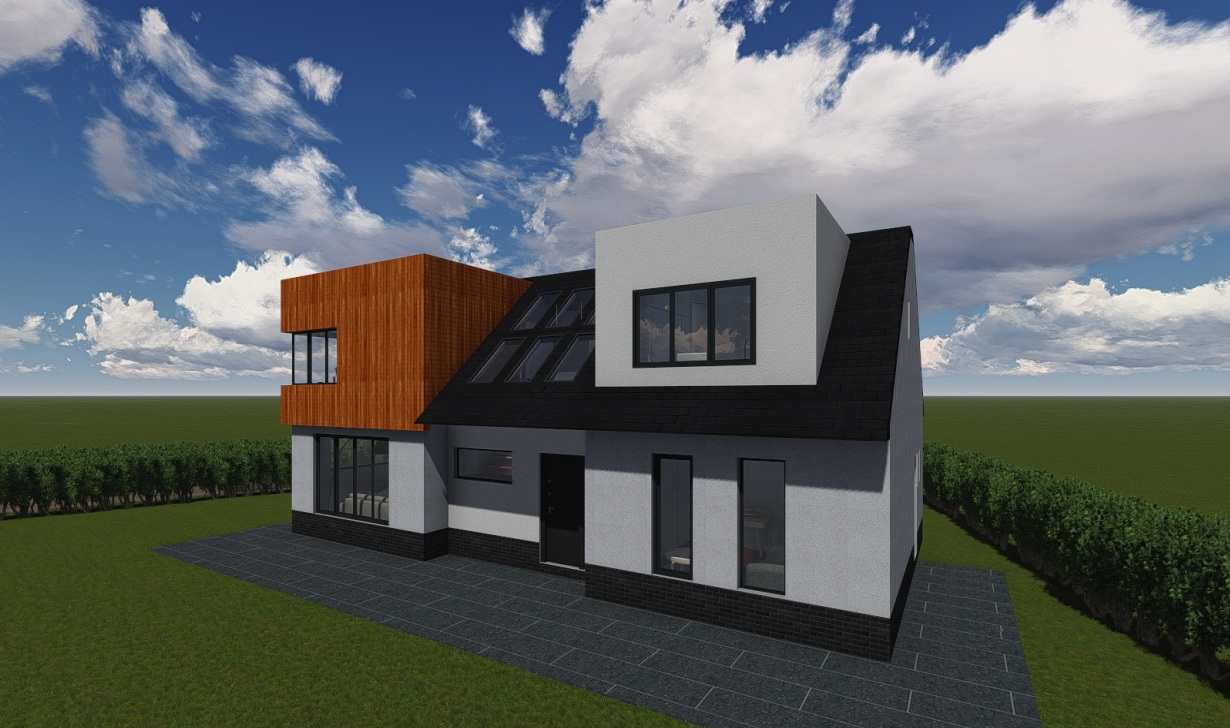
Tony L
-
Posts
397 -
Joined
-
Last visited
Everything posted by Tony L
-
 I know the PH airtightness target (ie max allowed) is 0.6 ACH @ 50Pa. My understanding of this is: if one of the external doors is opened then sealed up with an airtight membrane with a fan in it that sucks air out of the house to create a pressure difference of 50 Pascals between the inside of the house & the air pressure outside, & we keep the fan going & the pressure difference stable for an hour, if the house is going to score 0.6 this means that, in crude terms, 60% of the air inside the house at the start of the hour will have been sucked out of the house by the and of an hour & replaced with air from outside that will have found its way in through gaps and air-permeable surfaces. I also understand, that even a score at twice the value of the PH minimum, ie 1.2 ACH is still good, & if I can get a score this low, MVHR (or similar) will be required. If somebody wanted to rely on trickle vents & other holes in the house, rather than MVHR to provide ventilation, then they would have to ensure their house scored 3.0 ACH or greater, otherwise they’d be falling foul of building reg.s – in England – I suspect there are different rules for other areas. So, if I haven’t already gone wrong, my question is: what does this sentence following mean & how does this relate to the 0.6/1.2/3.0 ACH figures from my examples above? I can't make sense of it. Obviously, "that" is supposed to be "than", & presumably "p.a." is another way of writing "Pa". What is "h."? Hours? Perhaps this is a different way of measuring the leakage/permeability of the building in terms of the length of the building's perimeter. The sentence is from an example Building Construction Notes document that I’ve received from an arch tec, I’m considering using to complete my house design & provide drawings:
-
Thanks for Jeremy’s spreadsheet, @Adrian Walker. It certainly looks more straight forward than the PHPP spreadsheet I looked at, but I would have to ask a lot of questions if I were to use it to help evaluate my design, in which I am not too concerned about what’s going on downstairs, but am keen to understand what’s going on further up, where I have 3 dormers, 4 flat roofs, both north & south facing windows in the sloping roof, no heating &, if things work out well, no electric cooling either. I think I’d still rather outsource heat loss/solar gain calcs to somebody who can do it far more quickly than me. For now, I’m focusing on trying to find a competent person to take on my building regulation & construction drawings, including finalising some elements of the design. @Nickfromwales has recommended somebody, & I’m hoping this problem will soon be solved.
-
Good info - thanks, Nick. I was thinking it might be because the U values may not be good enough. I have been mindful of solar gain. Our summers aren't getting any cooler. All the glass you can see on the facade in the Sketchup drawing above is on the north elevation, so the low sun will just about shine through these windows for a short time in the morning as it heads around to the east elevation, & there's shading on the west side, so there will be negligible solar gain before the sun sets in the evening. The glass area on the other three elevations adds up to less than you can see on the north elevation & there's a 1m overhang on the roof at the back of the house to give shade to the ground floor windows.
-
No - the design isn't yet sufficiently developed to start anything like that. PHPP modelling sounded like a good idea (even though I will not reach PH standard), but then I had a quick look at PHPP modelling a while back & decided I don't have the time I'd need to learn how to do this myself, & paying somebody else to do it will likely cost more than I'm prepared to pay. If anybody wants to tell me, I've got this wrong (or perhaps tell me I've made a reasonable decision) please do so.
-
The building regs may force you to have less glazing. Thanks for the warning; that hadn't occurred to me.
-
Yes: if I can afford it, I'll be having one of these when my house is done. I've seen quite a few in my area. Pale orange seems popular, but it shows tyre marks. I think grey, as pictured, looks best.
-
I’d prefer less glass. The purpose of the glass is, to please my partner, who wants lots of glass, especially on the façade. It’s half her money, so I’m compromising. I’ve deleted a lot of the glass from our original approved plan, having learnt so much here on BH over the past year. Windows have been deleted from the sides & the south facing rear elevation. I also persuaded her that her log burner was a daft idea for this kind of house, & the chimney has been deleted as well. I’m more concerned about unwelcome solar gain in the summer months, on the east & south elevations, than I am about having to turn the heating up. The glass in the sloping roof above the hall/landing could be reduced, but this is helping to create space in front of the landing, because windows are a lot thinner than the roof so, yes, we could easily improve the thermal efficiency, but this would detract from the feeling of space in the hall/landing area - it’s a galleried landing & there’s only just enough space in front of the landing to make it work as a galleried landing, so the window reveals are really helping to create much needed space. The views aren’t “stunning”, but they do give us great pleasure. The views mostly comprise lots of different kinds of trees. There are one or two edges of other buildings visible, but we can’t see any of the other buildings’ windows, so the neighbours won’t be able to see in. There’s a small newbuild bungalow right next door on one side, but there’s a holly hedge between us (we trim it down to around 2.3m tall when it needs it). The house opposite, over the other side of the road, is in several acres, so all we see is the trees along their boundary with the road, & we have to look very hard to glimpse their house in the distance. The road is a B-road & there are no pavements, so there’s very little pedestrian activity. The view at the back will be our 2m high garden fence (just over 9m from the back of the house) + above this there’s a long view of trees to either side, & lots of sky, so very pleasant. On the west side, there’s big plot again. There’s a monster hedge on this neighbour’s side of the boundary (well maintained by the neighbour's gardeners) & all we can see of their house is the top of the roof.
-
Well done, & thanks for sharing - this is inspiring.
-
That's a good question. I ask myself often, & I keep getting different answers. I did the designs (several of them) & drawings to achieve planning permission; somebody else helped me out by adding a few notes. I'd not have bothered hiring them if I'd realised how easy this would have been, but this happened before I'd discovered Build Hub. I think I could (with lots of help from BH) have a go at doing the building reg.s /construction drawings & heat loss calcs, if I had fewer commitments & I wasn't in so much of a hurry, but I'm keen to pay to get this done well & done quickly. This is the next task. Then QS. Then we'll likely have to make some revisions to the drawings (for budgetary reasons) before they go in for approval. I reckon I can make a garage base (I've done this twice before) & stick build a garage (not done before) & deal with the roof. I want the garage to go up before we start ordering the insulation, so we can store it out of the weather. Due to other commitments/ time constraints & my ineptitude, others will be doing most of the building work. I expect I will decide my partner & I will PM this between us, to save money. I'd love to PM if it wasn't for my other commitments, but as things are, I know I won't love the experience. I'm not yet sure whether we'll hire every individual trade, or whether we'll employ a building firm to do the next stage (superstructure without roofing finishes) then the standing seam roof (if we can afford it) & flat roof finishes, then windows, & so on. Of course, PMing myself may not save anything at all - it depends on how many serious mistakes I make. In my day job (90% desk based), I'm good with attention to detail & completing tedious tasks, then checking my own work, so I expect these are transferable skills that can be usefully deployed on my building site. I envisage doing jobs such as preparing my B&B base, laying membrane then PIR, the next membrane, UFH pipes & getting ready for the screed, perhaps installing MVHR ducting into the metal web joists, soundproofing between floors, soundproofing & boarding stud walls, constantly reminding everybody about my precious air tight envelope, reprimanding anyone who damages the air tight envelope, sacking repeat offenders, making a DIY air suction rig & finding some leaks. The task I'm most looking forward to taking on is the exterior cladding on the three dormers.
-
All ours will be built in as well. I think I read that to reclaim the VAT you’ve got to be able to see the wall finish in the back of the built in wardrobe (I don’t have a problem with that) & you’re only allowed one shelf – is that right? Is this shelf rule enforced? I can’t see how it would be.
-
This is all very reassuring. Thank you, & good luck with your recently announced next project. I'm looking forward to reading about it.
-
Thanks. I'll have a look for this (& come back to you, if I can't find it). I was thinking to put a stripe of purple paint or flexible (lime?) parge onto the walls, then fix a ledger board with bolts into resin in the blocks. This seems more straight forward than Tony trays to me (although I could easily be wrong about this). Also, the ledger board approach means my joist ends won't be inside my (only 150mm) cavity, sucking heat out from the house. I could be persuaded on the Tony trays - I should think this would give a saving on materials.
-
Thanks @SteamyTea. I don't have plans in a suitable format to upload here yet. I have my original PP drawings, with lots of annotations hand written onto them. I don't have U-values - I'm hoping to find a competent person to decide on the build up of the various external surfaces & work out all this for me. Once I have drawings worthy of BH's attention, I'll upload them & invite criticism. Thanks again for your offer.
-
Thanks @LiamJones. That's impressive work you've done there. If I get to build a second house, I'd like to try to do what you've done. I did the PP negotiation/drawings myself, but I just don't have the time to fill the gaps in my knowledge then set about dealing with all this myself. I have a business to run, an elderly mother to look after (still in her own home) & other commitments (I'll spare you the details), so I just want to pay a competent person to deal with the drawings so we can get the full plans approval & start building the superstructure. We've already built up to our B&B floor under building notice. & we need the drawings to get a QS estimate as well - then we may need to change the spec' to fit our budget.
-
I didn't actually sack him - he's waiting for me to annotate his drawings & point out all the errors (this is a lot of work as there are so many errors). I'd rather start again with somebody new, who is competent & will make all the difficult decisions for me - such as wall/roof build up, insulation types, membrane types, what happens at all the surface junctions, etc. Each time I start a conversation with somebody new, it costs me a lot of time - only to find out they can't do what they said they'd do. I'm under a lot of pressure from my partner, who is angry & impatient. She's at the stage where she just wants a house that looks really good & can be built within our budget; she doesn't really care if it costs a fortune to heat in winter & overheats in the summer.
-
That's right: I don't really need a PH certified person to do these drawings for me, but I thought, if this man has drawn PH houses then he can definitely draw what I want, - let's call it BH principles, rather than PH principals. I've come around to the view that most of the people who do architectural drawings are stuck in the past & they only update their knowledge so their work can just scrape through the latest building reg.s, & that's not what I want.
-
Thanks, @ProDave. I’m on board with all of this, but it’s good to hear it again from one of the BH experts. With a 150 cavity & blocks either side, I can’t see that we’re going to do any better than 1.8 U value for the block walls, although I will look to fatten up the dormer walls so we do better there. I have plenty of space for deep warm flat roofs, but I’ll be compromising on the sloped roof insulation, so it doesn’t take too much space from the rooms under the sloped roof on the back of the house. I don’t think 3G everywhere will be affordable. If I can, I’ll have all the windows in the sloped roof in 3G, as there’s more loss through a window in a 40 degrees roof than if you stick the same window in a wall. & 3G in the roof windows will help mitigate solar gain too. I’ve done a lot of reading here on BH, so I have a good idea of what I want. The architectural technician who’s been doing the drawings for me took my brief, which included detailed explanations of how I want things to be. He claimed to have understood it & has drawn something that’s not even the same shape as my design, has a much higher ridge height, gas boiler, ME vents, cold bridges all over the place, & all sorts of other mistakes. I decided to cut our losses with this guy & try to find somebody else to do our building reg.s drawings & construction drawings. I spent a lot of time briefing a PH certified architect, who said he could help me & then another architectural technician, who claimed to have just completed an air tight project. The PH guy’s quote came in & it was thousands of pounds more than he’d said it might be after our initial long phone conversation & face to face meeting. The architectural technician, who was very keen when my partner spoke to him, said he no longer wanted the job, once he’d seen my brief: which he said was very detailed & a bit frightening. I got the impression he likes to work for customers who know next to nothing about how their houses should be built. So it could be a case of going back to the arch tec who gets everything wrong & making every last decision myself, then telling him what corrections to make to his drawings. This is going to take forever & I’ll be asking a lot of questions here – that’s why I was planning to pay more for the proper PH architect, who I expect would have known exactly how to draw all the details, without any guidance from me.
-
Thanks, @nod. That's my way of thinking, but the problem is, I'm certain we'll be there for a minimum of three years, to avoid the CIL payment, & more than likely we'll be there longer, so I want it to be a good place to live, but I don't know about four years from completion onwards, so we're not building with a forever home mentality. My partner is different from me. She is very focused on the house being worth a good deal more than we're going to have paid for it. That's good to hear, but how much is not a lot? Less than £12k? I'm very focused on the numbers that have a "£" in front of them, & the missus is, even more so.
-
Yes, the shape/form factor is far from ideal. My early designs had good form factor, but due to planning constraints, I was forced to choose between a bungalow & what we've ended up with. I don't have time to do the detailed mathematical modelling, you suggest, @SteamyTea. I need to make progress before my relationship disintegrates - I'm hoping for some estimates of additional cost to build, & perhaps also reduced costs to run, based on BH experts' knowledge & experience.
-
My partner (it’s half her money) has been speaking to someone who we approached to help us with the superstructure drawings, & he’s told her, unless we know we’re going to live in the house for 10 years, making it air tight is a waste of money because we won’t sell it at sufficient premium over a "normal" house to get our money back. He says we’d have to use a specialist eco builder & they cost a lot more. I’m thinking, if we have good construction drawings & we choose a builder that is comfortable with the concept of airtightness, we’ll be OK, if I’m on site to inspect the work at least every other day, & issue instructions, as necessary. We haven’t yet got superstructure drawings that are good enough to give to QS. So my question is: about how much more will it cost to build an airtight house than if I build a leaky house? I see the main costs being: MVHR system (£6k, if I do some of the installation work?) Membrane, tape, purple paint Ledger boards & hangers where FF joists meet exterior walls Additional construction hours – it’s sure to take a lot more time to get the details right & there’ll be a small saving on radiators, pipe work, etc upstairs. Obviously (to me at least), it’s more about comfort than payback times, but about how much could I expect to save on my heating bills each year (SE England & heating via ASHP)? I was thinking the answer to this might be around 70% - that’s just a wild guess , so if anybody has proper knowledge, please speak up. Of course, the easy answer is, “It depends…”, but please work with me on this & suggest some figures.
-
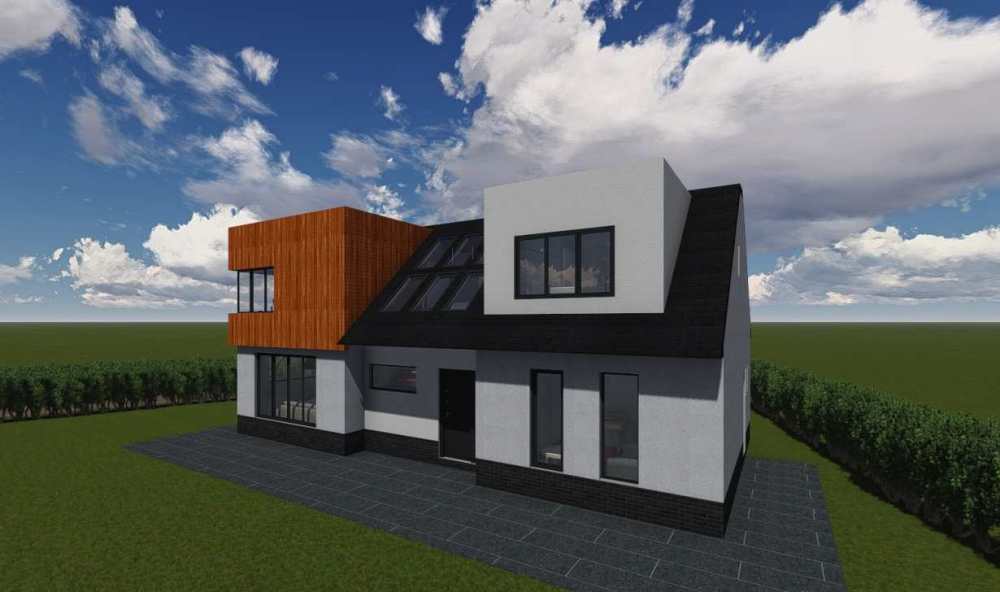
I’m building a house that will look a bit like this: 124m2 footprint , around 114m2 GIA downstairs & 75m2 upstairs. Block inner leaf, block outer leaf with render. Although I’m only planning for 150mm EPS beads in the cavity, I’m intending for there to be sufficient insulation upstairs to eliminate the need for upstairs heating. I’d like to see a 0.6 air tightness score.
-
How bad is this brickwork & should I start again?
Tony L replied to Tony L's topic in Bricklaying, Blockwork & Mortar
That's impressive work for an amateur, @Pocster. I laid a few courses of blocks 30 years ago, when a friend was building a garage for me, & I was surprised at how bad I was at it. -
How bad is this brickwork & should I start again?
Tony L replied to Tony L's topic in Bricklaying, Blockwork & Mortar
I’ll just tidy this thread up: The builder employed a firm of solicitors (quite a big firm from up north) to assist him in his attempt to bully me into paying outstanding bills totalling £10,873. There was a long exchange of emails, which I hope was costing him dearly (it didn’t look as though he was writing all these himself). I decided I probably wouldn’t need to engage a solicitor to help me until we had a court date. Of course, the builder was using lies & flawed logic to argue all his work was absolutely fine. In the end, he sent a credit note for £6,873 & I paid £4,000 to resolve the dispute. In order to get the credit note, I had to agree to not come after him if any defects, in addition to those I have already told him about, come to light. I’m not happy about this, but I decided to take the risk, so I could move on. This was the second credit note I’d received from this builder. The first one (£6,800) was received after a long argument over the cost of the extra works BCO insisted on after changing their mind about the foundations. Part of me really wanted to resolve this in court, & see him crumble as I presented my cast iron case, but as anyone who uses reputable sources to follow current affairs knows, the justice system in England & Wales frequently works against victims, so I decided not to gamble on it working for me. -
Yes, I like to know what kind of rubbish people are reading, so I read a variety of newspapers. When I bring one of my mum's previous day's newspapers to the office, I keep it hidden so nobody gets the false idea I'm one of those people that agrees with the newspaper's world view.
-
The white streaks could be efflorescence. This normally appears as patches, rather than streaks. Efflorescence is caused by salts dissolved in water rising up through porous brick/block work; the water dries, leaving the salts behind. Perhaps somebody with more knowledge than me will be along to tell you what you can do about it. You should be able to wash/scrub it off, but unless you treat the wall in some way it will return. If a wall is built with a DPC entirely above ground level, efflorescence should only appear below the DPC.