Tony L
-
Posts
397 -
Joined
-
Last visited
Everything posted by Tony L
-
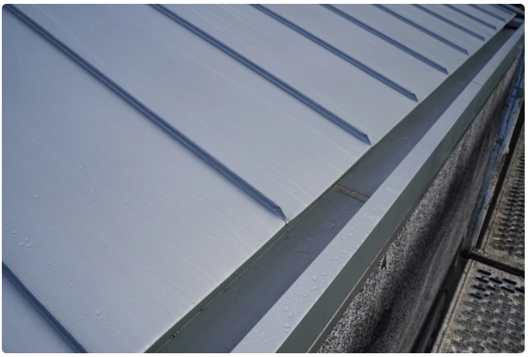
I'm not. The current plan is to have standing seam on the pitched roof sections only. The flat roof covering has been specified as GRP, although I'm not convinced this is my best option. I do wonder, whether having a 3 degrees standing seam roof over these 55m2 of flat roof areas might be no more expensive than GRP, because the standing seam team will be on site, anyway & it will be one less trade to worry about, one less thing to have to learn about & SS would likely be more robust than GRP. My concern about anything other than metal, is birds pecking through it.
-
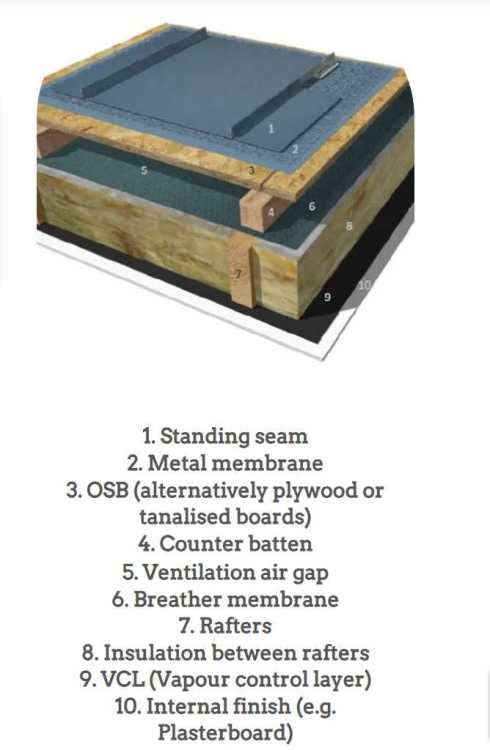
You need to fill in No. 6 with a roof covering - you can't leave OSB as your top layer.
-
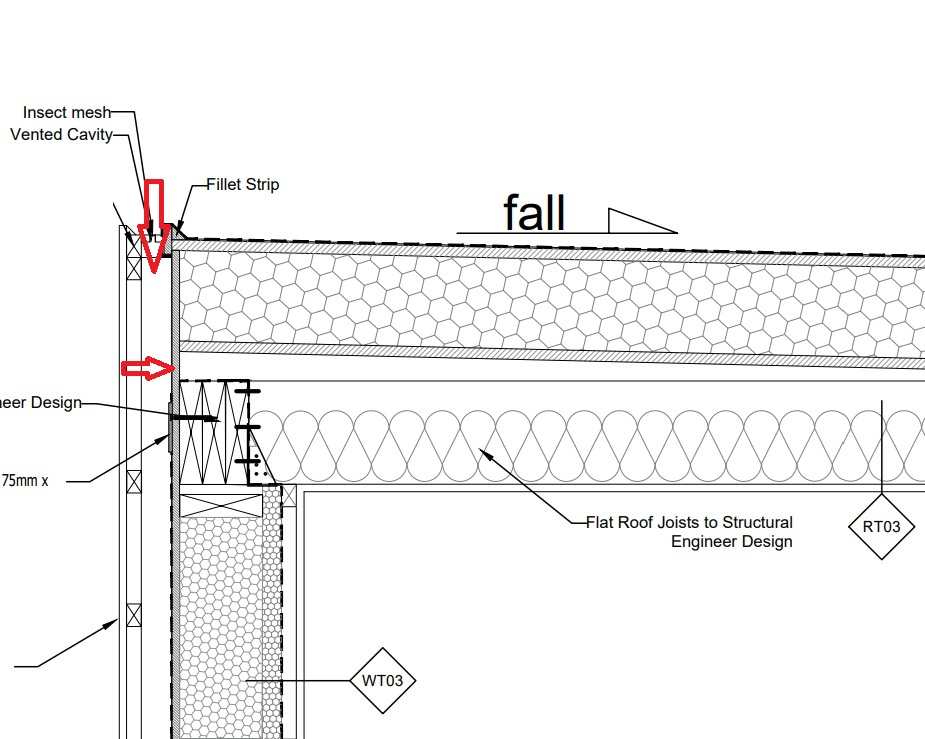
It should be, but I don't think it will be very warm in the middle of this make-up. The section I'm talking about is above the Rockwool, & in winter, cold air will be flowing through the void behind the cladding (a wide void due to cross battening for vertical cladding) then there's nothing but a sheet of OSB between this flow of air & the void made up from the firings & the empty space between the joists. I will ask the arch tec' to swap the fall around anyway, so rain drains towards the front rather than towards the back.
-
All good points from your post, above, thank you, @ADLIan. Yes, the arch tec's design with extra insulation beneath the warm roof was an alarm bell for me, which is one of the reasons I've asked about these roofs. But, I've seen at least one builder here, who seems to know what he's doing, saying he's done almost exactly what my arch tec' has proposed.
-
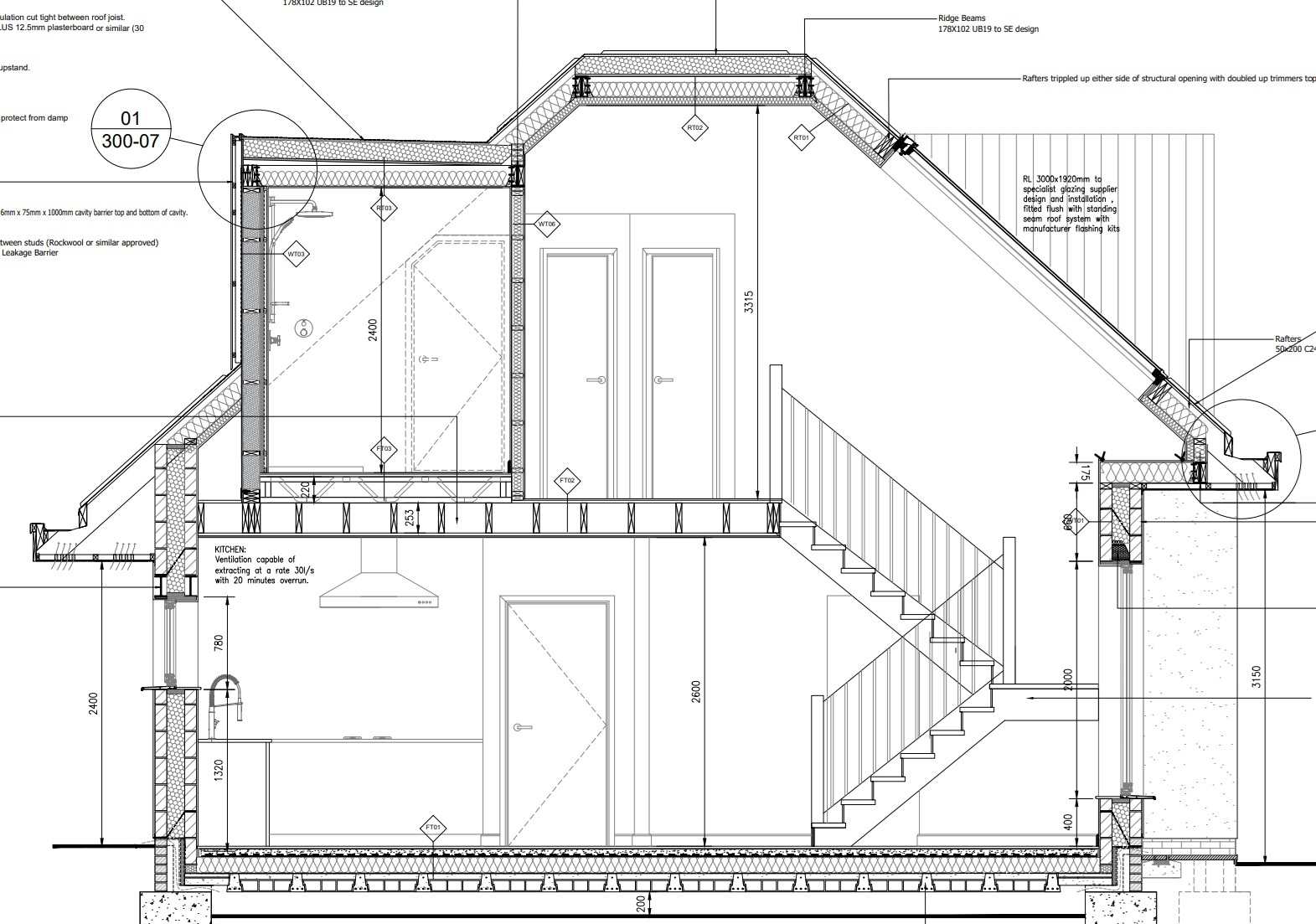
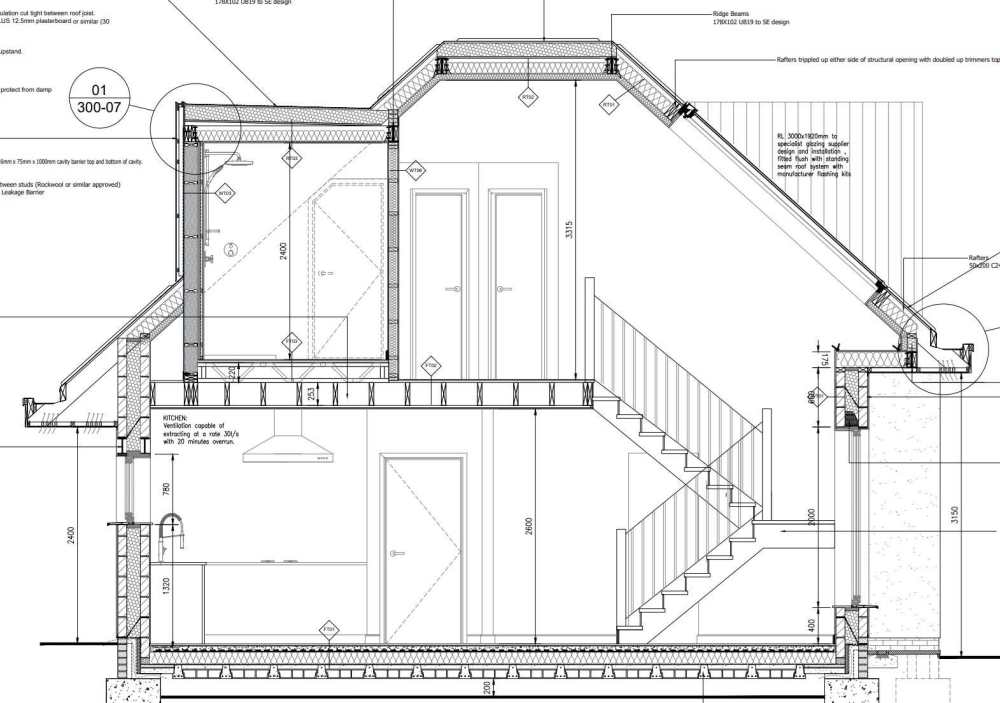
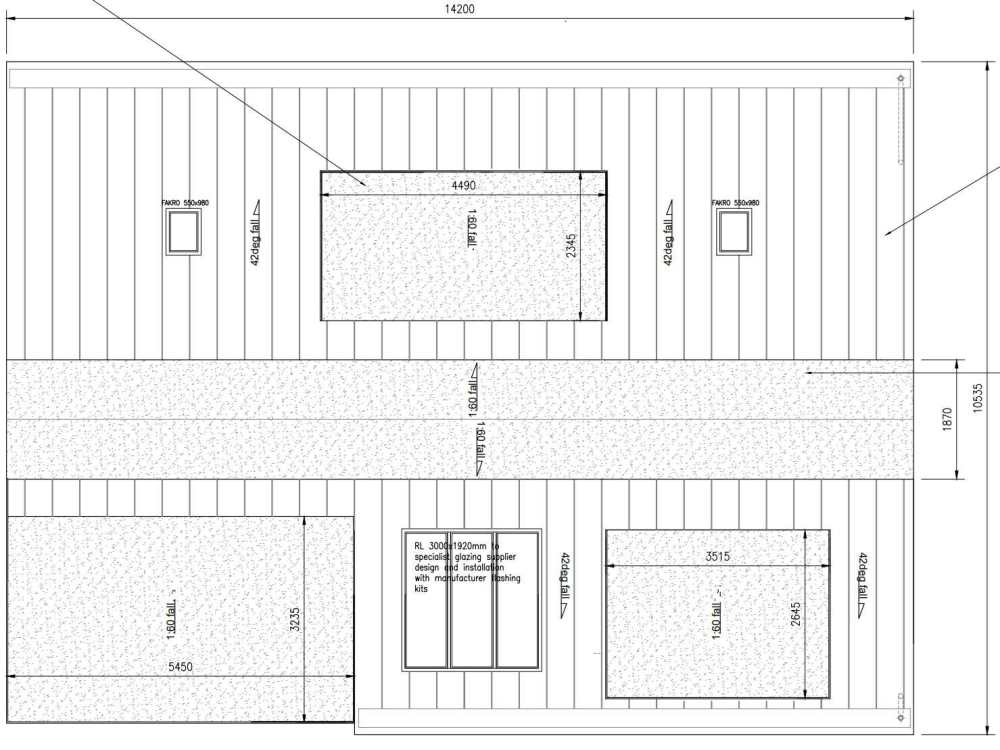
I must explain: the ridge height absolutely cannot go any higher. I could get away with adding 100mm to the height of the dormers if I have to, although I think reducing ceiling heights by 100mm, or more, is probably a better strategy (due to PP restrictions). There’s plenty of spare space inside my vaulted ceiling, in the section under the long flat roof, so this could be used to make this roof section deeper. The eaves across the front of the house is higher than PP allows, & I will ask my arch tec' for the wall plate height across the front to be reduced by 140mm to bring the eaves height down to where it should be, at around GL+2700mm. This will have the effect of pushing the 42 degrees front roof towards the middle of the house, making the flat roof across the ridge narrower by about 150mm. Rather than have the flat dormer roofs sloping backwards to drain onto the standing seam, as drawn, my plan is to ask for these to be changed to drain into a front corner, into a downpipe concealed behind the cladding then straight into the hidden gutter (from the 5450 wide dormer in bottom left) & onto the standing seam for the other two dormer flat roofs. The drip edges on the long flat roof that spans the house have not been properly drawn. I’ll get these changed so the drip edges overhang the standing seam ends by 100mm+, then the 50mm void under the standing seam will vent between the seams, under the long drip edge, which will protrude from the flat roof & lay on the seams. I realise there are many bad things going on in this section drawing. My plan was to ask about the spec’ for the make up under the flat dormer roofs first, then ask for help with some of the other details once the flat roof make ups have been resolved. I’m very grateful for your interest in my project. Thank you, @Iceverge & anyone else that's able to help.
-
Here's an early Sketchup image, to help you understand what's going on with the galleried landing & porch. The front of the house faces north - the north pointers on the arch tec's drawings are all incorrect.
.thumb.jpg.1e63407a1e54efbdd6e8fd0a6113d704.jpg)
-
Here's a section drawing. I’ll also upload 3x pdfs so you can see this more clearly. TonyL 300-04 - Section AA.pdf TonyL 300-08 - NB 1st RT03 is RT02 Proposed Build-ups.pdf TonyL 300-03 - Proposed First Floor Plan.pdf
-
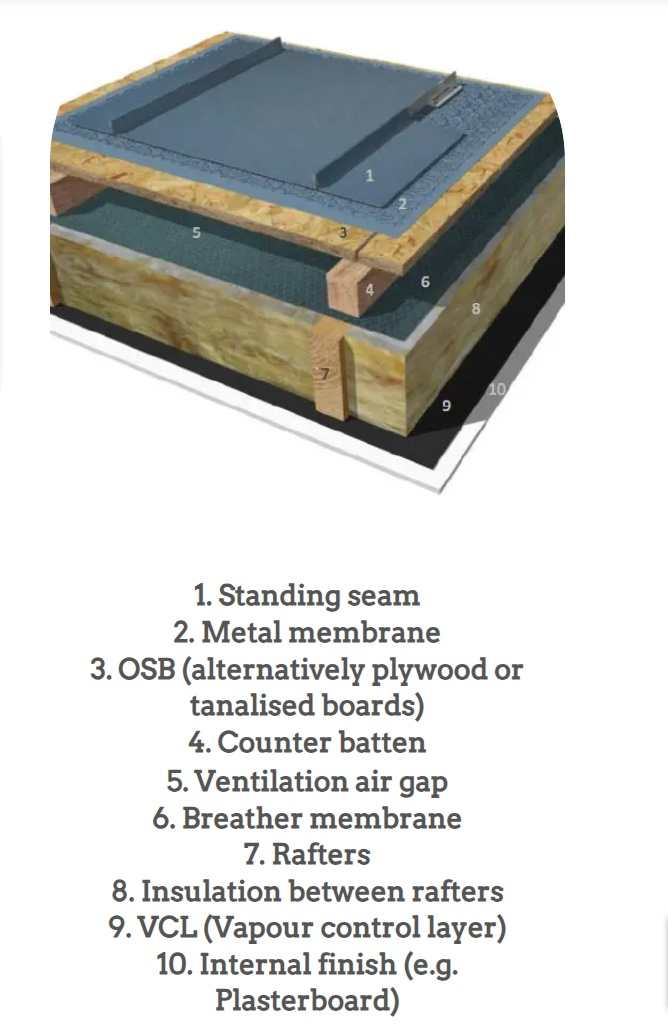
The sloping roofs will be standing seam. & I plan to get the roof make up below the standing seam changed to this, although with deeper Rockwool & insulated PB. There are small rooms under the sloping ceilings at the back, so I don’t want to make the roof much thicker than the 296mm drawn; this might include 200mm Rockwool + 72.5 Kingspan K118 (only 60mm of the 72.5 is phenolic insulation). More insulation would be better, I know.
-
Thank you @Iceverge & @ADLlan. I'm having a horribly busy day at work. I'll try to get back to you within a couple of hours. Anyone: why aren't my @nametags working as they usually do?
-
If you're lucky, one of the mods will do it for you. This looks really nice & I look forward to hearing more as the work progresses. I'd cut back on some of that glass. I'm guessing you have lovely views to the south, so all those windows will stay, but I'd say you should consider deleting some of the windows down the long sides & making some of the windows that are retained smaller. It will make your house cheaper to build & cheaper to heat/cool. I'm envious of your integral garage.
-
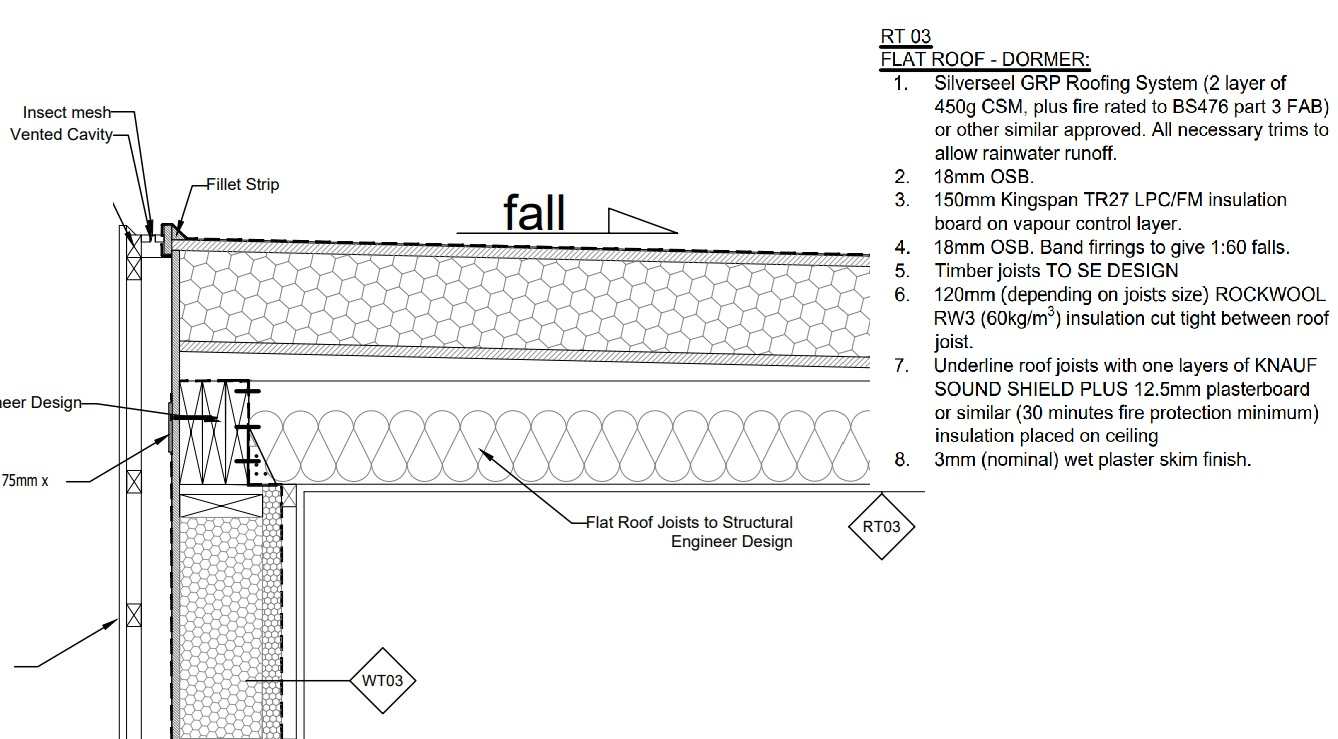
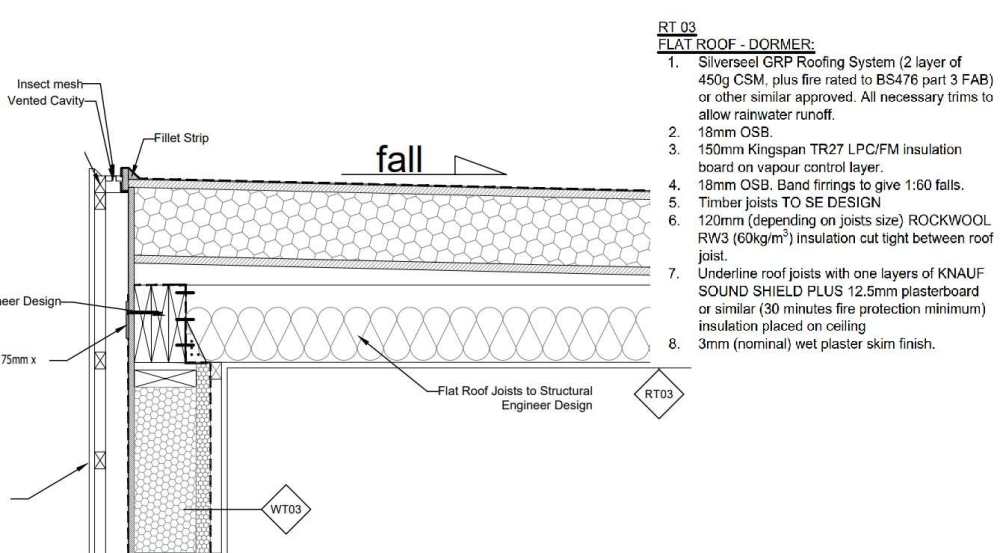
I don’t like this because: 1) There’s a big wedge of cold, damp air in the middle 2) Even if we fix 1) above, I’m concerned the 120mm Rockwool above the ceiling may insulate well enough to make the OSB supporting the PIR cold enough for condensation to form (& the VCL is above this OSB, so it will have a significant supply of moisture to it). 3) It’s a bathroom – even if we swap out the KNAUF Soundshield plasterboard for a water resistant plaster board, we may still need something else to stop moisture rising into the structure . Would we? I don’t know – I’m a novice. The same roof make up is specified over the bedrooms too. I need to ensure these rooms will be quiet. I’d be happy to hear the rain as I drift off to sleep, but rest of the household demands absolute silence. I’m thinking I should change the design so we have, from top down: 1. roof covering – which may or may not be not be GRP (let’s not get into that now) 2. 18mm OSB (can I get away with 11mm to save £330 over approx. 55m2)? 3. 200mm PIR with top layer Kingspan TR47, which has built in falls, meaning firings will not be required lower down (I haven’t priced TR47 yet). Taped at joins & in two layers with offset joins . 3b & is it worth the expense of Gapotape (or perhaps cheaper alternative) all around the perimeter, which will mostly be OBB3? 4. VCL – If somebody could tell me which one to go for or what the spec ‘should be (in terms of SD value? – I don’t know) that would be helpful. 5. 18mm OSB 6. 170mm C24 joists, or perhaps fatter 150mm joists, if SE allows 7. unvented air between the joists 7b. For outside walls, do I stuff 100mm (or more) rockwool against the sides, (along the joists on the long side & between the joists on the cheeks), so the roof insulation is “tucked in”? 8. 100mm Rockwool fitting tight between the rafters – this is for sound insulation, really, but it’s making the void cold. This sits directly on top of 9) 9. 12.5mm plaster board (water resistant type if it’s a bathroom) 10. resilient bars 11. another 12.5mm plaster board (water resistant type if it’s a bathroom) Once I’ve settled on a make-up, I can start worrying about the edges/interfaces.
-
& here’s part of the detail drawing for the bathroom roof.
-
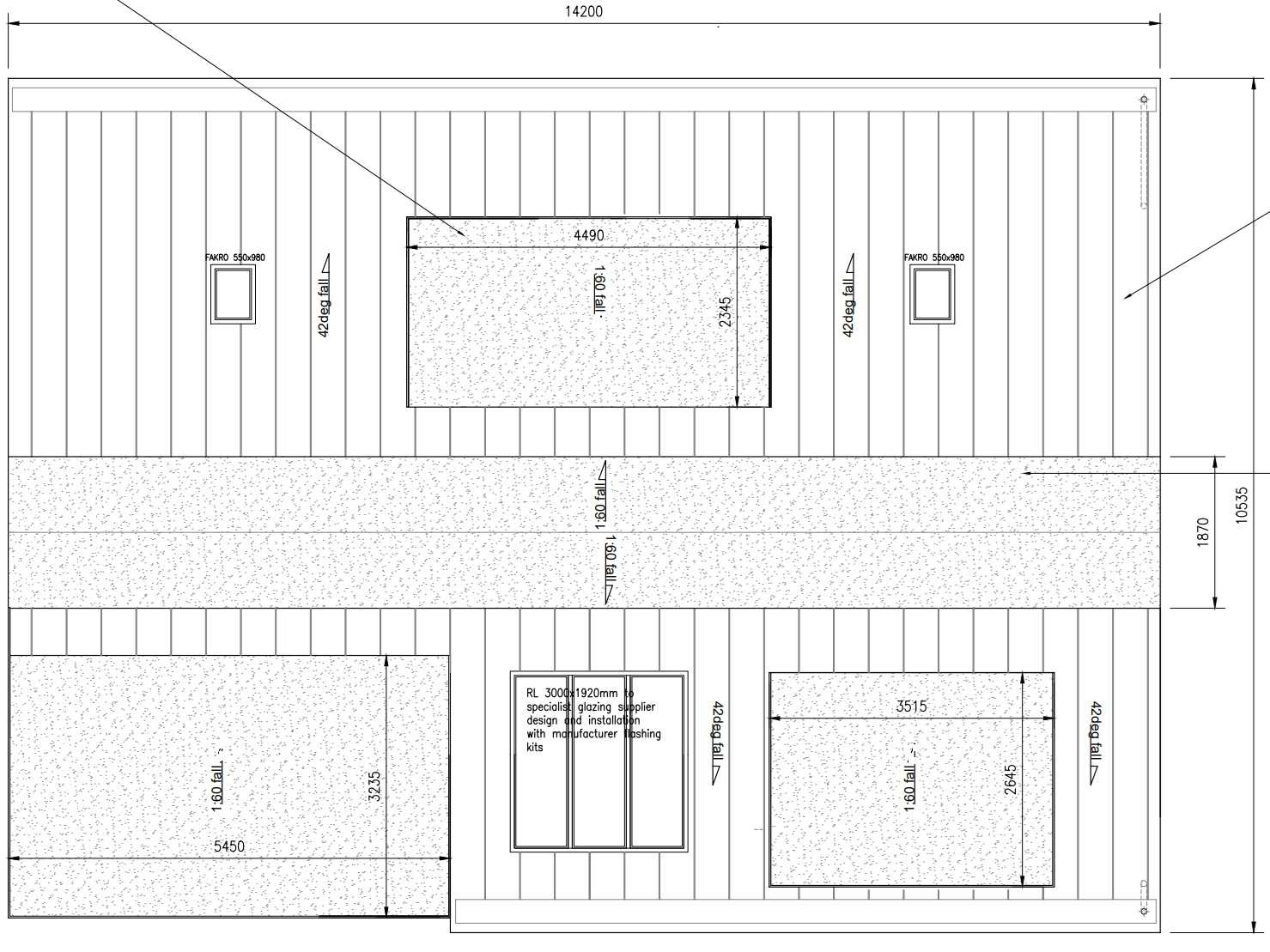
I’m checking through my architectural technician’s drawings (these are for BC & construction) & I’d like some advice, please. Due to planning constraints, my new build is going to have 4 large flat roof areas – see roof plan, below. The flat roofs make up well over a third of my roof covering, so I’m keen to get these right. Here’s the arch tec’s first draft roof plan.
-

MVHR installers or alternatives?
Tony L replied to Swampy's topic in Mechanical Ventilation with Heat Recovery (MVHR)
Anyway, that’s enough whinging from me, & I don’t want to hijack @Swampy's thread, so can anybody help with @Swampy's request from the first post? -
MVHR installers or alternatives?
Tony L replied to Swampy's topic in Mechanical Ventilation with Heat Recovery (MVHR)
Thanks @JohnMo. My brief to the arch tec specified MVHR & said, “Airtightness will be to near passive standard: we’ll aim for 0.6 & see how close we can get. Insulation will NOT be to passive standard…”. The arch tec’s drawings include a note which says, “The measured air permeability should be no worse that [sic] 10m3/(h.m2) at 50p.a”. & yes, I understand his 10 is not the same unit of measurement as my 0.6 ACH, but his 10 is too leaky to even meet current building regs for a non-MVHR new build, so this is pretty disappointing, really. I’m having to request loads of corrections like this. It’s taking forever. -
MVHR installers or alternatives?
Tony L replied to Swampy's topic in Mechanical Ventilation with Heat Recovery (MVHR)
Thanks for a quick answer on that one, @Bramco. I am just in the process of reviewing/correcting the first draft BC/construction drawings my architectural technician has drawn up for me, & my instructions include a note to delete the MEVs he's drawn in, so I just wanted to be sure. -
MVHR installers or alternatives?
Tony L replied to Swampy's topic in Mechanical Ventilation with Heat Recovery (MVHR)
I’m just trying to understand this. When you say, “We build…”, are you talking about your buildings that don’t have MVHR, or are you talking about people that self-build with MVHR? Or perhaps both groups of people. My understanding is, if I build a house with MVHR, I would most likely not have vents sucking air from the kitchen & bathrooms straight through my wall to the outside; the bathrooms will just have MVHR extracts & the kitchen will have the same + a recirculating hood over the hob that filters the air rising from the hob then dumps it into the kitchen to be taken away by the kitchen’s MVHR extract port. Have I got that wrong? -
Potton homes return as of today
Tony L replied to Post and beam's topic in General Self Build & DIY Discussion
Just ignore it then. It's just some idiot who doesn't deserve your time or attention. The internet is full of them. -
Of course that's right. & neither does it go within a few inches of the ceiling (another current fashion). I'd be putting it to the right of the fire place, with the sofa directly opposite. The rad isn't ideally positioned, but that wouldn't stop me optimising the TV.
-
This is my way of thinking, despite the missus wanting to be out as soon as we're safe from the hefty CIL fine.
-
Does aerobarrier negate need for airtightness detailing?
Tony L replied to SBMS's topic in Ventilation
Well done. Getting to that stage must feel like an important milestone has been reached. Please report back & let us all know how it goes. -
What does this architectural symbol mean?
Tony L replied to Tony L's topic in Surveyors & Architects
No. I'm in a low part of Surrey. I'm going to forget about snow for now, & resume the work on my drawings. I'm sure I'll be back with another question about my BC/construction drawing amends soon. -
What does this architectural symbol mean?
Tony L replied to Tony L's topic in Surveyors & Architects
Thanks for your thoughts on this, @Gus Potter. Re: gutter fall & high end/low end detail, I’m anticipating giving the gutter a good fall. The gutter will be behind the aluminium trim, which will be perfectly horizontal. That’s a good point about snow sliding down the roof ripping the gutter off. I hadn’t considered that. What I had considered was polishing the standing seam with ceramic coat, to make it easy to clean & that would definitely increase the chances of a covering of snow sliding off, as a big slab. We’re going for a black roof, & I can see myself getting my long pole washing device out to clean off any birds’ muck that might appear. As the roof is standing seam, I don’t think it would be too much of a problem to modify some PV brackets (or buy purpose made brackets) to hold some poles across the bottom of the roof, to make a snow guard. They could just go on for January/Feb, or perhaps if I make a good job, they could be permanent. It might be good to incorporate a little Tyrolean design influence. It’s my favourite part of the world. I can see gutter cleaning being a real problem on a proper 2 storey house with the type of roof & gutter I’m aiming for. You wouldn’t want to put a ladder up against the delicate edge trim that hides the gutters. In my case, the gutters are only at first floor height, so I’ll be able to access them using a step ladder, or better still, I have some of these mobile steps I can use.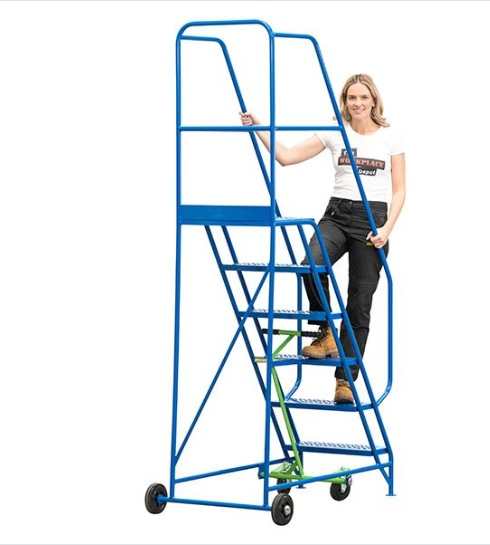
-
What does this architectural symbol mean?
Tony L replied to Tony L's topic in Surveyors & Architects
Thanks, @Nickfromwales. I'll let everyone know how they turn out. Some time in 2027, I should think. I'm prepared to put plenty of effort in to getting the gutters right. I think a lot of otherwise good looking exteriors are spoiled by the gutters & downpipes. I've got both my downpipes on the ugly side of the house, which can't be seen from the road, due to the orientation of the house & the neighbour's huge hedge. -
What does this architectural symbol mean?
Tony L replied to Tony L's topic in Surveyors & Architects
Thanks, @torre. I think attaching my gutter solution to the plumb cut rafter feet will be less costly than cutting all the rafters. I may end up with something like this.
.jpg.123c93841be7d1b7fa8f1a10e4b8f616.jpg)