


MortarThePoint
-
Posts
2294 -
Joined
-
Last visited
Everything posted by MortarThePoint
-
Gap between render beads and lintel
MortarThePoint replied to MortarThePoint's topic in Plastering & Rendering
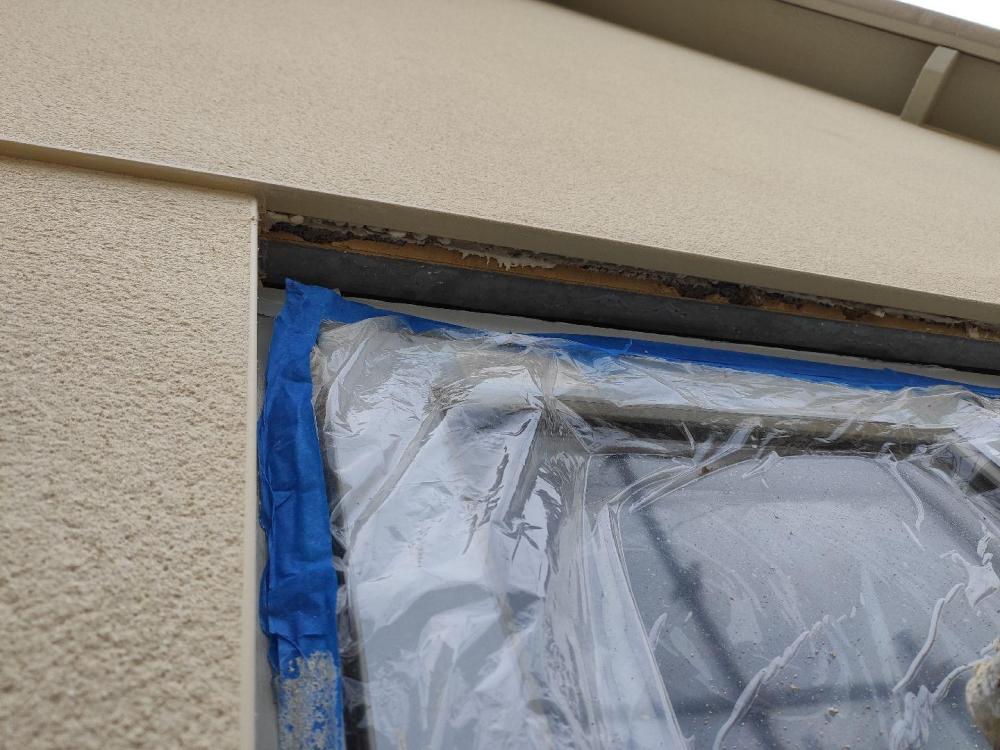
Could do. I think that could be hard to get looking neat. I was hoping to use some form of caulk or something. If black, I could then paint the lintel black. If ivory could match render. Needs to be exterior grade though obviously -
We have render coming down onto a bellcast bead above windows. There's a gap between the bead and the lintel. Can anyone recommend something fill this gap?
-
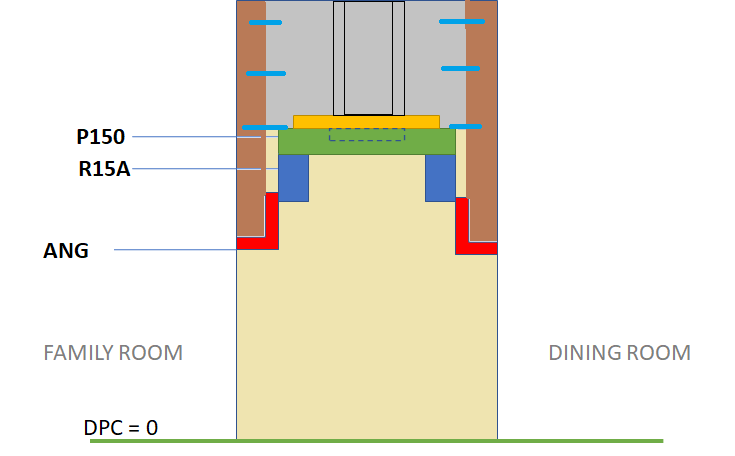
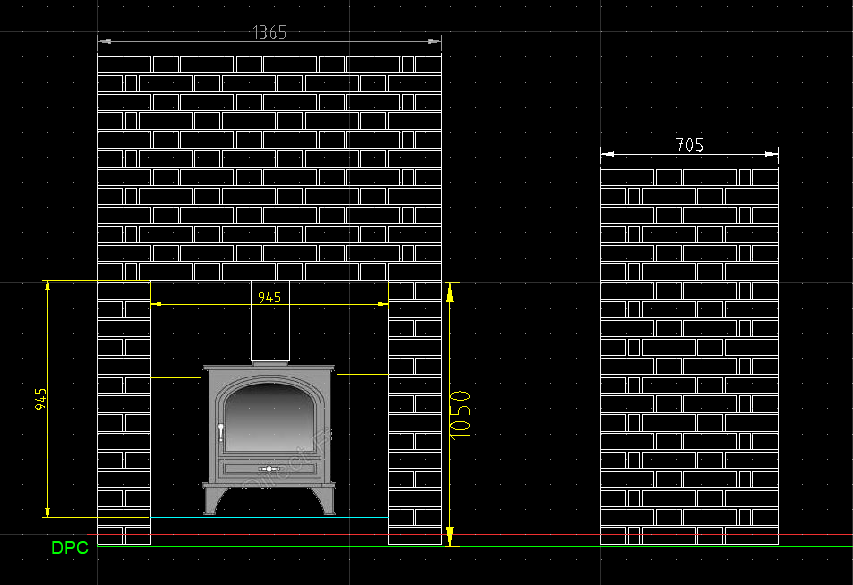
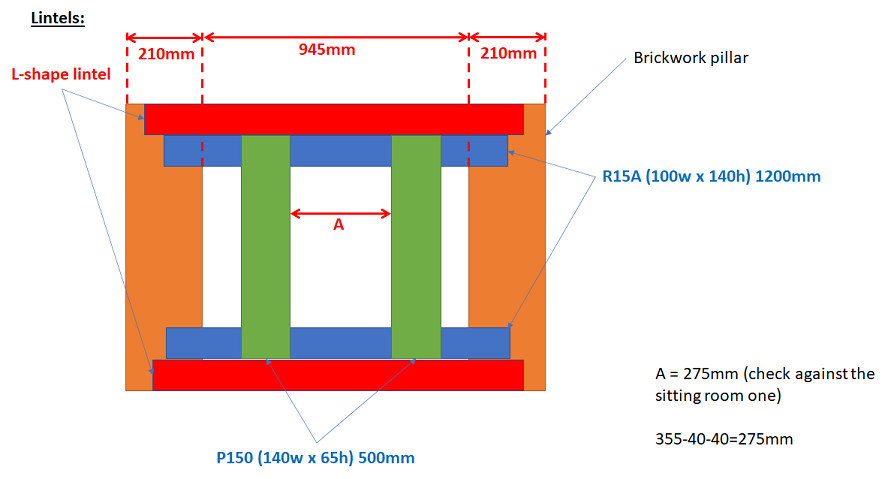
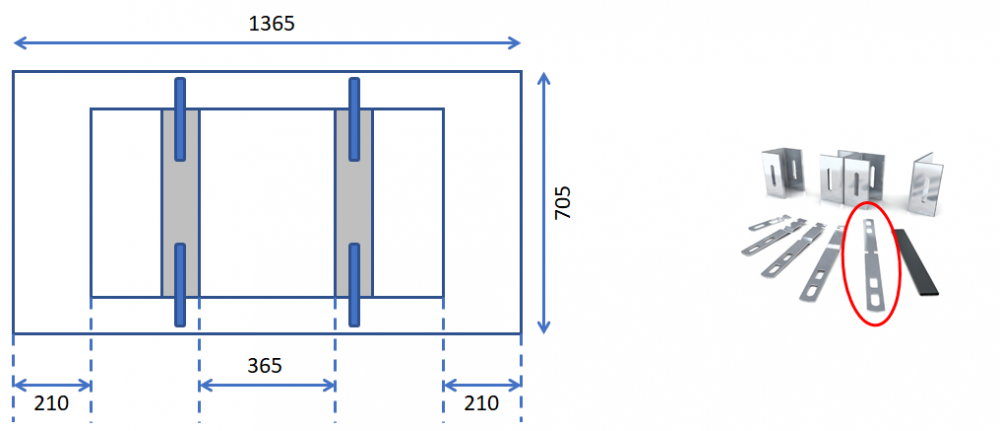
I thought this was going to be really easy but then... I have an opening for a double sided stove. The main structural lintels are two R15A (100(w) x 140(h) lintels) shown in BLUE below. Across these lintels sits some P150 lintels (GREEN) and the internal blockwork of the chimney as well as the flue liner base (YELLOW). To support the outer brickwork layer above the opening, We have used ANG steel L-shaped lintels (RED). All of the loads etc are comfortable and there would be an arching action in the brickwork meaning the ANG lintels are only supporting about 0.5m2 of brickwork (~30 bricks, 80kg vs SWL of 400kgf). Further, the brickwork is tied to the internal blockwork which is supported by the R15A lintels. The lintel scheme was checked by the Structural Engineer who was happy. I called Catnic today to ask about using the same type of lintel elsewhere and they said they shouldn't be used in fireplaces due to thermal transfer. I suspect they envisaged an open fire but I was hoping for comfort from others using these in a similar way. They are >450mm from the top of stove as it's a bit smaller than shown below and the stove manufacturer said it was OK to have combustibles >=400mm above the stove. I know the flue pipe has its own requirements too. Clearly the L-shaped lintel isn't combustible, but it gives and idea of the heat in the area.
-
Where are smoke alarms REQUIRED
MortarThePoint replied to MortarThePoint's topic in Electrics - Other
Interesting, I don't realise that they are required in rooms the chimney passes through. Do you have link for more information about that as I'll need to change my plans slightly. -
Where are smoke alarms REQUIRED
MortarThePoint replied to MortarThePoint's topic in Electrics - Other
This one is dinky: https://www.cavius.com/2002-10-year-smoke-alarm/ https://www.cavius.com/cavius-build-in-base-40mm/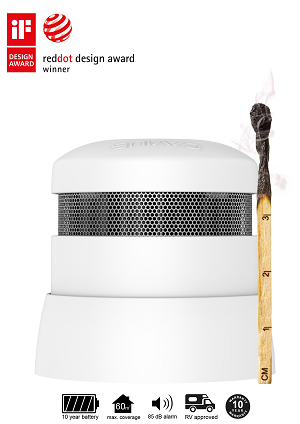
-
Where are smoke alarms REQUIRED
MortarThePoint replied to MortarThePoint's topic in Electrics - Other
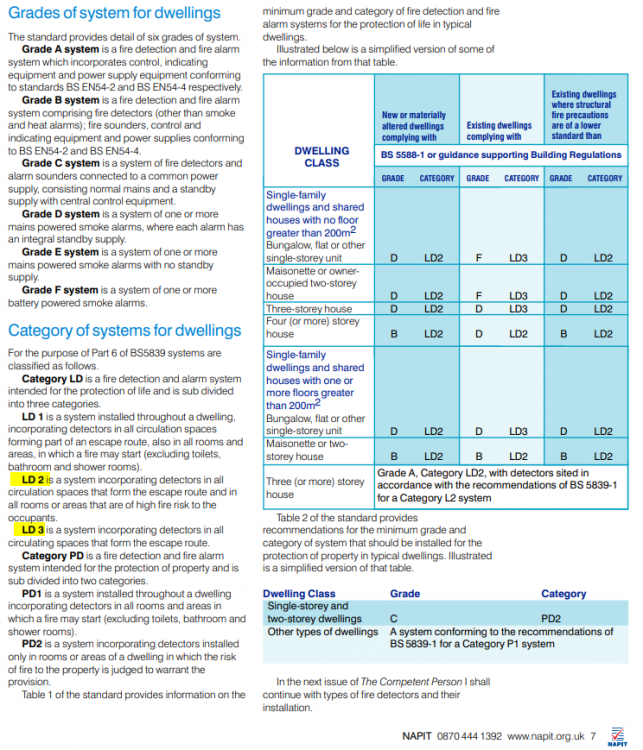
A couple of sources below including from Part B. Looks like hallways and kitchen (though not always) are required. "If your kitchen is not separated from the stairways or circulation routes by a suitable door, then you must also install a compatible heat detector in the kitchen, interlinked with the other smoke detectors positioned as above in the circulation routes" https://www.tameside.gov.uk/buildingcontrol/guidancenotes/note16.pdf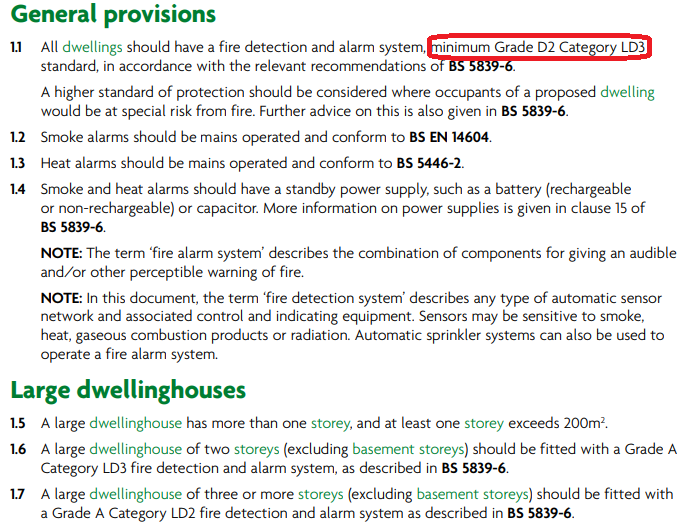
-
Where are smoke alarms REQUIRED
MortarThePoint replied to MortarThePoint's topic in Electrics - Other
England -
I know where I want to have smoke alarms, but I as wondering where the regulations require them. Reason being is I could fit more discrete battery ones in the rooms that aren't required by regulations. As I understand it, I need to have them "in all circulation spaces that form the escape route and in all rooms or areas that are of high fire risk to the occupants". Now that second bit is open to interpretation. Do building regulations require them in rooms with wood burning stoves. I know CO alarms are required but what about smoke alarms. I want smoke alarms in these rooms, but would prefer more discrete battery ones.
-
That's a good deal, well done! A mortgage on the current house would help. The rear house also has access via a 'farm track' which belongs to it, so whilst the shared drive is the preferred route it's not the only.
-
We're building a house behind an pre-existing house that we are currently living in. So far we haven't needed a mortgage, but will ultimately. We could get to habitable and BC signoff without a mortgage but I would rather have a 'standard' mortgage sooner than later as rates likely to rise and feeling the pinch. Options: A) Mortgage just the pre-existing house, but lender could get sniffy about the building site out back, though there is a very natural divide between the two with >0.5 acre for the pre-existing (but shared drive). B) Mortgage against just the new house. C) Mortgage against both, may still be sniffy about building site but clearly the value is higher The deed currently covers both 'sites'. I could get a solicitor to split but timing of that may be critical in terms of capital gains tax. I guess a loan is against a deed so (A) and (B) would need the deed splitting (?). If (B), when is it finished in the eyes of a lender: When I say it is by virtue of having a working kitchen and loo When the BC says it is habitable by way of a letter Completion certificate without signed off planning conditions Completion certificate with all planning conditions signed off Depends on loan to value ratio (LTV)
-
I used my compressor to flush the system yesterday. Sprayed the walls a few times, but think I got most of the water out. Left at 3bar air pressure. It's obvious to see how much more effective water is at leak detection through pressure loss than air is due to air compressibility
-
Fair play, you now have the experience to know how robust it is. Personally, I still wouldn't risk it and would pressure test and then leave the water in. It's less buoyant with water in, but shouldn't be going anywhere anyway. I think I read somewhere about the initial deformation of the pipes when pressurised, but it's not like screed isn't strong enough to resist that.
-
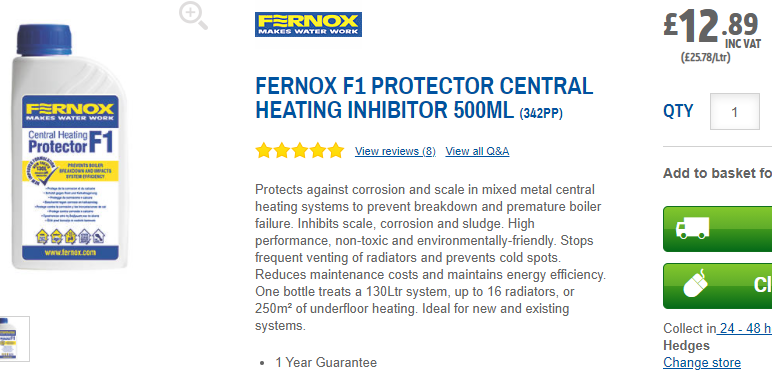
Plain inhibitor (no antifreeze) is much more dilute and cost effective than with antifreeze but obviously wouldn't add any winter protection https://fernox.com/product/protector-f1-500ml/ https://www.screwfix.com/p/fernox-f1-protector-central-heating-inhibitor-500ml/342pp

-
Pipes full of water and house roof on with proper windows half in (poly windows elsewhere). It is the conventional wisdom to do a wet pressure test before the pour and to leave it pressurised during the poor. The pressure test could identify if the pipe was damaged as laid or at another point prior to concrete which you could identify and rectify before pour. Agree you are unlikely to do anything during pour. But it's nice piece of mind to still have pressure after the pour. Finally, a pressurised pipe will better resist damage from being squashed. 6bar of pressure is around 100PSI so can resist the full weight of a person across an area of just 12mm x 100mm which is around a foot's width. Yes the pipe is strong, but may as well help it. Here I am convinced water is a better choice than air as air is compressible and water not. That means that air would only ever push back with the system pressure whereas water could momentarily increase the pressure, and locally due to inertia. The inertia of the water would resist impacts much better than air would. Agreed, but when inexperienced it is often about minimising unquantified risks. You don't have the experience to know it will be fine anyway so you do what you can to give yourself the best chance.
-
I've used 16mm pipe with an ID=12mm so 113ml per metre. My total system volume is 180l, so I'd need 45l of this stuff or 9bottles at £202. Expensive but less than burst pipes. Do most people have antifreeze/inhibitor in their UFH systems? I know inhibitor is a must for radiator systems, but don't know about UFH. @Nickfromwales do you normally install inhibitor antifreeze in UFH?
-
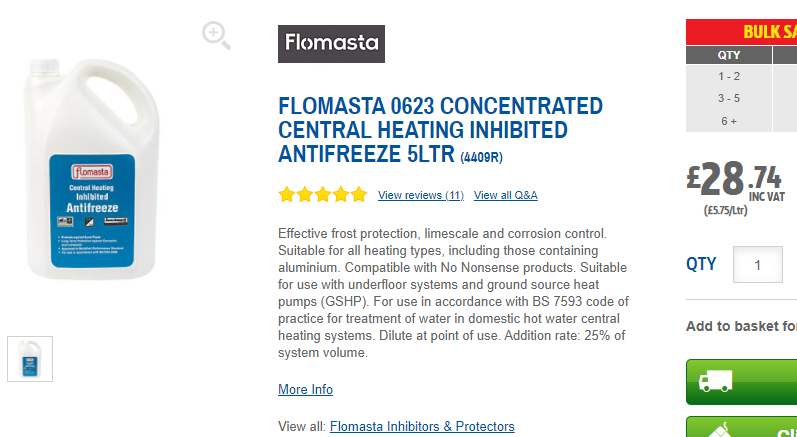
Is there any trick as to how to add it to the system. I filled my UFH directly from mains so don't have a pump box. Might have to get a small water pump (like for fountains) as haven't plumbed up any proper water pumps yet (system is only UFH pipes and manifolds so far). I presume this is what you used: https://www.screwfix.com/p/flomasta-0623-concentrated-central-heating-inhibited-antifreeze-5ltr/4409r
-
Does Antifreeze make your heating quieter?
MortarThePoint replied to ProDave's topic in Underfloor Heating
What antifreeze/inhibitor did you use? Air bubbles add a lot to the noise of a system, is it possible that when you topped up the system you significantly reduced the amount of air in the system? -
I have a compressor so could threoretically blow out the water, but I'd rather not I think.
-
I have UFH pipes installed in screed and am unlikely to have any heat source available before the temperature starts to get low over winter. Do most people just have plain water in their UFH or is antifreeze usually added? Has anyone else gone through winter with UFH in place but unheated? Another consideration is that once I eventually have the ASHP installed, I would like to be able to use it to cool the UFH during the summer. I'm sure it would be set up to keep the water above freezing, but a failure mode is to over call the water which could burst pipes.
-
Pitched Roof Counter Battens For Insulation
MortarThePoint replied to MortarThePoint's topic in Heat Insulation
Wow that must have given a very good U-value as you pretty much have a continuous ~300mm thick layer of foam insulation. I can see Posi-joists work really well with insulation like that. -
Installation Deadline for ASHP for RHI
MortarThePoint replied to Andeh's topic in Air Source Heat Pumps (ASHP)
I can imagine an unfortunate time gap opening up between the two schemes for new builds though unfortunately. I have spoken to installers that loath the MCS/RHI scheme and say how much it jacks up the cost. There's the danger the new scheme will just be the same nightmare. One installer has said he's considered abandoning doing ASHP installations because of the MCS. -
Installation Deadline for ASHP for RHI
MortarThePoint replied to Andeh's topic in Air Source Heat Pumps (ASHP)
I don't know if there has been much confirmation, but looks like the new £5,000 scheme is not available to new builds: "The grant won't, however, be available to those in social housing and new-build properties at launch." https://www.moneysavingexpert.com/news/2021/10/government-to-offer-p5-000-grant-per-household-to-help-them-repl/ This is bad news for anyone worried about the RHI deadline next March. -
Hmm, now feeling less smug about my 2m spirit level.
-
I'll be doing that for architrave and skirting for any tiled/wood/laminate areas, but I can see the benefits of door lining going in before plastering. Maybe not before plasterboard though I guess. I'll probably loose fit when putting up the MF and slide it out for plaster boarding, before then finally fitting before plastering.
-
No MVHR. Probably want a gap of around 3 - 5mm for carpet clearance. Looks like I'm OK with not having to trim the verticals.



