MortarThePoint
-
Posts
2168 -
Joined
-
Last visited
Everything posted by MortarThePoint
-
Bay windows for complete beginners
MortarThePoint replied to MortarThePoint's topic in Windows & Glazing
Any water that penetrates the render will penetrate the blockwork too. There isn't a continuous void between the render and the blockwork. You don't have a weep on each step in render do you as that would cause staining. There is a weep at the end of the stepped cavity tray 'staircase' -
Bay windows for complete beginners
MortarThePoint replied to MortarThePoint's topic in Windows & Glazing
- -
Bay windows for complete beginners
MortarThePoint replied to MortarThePoint's topic in Windows & Glazing
I'm confused as to why this will leak. There is a stepped cavity tray above to guide water down the cavity away from the abutment and there is sufficient lead upstand to cope with roof water splash. Unless it's cut in to the wall immediately below a cavity tray, the lip won't do anything. -
Bay windows for complete beginners
MortarThePoint replied to MortarThePoint's topic in Windows & Glazing
Bay pole jacks supporting corner posts look to be the correct solution and rated (most) to 2t so plenty of capacity. https://www.windowwidgets.co.uk/corner-posts/ The challenge now is how to mount it on the brickwork as the exterior leaf corbels out by two courses (32mm) at the top of the short wall of the bay. I can lay some cut bricks to fill in behind the corbelled bricks, but it would be nice to have a better footing. I guess an L-shaped (in plan) plate laid on top of the brickwork could act as a spreader. Would be nice to bridge the cavity with a square plate, but that would create a cold bridge. [mild steel 50W/Km, 10mm x 200mm x 200mm(bridge) --> 50*0.010*0.200/0.100=1W/K] -
Bay windows for complete beginners
MortarThePoint replied to MortarThePoint's topic in Windows & Glazing
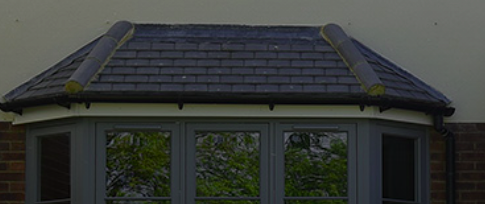
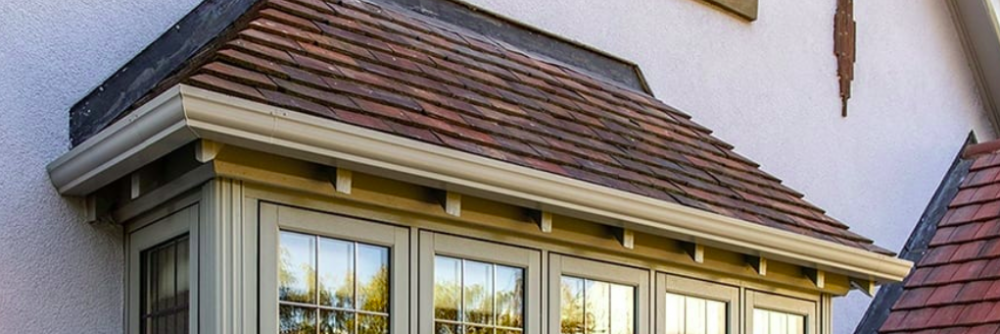
I'm sure I've seen a lot of houses with render down much closer to the bay window tiles. Have they rendered over the lead or got tiny lead flashing upstand? Render tight up to roof: Close: Render quite far from roof: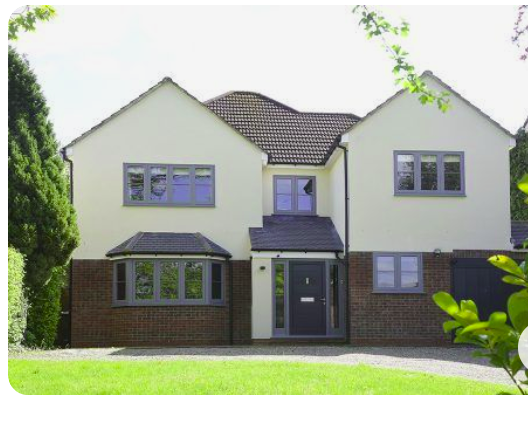

-
Bay windows for complete beginners
MortarThePoint replied to MortarThePoint's topic in Windows & Glazing
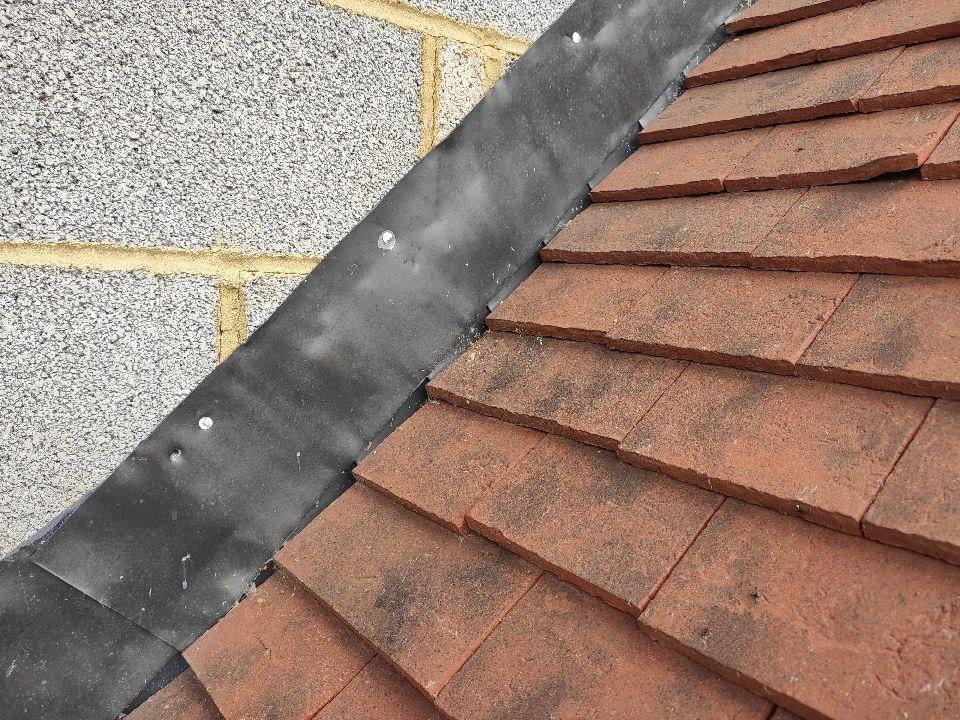
Couldn't find their PDF but found another organisations Craftsman's Guide. they show that the render bead does go far over the lead flashing. Unless the lead is trimmed a bit, it may only just reach the nails holding the lead flashing in place. They haven't chased the lead in. Should it be chased in?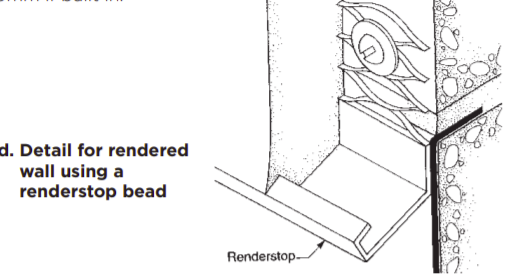
-
Bay windows for complete beginners
MortarThePoint replied to MortarThePoint's topic in Windows & Glazing
Thanks. Cavity trays are in and there is a lintel in the wall (so not a pile of rubble ? ) Just kidding, I presume you mean keystone across the bay not in the wall. I think I've been overestimating how far the render goes over the lead. Render says 30-50mm. That should leave lots of room to shift the lead slightly to tuck soakers under shouldn't it? -
Bay windows for complete beginners
MortarThePoint replied to MortarThePoint's topic in Windows & Glazing
Other options that come to mind: Add some stub rafters (~400mm long that are enough for the first two courses of roof tiles and the battens beneath. Tile top two courses of tiles and dress with lead etc. Problems: What to do about roofing membrane? Would get in the way/knocked. Not render this area. hold the render back around the bay window roof and then later once the roof is in place feather in a second job of rendering. Problems: could create a visible join, could create cracking weak spot at join. Weld the lead line. Weld each soaker that is added to the flashing and to the soaker beneath it. Dress lead over the render. Not aesthetically what we want. Handle the leaks. e.g. use DPC dressed on wall and tucked over roofing membrane Problems: extra material to squeeze under the render. Could cut it the DPC into the blockwork below the stop line of the render but above the bottom of the lead flashing. Could put excessive amounts of water on to the roofing membrane. Handle the leaks 2. let the water go down onto DPM over the ceiling below. Problem: could have pooling and humidity/mold. -
Bay windows for complete beginners
MortarThePoint replied to MortarThePoint's topic in Windows & Glazing
Do you mean these bits where it's a sloped roof abutment rather than ridge abutment? I could tuck some DPC underneath where the lead would go that could then get folded onto the roofing membrane. In that way any water that got through the lead would be guided on to the roofing membrane by the DPC. That makes for a bit of a stack up under the render though which could be a problem (render cracking).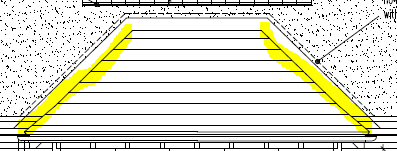
-
Bay windows for complete beginners
MortarThePoint replied to MortarThePoint's topic in Windows & Glazing
I pre ordered the windows for the rendered sections and they are now installed -
Bay windows for complete beginners
MortarThePoint replied to MortarThePoint's topic in Windows & Glazing
I pre ordered the windows for the rendered sections and they are now installed -
Bay windows for complete beginners
MortarThePoint replied to MortarThePoint's topic in Windows & Glazing
Any other options? The render is booked in for just over a week's time. He'll need the scaffold to stand on too -
Bay windows for complete beginners
MortarThePoint replied to MortarThePoint's topic in Windows & Glazing
Why will it leak? Won't any water striking the flashing drain onto the soakers that are tucked under it. -
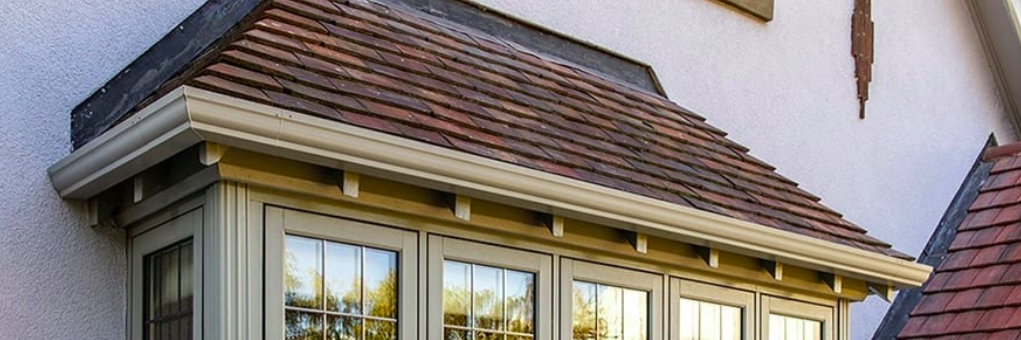
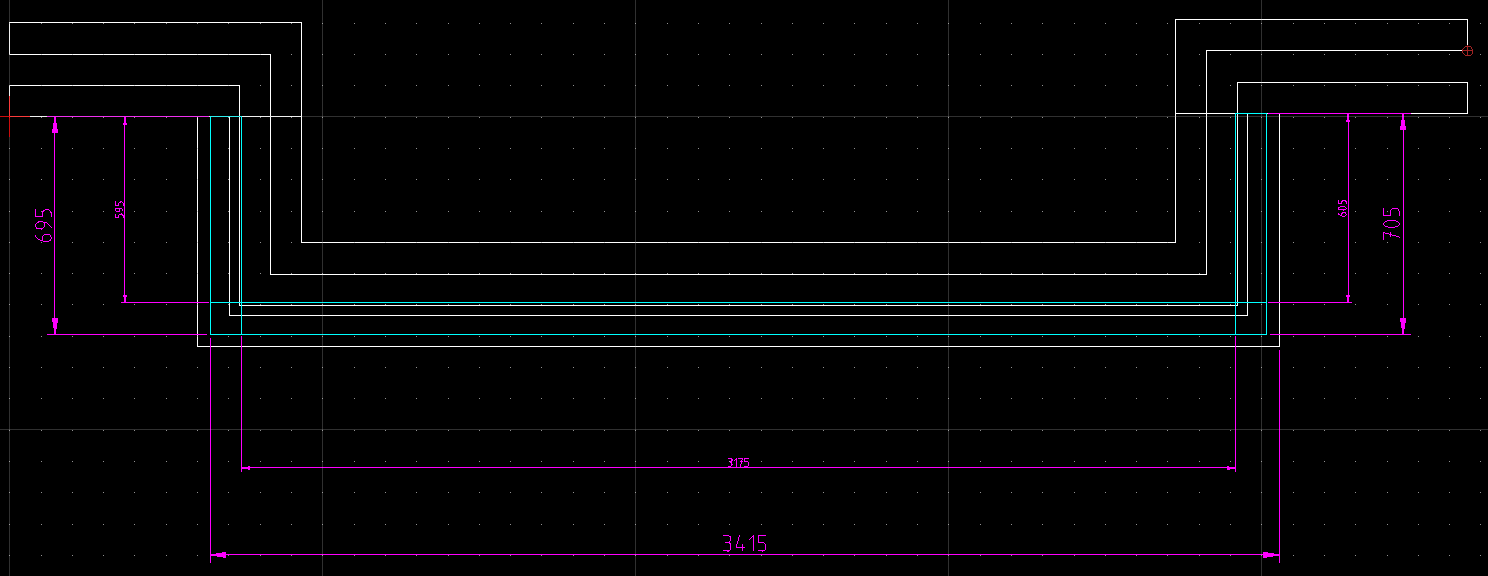
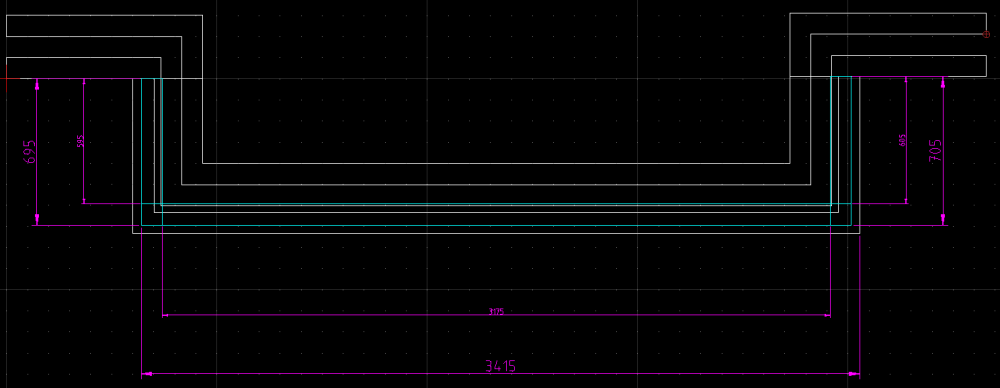
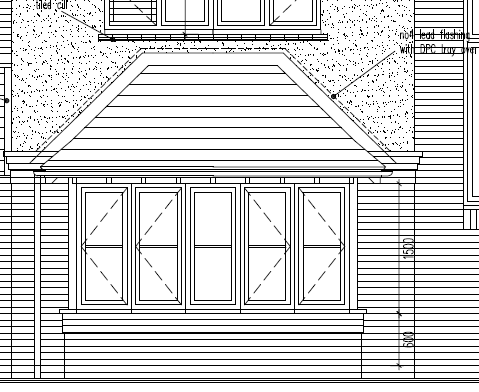
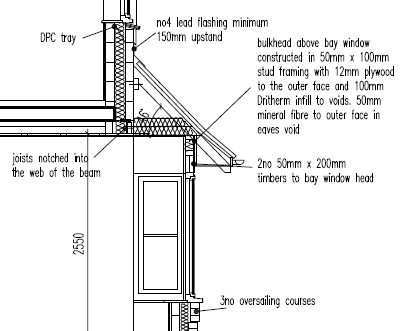
I'm specifying the windows for our bay window and it's raising a lot of questions that I'm sure the wiser among us have come across before. Below is an extract from the elevations drawings and a dimensions drawing of what the masonry and window elements look like in the bay. Questions: Window tolerances: Across the front to the rectangular bay the dimensions are in the hands of the window manufacturer as it's not like it needs to fit with a reveal that is slightly off nominal or slightly off plumb. So there I presume I specify the actual dimension I get by measuring on site and subtracting twice the desired amount the windows are to be set back from brickwork (twice because one set back at each end of the run). That leaves the dimension between the pillar and the brickwork wall. Here we are subject to variations in plumb etc. For my windows in reveals I have allowed a tolerance of 5mm to the cavity closer and lintel on all four sides. Do I just allow a tolerance of 5mm on these side dimensions? If so that yields left: 695mm - 2.5mm(cavity closer) - 5mm(tolerance) = 687mm and right: 705mm - 2.5mm(cavity closer) - 5mm(tolerance) = 697mm. Is that correct or am I missing something or being too tight with the tolerances? Roof support vs pillars: I'm pretty sure all the windows quotes I have had have said their pillars aren't structural, so I need to work out how best to support the hipped bay roof. Making it self supporting off the wall could be a big ask as it will put a lateral force on the wall that will try to pull out any fixing used at the roof's pitch abutment*. The rightangle bay posts in the window range I have gone with appears to include a metal corner post and jack arrangement, but no information about how much weight is allowed. The roof is around 1100mm x 4200mm at a 45 degree pitch (1.5m pitch abutment length) so that works out as 1.1m*((1.5+4.2m)/2 + 2*(0.5*1.1m))*1.41 * 77kg/m2 = 572kg is just tiles. The load is mostly on the wall side, but I can easily see >100kg required on each pillar support and that's before adding any snow load etc. I guess a factored load would be more like 300kg. [*] Force calc: taking moments about the bottom left corner and just considering tile weight: F_fix*600mm = 77kg/m2*(1100mm*600mm*1.41) * (1100mm/2) --> F_fix = 66kgf = 0.7kN (first 600mm is the vertical distance to the fixing from bottom of 'truss', second 600mm is fixing spacing). There are other weights to be considered so probably more like F_fix = 2kN, perhaps 1kN if using one fixing every 300mm instead. Most of the blockwork is a low panel beneath the window so no real weight to the wall there. Abutment lead vs render: The render above the bay roof needs to go on before the roof is in place (scaffolding in the way). This means what would normally be supporting the lead isn't there yet. I think I understand the approach here. The roofer puts in flashing flat to the wall which gets mostly rendered over. The roofers then tuck their soakers under this flashing when the roof gets installed. Above the windows: There is a short vertical distance ~450mm that needs to get framed out in timber. This is then to receive 12mm painted plywood. Across the top of the windows 2no. 50x200mm timbers. No real need for soffit, but will need sprocket, fascia and guttering.
-
Partitions: Timbers studs Vs Metal C studs
MortarThePoint replied to MortarThePoint's topic in General Construction Issues
OK for now. My local Minster and Travis Perkins have the standard stuff in stock. The BG Acoustic and deep track needs ordering in (e.g. from CCF), but that's only a couple of days (supposedly). Prices have been going up, but nowhere near timber. -
Partitions: Timbers studs Vs Metal C studs
MortarThePoint replied to MortarThePoint's topic in General Construction Issues
No test thankfully and likely overkill anyway ? -
Partitions: Timbers studs Vs Metal C studs
MortarThePoint replied to MortarThePoint's topic in General Construction Issues
Does anyone know if I should start a BG acoustic stud (Acoustud) partition on a blockwork abutment with a standard C-stud or on a vertically mounted section of floor/ceiling channel? The BG Acoustud doesn't have a flat back so won't work screwed t a blockowork wall. Tried getting an answer from BG but their swamped and haven't responded. -
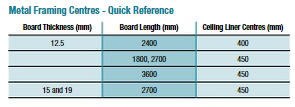
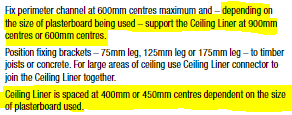
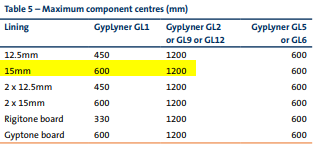
Hmm, looks like TradeLine specify 400mm centres though! Also with reduced GL2 c/c. https://user-ehptxzr.cld.bz/ccf-bookshelf/Tradeline-Brochure-2017/86/ GL1: TradeLine 2.5m/m2 £0.83/m, £2.08/m2 GL2: A Hough 12.5p each but 4.2/m2 GL3: A Hough 18p each but 0.7/m2 GL8: TradeLine 75p/m That makes the arbitrary 4m x 4m room 16m2*(£2.08/m2 + £0.53/m2 + £0.13/m2) + 16m*(£0.75/m) = £55.84 or about £3.50/m2 plus screws which is more than BG. BG is only at 600mm centres with GypLyner if using 15mm plasterboard though: WhiteBook C06. S04. P07 If using 12.5mm plasterboard the TradeLine offering will still be cheaper than BG despite using more GL2 brackets.
-
I've had some prices on TradeLine and it is much cheaper: GL1: TradeLine 1.67m/m2 £0.83/m, £1.38/m2 GL2: A Hough 12.5p each which is similar to Builder Depot GL3: A Hough 18p each which isn't better than Builder Depot GL8: TradeLine 75p/m That makes the arbitrary 4m x 4m room 16m2*(£1.38/m2 + £0.18/m2 + £0.09/m2) + 16m*(£0.75/m) = £38.40 or about £2.40/m2 plus screws.
-
Partitions: Timbers studs Vs Metal C studs
MortarThePoint replied to MortarThePoint's topic in General Construction Issues
That works out as £6.50/m of wall uplift to timber plus resilient channel at around £6/m of wall. -
Partitions: Timbers studs Vs Metal C studs
MortarThePoint replied to MortarThePoint's topic in General Construction Issues
With a timber wall, you're looking at starting around STC32 and going into the 40s at best without using resilient bar (aka resilient channel) or doubling up on timbers. Timber highlights from IR761: Page 26: 406 c/c, 90mm timber studs, double layers of 13mm plasterboard, mid density insulation STC 38 Page 178: 610 c/c, 90mm timber studs, 16mm plasterboard, lower density insulation, resilient bar one side 406c/c STC 50 Page 218: 406c/c, 90mm timber studs, double layers of 13mm plasterboard, lower density insulation, resilient bar one side 610c/c STC 57 Page 350: Double timber wall, 610c/c, double layers of 16mm plasterboard, lower density insulation STC 69. Good below 125Hz (e.g. 26.7 @ 50Hz) Some MF highlights (copied from previous post): Page 89: 610 c/c, 90 steel studs, 16mm plasterboard lower density insulation STC 50. Page 93: 610 c/c, 65 steel studs, 13mm plasterboard (double on one side) lower density insulation STC 51. Page 120: 610 c/c, 90 steel studs, 16mm plasterboard (+13mm on one side) lower density insulation STC 55. Page 124: 610 c/c, 65 steel studs. two layers of 13mm plasterboard each side, lower density insulation STC 55. Page 245: 406 c/c, 90 steel studs, two layers of 13mm plasterboard each side, low/medium density insulation, resilient bar one side 610c/c STC 60. Page 350: Double timber wall, 610c/c, double layers of 16mm plasterboard, lower density insulation STC 69. Good below 125Hz (e.g. 26.7 @ 50Hz) So looks like you get about the same result using 90mm timber studs with single sided Resilient Channel as you do using 65mm metal studs. Mapping to the UK that would be 95mm timber and 70mm MF. The timber option is about 40mm thicker and currently more expensive. 70mm MF is around £1/m of material whereas 4x2 is above £2/m of material and would need the resilient bar on top of that. -
Partitions: Timbers studs Vs Metal C studs
MortarThePoint replied to MortarThePoint's topic in General Construction Issues
Internal. I have two kids and like the sound of mechanical clocks and a good read ? -
Partitions: Timbers studs Vs Metal C studs
MortarThePoint replied to MortarThePoint's topic in General Construction Issues
My comment was made a bit quickly. Pointless to go nuts with the soundproofing if the door isn't specifically sound proof. Even then, the door is likely to be the weak spot in any wall above 44dB which is a single skin each side (denser board type) insulated wall of C-studs. -
Partitions: Timbers studs Vs Metal C studs
MortarThePoint replied to MortarThePoint's topic in General Construction Issues
Important to remember that any wall with a door in is pointless to soundproof ? link -
Partitions: Timbers studs Vs Metal C studs
MortarThePoint replied to MortarThePoint's topic in General Construction Issues
I've been getting my head around Partition duty and I think I'll be happy as long as it is Severe duty in certain places. BG Habito is expensive (£20) and only available to me in Pallet quantities (38 @ 2.7m). It's good stuff though and the BG System Selector says a sheet of Habito either side of a 70 S 50 C-Stud is Severe duty rating with Sound Insulation of 38dB. That's with no insulation and they don't give a value with insulation. However, I can deduce from page C04.S02.P04 of the White Book that adding 25mm of acoustic insulation adds 6dB, so would make that combination 44dB. Given the incremental cost, I think I'll go with the Acoustud and SoundBloc upgrades which give Severe duty and 58dB sound insulation, the same as insulation + 2x SoundBloc each side. That gives me some combinations that all have 58dB: Habito + Soundbloc both sides £65/lm Habito + SoundBloc one side, 2x SoundBloc the other side £57/lm 2x SoundBloc both sides £49/lm In less sound and duty sensitive locations, I can go single skin with 50dB: Habito both sides £47/lm Habito one side, SoundBloc the other side £39/lm SoundBloc both sides £31/lm Future proofing with Habito is going to cost me a fair bit, but not as much as if I was to put Plywood or OSB in at their current prices. I may end up with some Habito sheets left over though. I can do this as I don't have many metres of partition to address. For reference, a 40dB 70 S 50 wall (with insulation) would be around about £18/lm I think. On this, SoundBloc each side adds about £8/lm and the Acoustud adds about £5/lm. I don't have any fire requirements above 30 minutes.