JohnW
-
Posts
188 -
Joined
-
Last visited
Everything posted by JohnW
-
I’m in a real quandary and I’m hoping you guys can help me decide on the way forward… I’m building in Northern Ireland (currently at the detailed drawings stage) and had my mind set on achieving the following specification (U-values in brackets)… · Floors o Ground (0.14 W/m²K) § UFH in 100mm screed § 125mm foil backed polyurethane § sub-floor o First § UFH in 75mm screed § 50mm insulation § hollow-core slab § 150mm void for services (including MVHR ducting) · Walls o External (0.15 W/m²K) § Sand/cement plaster § 100mm block § 200mm cavity fully filled with pumped in grey beads & glue § 100mm block § Sand/cement plaster · Roof o Warm roof (0. 13 W/m²K) § 100mm insulation on top of rafters § 125mm Spray foam insulation between rafters § Plaster board with foil backing · Glazing o Triple glazed Windows (0.85 W/m²K glass & frame combined) · Heat source (no mains gas available) o Domestic hot water – Air Source Heat pump (using Economy 7 at night) o Heating – Air Source Heat pump (using Economy 7 at night) · Mechanical Ventilation with Heat Recovery · Air tightness target 1m³/hr/m² HOWEVER… now that I’ve started getting prices, it’s obvious that this approach is exceeding my budget. I don't want to reduce the size of the house, so I believe I have 2 options; 1. Find a cheaper way of achieving the same target values or 2. Reduce the spec and settle for "lower" target values I appreciate that this is a very generalised question but, I welcome any advice from forum members as to which of the 2 options they would recommend and also some detail on how to achieve the recommended approach. Thanks John
-
Congratulations - enjoy it.
-
Hi @RandAbuild - those IdealCombi windows look great - could you give me some idea of average cost per metre square please?
-
Thanks @Declan52, will do.
-
They're one of the suppliers we'll be going to for a price so it's great to hear positive feedback @JamieM, thanks for that. I'll be keeping an eye out to read your other reviews with interest.
-
Tender reponse - what level of detailed breakdown?
JohnW replied to JohnW's topic in Costing & Estimating
Thanks @vfrdave and @JSHarris you are echoing exactly what others have told me and therefore my expectations are low in terms of the detail I'm expecting to receive back from builders. That low expectation is the reason for this thread. What I'm hoping to produce is a well defined tender request document that clearly states how the price needs to be broken down and what level of detail is required - it's the only way I can have any hope of comparing apples with apples. -
Tender reponse - what level of detailed breakdown?
JohnW replied to JohnW's topic in Costing & Estimating
Thanks @Fallingditch, spreadsheet is great and some very useful advice above. Can't believe the disparity between the highest & lowest prices...nearly £300k!! Gulp...I think I'd better prepare myself for some shocks. -
I plan to use a main contractor and will be going out to tender in the next month or so. I suspect builders will be happy to come back with a single line price, however I will be asking them to break it down into more detail so I can compare apples with apples. To get me started, can anyone suggest a list of items that the prices should be broken down to?
-
You are wrestling with a similar dilemma to mine, except my wife's not involved! My only hesitation with the Cemfloor product is that it's Thermal Conductivity is 2.9W/m K compared to concrete 0.8W/m K which I interpret as...the floor will release the heat into the room much quicker than concrete, i.e. quicker response times, however the converse is also true in that, when the heating is off the heat will leave the floor quicker i.e. cool down quicker. My thinking is that the quicker response is attractive if you plan to run your heating intermittently, e.g. have it switch on 1 hour before you get home from work, however we have been advised to run an ASHP using cheap tariff electricity overnight and let the thermostats determine when the house needs additional heat during the day. with this approach concrete seems better because it releases the heat more slowly and therefore the ASHP is less likely to switch on during the day, however with the Cemfloor screed losing the heat quicker I assume the ASHP would switch on more frequently. Does this make sense?
-
I suspect this thread could roll on for weeks as there appears to be many ways to skin this particular cat. I think, I now have enough information to make a well informed decision, which will definitely involve increasing the insulation in the floor, reducing cold bridging and attempting to achieve a floor U-value as close to 0.1 as the budget will allow. So, thanks again to everyone who contributed to this thread. I really appreciate the combined expertise and the unselfish time & effort you have all spent.
-
What U-value are you hoping to achieve with this @joe90?
-
What U-values are you hoping to achieve with your 2 options @JamieM?
-
@Declan52 that's a fair point.
-
What U-values are you hoping to achieve with your 2 options @DeeJunFan?
-
In the scenario you paint above with the UFH pipes close to the top of the structural layer, would the structural layer not be deeper than 100mm and therefore a large percentage of the heat from the UFH pipes would transfer downwards and never make it to the surface where we need it?
-
Thanks @joe90, @JSHarris it's good to hear we appear to be planning correctly...just have to build it correctly now
-
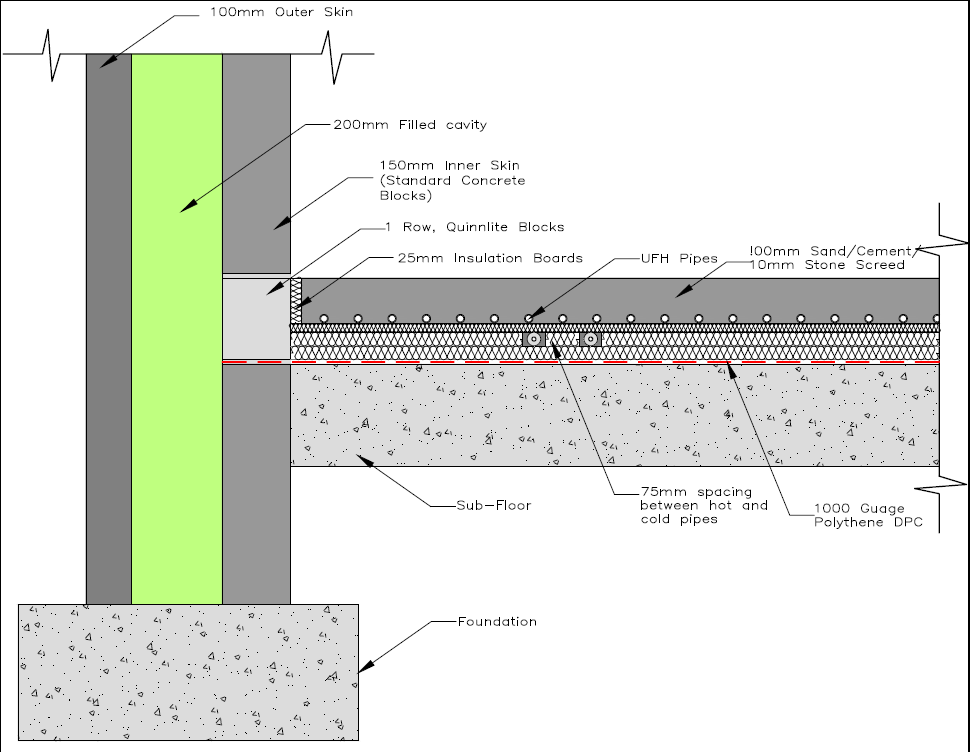
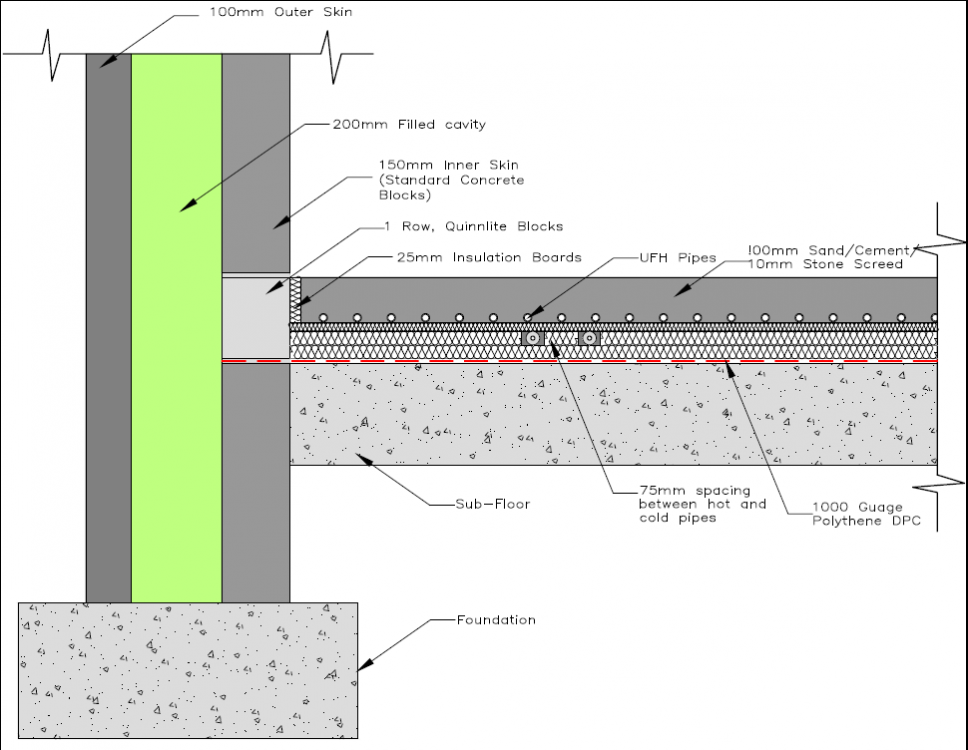
Thanks @PeterW, it's not dissimilar to what we have been advised to use. (See below - I should also point out that this image and all technical & design information contained within are the copyright of Reinco Insulation & Renewables consultant, Eric Davidson)
-
Thanks @PeterW, I would appreciate a look at your sections
-
Thanks @Temp
-
Yeah, it's a new build.
-
This approach sounds the same as JSHarris http://www.mayfly.eu/2013/10/part-sixteen-fun-and-games-in-the-mud/ I hadn't considered it before now will certainly give it some thought - thanks. Is this approach more expense?
-
No reason that I am aware of. If the budget allows we will consider more insulation and less screed. In fact it is one of the reasons I'm considering the liquid screed, it's only 50mm so would potentially give us 50mm to play with.
-
We've yet to break ground but we are very hopeful that the ground is good enough for strip foundations, concrete sub-floor (not 100% sure what depth), then as you say insulation, UFH and screed after 1st fix.
-
Ok...having digested The Great Thermal Mass Myth................ thread I will attempt to summarise my understanding, so please correct me if I've got it wrong. "Thermal mass" is a term used frequently which has no meaningful measurement and therefore should be ignored The 2 measurable characteristics I should look to compare are; Heat Capacity (J/deg K) and Thermal Conductivity (W/m K) for convenience I will refer to them as HC and TC Ok, armed with this information it appears that a concrete screed (with 10mm stone) probably isn't very different in terms of both HC & TC to a standard sand/cement screed. For arguments sake we'll say concrete screed has the following values HC(880) and TC(0.8) so to compare it to liquid screeds I need to know their HC & TC... The 2 liquid screeds I'm considering are; RTU Ultraflo with a HC(?) and TC(1.66-1.88) and Cemfloor C20/F4 with a HC(?) and TC(2.9) I haven't been able to find out the HC of these liquid screeds, however the higher TC values suggests that they will conduct heat quicker than concrete and will therefore "respond" quicker, I.e. gain heat quicker and cool quicker. So the question is, what impact is this likely to have on my heating strategy? I am assuming not very much in a well insulated, reasonably airtight house or will the unknown HC values for the liquid screed scupper my master plan???
-
@JSHarris, once again a very comprehensive and helpful response. Thank you.