


bgmill
-
Posts
66 -
Joined
-
Last visited
Everything posted by bgmill
-
Those vibrating blades are a nice idea but I think they would draw your attention too much unless placed somewhere inconspicuous (which defeats the object somewhat). I've been keeping an eye on this project: https://www.halcium.com/
-
@gc100 £15k for a 280m borehole sounds cheap! Our hydrogeological survey said we should expect 110-120m and I couldn't get a quote under £18k for the borehole alone and ~£25k all in. In the end we opted for a new 32mm supply pipe instead but we only had to go around 100m to the mains (albeit moling under a tarmac road the entire way). @YeBullen where is your neighbours meter? is it at the mains connection 1km away or closer to your plot?
-
We're about to receive planning permission and move to detailed design stage so the all-important build method needs to be decided imminently. Now, having lived in TF houses previously we had decided early on that we didn't want to build one. We have 3 noisy kids and sound travels far too easily in timber houses for our sensitive ears, slamming doors rattle windows in adjoining rooms etc. For this reason we were originally planning on going with ICF. Unfortunately, we can't find any contractors locally that have enough experience in ICF and we also don't want to be the guinea pig build where they make all their mistakes. So we're now looking back to traditional brick/block with a large cavity (blown bead fill) and wet render on the inside. We'll couple this with a SIPs roof as we have vaulted ceilings upstairs. My question is: what's a real-world u-value we could expect to achieve going this route? and, what could/should we specify to improve things? We're not on mains gas and don't want an oil burner (which we have in our existing bungalow) so have specified ASHP with MVHR in the planning application. Would this still be viable given the lower u-values of a B&B build?
-
As an update, I managed to get a new 32mm supply pipe installed for £1800 in the end and we're now getting ~25 ltr/min.
-
@PeterW they shared the engineers notes from last year and, to be fair, that matches what he told me on the day just before he tested flow rate at my boundary. Having said that, there's no other 'proof' as such. The new supply pipe will be just to my property, everyone else will stay on the existing shared one.
-
My request went to their legal dept and they've produced some detailed maps and correspondence with previous owners that does indeed suggest it's a private supply pipe that feeds 3 other properties as well as mine. I'm waiting on a final quote but they've given a budget estimate of £3000 to mole a new 25mm pipe, which seems reasonable. Is 25mm adequate given the distance or should we be looking to increase to 32mm?
-
Short of selling a kidney...
bgmill replied to wbc978's topic in General Self Build & DIY Discussion
£80k for a plot with an existing bungalow sounds outrageously cheap so well done on finding it! Although you've ruled out the caravan on site, it really is the most sensible option. I'm not saying it will be easy, but you'll find lots of stories on BH where families of 5 have managed it (also with babies/toddlers) so it's definitely doable. -
I've been onto Anglian Water and they're adamant that this is a "private communications pipe" and that it's my responsibility. They're saying the "controlling boundary stop" is on the main road, which was tested at 25 litres/min and 2.5bar so this is well above what's required of them. I've asked them for evidence that the pipe is private and that every property down the lane has their own supply (there are 5 properties in total and we are the 2nd along). It would seem very strange that they would run a separate private pipe to each, especially considering the furthest is some 350m and council-owned.
-
@Temp No plans for unsoftened water to the kitchen sink no. We distil all our drinking water anyway as the chlorine is so high direct from the mains it's like gulping pool water. The engineer was very insistent that the connection pipe not their responsibility but no harm getting them back to confirm that's 100% the case I suppose. This "pipe bursting" seems like a potential solution though as it will be a lot cheaper than moling. @PeterW It's Anglian Water.
-
@Temp thanks, I did see that thread but I assumed that if the softener was in between two accumulators then it would have the same pressure on both sides as it's isolated from the mains.
-
Meter and stop valve are both on the boundary of our property (100m away from the main road). The water company claim the pipe is private and our responsibility as they have no records of any pipework beyond the main road junction.
-
No clue, I'll see if we can find out though as it's worth a shot.
-
Yeah, when we had the water co come and do a flow test the engineer put a standpipe on the stop tap on the boundary and let it run for about 20 mins into the drain between tests but no difference.
-
To set the scene: our water supply travels around 100m under a private single-vehicle tarmac lane to the mains in the nearest public road. This was installed some 50-60 years ago and is now furred up to the point that we get a flow rate of around 8 litres per min, albeit with good pressure. Due to the distance, cost and disruption of moling a new mains pipe we're looking at accumulators instead. I think we'll need around 700ltr but we don't have space for such a large tank so would two 450ltr tanks in the following layout work? mains --> 1st accumulator (in cold garage) --> water softener --> 2nd accumulator (in pump room inside house) So essentially we'll have one tank of hard water and one tank of softened water. Is this likely to cause a reduced lifespan of the hard water tank or should we try to squeeze both in after the softener if possible?
-
What brick colour goes well with cedar cladding?
bgmill replied to bgmill's topic in New House & Self Build Design
Yeah the silver/grey that cedar ages to is what the attraction was for us but certainly after doing some research we will want to be treating it to ensure the aging is uniform. I have a neighbour that has a 10 yr old garden office clad in cedar which still looks great so I will pop over and ask him what, if anything, he used on it. -
What brick colour goes well with cedar cladding?
bgmill replied to bgmill's topic in New House & Self Build Design
We haven't committed to any specific timber yet no, but the architect has mentioned a product to expedite the "weathering" process for cedar to get it to a uniform silver more quickly as patchiness was an initial concern of ours. I will investigate some more on potential treatments before we commit fully. -
What brick colour goes well with cedar cladding?
bgmill replied to bgmill's topic in New House & Self Build Design
Tracking down the brick used in the images is the hard part. I've asked a few of our friends/family who have built their own houses for the names of their bricks and they look completely different online to what they do in the flesh so it seems a bit hit and miss on what you end up with! -
Our design currently consists of a mix of cedar wood cladding and brickwork but we're struggling to find the correct colour brick. We don't like traditional red brick and favour a more greyish colour that mimics stone from a distance (so has some light/dark variance throughout). Recommendations welcome!
-
For anyone interested in how this panned out... After ~15 months we've finally agreed the finer points and have last week signed Deeds of Easement awaiting registration with Land Registry. It has been a very painful experience and one I didn't expect to drag out for so long, but the good news is that we held firm and got what we wanted in the end - albeit at a financial cost (my legal fees clocked in at around £5k + VAT). The only thing I couldn't get a contractual answer for was a date to implement the under-grounding works (the DNO cited Covid as the primary reason) but I think if push comes to shove I can now serve notice on the Wayleave which should at least force some action within 6 months or so. We can now breathe a sigh of relief and get on with the good stuff, engaging with an architect and getting our build off (in?) the ground!
-
This is the route I went in the end and am waiting to hear back from their solicitors (who have indicated they've agreed to similar terms previously). I'll report back if/when we get it resolved!
-
The saga continues... We're now around 10-11 months into the process and believed we were almost at the finish line however a final issue is now threatening to derail things entirely. To recap: - we own a double plot with plot A containing an old bungalow and plot B wrapping it on two sides (see attached, red plot = A and blue plot = B) - we have an HV overhead line essentially crossing at the middle boundary with an off-shoot that cuts through plot A diagonally (marked green). Neither line supplies our property or any of our neighbours. - the main east-west HV route is entirely over-sailing, with a pole on our immediate neighbours land and the other about 100m away from our boundary in the farm field. - the off-shoot has two poles, both on our land, one at the NE corner and another at the SW corner. This is the one we want removed/buried as it cuts through where we want to build our new house. There's an existing wayleave between UKPN and the previous owners with a 6mo termination clause. - original quote was in excess of £30k to underground the route along the orange marked line but we finally had the DNO agree to cover all costs in exchange for easements for both the over-sailing line and the new underground route; all good and we agreed to this to avoid serving notice and risking them applying for a compulsory wayleave. - fast forward a few months and we finally got the Heads of Terms through. Unfortunately the proposed terms would allow them to "erect, supplement and maintain" new overheads, inc. supports along the easements if they so wish in the future. Not an option for me and clearly defeats the purpose of what we're trying to achieve. - I was told "no negotiation" initially but eventually managed to get them to agree to remove the clauses after 3-4 weeks of emails back-and-forth - result! - next stage, Deeds of Easement were finally shared however a brand new clause had appeared disallowing me to lay any cable, conduit or pipe "across, under or above" the area marked in orange. Arghh! So this is where we currently find ourselves. As the easement completely separates plot A from plot B it means one of my major build requirements - ground-based solar PV in the NW corner of plot B - would no longer be viable as there would be no way to connect it up to the main house. It also precludes all sort of other things we or a future owner might want to do further down the line and would inherently devalue the land IMO. I've asked if they can allow some kind of crossing area, clearly marked above ground with signage and at whatever max depth they tell me but I'm curious if crossing underground HV is an absolute no-go and I'm just fighting a losing battle here? The alternative would be going all the way around the outside of plot B, however that comes with it's own issues such as not being able to put any sheds or other structures against the boundaries for example, so again not an ideal scenario!
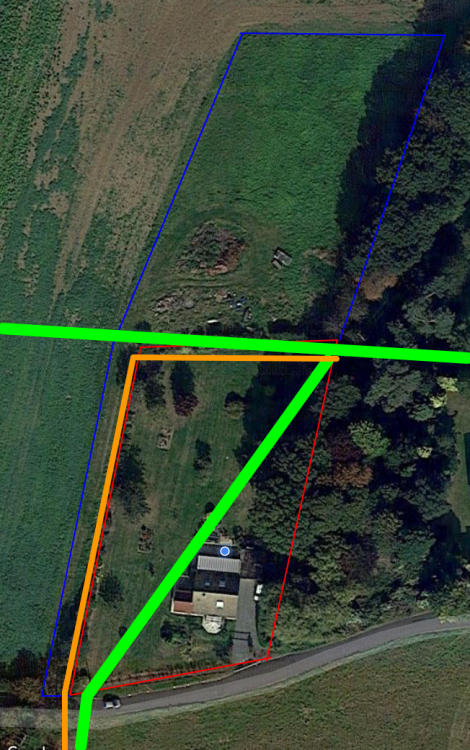
-
When we first bought our donor bungalow we had lots of scratching/scampering noises at night in the ground floor ceiling cavity. We put poison down and about a week later started to notice a pretty horrible smell but couldn't pinpoint where it was coming from. Fast forward a few days and we had flies *everywhere*. I'd say at least 1000 over the course of 7-10 days. We had to block off our downstairs toilet at one point as this seemed to be their primary route into the house (from behind a built-in mirror) and we'd wake up to swarms in there trying to get out through gaps around the door. Long story short, if it's anything bigger than a mouse you might have some trouble ahead - we had rats according to the pest chap, no idea how many but the aftermath would indicate a few at least!
-
It looks like I spoke too soon, the heads of terms arrived in the post today for our works and - surprise, surprise - the DNO has included easements to "erect, use, maintain and supplement overhead lines and supports" along the agreed path as well as the underground grants. This is obviously not what was agreed as the whole purpose is to underground everything, not give them a permanent right to do the opposite at their will. A few rounds of email followed and it appears that they're not willing to negotiate so I'm deciding on next steps. I think it will involve terminating the existing wayleave (signed by the previous owner so may not even be active), serving notice to remove equipment and then fighting against any compulsory wayleave action they take. As I've been cooperative all the way as well as provided an alternative route I hope that will go in my favour if things do go legal.
-
I was quoted £35k+VAT by our DNO to underground around 120m of overhead HV that bisect our plot. In the end we came to an agreement that they foot the entire cost in exchange for an easement - my neighbours were also on board, which always helps, and the underground works will now extend into adjoining plots so no need for anything above ground/visible on our plot at all now. What are the terms of your wayleave? ours had a 6-month termination clause but we also had a bargaining chip that the cables were actually lower than they should be so I'm not sure how much that swayed the decision with the DNO. I don't imagine nearby trees would make any difference tbh, our wayleave gives them access to come in and assess/chop down anything deemed problematic (which they do regularly). Don't assume they will automatically opt to seek a compulsory wayleave though - have they said they would?. As long as you're being supportive and providing options that should be a last resort for them I would imagine as their network relies on land owners being cooperative and keeping good relationships.
-
It will all depend on the block size and whether you have many empty blocks to seek, I'm guessing you probably had very few. Here's the results from a ~100GB partition with ~80GB free on my machine with and without conv=sparse: bgm@wintermute ~ % du -sh *.dd 12G sparse.dd 98G test.dd


