


Hilldes
-
Posts
375 -
Joined
-
Last visited
Everything posted by Hilldes
-
@MJamesW the company is regulated and I logged a formal complaint and have the response - in which the proposed wording was revised. I responded saying I was OK with the revised wording. Although it is now 1.5 weeks since I replied and no response from them so far. Overall the delays have cost me several £K as I'm stuck on self build mortgage interest rates.
-
Patio to wall junction - help please on building regs
Hilldes replied to Hilldes's topic in Building Regulations
Thanks @SBMS On the detailing I think the most challenging part is not the threshold to the door it is the patio to wall junction either side of the door. As others have said the patio can be level with the door threshold either side of the door provided the DPC in these sections of wall is move up my 150mm. I can picture how this works with block and brick built houses but not with timber frame inner skin with render board outer skin. Thanks for the note on the indemnity option on the other thread - given we all know this is common detailing much better for warranty provider to acknowledge this is established practice (with the right measures in place such as drainage) and add not a highly visible policy exclusion that is clearly just for this property. This may not affect you though if you patio is completed before the BCO completion visit. In my case there is temporary landscaping and the patio will be added later. -
Thanks for the idea @SBMS will look into this if I'm not successful in challenging the warranty provider for more appropriate wording.
-
Patio to wall junction - help please on building regs
Hilldes replied to Hilldes's topic in Building Regulations
Thanks @Mr Punter I don't plan to do this - I will keep all paving >150mm below DPC. I just want to ensure the warranty condition does not exclude reasonable options for potential future purchasers. I see Paving Expert has some 'work arounds', but I think not technically compliant with building regs. -
Patio to wall junction - help please on building regs
Hilldes replied to Hilldes's topic in Building Regulations
Thanks @nod @Canski and @Radian. Please could you point me at the relevant text in Approved Documents, or LABC, NHBC etc. so I can quote back to warranty provider. On changing the provider, my only option I think would be a retrospective warranty as the build is complete and this one condition is the last one to resolve - although it has taken a number of months so far to try and resolve it. -
Patio to wall junction - help please on building regs
Hilldes posted a topic in Building Regulations
Hi all, Need some help please to interpret building regs. This relates to a problem I have with a warranty provider in this thread. The warranty provider is quoting this: "The Building Regulations Approved Document C – Site Preparation and Resistance to Contaminants and Moisture includes ways in which internal and external walls must be designed/ constructed in order to resist moisture from the ground. Section 5, Clause 5.5b confirms ‘if the wall is an external wall, the damp-proof course should be at least 150mm above the level of the adjoining ground (see Diagram 8), unless the design is such that a part of the building will protect the wall;’" I want to ensure that any furniture purchaser could have reduced distance between DPC and finished external ground level for a patio or level threshold to Bifold doors for example. With the trend for level thresholds at patios, there must be something in the building regs that support this option? For example, with suitable linear drainage channel at the patio to wall junction. I believe there is also a reg on the maximum step down from and external door to external finished ground level - is this less than 150mm? Help would be much appreciated to close off this saga with the warranty provider that has been ongoing for months. -
Thanks for the additional input @MJamesWand @Kelvin. Very relevant to where I am currently with this... An update from me - I'm approaching the position where I need to take legal action against the warranty provider. I'm concerned the specific warranty exclusion wording will cause undue concern wth potential purchasers and their solicitors. The wording in particular is this: "It is a condition of this policy that the external finished ground level for the entire perimeter of the Housing Unit must be maintained a minimum of 150mm below the damp proof course. Failure to maintain a gap of 150mm between the finished external ground level and the damp proof course will result in all loss or damage caused by or attributable to water and or damp ingress being excluded from the Policy." The problem is the "...entire perimiter..." part of the wording. My argument is even the level threshold to the front door (required by Building Regs) contravenes this policy. Also, if further purchasers of the house wished to have a level threshold say for the bifold doors, this would also be in breach of the policy. To give some context, this is the last in a series of issues I've had with the warranty provider's technical auditors raising defects without valid justification. It is a shame because the provider is one that I believe is quite popular on BuildHub.
-
New build design & floorplan - Comments please!
Hilldes replied to jimmyharris80's topic in New House & Self Build Design
GF plant room may be a bit cosy depending on what is going in there. Our is 1.8m x 1.7m with MVHR, home automation cabinet, UFH manifold, gas boiler, soil stack, BT fibre. I wish I had made it larger as some of the electronics ended up in an airing cupboard upstairs (Sonos amp, LAN switch, NAS drive, CCTV kit). The MVHR unit and associated ducting being the largest item by some way in the GF plant room. -
My UVC's pressure/temperature relief discharges to an internal soil stack via a HepVo. This soil stack has an AAV at the top - is is not vented to atmosphere. This was approved by Building Control (England) because we have an outbuilding that has a WC and the stack there is vented to atmosphere. Because of this, all the soil stacks inside the house can have AAVs fitted and none vented to atmosphere. Jeremey Harris explained it on here. Not sure though if I'm missing the point on Passive House - soil stacks internally are not a good thing? P.S. the plumber refers to the HepVo as a "fanny trap". You have to look into it to realise why 😯.
-
@Thorfun I used CAT6 to all light switches and presence sensors. Given the switches are mostly retractive are just switching 24v and even the touch pures work fine with CAT6. The other benefit of running a dedicated CAT6 to each end point is that if you get a cable fault it only affects that one device. During the 2nd fix electrics we found we had plasterboard screws through T&E (handling 230v) in two separate locations which caused faults and had to have cable sections replaced. I did run 1mm2 T&E to all light switches. Totally redundant. But its cheap and easy to run and I like the idea of being able to say to potential purchasers they have the option of conventional wiring if they wish to revert. Interesting point though made by Rob99 on use of Quinetic as an alternative to home automation central control. All lighting used 1mm T&E with the exception of six Loxone RGBW spots above this kitchen island - these use Loxone Tree cable. The only other location I used (Loxone) tree cable was from ground floor plant room (Loxone cabinet location) to the first floor plant room to give the future option of using Loxone UFH actuators. The UFH actuator uses T&E at present. @Rob99 if you put in tree wiring but don't use Loxone tree cable what cable do you use? More on the light switches... We have just two Loxone Touch Pures at present - using the temperature sensor for heating control as one zone downstairs, one zone upstairs. Not sure why but the retractive switches are fine in some locations, but can resonate in the studwork in other locations (i.e. quite noisy to click), especially where you click multiple times to cycle through lighting moods and double click to go direct to 'off'. Will probably start replacing some of the retractive switches with Faradite tap-1s (£50 each so less than half the price of Touch pures). We have a Faradite Tap-5 switch and that just switches 24v DC and CAT6 is fine. You will use more CAT6 cores on Faradite Tap switches e.g. Tap-1s with just one central switch zone, you can supply 24v to the backlight (a nice feature and I find better than the back light on Touch Pure gen 2). Noting the Tap switches don't have temp sensors, but are lower profile than Touch pures.
-
Thanks @Kelvin there was no mention of my hard landscaping condition being temporary but that might be worth exploring. On both my potential exclusions I’m just not happy about the way they were raised as there was nothing in the contractual type documents at the start which would have forewarned- eg nothing in the contract that said there are elements of roofing such as box gutters that will require insurance backed guarantees. On the hard landscaping one I just don’t see the risk for the warranty provider. While the structural elements of the property are unlikely to change in the 10 year warranty period, hard landscaping could be changed at any point and lead to water ingress at/above DPC and in the case of a warranty claim the warranty provider would I guess not pay out because damage was caused by the action of the owner. These last two ‘defects’ are all that is open from a surprising number raised by the warranty providers technical auditors (not by Building Control) - all of which on my opinion were frivolous.
-
I've got the Building Control completion certificate about to activate the 10 year structural warranty (new build). The warranty provider has standard conditions and exclusions that they apply to all warranties - which is fine. For my build, the warranty provider is proposing to add two additional and specific exclusions that will be called out separately that would be visible on the Certificate of Insurance. the roof has box gutters which require an insurance back guarantee - I don't have this. the hard landscaping is not 100% complete around the perimeter of the property and the warranty provider says there is a risk that when this is completed it will not leave the required 150mm gap between finished ground level and DPC. I can't recall either of these requirements being specified in the warranty contract at the outset. I'm concerned these will be viewed negatively by conceryancers or potential purchasers if we sell within the warranty period. Has anyone experience of such additional exclusions and what the impact might be. The warranty provider says additional exclusions are not uncommon.
-
An update for anyone specifying and purchasing similar. I got two further quotes from the suppliers linked above. Order placed with one of them for £760 including delivery. The local company I got the first quote from was not interested in competing with the other quotes. On the specification, the consensus of all three suppliers was that 13.5mm toughened and laminated glass would be required where no handrail is fitted. Also the holes need to be a minimum of 1.5 x hole diameter from the edge.
-
@SuperJohnGAre your fixings going into render board?
-
One of the two extra quotes came back as £638 inc VAT (which includes delivery at £96 so £544 for glass inc VAT). This is for 10mm glass which is what I specified in the drawing. I have asked of this is toughened and laminated as I specified. The first (expensive) quote though stated that because this glass is installed without a handrail, this will need to be toughened laminated and 13.5mmm or 17.5mm thick. They had quoted for 17.5mm and said they could quote for 13.5mm but that would be around the same price. Third quote awaited. They have suggested changes to the drawing because I had specified holes 17mm from the edge of the glass - which apparently increase risk of cracking in the tempering process. So recommend holes min 50mm from edge of glass.
-
Thanks @SuperJohnG that is a useful benchmark. I've asked for quotes from the two other companies mentioned here. The more I think about my first quote for Juliet glass - at around £500/m2 - that is about what I paid for the glazed gables themselves, which include triple gazing, frame and openings.
-
Thanks, will ask them for a quote
-
Thanks @temp, the quote excludes fixings
-
Thanks Conor I must admit I’ve not looked at building regs for a while but from memory it does not specify the structural requirements for glass but each case would need to be assessed by a SE.
-
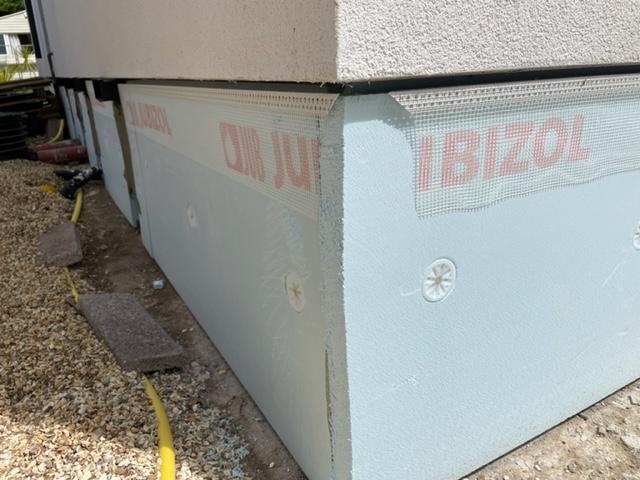
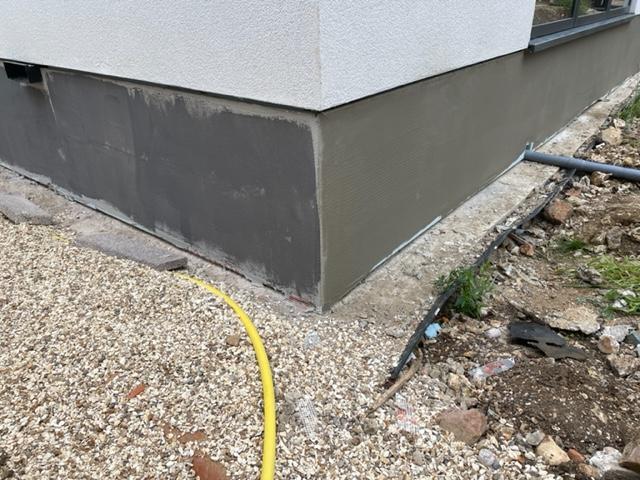
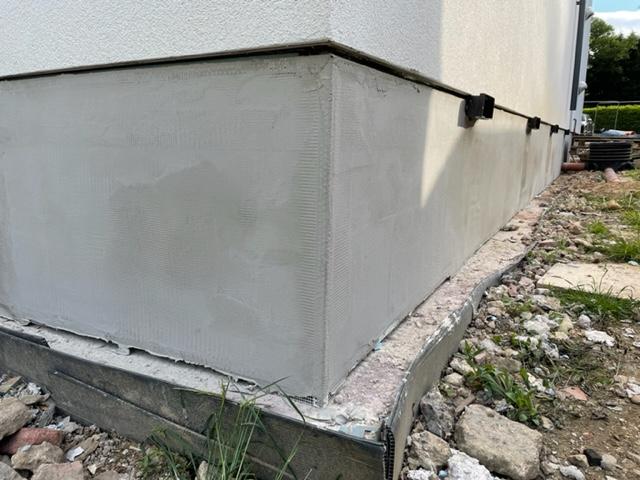
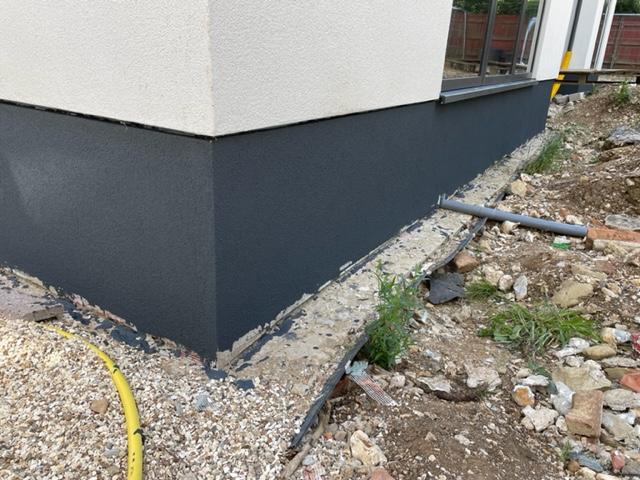
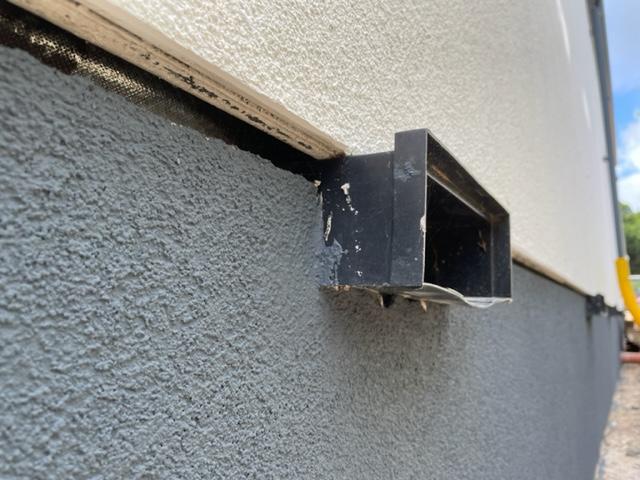
So the area below DPC is now completed. These are JUB products: 50mm XPS Insulation - fixed mechanically and chemically (the glue was the same product as base coat render I think). Fixed to 140mm concrete blockwork. Base coat render (right) then primer for top coat (left) Top coat render
-
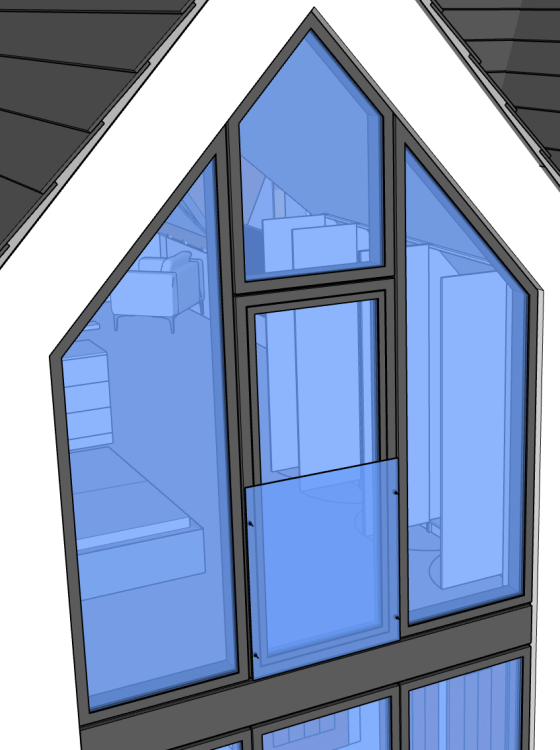
Hi all, I'm getting quotes for a glass balustrades for each of my three glazed gables - as in pic... This balustrade glass fixes to the frame of the door in the central section using fixings supplied by the window manufacturer. Four holes for each piece of glass. The Juliet the door opens in. I have a quote from a local glazing company... "17.5mm Clear toughened and polished edges laminated together with an external grade interlayer and holes as per diagram 3 @ 906mm x 1100mm - £1250.38+vat" The price seem high to me - what is your view please? Anything in the specification that is not necessary - e.g. I would have assumed that 10mm toughened and laminated glass would suffice for this relatively small area. Thoughts appreciated...
-
The knobs on my Hep2o brass manifolds are really sturdy
-
Where to buy Loxone kit (DIY)
Hilldes replied to Hilldes's topic in Networks, AV, Security & Automation
Rather than a demo case I bought a few components and wired them together for test rig to play with the Config software. Mini server, touch pure tree switch, 24v RBGW downlight tree, 4.2A 24v PSU, motion sensor. Some great videos in the foundation series that get you started with Config and covers all the main Loxone hardware components. -
Loxone Price Increase - May 2022
Hilldes replied to Rob99's topic in Networks, AV, Security & Automation
Thanks for letting us know Rob! -
Thanks @JOE187 will consider that as an option. The other option I'm tentatively considering involves core drilling smaller holes - about 50mm and align them horizontally where the standard telescope vent would penetrate the wall. Then cutting the off the section of telescope vent that would have penetrated the wall and fixing the telescope vent to the wall and sealing it against the core drilled holes. I would add more telescope vents if needed to meet the mm2 of venting required as each vent would pass less air than with the standard rectangular section penetrating the wall.


