Dan F
-
Posts
1431 -
Joined
-
Last visited
-
Days Won
2
Everything posted by Dan F
-
Yes, it only uses the highest flow temperature of enabled circuits. That's how the Valiant controller works anyway.
-
I have two different flow temperatures for different circuits all controlled by the Vaillant ASHP controller. You need: - Buffer - Mixing valve and temperature sensor on each circuit - Controller that supports this. If the two circuits are for two different zones in the house, then you can assign them to zones with each zone having its own thermostat, min/max flow temperatures, schedule, set-back and even its own heat curve. The ASHP will deliver the flow temperature (to the buffer) that is equal to the maximum flow required by the different circuits. The circuit(s) that needs lower flow temperature will then mix down.
-
Any product recommendations similar to Sunsquare
Dan F replied to nmh's topic in Skylights & Roof Windows
We used these https://toughenedglasssystems.co.uk/product-category/rooflights-and-skylights/fixed-rooflights/ There are a lot of companies offering similar products. -
The model you are referring to looks like it has "solar protection" (or so it says on the next page). 2G with solar protection is almost certainly going to have lower solar gain than 3G.
-
Insulated Concrete Slab Garden Office - Questions
Dan F replied to Ticky's topic in Garages & Workshops
This is another approach, that we used on house, that doesn't involve a retaining wall on the slab. We did this because the rear of the house has a level threshold and we wanted the rear patio at the same level across the whole back of the house. (The drawing is slightly wrong because external GL is actually the same as internal FFL)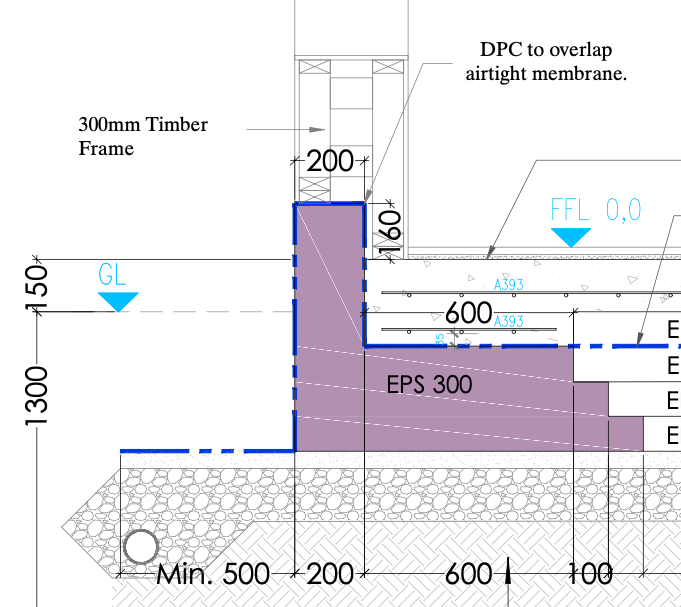
-
Insulated Concrete Slab Garden Office - Questions
Dan F replied to Ticky's topic in Garages & Workshops
We used this approach to get a 2.8m high garden room with good internal headroom (the ground level was higher at the back of the building). (We just used standard low u-value blocks for the retaining wall, nothing special)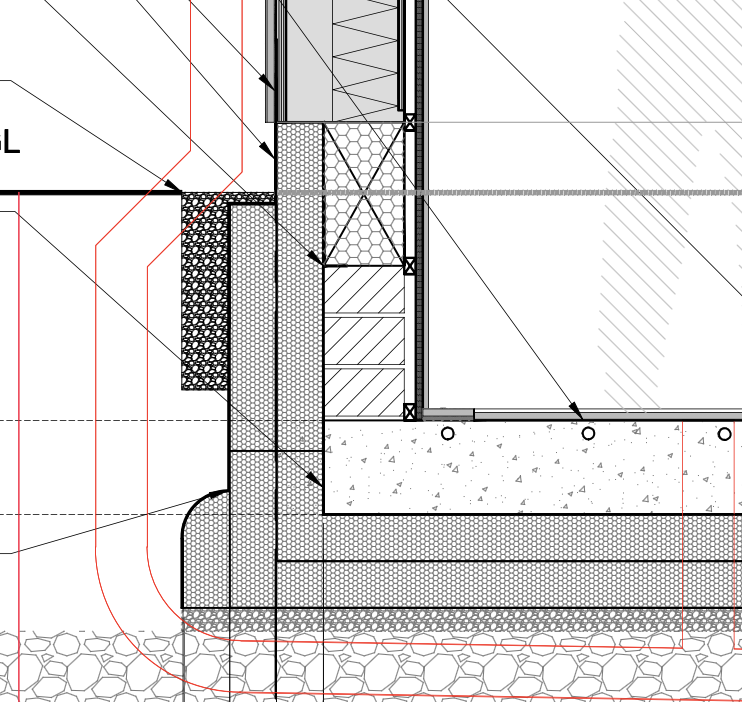
-
Bypass is used when it's cool outside and you want to cool down the interior. When it's hot outside bypass isn't used.
-
It doesn't come in at 39C. If the internal temperature is 21C and MVHR is 90% efficient it comes in at 23C. 23C is better than 39C but: - You need more cooling power to cool incoming 23C (that you are now bringing in faster due to boost) than you do to cool existing 21C air in the room. - The Comfopost power figures assume 27C. If the air is 23C and not 27C then power is only going to 80% of that stated. If you don't want to use split-unit and want to use ASHP (that you may be using for heating/DHW), then fan-coil units are the answer.
-
I already gave it a go (Passivhaus with automated external shading) but probably wouldn't do it again, to be honest. I've posted about it elsewhere but the effectiveness is fairly poor even with MVHR on boost. While it's not immediately apparent, there are a couple of issues with the manufacturer-supplied cooling power data to be aware of: - It assumes air into Comfopost is 27C, but if you are keeping the house at a reasonable temperature and have an efficient MVHR it will never be 27C. - With an A/C or fan-coil unit, you are recirculating the air in the house so the kW quoted is what you get. With an MVHR on boost with a Comfopost a portion of the quoted kW goes into cooling the incoming air (which you are now bringing in at a faster rate) and only the remaining cooling power actually acts to reduce the temperature in the house. Let me know if you want any further details.
-
Insulated Concrete Slab Garden Office - Questions
Dan F replied to Ticky's topic in Garages & Workshops
In order to get good head height, we had our slab below ground level on 2 sides. A retaining wall was built on the slab (in turn on top of EPS) and then we uses EPS/DPM between the wall and ground level. Blocks were also a special low u-level type as well, from what I remember. Isoquick helped with the design and supplied the EPS. -
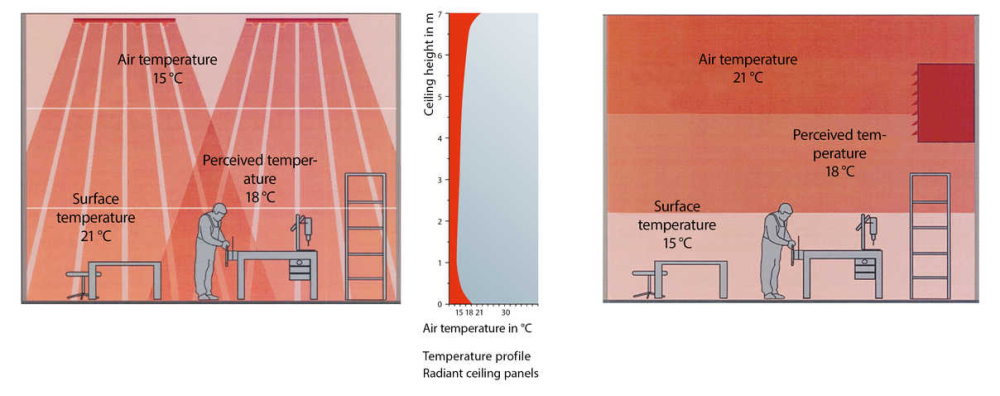
Looking at it this may be the case, although for some reason Zehender's sales guy showed us this system when we visited (we live fairly close) It's an interesting approach to heating/cooling though. I always wonder if there is anything in the 40% saving claim they make and if these same savings apply to infra-red based radiant heating.
-
This guy looks like a good source for info on infrared panels (also has youtube). https://twitter.com/Chris_Hill321 This is the Zehender system: https://www.zehnder.co.uk/zfp. (note: it's radiant but not infra-red and therefore supports cooling too)
-
Lack of cooling and running costs are 4 x more expensive to heat than wet UFH with ASHP. If you really want to avoid ASHP on day 1, then could use a much simpler Willis heater and pump to heat UFH. If I was you though I wouldn't bother with the Zehender cooling unit, I have something similar (ComfoPost) which is the same idea but powered by ASHP but it's not very effective at all. Likewise with the UVC with built-in ASHP, more useful to have a standalone ASHP which can heat water and cool the house when it's 35C outside rather than something that only heats the water. Don't know anything about radiant panels personally. Planning electric ones or water? Zehender does water ones I think which can cool as well AFAIU. You can see the system running in their showroom in Camberley. That said, we stuck to standard UFH. We only have UFH and towel rails in the bathrooms on the first floor, it's workable but we kind of regret not putting anything else in, as not all the family are keen on bedroom temps dropping to 18-19C!
-
Shutters? Do we need them?
Dan F replied to puntloos's topic in Energy Efficient & Sustainable Design Concepts
See if you can get hold of it. It's really easy to add/remove shading. It's also easy to stress-tests by reducing max comfort temp down from 25C or changing climate data. -
Shutters? Do we need them?
Dan F replied to puntloos's topic in Energy Efficient & Sustainable Design Concepts
I wouldn't agree with that. It's going to be dependent on the specific house design, size of windows and orientation, but PHPP consultants are generally going to want to use overhangs/shading as the primary way to reduce overheating (most people don't want to make their windows smaller!) and they try to avoid the need for active cooling (at least in the U.K.). Do you have a PHPP model for your build? That's the best way to understand the impact of these Velux having (or not having) shading. -
They reckon 6-10% more efficient, but that's going to depend on the heat pump and the external PHE obviously has higher losses than an internal coil. What Mixergy claim is that the PHE means that i) the tank volume is more fully utilized ii) they can offer slimline tanks. If you want a PHE for a standard tank you could look at this one: https://mcdonaldwaterstorage.com/products/plateflow-plate-heat-exchanger/. I don't know where the Mixergy PHE is installed relative to the tank, but this one being at the top means that: "At times when less than the steady flow rate is required, all the hot water requirement is generated instantly by the PHE (A), with any excess recharging the buffer vessel (B). Only when demand exceeds the steady flow rate of the PHE, is water from the buffer vessel used (C). Even when the buffer vessel is depleted, the steady flow rate is always available."
-
Some can do 2 showers, but (especially if the shower flow rate is high) one per shower is the way to go. That said, looks like Showersave have a commercial option which might be worth looking at: https://www.showersave.com/commercial-new/
-
This certainly works with Mixergy, assuming you aren't heating the tank with ASHP (then it heats the lot in one go!), if you don't mind the bells and whistles of being internet-connected, having an app and the additional cost. I don't know about partial charging with the Sunamp to be honest, although when I looked into them they didn't have a mechanism to understand the state of charge I don't think. So you are avoiding an ASHP for UFH+DHW, but planning to use one (which will have limited capacity due to the limited rate of airflow) sat on top of your MVHR unit? Combining so many different heat sources just adds complexity IMO. If you have a battery + home assistant you don't need a PV diverter. Just put some logic in place that turns on the immersion heater (3kW) when battery SoC>x and PVPower>y, or even simpler when your battery SoC > z %. Mixergy tanks did come with dual immersion before, so you could use Mixergy-control for one and a separate PV diverter with the other one, but they've since changed the design to reduce heat loss and they only come with a single immersion heater now as standard. Depends on your heat source IMO: - If you plan to heat via immersion and will take advantage of the partial charging then Mixergy makes a lot of sense and avoids the complexity of trying to replicate this via multiple immersion and external logic etc. - If you plan to heat via ASHP primarily, partial charging is a non-starter and the value of Mixergy is therefore quite limited. Vaillant do one. But agree, might not be feasible if UVC is in the centre of the house. I'd personally get a single A2W ASHP for DHW/heating/cooling and not try to mix and match so much, as otherwise, you'll end up with ASHP on top of your MVHR, ASHP on top of your UVC and potentially an A2A unit at some point and a lot of controls complexity. Also, make sure you get your PHPP consultant to calculate "cooling demand" and then stress tests it for climate change and ensures that you design for sufficient shading and active cooling on day one. (if you want to avoid adding A2A in the future that is.
-
Even if you don't plan an A2W ASHP, may still be worth putting the UFH loops in case the other methods aren't as effective/sufficient as hoped. How much m2 in your thermal envelope? What is your plan for cooling? Cooling is one thing UFH does very well, but you can't do with electric UFH, towel rails or radiant panels.
-
Agree. I don't know the details from a regs perspective, but if Loxone is separate and correctly protected it can be classed as an "appliance" with reduced compliance I believe. As soon as you start putting stuff in your inside CU that is a whole different ball game. There are some threads that touch on this over on https://groups.google.com/g/loxone-english, and a guy called Martyn is particularly knowledgeable on this.
-
PHPP Does include heating and cooling systems and calculates PER demand based on this. That said, this isn't relevant for "PH Classic" using the standard criteria, and only becomes important for "PH Plus/Premium" where PER is important. I've just been providing all the M&E information for our build, which includes ASHP efficiency, UFH flow temp, UVC specs, WWHRS specs etc.
-
We used this screwless range. Good quality and comes in number of finnishes as well as a broad variety of different fittings: https://www.hamilton-litestat.com/decorative-wiring-accessories/hartland-g2/
-
Yes, in the case of the Tesla product it is the "gateway" that does this using a meter on the supply. Other products have different equipment to do this, but they all need to use a 3-phase import/export meter. With the Victron system, you use three seperate charger/inverters (one of each phase), and then it has a seperate contro lsystem called the "Cerbo GX" which connect to all inverters and the 3-phase meter and does this.
-
Maybe, but this is a simplifcation that won't apply every day due to the weather and clouds! Practically, using ASHP when the sun is out means: - ASHP controls to i) turn it on when certain PV output is reached ii) ensure ASHP stays on for a minumum run time. - Some high-tarriff import when the sun goes behind a cloud. Would have to run some models. But if the consumption of your AHSP is 2.5kW and clouds mean your PV is fluctatuing between 1kW and 4kW then you will be importing more on an expensive day-time tarriff, with this approach. (Turning ASHP and and off based on PV output isn't a good idea.)
-
A solar diverter makes no sense if you have a ASHP and a battery (to act as a buffer), but if you have ASHP without a battery solar diversion still makes sense because: i) A heat pump will have a minium power, where as solar diverter and divert small amounts of excess into hot water. ii) The sun comes and goes but you can't instantly turn heat-pump on and off to react to the available power, where a solar diverter can deal with this. iii) Even if you try to turn heat pump on/off to react to available power this might not be ideal for the ASHP. There may be some days where PV production is both enough, and constant enough, to dire up heat-pump at midday to heat hot water but, particiauly in the UK climtate and considering lower levels of PV output in spring/autmumn this will be rare. I don't currently have solar diversion or a battery, but as soon as I've installed a battery I will be using Loxone to decide when to fire up the ASHP based on i) SoC of battery ii) tarriff iii) PV generation and expected sunshine hours the next day.