


JIH
-
Posts
61 -
Joined
-
Last visited
Everything posted by JIH
-
So if I use the coil side of a UVC for DHW preheat I am using the non-potable side?
-
Ok, you've given me some food for thought! Thanks for the Trevor tip I think I might try this from the other end, so to speak. I'm settled on using LPG to bring pre-heated water up to desired temperature for DHW. Therefore I will need a G3 plumber onboard to install it and do subsequent do annual inspections. I shall see if I can find one to quote for installation of water heater and possibly UCV and annual inspections. If I did decide to keep with the 'vented' option (as per my drawing my understanding) I understand that as long as I don't put in an immersion heater the system is considered to be "used solely for space heating" and the Danger from Heat guidance does not apply (Scottish Domestic Regs 4.9.0). Meanwhile I think I will get Newark to give me couple of quotes, one for a large coil and one for an external heat exchanger and see how it all adds up. Thanks again.
-
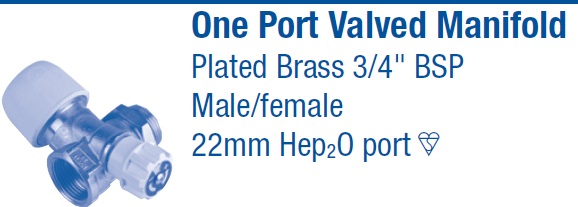
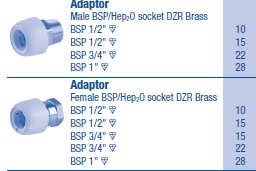
I was trying to keep it simple - just run the pipes out through the hole in the wall with the ASHP pipes. Construction: timber frame with 300mm pumped cellulose (MBC) but externally at this point clad with Knauf render board and rendered with K1. Reluctant to cut flue sized hole through render and board. I'm slowly learning. But what does the "iron" signify with a copper fitting? Is it to do with BSP parallel/tapered thread? I take I need "irons" for joining to these? But could possibly use these? Apologies for all the questions, but my head hurts Would you reckon one of these would do me for the thermal store? Would the supplied coil be suitable as I would not be using for the purpose it was designed? I will be taking heat out rather than putting it in. Or does the principle work fine vicky verky? Thanks.
-
Ok, understood. However I was going to use the 3/4" Hep2O valved manifold fittings at the DHW manifold. Ok to increase to 22 just before this? Rinnai outside as I've not allowed for flue in the build! Thanks
-
@Nickfromwales that depends on the height of TS. Option 1 - TS under half landing (tank <1100mm) distance to Rinnai = 2m in plan Option 2 - TS in utility room (tank >1100mm) distance to Rinnai ~ 1m in plan as heater on wall directly outside Distance from heater to DHW manifold ~ 2m in plan. Would much rather have tank under stairs if possible as utility room quite small. Go from 15mm to 22mm at the outlet of the Rinnai? Thanks.
-
Yes I am a wee bit reluctant to use my house as a test of my soldering skills. There is already enough to keep me awake at night... The Hep2O looks pretty fool proof and being de-mountable should make fitting to the space easier, I hope. I shall definitively beg/borrow/steal a pipe bender, and thank you @Nickfromwales for you offer of how to drive it! If the tails on the water heater are 1/2" and the DHW manifolds are 3/4" where should I make the reduction - at the heater or manifold for hot? At the tank or heater for "cold"? Thanks
-
Ummm. . . You make it sound so easy
-
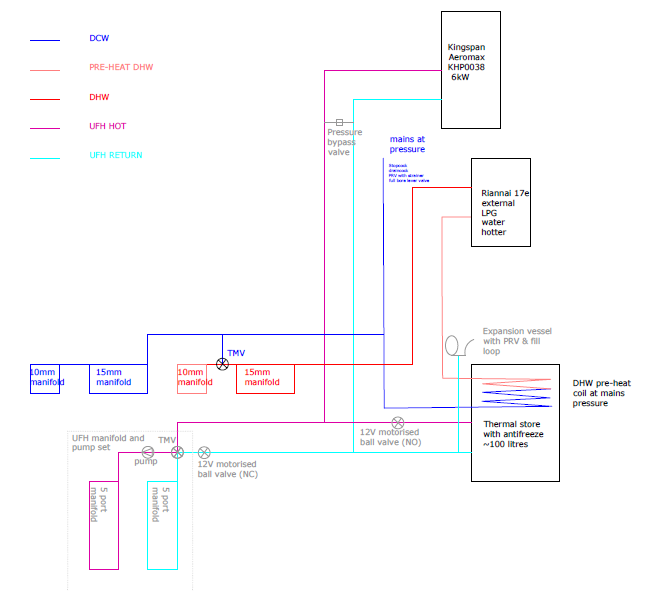
So does anybody have any concerns regarding my proposed system as above? If not I'll get on and order lots of Hep2O fittings, copper pipe and maybe a bender... I was thinking of taking off a feed from the pre-heat before the LPG water heater to feed the 10mm DHW manifold. My thinking was that most of the time I could have warm water to WHB without the need to heat it up through the heater only to mix it down through the TMV. However if I required hotter water than that of the thermal store (for those wet shavers) then I could shut off this feed and go through the mixer. All input appreciated. Thanks
-
Or a passover according to @Onoff's reference guide: http://bpec.org.uk/wp-content/uploads/2016/01/BPEC-Essential-Plumbing-Skills-Copper-Pipefinal-version.pdf Perhaps it's similar to the dwang/noggin controversy and depends on your ancestry?
-
Thanks @Onoff, some useful stuff here for bending. Nice saddle/crossover/passover
-
Thanks @JanetE for the pics - very neat work! If you fancied a trip north. . . Did you increase the thickness of the wall behind the shower because of the plumbing? Which toilets did you 'plumb' for? I planning Duravit all round with the Stark 3 rimless toilet Dwangs up here!
-
Great idea - I shall have to investigate the pipe bender, thanks @Vijay. But I will steer clear of the solder cross-over as the idea is not to use solder joints at all (as I can't solder). Will have to try and take a leaf out of @Onoff's book and bend it over.
-
Yes indeed @JanetE I've had fun feeding all the runs through the joists especially as have a route constrained by steel beams and staircase. Do you think I need to pressure test all the runs before boarding up my ceiling @jamiehamy? I hadn't planned to as it would be quite difficult to wet test at this stage and I understand that air testing with Hep2O is a no no. Ok thanks @PeterW, no PTFE tape. I'm happy using Hep2O back from the taps to the manifolds. But do you think it would be best for me to use Hep2O fittings on copper for the rest of my plumbing? For instance using Hep2O fittings instead of solder to make up this (@jamiehamy's pic) And indeed on the heating side too, as per the diagram on my original post? Heating_DHW_Preheat.pdf Thanks
-
After having had an eye watering quote for my plumbing I've decided to give it a shot myself. I will try and put into practice the advice I've read on this site and hopefully get some clarification on points I've not grasped... So I have almost finished the first fix having run most of my wastes to the stack. Also got all the HEP2O runs in for the radial plumbing system ready to feed the yet to be built HEP2O manifolds (10mm for WHBs and WCs, 15mm for rest), following in the footsteps of the Welsh 'master' @Nickfromwales, @jamiehamy et al I have 3 bathrooms and day to day DHW requirement is low but medium when visitors. Heating by 6kW ASHP to low temperature UFH, ground floor only. The system I have decided to go with is based on @JSHarris's model, but with a thermal store with mains pressure coil for DHW preheat going to external LPG gas water heater to top up the temperature. I know I will require a G3 plumber to fit the gas heater. I have no experience of plumbing and as I cannot solder my thinking is to use all compression fittings once away from the DHW & DCW HEP2O manifolds and for the heating side of things. Although with the amount of PTFE tape needed I might be better with HEP2O fittings! Might HEP2O fittings be more 'fool proof' than compression fittings? Here is my attempt at drawing the system up. I'm about to start ordering stuff so would really appreciate feedback, especially with regard to the 'thermal store'. That seems like a lot of antifreeze. Many thanks. Heating_DHW_Preheat.pdf
-
Another one
-
I paid £155 for a 4.5 x100m roll of MD100 . Was the cheapest non woven I could get delivered up here.
-
I used Velux insulated recessed slate flashing kits for my 2 C04 Velux roof lights. Grey coloured foam collar as @Mr Punter says. All worked fine. Think there are some videos buried in their website regarding fitting.
-
Aaha! Got it, thanks?
-
Thanks for reply @JSHarris. So you have 2 closed circuits, one for UFH and one for DHW pre-heat via plate exchanger. But is it possible to use the DHW pre-heat directly from the tank, which would appear to be simpler? Or am I missing something? What are the advantages of using the closed circuits and plate exchanger system?
-
If I wanted to take heat from my UFH buffer tank to use as pre-heat DHW should I put the pre-heat water through the coil, or should the UFH go through the coil? Should I refer to my buffer tank as thermal store if it has a coil? Thanks
-
I too applied the tape in the gap after windows and doors in situ. Dortech had some videos on utube for fitting compriband which I found useful. One thing to watch out for on the doors is that mice can't reach it! They love to chew it.
-
What method is best to determine floor levels from defined point
JIH replied to oranjeboom's topic in Tools & Equipment
+1 to this, very pleased with mine -
None what so ever!
- 22 replies
-
- 1
-

-
- electricity
- new connection
- (and 2 more)
-
@ProDave I work it out that 1 kWh of propane costs £0.12 allowing £80 for 47kg bottle. Using it to top off preheated water with Delta ~8 degrees C, and allowing 1400 litres per week usage, works out at one bottle per year. This is comparable with standard rate electric but with gas you are not penalised for using during peak hours and the water flow rate should be better than an electric in-line water heater. I have a trolley Do you intend to use a buffer tank with an indirect coil in your heating system? Or would you have a 2 tank system?
-
Thanks for the input folks. Although not quite as far north as you @Stones I don't anticipate having overheating problems due to large overhangs and partial shading from trees to south but will use solar blinds if necessary. I think I've got the space heating covered using an ASHP (or electric boiler) feeding the UFH with buffer tank. I'm quite keen to use a buffer tank as I think it would make the UFH more controllable and less likely to cycle between too hot and too cool that may result from a direct system. Do you intend to have a buffer tank in your system @TerryE ? Regarding DHW, I'm keen to explore what options are open to me without E7/E10. I've attached a diagram of a system that uses the buffer to preheat water to an LPG boiler. (Using @JSHarris's diagrams as starting points!) Do you think this would fly? I think this model has several advantages: relatively low capital outlay compared to SunAmp (LPG boiler < £600) not rely E7/E10 flexibility - with low hot water demand (using push button showers so not loved by @Nickfromwales ) would not use large amounts gas, but if high demand supply is 'limitless' and flow rates not compromised good flow rates low standing losses Obvious disadvantage is having to lug 47kg propane bottles about. I would really appreciate feedback as I have no experience. For instance is it possible to use tank both as buffer (indirect) and as low temperature DHW tank? Cheers. Preheat model.pdf