
Radian
-
Posts
2586 -
Joined
-
Last visited
-
Days Won
15
Everything posted by Radian
-
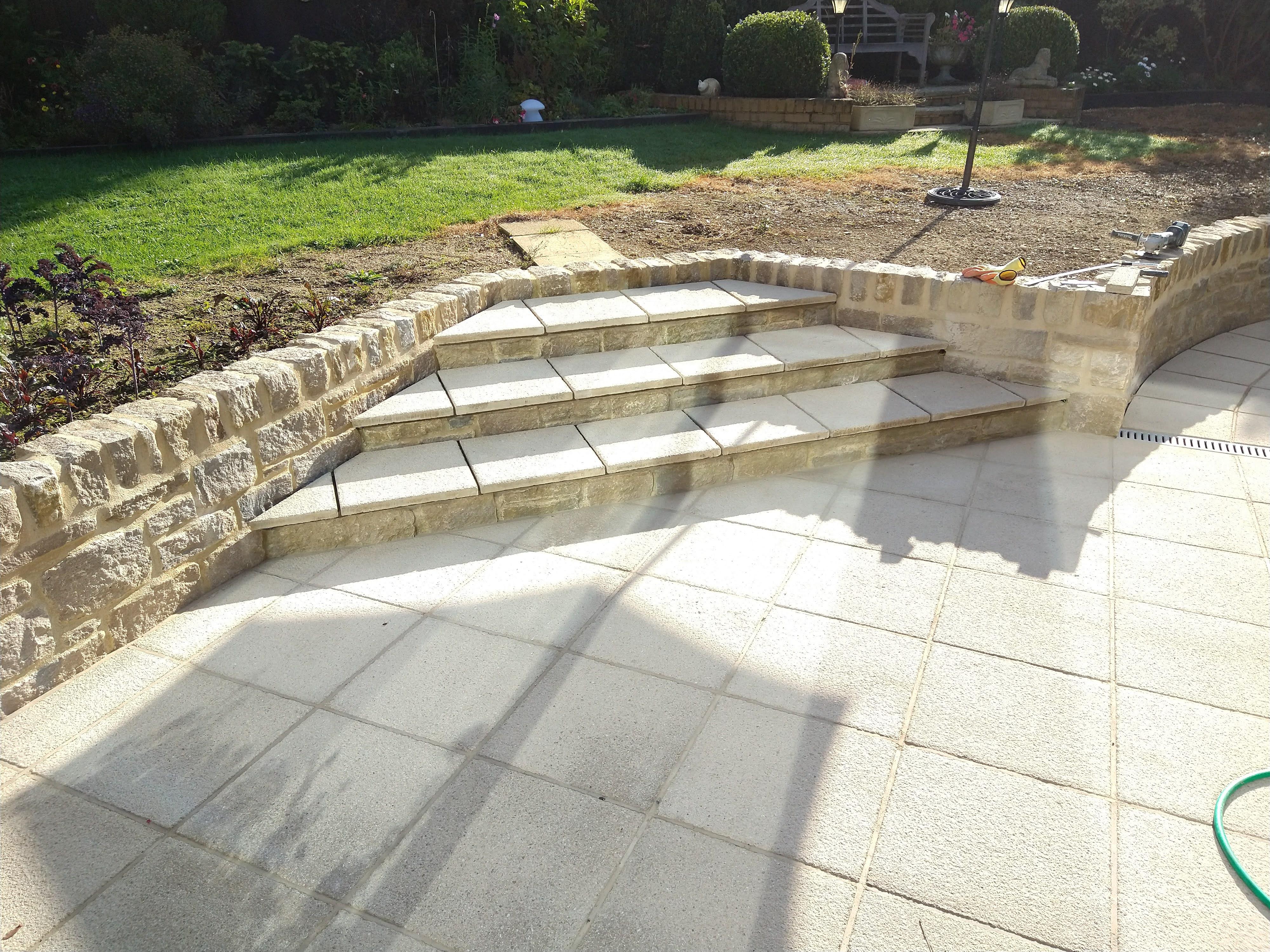
I hope the colour of the mortar shows up in my photo (BTW the steps wern't pointed at that time). I was quite surprised at how there was no hint of greyness to it - I think the strength of the ginger somehow cancelled it out, but yes, I was most relieved not to have to pay out for the expensive cement again!
-
I found the mortar made with Snowcrete to be incredibly sensitive to the colour of the sand. Our house was built with purbeck sandstone set in a mortar composed of one part both white cement and lime with six parts of what was referred to as 'ginger' sand by the planners (to match local buildings) and when I built some recent additions I had a hard time matching it. I ended up with three different sand supplies and had to mix them carefully to get a decent match. What did suprise (and please) me was when it came to pointing the patios I wanted a slightly different look and mixed up some grey OPC with the 'gingerest' of the three (because I still had a ton of that left over). The mortar came out quite a light buff which blended nicely with the slabs.
-

Semi-final plans --- feedback/critique welcome!
Radian replied to RK6's topic in New House & Self Build Design
I think the master bedroom could do with a little bit more floor area to make it less rectangular. I would as much as you can spare off the adjacent bedroom and also move the door up the corridor to the end of the rooflight. This lobby area then becomes dedicated storage/display cabinets for the bedroom. Agree with doing plenty of research on cinema area - maybe check with an AV supplier and talk it over in their demo room. Good luck with this very cool project! -
Nice one!
-
Galvanised up to the sills would suit those doors which should be OK with splash, it's just the underside of the EWI. Maybe you could build up to the underside with more black bricks (flush with EWI) but leaving gap to foundation at rear & EWI above for sealant? Probably a daft idea!
-
Long shot... have you ever right-clicked the web page for those stats and selected "View page source" or similar? Maybe just images pushed from server but if there's some <script> stuff...
-
Sure. The only reason I used mine in this role was to host an mqtt server and sql database. I've got plenty of ESP8266s and ESP32s pushing/pulling stuff into those. Can't beat bare metal STM32 or even a PIC chip for a bit of PWM over a myriad of IO's ?
-
NR is built on JS so no luck there. How bad is it though? Pi is generally a Watt or two. The actual difference between this and Arduino powered from a USB charger would be negligible. If you were really keen, you could easily do a PV/battery UPS to run it off-grid.
-
Generic Tuya lamps. Use with Smart Life or Tuya app. Pairing with 2.4mHz wifi only - can be problematic. you may need to reset them to pair direct (i.e. they put up a wifi access point that you connect to initially). This usually involves power on-off-on-off-on-off-on then it flashes slowly. App has option for Easy (actually hard) or AP mode when you add a new device. Choose AP and follow instructions.
-
I agree with most comments. Downlighters are getting a bit old-hat except for task lighting situations. Avoid the higher colour temps unless you're nostalgic about arc-welding. Make use of any natural overhang, hidden ledge etc. to run led strip. Consider embedding linear strip with diffuser in ceilings, corners etc. Use strips with tuneable colour for extra atmo. Also check out the larger format LED panels(e.g. 600mm x 600mm) for utility, garage, or 'big statement' lighting in kitchen. Lastly (and I really should kick myself for saying this) don't shy away from Chinese smart bulbs and strips using Smart Life (Tuya) as they often out-perform big brands at a fraction of the price. The trick is to buy one, give it try and if you don't like it - bin it and try a different one until you're happy. They're generally that cheap. I ❤️ Alexa (she lets me play around with her back-end)
-
One of the many relay boards like these on the market (make sure it has opto-coupled inputs) could be wired to the GPIO pins on a Raspberry Pi and power 240V valves like the Honeywells or Wundas. Theres even a POE hat to power the Pi. Tons of HA software already available or you can piece together your own in node red. You do seem to have a thing about EM though... I hope you appreciate that the power levels of deliberate radio sources like routers and wifi gadgets are incredibly tiny compared with cellphones, radio base-stations and even accidental sources like - oh, just about anything with digital electronics! That's why the range is always so pathetic by comparison.
-
Yes, manifold distribution would be the way to go for more than a couple of zones and those are designed with an eye on power consumption at least. How long are the sensor leads out of curiosity?
-
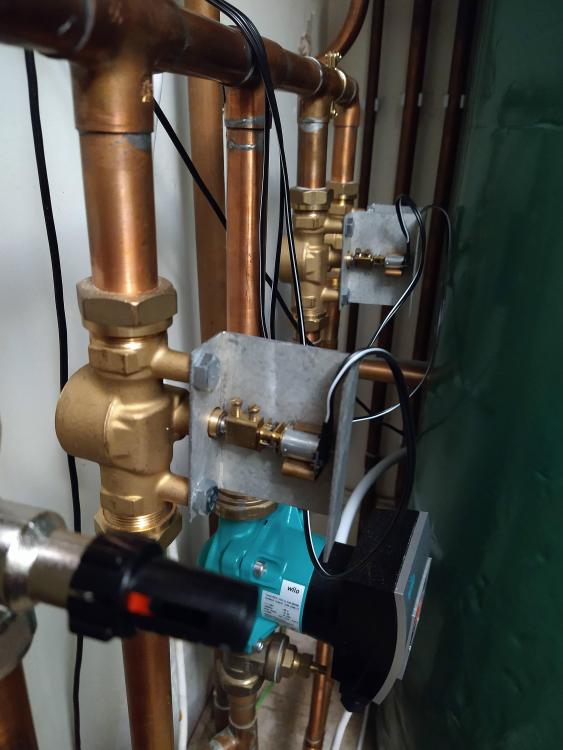
If you do go down that route, a £30ish Zigbee TRV could be your best bet. There's a zigbee2mqtt project that can be run on Raspberry Pi which, with the addition of node red could let you knock-up your dream-come-true entirely self-hosted setup. I have a blend of both approaches to zoning but when you can home-brew a motorised valve for well under £20 zoning each room does seem attractive. The motors I've used can also be fitted with a hall-effect sensor that encodes shaft position to give full servo control to make proportional valve opening possible. I haven't done that because I only needed three zones that all have their own temperature controlling components. I do make use of the fact that the motor's braking isn't quite up to holding the valves fully shut... to pinch them off I keep the motors in stall (the constant current driver does this loss-lessly through PWM) but when my tiny UFH zone is the only load, the boiler can't modulate down low enough without cycling so I keep the main radiator zone slightly open which has the effect of gently pre-heating them in the wee small hours.
-
Regular failures are a sign of poorly engineered products. But what about the power consumption? I don't see any discussions about this but 6Watts 24/7 x how may valves are in play? Some people can heat their whole PH on that! I thought that about Honeywells too, to begin with, but that was the last type I had to replace. And yes, the 3 port mid - I had one that went both ways irrespective of where the shaft was pointing. At least the actuator wasn't to blame in that particular case! I took it apart expecting to see a missing rubber seal but it all looked kind of OK.
-
Oops, didn't see your post go in before mine. I see we are in agreement.
-
What's the thinking behind the use of tray in this case? I understood that the 150mm below DPC was to prevent rain splashing up or being wind-driven up to the wall above DPC. Does the tray simply act like moving the DPC up to the recommended height? Of course, in level thresholds, the door itself isn't bothered by any of this and a linear drain at the threshold is the standard solution. If all you were trying to do is, say, bring the patio level up to 100mm below DPC then might not a linear drain suffice? This would positively drain the sensitive area and while not eliminating splashing entirely, it would reduce it considerably. I've put in 10m as a complete newbie and I'd say it's quite doable. I also laid 106m2 patio over the course of the year and was actually a bit sad when there was no more left to do!!!
-
Calculations are one thing but Barryscotland is in the process of gaining real, empirical data. If he logged his indoor/outdoor temperature differential vs. kWh input wouldn't that yield a more accurate Q instead of arriving at it from U*A*ΔT using a long list of assumed U values? Often wondered about this because it sounds a lot easier ?
-
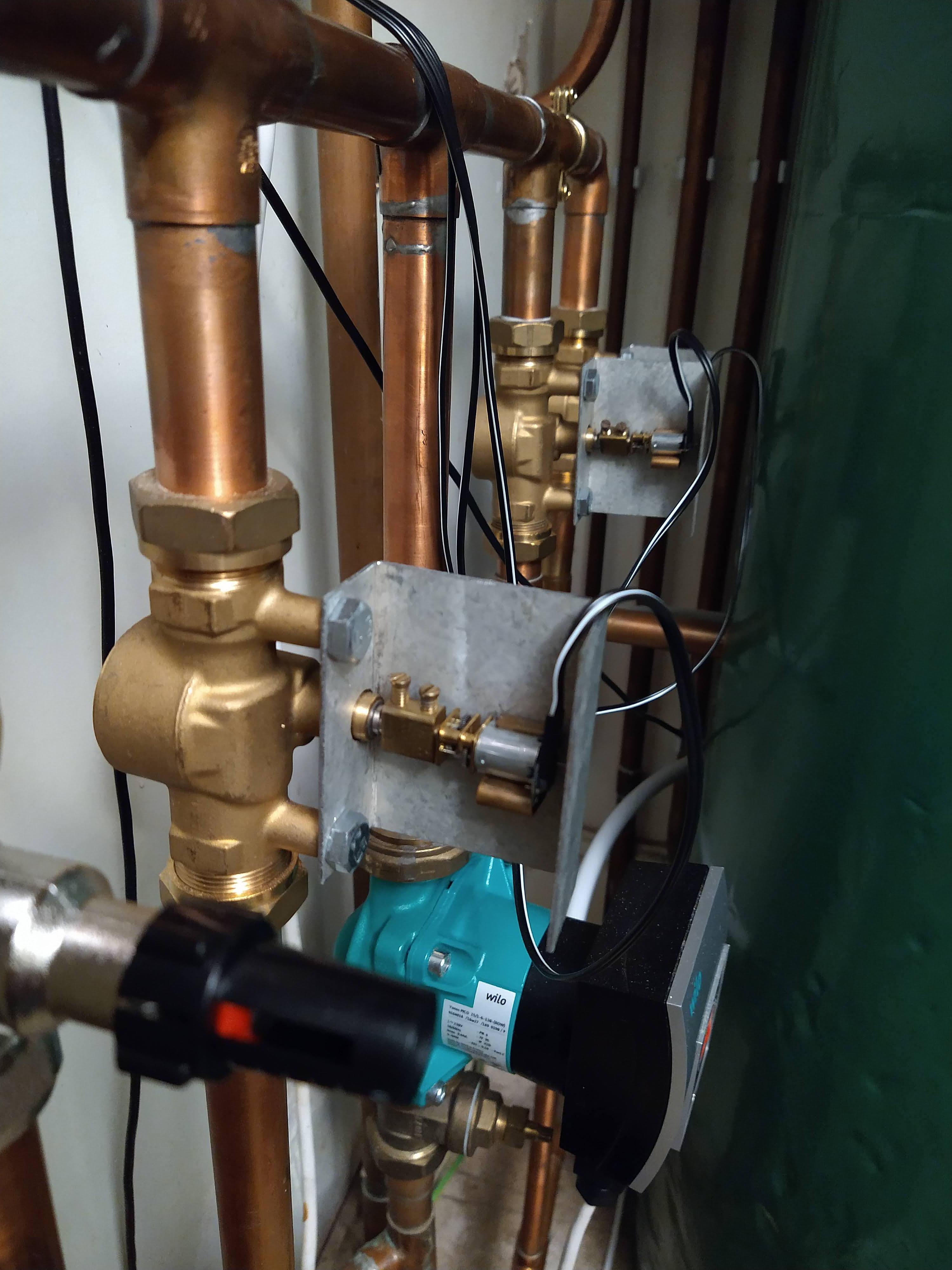
I have a pathological hatred of typical 2-port valves. They all seem to be based on the same ancient, crappy, design of a synchronous AC motor that gets hot when driven to stall, via a micro-switch hacked-in current limiting resistor (that also gets hot) dissipating something in the order of 6 Watts. Getting on a bit in years, I've lost count of the number of actuator heads I've had to replace and the price of them was beginning to feel more like a tax on owning a heating system. The final straw came on a frosty X-mas morning when the heating didn't come on because... That was a couple of years ago and because SFix & TSn were closed for the festivities, I enlisted a Raspberry Pi, stepper motor and 3D printer to be hero just for one day. This episode gave me a taste for getting back control of my heating system and I have not looked back since. These days I use a bunch of drayton 2-port valve bodies (£3 Ebay) with a micro metal gearbox motors (<£5) driven by Pololu H-bridge constant current drivers (£5) mounted on some scrap metal: My question is... do people around here just put up with the typical Honeywell/Drayton valves circa £60 or do they go for something more exotic (that I've yet to find) or are they rolling their own like me?
-
The PRV could open if the thermostat contacts weld shut causing the water to boil. Granted it's very unlikely but at the very least I would have it pointed at the wall and not at face level ? Another reason might be if the expansion vessel lost pressure on the dry side without you knowing about it when filling, then the natural expansion from heating the water might open the PRV. Again unlikely if only heating to 25C but it would bother me all the same. I do understand that you're making it uber-simple as a highly temporary fix but those NI pipe-bombs give me the willies ? (says the man seriously considering one to get another UFH loop going while waiting for the current price of ASHPs to de-orbit)
-
I wonder if the fibre filled cavity performing as it should? Unless the outer leaf is rendered in K Rend I'd be concerned about wind-driven rain in your location - where abouts are you?
-
Increased resistance makes the current draw go down. The resistance of the long cable run will drop some voltage and reduce the current. It will however dissipate power as heat so the heater element will not reach its design temperature and the cable (from the reel) may exceed its. A coil of cable has self-inductance from which the magnetic field opposes current flow (inductors are sometimes called chokes). This is similar (in effect only) to resistance and therefore also dissipates heat.
-
Pressure release valve needs a safe route someplace? I assume you put a 13A plug on the end of the cable -- keep an eye on how hot that gets as they're not rated for continuous use at maximum current. Interested in how this goes ?
-
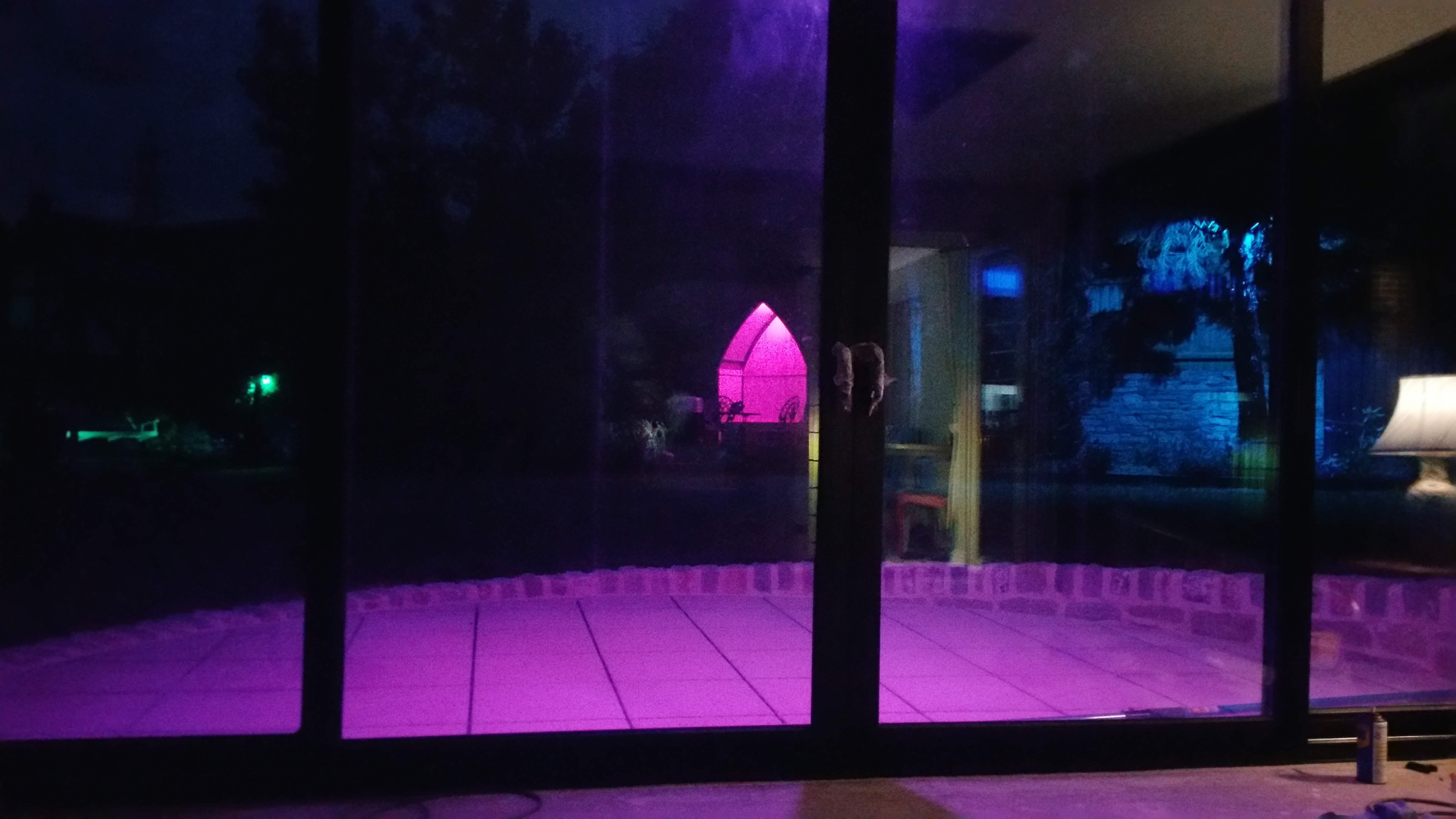
Hello again, it's been a while, and thanks for all the advice I received back in 2019. I now want to update my topic with the outcome - which is that I did put in a wet UFH loop - and that I'm very glad I did. Initially I decided to hedge my bets and lay in a PEX loop as well as some ducting for air-to-air during the construction of the extension. Neither were costly and meant we could decide on the heating solution once we had gained experience using the room. This didn't happen until summer 2020 during which we occasionally had outdoor temperatures in the high 20's peaking at 32. The garden room mostly behaved very well with only the period between mid-morning and mid-day seeing too much solar gain from the S.E. elevation. Jeremy Harris was right to point this out as being potentially the more significant issue. However, by opening both sliding doors a little way to get a crossflow (on the N.W.- S.E. axis b-b on the plan) the room could be kept comfortable. If the house wasn't occupied we would simply close the doors to the rest of the house. So far, so good. Winter 2020-2021 wasn't particularly cold so we employed a 1200W halogen portable heater and continued using the room whenever we wanted to. This was very encouraging and by October this year, having had another comfortable summer, I decided just to hook-up the UFH and leave the air-con ducting buried in the wall. Now we've had a few sub-zero periods since then it seems that we have a good solution. On a sunny but cold day the room is benefiting from a solar boost in the morning so generally it comes on overnight and goes off after between 4 and 12 hours depending on weather. The only issue I have had is that my boiler only modulates down to 10kW so if the UFH is the only load it would short-cycle too much. Rather than install a buffer tank I simply modified my control algorithm to modulate the zone valve serving the central heating radiators which now get a tiny pre-heat in the early-hours. My zone valves are custom servo-actuated home-brews operated by a Raspberry Pi which means I'm also logging all the temperatures and energy usage to keep on top of things.
-
How many people must there be with double garages exceeding 40m2? 6m seems a fairly common depth - so width greater than 6.66m would put you in "no man's land" group 7(a). Opening both sides of a 2m wide SUV in less than 3.33m is not all that practical. I bet the 40m2 figure hasn't been updated in over 40 years.
-
Hi stephen, that's our very next move only this all kicked-off after close of play on Friday (as always seems to happen) Been stewing on it all weekend and decided to cast around here for ideas. Is it possible BC may make an exception? I mean, is there an element of discretion available or are "rules rules". Never been in this kind of situation before.