


Randomiser
-
Posts
182 -
Joined
-
Last visited
Everything posted by Randomiser
-
Do chimneys form part of the principle elevation?
Randomiser replied to Randomiser's topic in Planning Permission
Thanks for the link, that is a helpful guide. I very much hope it is the one on the left, but I am struggling to find anything that actually states this and indeed, unless I am missing it, the guide you linked to doesn't cover this specific point. I have looked at the Technical Guidance for Householders on PD and can't find anything in that, it only shows examples with bay windows but nothing on chimneys. Do you know where I can find something that cover this specific point? -
This is a seemingly dull and techy question, but potentially material to anyone wanting to do a permitted development side extension. Let's take a simple example of a house which in plan is otherwise square but with a chimney on the left hand side. Would the principal elevation ignore the chimney as on the left or take it in to account as on the right? Any thoughts or experience much appreciated.
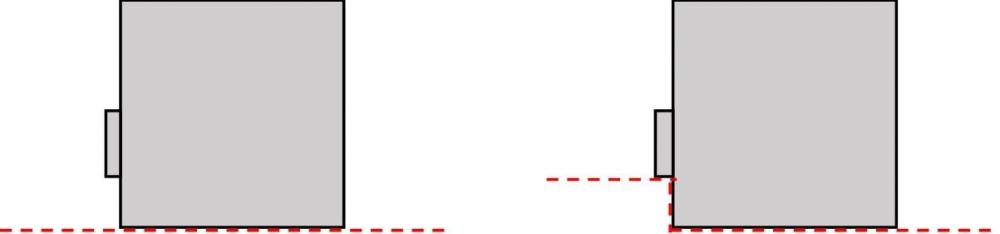
-
Reusing planning drawings without permission
Randomiser replied to willbish's topic in Planning Permission
Glad to hear it has been resolved. -
Congratulation, well 95% congratulations I guess ?
-
Permitted Development - Side Extensions
Randomiser replied to Randomiser's topic in Planning Permission
That is a very logical observation. Not that planning is always logical of course ? -
Permitted Development - Side Extensions
Randomiser replied to Randomiser's topic in Planning Permission
Only 4m high anywhere and eaves max 3m within 2m of any boundary. -
Silestone worktops from DIY Kitchens (or elsewhere?)
Randomiser replied to MJNewton's topic in Kitchen Units & Worktops
We have Silestone in our current kitchen, not via DIY kitchens though. We are extremely happy with the worktops and would definitely have them in future kitchens. -
Permitted Development - Side Extensions
Randomiser replied to Randomiser's topic in Planning Permission
That is exactly how I read it Ed. If you go either side both are individual extensions and can therefore each be up to half the width of the original house. I had just assumed that it would be the total additional width, but that does not appear to be what it says. -
I wonder if anyone can help with a query on permitted development rights for side extensions. I have looked at both the Technical Guidance for Householders (https://assets.publishing.service.gov.uk/government/uploads/system/uploads/attachment_data/file/830643/190910_Tech_Guide_for_publishing.pdf) and the underlying legislation (http://www.legislation.gov.uk/uksi/2015/596/made) and in both cases I think they are saying the same thing, but my conclusion surprises me, so I thought I would check to see if I am missing something. I am looking at A.1. (j) from the Act which says: What I expected was that the total width of side extensions would be limited to half the width of the original house. But that does not appear to be what it is saying, if it were would it not refer to the enlarged parts of the dwellinghouse? By treating them as singular it suggests (to me at least) that each individual extension needs to comply with the three tests. In the case of a detached house does that mean an extension of 50% of the width of the house can be built? If the intension was to limit the total width of the house after permitted development extensions to 150% of the original width why not just say that? The technical guidance only shows semi-detached examples, so it is no help in answering this question. Has anyone ever come across this question and or point being tested? Has anyone seen a situation where permitted development rights on both sides of a house has been successful? Many thanks in advance, Randomiser.
-
Low flow rate in mains pressure system
Randomiser replied to Randomiser's topic in Other Heating Systems
OK, thanks again. It sounds like the accumulator is the answer as otherwise if he is unlucky and it is found quickly he will need pretty much the whole house ripped apart to find the restricting pipework. Do you have any thoughts on the size of the accumulator relative to the size of the cylinder? -
Low flow rate in mains pressure system
Randomiser replied to Randomiser's topic in Other Heating Systems
Old house that was then extended many times before my uncle bought it, last one was in the 80s. Suspicion is that the plumbing system has just been added to every time it was extended without ever having been fully replumbed. He tells me there are "pipes everywhere under the floors and in the loft". -
Low flow rate in mains pressure system
Randomiser replied to Randomiser's topic in Other Heating Systems
Thanks for that Temp. Yes, uncle not happy that it has got to this point before problem spotted. I imagine changing pipes to house would be a big issue as he is a long way away from the road and if I recall correctly his water metre is at the end of the drive, so a lot of new pipe he would have to run. So from what you say an accumulator should help as the static pressure is around 4 bar, which I think is pretty good. What you say about sizing is interesting, should the accumulator be the same size as the unvented tank he has had installed, 200 litre I think? That would presumably mean he would run out of hot water at the same time the accumulator stopped adding additional flow to the system. Or does it need to be even bigger to work effectively? Thanks again for your help. -
Required to Demolish in Salcombe in AONB
Randomiser replied to Ferdinand's topic in Planning Permission
Did you manage to get costs awarded against them? -
Required to Demolish in Salcombe in AONB
Randomiser replied to Ferdinand's topic in Planning Permission
In the area I live there is a bit of an epidemic of things being build without consent (or built very differently to an existing consent) and then retrospective consent is applied for. In the vast majority of cases the local council planning team wave through the application. Having spoken to one of the local councillors about this I suspect that the issue is that most of the applications are by developers or individuals with deep pockets who have made it clear they will appeal a rejection and the council just doesn't have the resources to fight all the appeals. Our local Parish Council is getting very exercised about it but is powerless to do anything, they suspect that anyone with deep pockets is now being advised by local architects and planning consultants to take this approach as a retrospective application is more likely to get approved than applying for consent before doing the work. I am pleased to see that at least some councils appear to be willing to take on those who may think the size of their bank balance means the rules are different for them. -
A relative has just had an update to their plumbing (existing house, not a self build). They have had an unvented cylinder installed but now have problems which they are told are being caused by a low flow rate, rather than water pressure. Apparently the water pressure is about 4 bar and the flow rate 12 (litres per minute?). They have been told that with a mains pressure system they cannot have a pump added but could add an "accumulator" to the system. They asked me what I thought and I had to confess I had never heard of an accumulator before. I did a quick bit of online searching and think I understand the basic principle of one works, but what I have read seems to suggest it is installed to help with low water pressure as it returns the water pressure to static pressure from working pressure even when water is being drawn. What I can't find is if this will do anything for the flow rate in the system. Any thoughts / experience / info I can pass on would be much appreciated.
-
Planning laws preventing my dream home.
Randomiser replied to Waterworks's topic in Planning Permission
Certainly around where I am the only thing that sustainability based rejections focus on is increased car journeys. They never take it beyond that, but I presume it is because the underlying assumption (sorry!) is that those car journeys will be in petrol or electric cars. It makes me wonder whether it would be possible to enter in to some sort of voluntary obligation that those living in the house will only ever own electric vehicles. Has anybody seen such an attempt anywhere? If so, what was the response from the planning authority? It would potentially open up potential plots that have previously not secured consent. -
Planning laws preventing my dream home.
Randomiser replied to Waterworks's topic in Planning Permission
As an economics graduate I feel I can get away with the only economist joke I know... An economist, a physicist and an engineer shipwrecked on an island with just tinned food and no tin opener. "Heat the tin up on the fire" says the physicist, "the contents will expand and force their way out." "You mean explode" says the engineer, "winch that rock up in to that palm tree and drop it on to the tin to break it open." "You mean crush it" says the economist, "the answer is simple, first, assume we have a tin opener..." -
In another thread I brought up Paragraph 55/79 and referenced a potential plot near me where consent for a more standard house had been turned down. I have since dug up a bit more information and while I think it is the final nail in the coffin for this potential plot I thought it may be of interest to others. Rather than completely take over the other thread I thought I would post it separately. Having finally been able to get hold of the most recent appeal for the potential plot there is some explicit language relating to paragraph 55/79. In previous appeals there had been mention of points (a) to (e) not applying and one inspector commented that the house might not be considered isolated. However, in the most recent appeal the Inspector was much more explicit and stated: " The appeal site is close [to] other buildings... Consequently, I do not consider that the proposal would result in the development of an isolated dwelling and there is no need for me to consider whether the proposal would meet the circumstances a) to e) in this respect." I found this interesting as one of the main reasons for refusal is that the potential plot is outside of any settlement boundary and therefore described as being in the open countryside. However, I then came across this brief piece reporting on a judgement from March 2018, which may have informed the Inspector's view. https://andrewlainton.wordpress.com/2018/03/30/court-of-appeal-clarifies-meaning-of-isolated-housing-in-nppf/ In short it appears that a small group of houses with no associated services outside of any settlement boundary is still potentially considered a settlement and a potential plot nearby would therefore not be isolated and so ineligible to be considered under paragraph 55/79. Given this judgement, it would seem that some previous decisions by the Planning Inspectorate have interpreted the NPPF differently. For example in this case an appeal was allowed. https://docs.harrogate.gov.uk/AniteIM.WebSearch/Results.aspx?grdResultsP=1 The following is included in the appeal decision justifying the use of Paragraph 55/79: "The appeal site is an open field on the edge of the village of Cattal… ...Cattal is located around a kilometre from the railway station but has no notable local services. The parties agree that the site could reasonably be described as an isolated dwelling in the countryside which local policy and the Framework seek to resist." From what I have now found the March 2018 judgement has probably further reduced the scope for Paragraph 55/79 applications, limiting them to houses standing in splendid isolation in the countryside.
- 1 reply
-
- 1
-

-
Surely you still have to pay for Grand Designs?
-
Planning laws preventing my dream home.
Randomiser replied to Waterworks's topic in Planning Permission
That all makes sense. I would definitely like to lay on my death bed and look back on having played a part in creating an amazing piece of architecture. The challenge is that amazing is unlikely to come cheap. By the time I pay the going rate for plots that have / will get consent the remaining budget is unlikely to create something more than a bit better than average - indeed we have a plot, but what is slated to be built there is definitely not in paragraph 79 territory, but we can afford it. So the thought process is less a matter of loopholes and more one of opportunity. If we could buy a plot at a lower price because the prospect of planning consent is considered low that would leave a bigger budget for the build and amazing becomes more of a prospect. But I am sure I am not alone in being in a position where dreams and reality don't occupy the same space ? -
Planning laws preventing my dream home.
Randomiser replied to Waterworks's topic in Planning Permission
I find that bold sentence very interesting, but in a negative way. Part of my interest in para 79 is because it sparked an idea in my mind about a piece of land not far from us. It has had more than a dozen goes at getting consent for one or two houses. It is outside any settlement so regarded as countryside but somewhat oddly it has houses on both sides and behind it. It is nearly an acre so a big enough site to do something other than squeezing a new house in to a row of houses. I think the owner has pretty much given up on getting consent to build on it and in the past I heard he had offered to sell it on to a few people. It is massively overgrown and in the past people have fly tipped significant amounts of rubbish on it. Oooo, I thought, could one look at paragraph 79 here? However, having looked at one of the recent appeal decisions the Inspect has said that whilst it is not sustainable because of the lack of services and public transport near the site she would not describe it as isolated given there are a lot of other houses nearby. Given your comment above I fear if the planners were so inclined they would argue paragraph 79 did not apply as whilst it is in the countryside, it is not isolated. IMHO that would be a ludicrous outcome, but I fear it may be what would happen. -
Planning laws preventing my dream home.
Randomiser replied to Waterworks's topic in Planning Permission
Apologies, I did not realise the programme was not viewable, not much use to the OP then. All I seem to recall from watching it at the time was that wheels played a big part in the legality of it and McCloud made a big thing of it not mattering if they were buried in the ground if they were still attached. -
Planning laws preventing my dream home.
Randomiser replied to Waterworks's topic in Planning Permission
Is it still possible under current planning rules to follow this approach... https://www.channel4.com/programmes/kevin-mcclouds-man-made-home/episode-guide -
Planning laws preventing my dream home.
Randomiser replied to Waterworks's topic in Planning Permission
Ahh, re reading your post I presume the "per" was short hand for per year, I just judged you by my own standards and assumed it was some sort of typo and you meant 20 in total ? -
Planning laws preventing my dream home.
Randomiser replied to Waterworks's topic in Planning Permission
According to these guys it is at least 66, so loads better ? https://studiobark.co.uk/paragraph-79-paragraph-55/


