


G and J
-
Posts
2055 -
Joined
-
Last visited
-
Days Won
9


G and J's Achievements

Advanced Member (5/5)
640
Reputation
-

List of ASHPs with cooling capability
G and J replied to Stu789's topic in Air Source Heat Pumps (ASHP)
We have a 6kW R290 Maxa. Slightly higher power than you ask for but seems to be ok. Comes in a pleasant colour too (for it’s position in our garden). Is there any difference in sound level in general between R32 and R290? -
MCS umbrella scheme. Anyone done it?
G and J replied to flanagaj's topic in Air Source Heat Pumps (ASHP)
I’m sure he meant compared to the best quote he got otherwise. Honest. -
Happy to oblige. To be fair I’ve a big history of making people laugh, especially on the build. Shame it’s usually either at me or me work lol So I’ll be nudging into my ninth decade, and therefore one replacement = 30 years so that’ll see us both into our android staffed in orbit care facility. Like Wall-E but with fewer cocktails and more meds.
-
So they last forever then. Fab.
-
Yes you can. I would thoroughly recommend you get help from a local installer. We did, we are lucky enough to have a really great guy who went through our design in detail in return for us buying all the bits from him. I probably could have got the bits cheaper on t’internet but the difference was a small price to pay. Not sure you want to attach the liner directly to the register plate mind…
-
So how long does an average heat pump last then? Whilst it’s a bit of string question in many ways there must be norms. Modern condensing gas boilers seem to have a useful life of about 9 years, so is there an equivalent for heat pumps? Or are they trigger’s broom?
-
Our max temp difference will be 35°C (ambient background temp min to max hot water temp). Long runs are bad news for hot water so to be avoided anyway. (Most of our sinks/basins are served by 10mm hep to get hot water PDQ, which is working well though it does mean the flow rate isn’t torrential). In practice I’ve only one straight section over a metre long and that’s to the garage through a 4.5m duct with bends either end. Do you really need long straight sections?
-
Finally. Some positive progress
G and J commented on flanagaj's blog entry in Contemporary Ball Ache
Good to hear. Materials in last photo looking good. Which window colour are you going for (assuming that's what 2 colours are)? -
Comment on our landscape design
G and J replied to Mr Blobby's topic in Landscaping, Decking & Patios
+1 -
Comment on our landscape design
G and J replied to Mr Blobby's topic in Landscaping, Decking & Patios
Is that because he can do the latter and not the former? -
Comment on our landscape design
G and J replied to Mr Blobby's topic in Landscaping, Decking & Patios
Not sure which room is which ( take sliding doors to indicate one most used rooms?), nor how old kids are, but how about wide tread, shallow steps down? Not necessarily cheap but would give view downs to grass and double up as extra seats? (Could be done more cheaply to start with, grass treads over sleepers or like with a view to a paved version in future)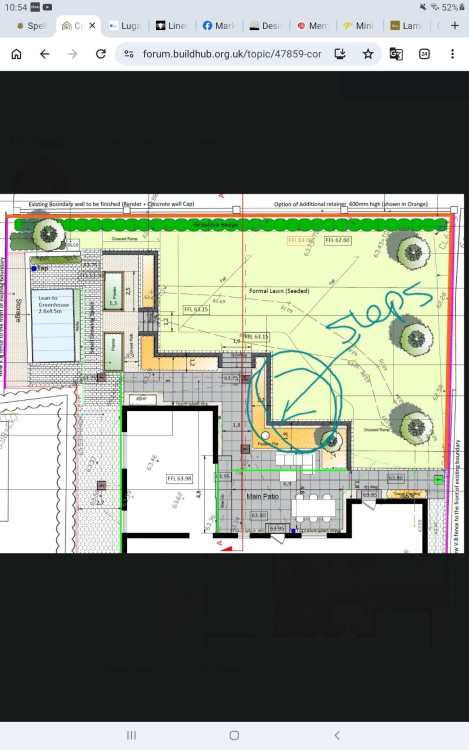
-
Eaves flashing gutter of Insulated box section panels
G and J replied to BotusBuild's topic in Roofing, Tiling & Slating
‘Tis quiet, but remember, those two things you mention aren’t mutually exclusive lol We’ve got those type of panels on our garden building and they come with the 75mm cutback to effectively form a drip and stop the insulation getting wet. We used a company called Briarwood which was a lot better value than Kingspan and they were jolly helpful when I talked through the installation.- 9 replies
-
- 1
-

-
- eaves flashing
- gutter
- (and 1 more)
-
I’ve wrestled with this one, but I calmed down when I thought about the fact that the power of the smallest unit was similar to the heating power needed to maintain 21°C internal when it is -3°C outside. At that point i concluded that the smallest unit will more than do. Bit like our ASHP actually.
-
I'd feel really nervous about how this is going...ditto for your hob post.....how can you confirm the measurements are "right" if you don't have measuring positions, same equipment, all the facts about what can and can't be done...? In contrast out fitters came to template (physical sheet material took circa 2 hours for kitchen and utility) and that was the point at which we discussed finer detail such as how far back tap was etc. From that point in it was their measurements; their job to match slab to the measurements; their risk. We were never asked to "sign off" other than confirming the slab we had chosen. Are they actually asking you to confirm the drawings or are you acting out of caution? Btw very similar sinks (Franke) 5mm overhang all round (no accessories on sink ledge). Our old place was closer to flush (was indeed a stonemason who branched out into worktops) ....we prefer the larger over hang as, to us, it appears more finished.
-
Any recommendations for whole-house Water Softeners?
G and J replied to Great_scot_selfbuild's topic in General Plumbing
We’ve done exactly the same (I think we followed Dreadnought’s recommendation) and it’s fine and dandy and a good price too. We’ve also got a Qooker tap. We fitted the Qooker Scale control, it’s another cylinder to go next to the main cylinder, or in your case a cube. We’ve got 33 whatevers hard water (yes, 33 individual little droplets from the test kit till it changed, sigh), and I think it’s a condition of the Qooker warranty that if you have hard water you have to have a scale control doberry. As an aside, why an unsoftened tap in the room of utils?



