marshian
-
Posts
1494 -
Joined
-
Last visited
-
Days Won
5
Everything posted by marshian
-
dT is also related to flow temp - lower the flow temps the narrower the dT will be (for same circumstances)
-
Why is 12 deg important to you? At 70 deg flow temp you might see that at the boiler but not if you are running flow temps the allow the boiler to be in condensing mode all the time 27 rads is a lot of rads do you have control of the pump or is it inside the boiler - if external I’d try a faster pump speed - it could be that there just isn’t enough pump pressure to overcome the circuit resistance at the extreme ends of the system
-
I don’t think I’d be calling an engineer out if no repetative fault - £144 is a lot of money - will be an interesting conversation OP “here I saved screen shots of the fault” GE “no fault in system now - £144 please - cash or card” Good luck
-
I don’t think he meant a 19kW heat loss - he meant the gas engineer proposed a 19kW boiler and he asked for 32kW to be installed
-
The oversize element (32 v 19kW) doesn’t matter it can modulate to a silly low figure cos Viessmann and if it’s a combi you may need the 32kW for HW. The “sue Viessmann” made me laugh a lot - it’s thrown up an error code for the first time in 2.5 years - it’s under warranty if a reset (power down) fixed it then move on with your life it was a glitch - if it needs a reset every day or week then get an engineer in
-
Oooff - you’ve done well in that age building - well done
-
I’d want to be closer to 40 deg C flow temp to move to a HP - 50 is at the top end of HP range and you might not get the COP you would need to break even on energy cost (3.0 to 3.5 unless you have a cheaper tariff for electrickery)
-
Yes it cycles more ~32 fires/starts in 24 hr period with a higher WC and sheduled heating that would be ~12 cycles in 24 hrs however I am not seeing a huge increase in gas consumption with the current boiler (the prev glow worm yes big increase when cycling more than 3 cycles per hour but it had a 10kW min output)
-
schedule heating (on/off/on/off) I’m running WC curve of 1.4 Constant on (with setback temps instead of off) I’m running a WC curve of 0.8 I’m working my way towards on (no setbacks) and I think that will be a WC curve of 0.7 Logging HDD data v gas consumption (minus HW) I thing last stage will be 5 to 10% more usage but house comfort will be better (more heat pump like)
-

Can the flow temperature be too low?
marshian replied to JohnnyB's topic in Air Source Heat Pumps (ASHP)
That’s not a huge circuit IMO On the bypass valve (my system is boiler rather than HP) but I have it set to only open when the circuit pressure is driven up to the point where just 1 rad is in circuit (from memory that’s about 0.3 bar on the scale) and that stops me dead heading the pump and keeps the flow rate up enough for the boiler to fire once flow temp has dropped enough -
All of the above Viessmann 100 W heat only (16 kW) Not a single rad remains from the original house set up 95% of the rads were changed a couple of years ago when I was running a 24kW glow worm boiler the point I was is that rads correctly sized for flow temps and room demand will work perfectly well whatever the heat source is
-
I don’t get the heat pump and rads comments I could run a heat pump instead of a boiler with the same flow temps I’m running a gas boiler 13 rads with a flow temp of 30 - to 40 deg depending on outside temp - it’s an early 1980’s with some insulation improvements (loft insulation is mainly 70mm so sub standard) and I’m running it 24/7 with setbacks at night and during the day when there is no one home - rad delta is around 6 to 9 deg (depending on flow temp) none of the rads are in the traditional sense hot but room temps are comfortable.
-
Hacking combi to run dhw and heating at the same time
marshian replied to sonicboom's topic in Other Heating Systems
Is the output of the boiler capped for HW for either temp or boiler power? I can understand the output being capped for CH because 26kW boiler feeding a 3kWh heat loss is massively oversized but it makes no sense to me to have only 7kW and 40 deg water Have you got the ViCare App so you can see what the boiler is doing? In my app I can set HW temp different to CH (100-W heat only with 115L cylinder and HW demand box) I'm pretty sure the app would enable you to increase the HW set point to say 50 and the boiler would modulate according to HW flow. I really don't see the point of trying to hack the boiler to do both at the same time - with a heat loss of 3kWh you aren't going to see a house temp drop even if you are running a really big and deep bath!!! -
Company I have worked for since early 90’s embraced that same concept - all software central - little boxes instead od desktop PC’s all in the name of effeciency and cost saving on IT It was a bloody car crash and I got to see it implemented and the business suffer the workrate of everyone go down the toilet and the IT dept run around like loons trying to make it work…… 18 mths later pretty much everyone was back to proper desktops or new fangled laptops
-
Is there an option to lift the floor and run that cable underneath?
-
Neighbour’s ‘Temp’ building maybe ignoring building regs.
marshian replied to G and J's topic in Building Regulations
Sounds a lot nicer than a park home…….. -
I'd be starting at the slowest speed possible and seeing how the system responded If the rad circuit has been balanced using the lockshields for a pump set to max you might have to allow a little bit more flow thro the rads but it may not be necessary - I can run my pump on 1 or 2 with no re-balancing required - only difference is the difference between flow and return on each rad drops with an increase in pump speed.
-
I don't read that the same way - sorry I read that as without PWM the pump can be run at one of 4 speeds

-
Why not try turning the pump speed down? I would be surprised in the system needs a pump running flat out unless it's a really big system with a lot of rads and UFH I've got 13 rads no UFH and I have a smaller pump running on min speed (out of 3) - I can run it faster but the temp drop on each rad gets narrower and system noise increases as TRV's start to restrict flows In fact I'd actually try the slowest speed and work up from there if the house room temps started to nose dive (it's currently a good environment to do this exercise) I'd gradually increase pump speeds until control was there
-
Weather Compensation for Radiators only and UFH only
marshian replied to John Carroll's topic in Underfloor Heating
Can I make a couple of comments 1. You make very nice spreadsheets that are really easy to follow and incredibly useful as a resource - thank you 2. I'm very sure all of my rads are oversized 😉 but your spreadsheet has made me actually think about how oversized mine are (I did the heat loss calcs a while back and when I've finished my loft insulation project I'll do the whole thing again to correct for the changes). I will probably help my understanding if I go and work it all out room by room. I'm not about to change rads for even bigger ones - that would probably be an expense for little gain (or a stupidly long payback) I'm already operating the boiler on CH in condensing mode all the time the returns on reducing flow temps further might be fairly damn small. -
Weather Compensation for Radiators only and UFH only
marshian replied to John Carroll's topic in Underfloor Heating
I would think that the WC curve would be the same for UFH as Rads if the heat loss of the property is the same and the heating is running in the same way The rads are just providing the distribution of the energy same as the UFH to replace the heat lost. I'm running my WC at a curve of 1.3 but I'm gas boiler and scheduled heating rather than 24/7 with setbacks - I'm absolutely sure I could run a lower curve (1.0 or 1.1) if I moved away from scheduled heating (I get to do this at Xmas when I'm home for an extended period). UFH is just a massive great radiator in the floor but it's slower to respond and needs a longer lead in than rads at lower flow temp but once it's up to temp it's just replacing the heat loss -
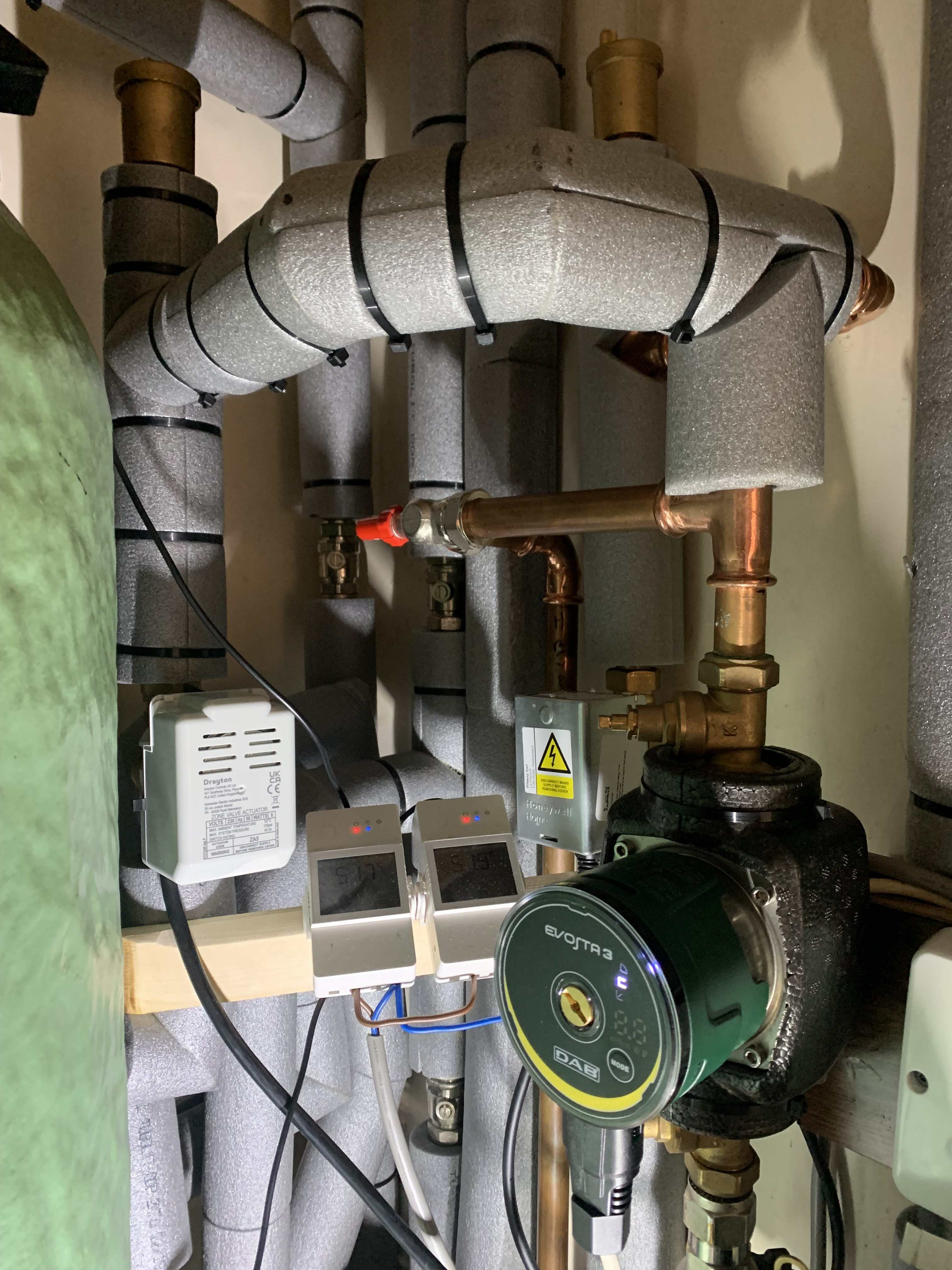
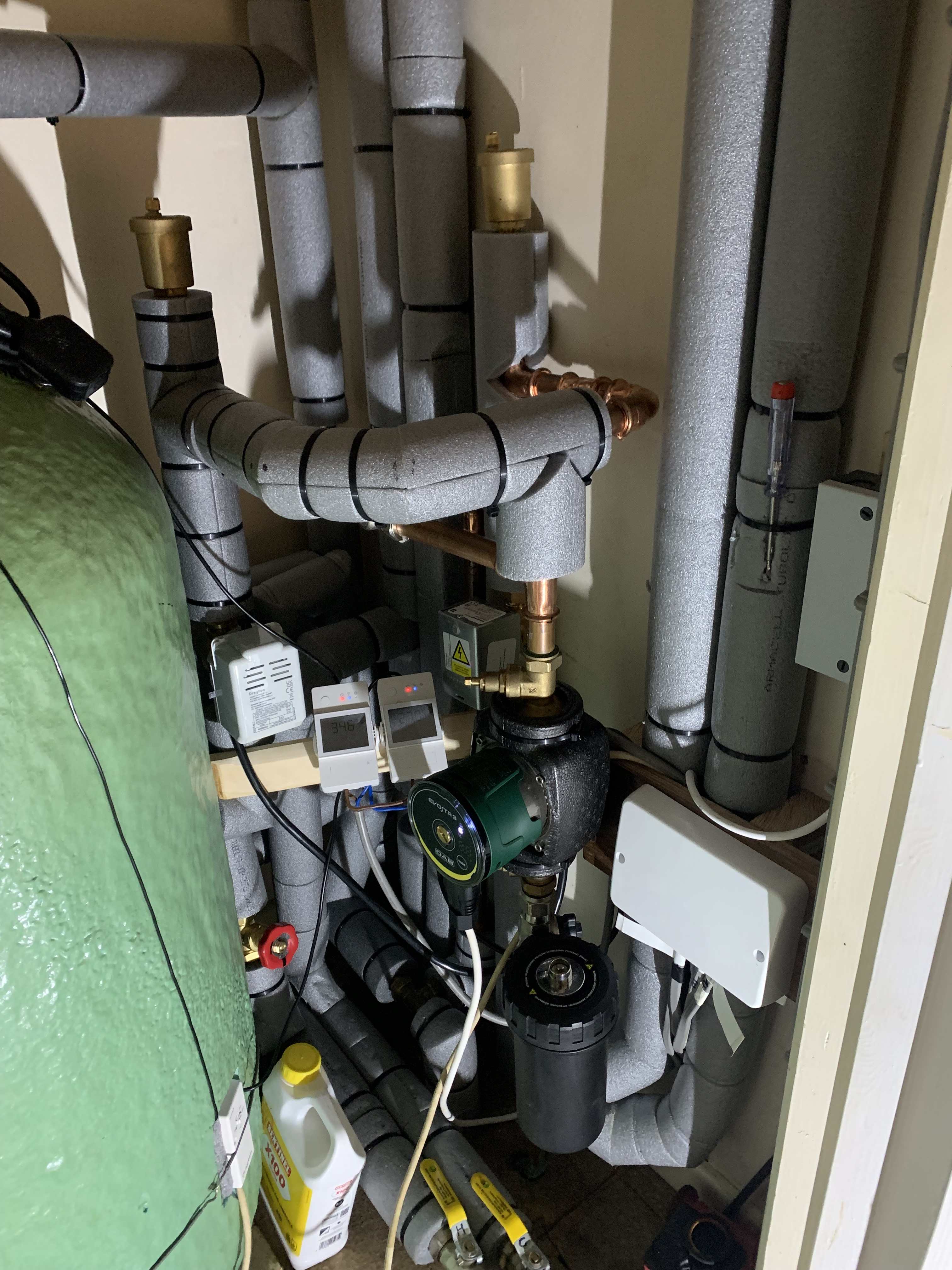
OK running out of time because we are going on holiday for two weeks but I’ll answer what I can Pump speed 1 10-11 W in normal operation Head is 1.8 m flow rate is 0.7 m3/hr on HW and 0.6 m3/hr on CH ( it can get down to 0.3 m3/hr as room TRV’s shut down Boiler flow temp 40 return temp 30 on pump speed 1 Most rads have a 9 to 10 deg drop between flow and return Pump speed 2 15-18 W in Normal operation 3.0 m head Flow rate is 0.8 m3/hr on HW and 0.7 m3/hr on CH (again it can get down to 0.3 m3/hr as rooms TRV’s shut down Boiler flow temp 40 - return temp 34 most rads have a 6 to 7 deg drop between flow and return House has 13 rads 2 ladder towel rails (toilet and utility) 2 med size verticals (Bathrooms) 1 large vertical (kitchen) 4 T22 500 x 1200 (bed rooms) 2 T22 500 x 1400 ( Dining and main hallway) 1 T22 600 x 600 (front hall) 1 T33 700 x 1400 (living room) Re pipe calcs (just saying whilst the height of the vent was as stated the length of the pipework to the vent is probably 7m from where it is below the pump to the outlet above the F&E tank. So there is a fair bit of water in the pipe) Automatic air vents are open all the time but when air is introduced the aerated water tends to stay in the pipes - never hear them expelling air unless it’s a system refill then they hiss away a lot if I shut the bottle vents for a day or so I’ll get a 1 sec hiss when re-opened so I know they work ok - I just think when the circuit gets a slug of air in it they aren’t very effective at getting it out due to flow of water in the circuit I think that’s all of your questions answered Better picture of the pump and pipe configuration below (with all the lagging almost complete it just looks like a sea of grey) I’ve not lagged the bypass leg because I’m still trying to find a good compromise setting that doesn’t allow too much return when all rads call for heat but does allow a little flow when some TRV’s start to close
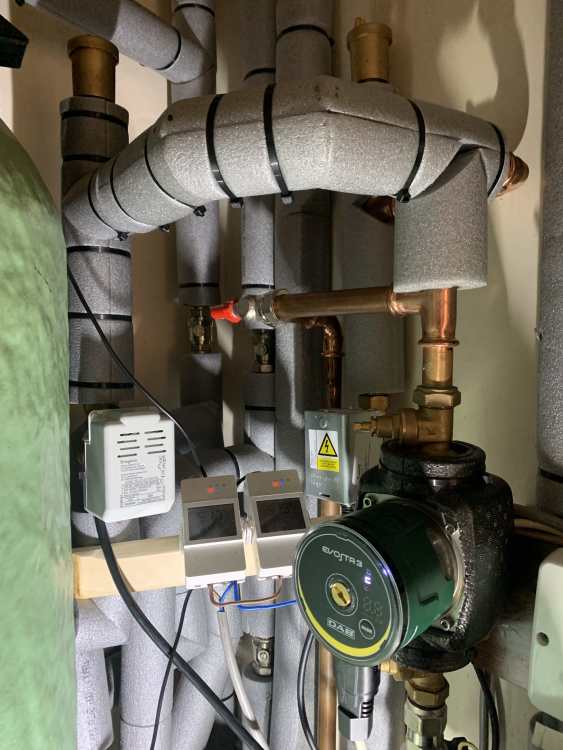
-
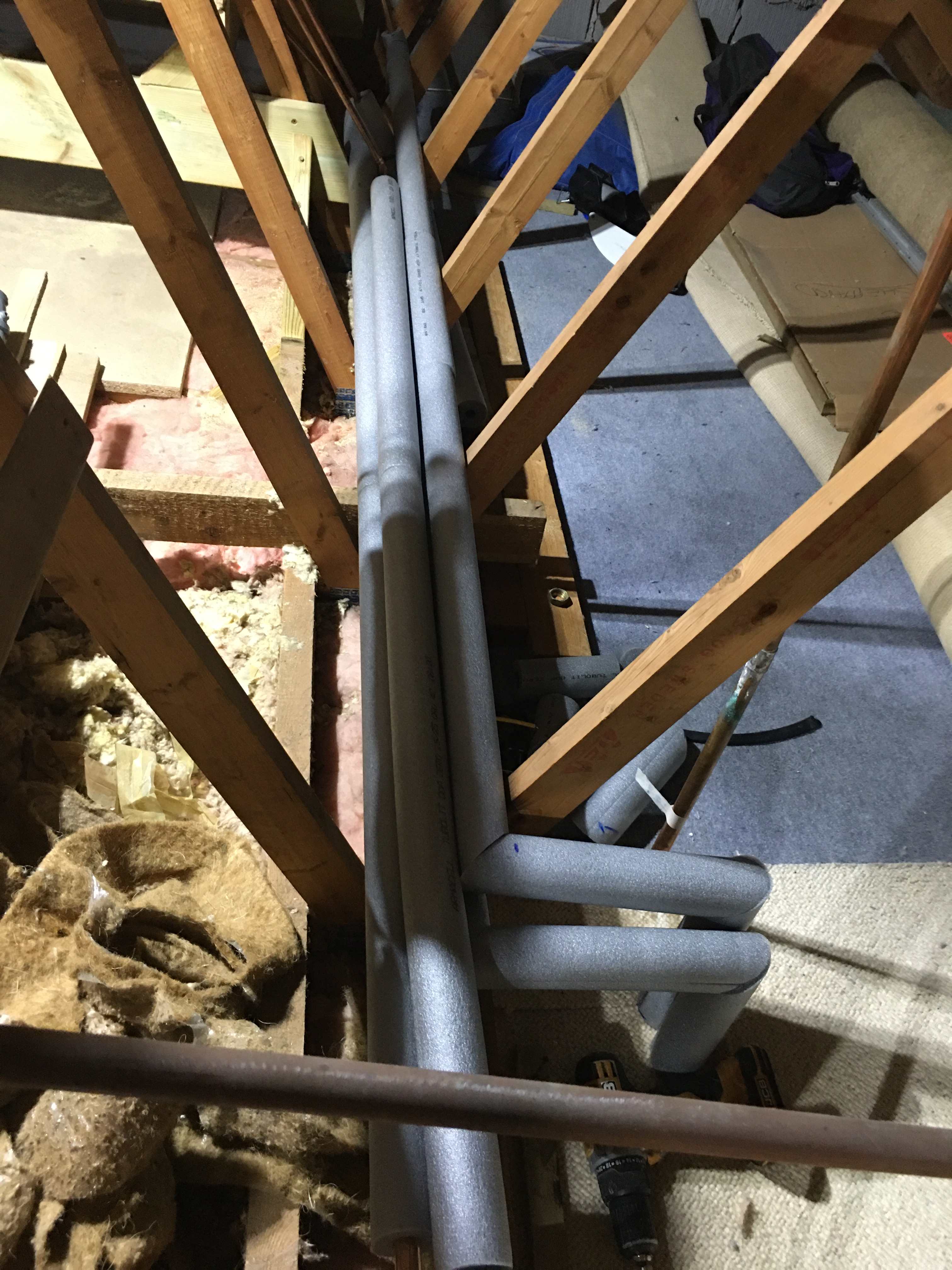
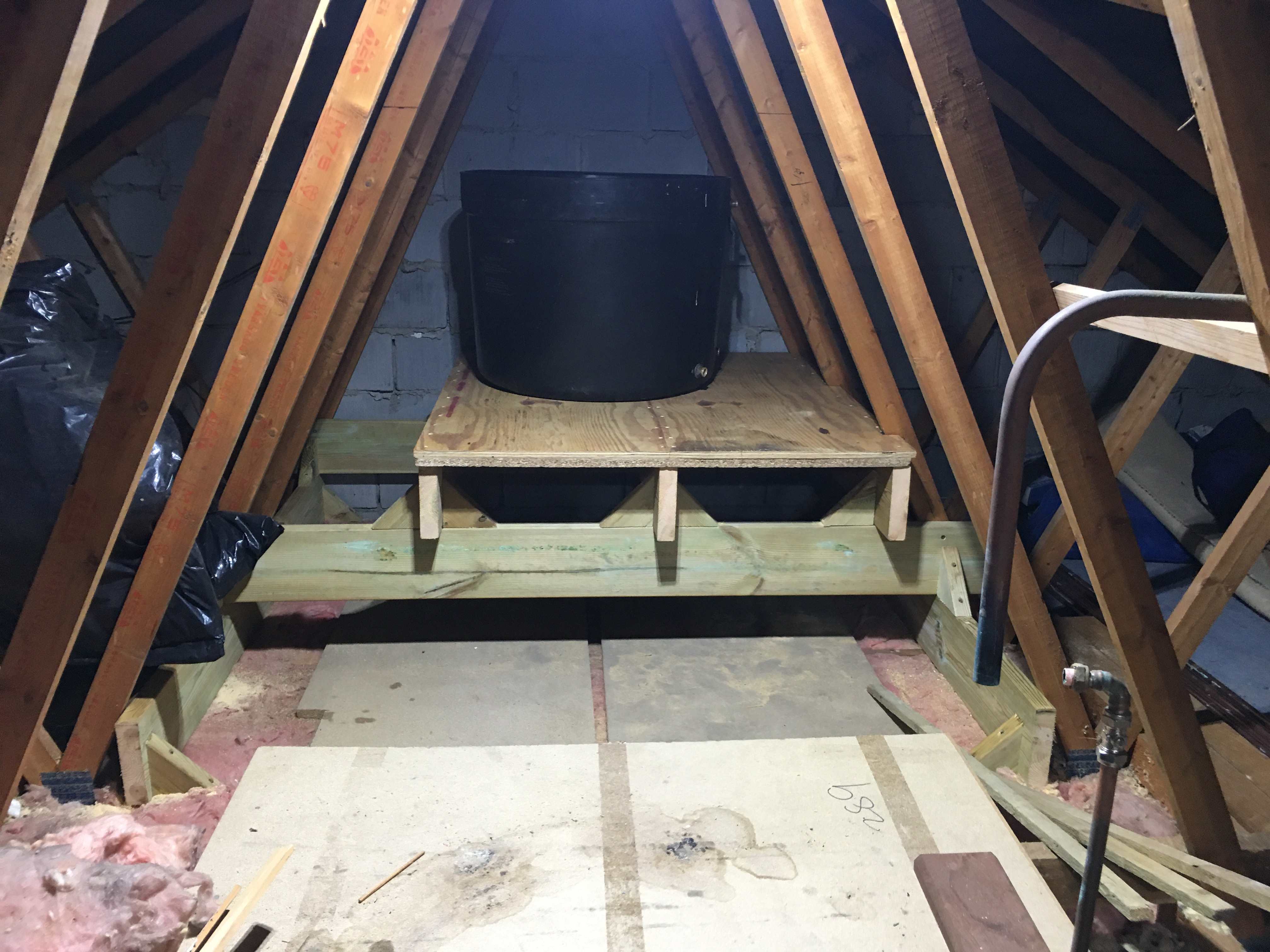
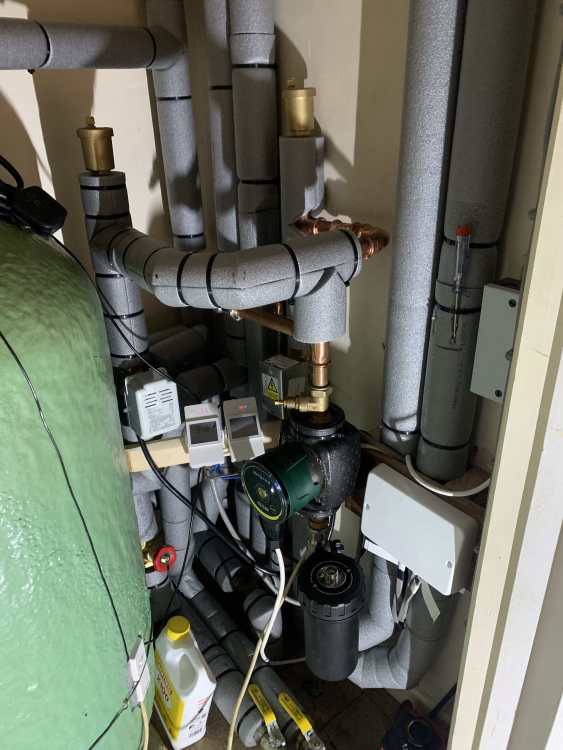
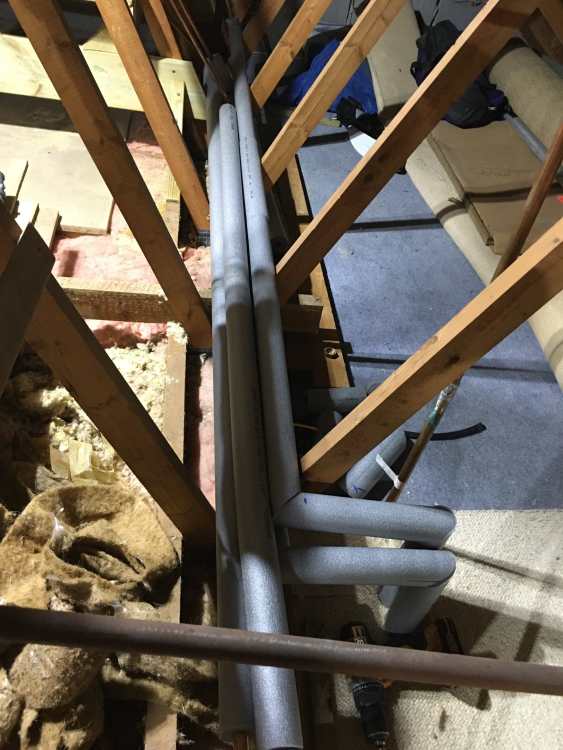
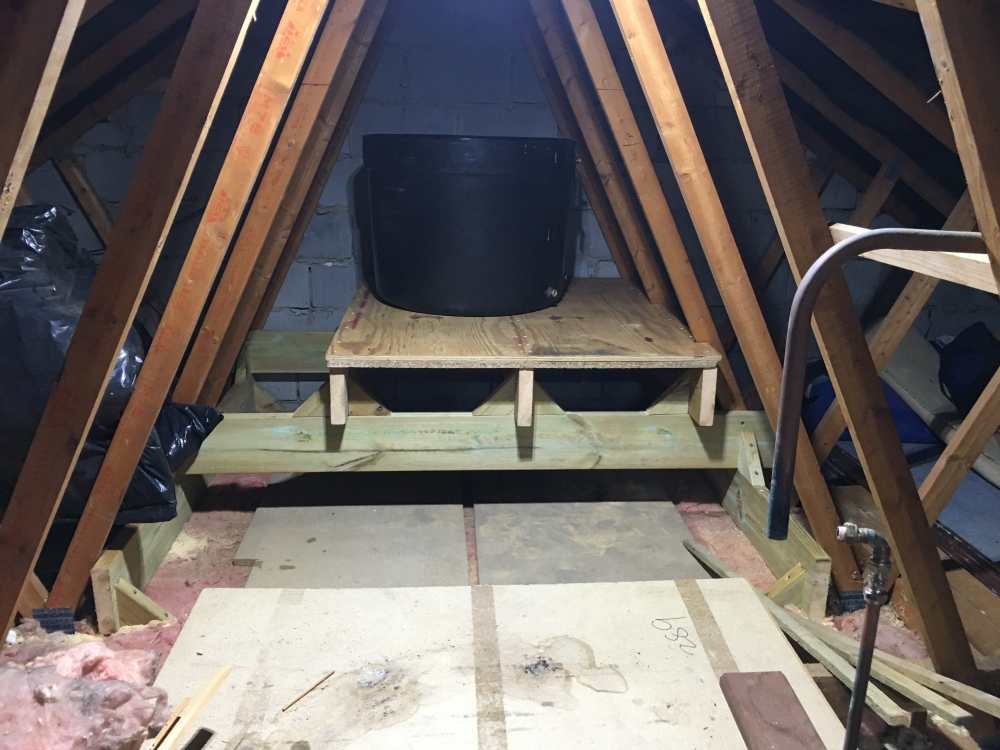
Current set up Filter, pump assembly is all same From pump T to bypass valve to HW return then T splits to go right for CH (NO zone valve) or goes left to HW (NC zone valve) coil in tank Both CH and HW legs have bottle type air bleeds Boiler is 1m below the pump I will try to do the new glass trick today Your calcs on volume of water in 22mm pipe assume that the height of the vent is also the length of the pipe but thats not the case the pipes go thro the ceiling of the airing cupboard and into the loft space - there they travel horizontally 3m along the loft before rising up to the F&E tank. the tanks were relocated a while back because they made access to the loft space difficult
-
I guess this means whatever problem I have it's always been there - I just put something in that masked the issue Now it's set up as X plan and has bottle vents on both HW and CH legs* they aren't as effective removing air as a 1.5 M length of 15mm copper right above the pump *sighs
-
Oh that is such a long story I don't want to go there........... Set up was a Y plan with a 3 position valve HW HW&CH and CH only The whole system was controlled by a sunvic set up and when the 3 postion valve failed I converted to a drayton - however that was incompatible with the wiring centre and so an adjustable spanner was deployed to switch from HW to CH and Nope I'll stop there................. The pipe you want to know where it's going was to a manual vent - I've always had an issue with air in the system since we bought the place in 1991 it used to accumulate over time so I put a stupidly long leg of 15mm copper pipe up the side of the airing cupboard and just used to bleed it every month...................