mickeych
-
Posts
91 -
Joined
-
Last visited
Everything posted by mickeych
-
Sounds like a cost plus basis except you are also supplying the materials! If his rate per M2 is good, he comes recommended and you can see examples of his work I would definitely consider him. If you are paying a very clear rate for the work that he is doing and you can measure the amount of work he is doing IE rate per M2 of brick or block laid, it takes the 'finger in the air' and 'extras/not included' type issues one seems to get when accepting a lot of 'all-in' quotes.
-
Offer accepted, but funds wiped out from land purchase.
mickeych replied to flanagaj's topic in Self Build Mortgages
Just use the cost estimator as a guide to show a lender that you understand and are considering the costs in your project. Speak to a good broker (really can't fault Mayflower and we have been working them for 16 months now for a very complex project!) They should be able to guide you as to the most appropriate level of costing/detail you provide to the lender to enable them to underwrite the loan. Some lenders can get a little nervous with the idea of you taking on the work yourselves unless you are in the trade or have prior experience (so I am told). Also - what you get funding for and exactly what you end up doing or who you work with can be a little different in reality. So long as the end result is the same and you get the valuations that you are aiming for to release funding and reach completion all within the scope of approved plans and you are paying the mortgage this is the goal for everyone! -
Offer accepted, but funds wiped out from land purchase.
mickeych replied to flanagaj's topic in Self Build Mortgages
It probably depends on the lender, but in our case they wanted full details on costs and potential contractor long before we were in a position to confirm this, so it was suggested to us that you show as much detail as possible from a QS service and include an outline quote from a reputable contractor to avoid any delays and back and forth. The other things we learned from the process is that the lender has a 'tick-box' that needs to be completed at this point to weed out the hopeful from the realistic self-builders and that means as much detail as the lender asks is needed and no debate! -
Offer accepted, but funds wiped out from land purchase.
mickeych replied to flanagaj's topic in Self Build Mortgages
Oh yes, just 1 thing to be aware of if you are going down this route that no one tells you is that once you buy the land, if you need to provide the title deeds to the lender (which you will), you will have to ask your solicitor to expedite the title registration with the Land Registry as the normal queue is currently 18 months and the lender is unlikely to proceed without a clear title deed. -
Offer accepted, but funds wiped out from land purchase.
mickeych replied to flanagaj's topic in Self Build Mortgages
Ditto that we are using Harpenden through Mayflower Brokerage. From a risk perceptive, lenders prefer to lend against a solid valued asset which you already own (such as land with FPP). By lending to you and taking a charge over the land they are offering a form of re-mortgage. The combination of a fixed value of the land greater than what they are going to lend overall (ie they are only lending you 280K against a market value of 350K) and the prospect of the future value being added to the original asset, make it an easier decision for them to underwrite. Lots of caveats about personal circumstances and loan types and limitations in there ,but this is how it should work in principle. -
Contractors All-Risk Policy and mortgage lender interest
mickeych replied to SarahG's topic in Self Build Mortgages
We had the same issue. Assuming your lender has also asked you to provide Site Insurance with them named as having an interest too, (and probably for a sum that they have specified), then you should be able to point out that requiring the builder's CAR covers this same risk is double insuring. If they accept this then they will accept just sight of the contractors CAR (to show that they have one) in addition to the Site Insurance that you are providing. Our broker at Mayflower helped sort this out for us so I am sure that if you are using a broker they can also advise. Like you we were initially spooked with all the requests for insurance this and warranty that, but you will find a way through it! -
agreed and I have a plan to further accentuate the size of the aperture by continuing (and increasing the angle of) the taper as we frame and insulate it. This should in theory give us openings of around 400-450mm on the inside. We are also aiming to insert downlights into the frame to provide back lighting
-
The whole barn is like this outside and inside the mixture of estate bricks and the rubble stone. It is stunning and such a shame that it will be covered with insulation, but we are limited by the regulations and practicality of trying to make the building an inhabitable space. We are aiming to expose as many of the original features as possible such as the timber 'shoulders' and the trusses and purlins too but as with all these things, we are having to spend a lot of time and money on trying to save the fabric of the building.
-
Yes they taper out quite considerably so the width on the outside is around 130-170mm and on the inside is around 225-300
-
I think that this was initially my thought but then as @saveasteading points out they are all on show in the various rooms in the house and in 1 or 2 cases they are the only wall apertures allowed by conservation. At the 'front' of the barn the slots have quoins around them (looks like these were the 'showy' ones) and the others are framed by estate red brick. The outside of the slots have been chopped about over the years too, so we will need to make good the quoins and brickwork and as they taper inwards, we can move the glazing back into the 'hole' to make it fit with 150mm as the minimum width but it may look a little odd. Maybe a combined approach of bonding the glazing directly in to the opening with a very skinny home made wooden frame painted up on the inside?
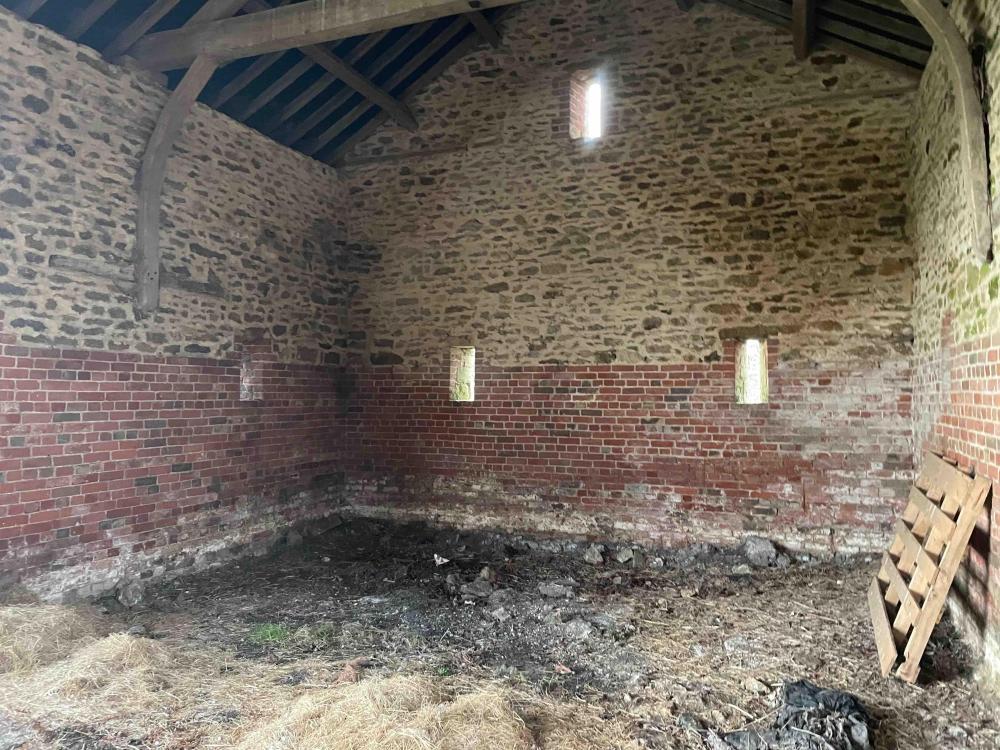
-
This is an odd one! We are converting an old threshing barn and have started looking at glazing costs and suppliers and we realised that the 10 breather 'arrow' slits in the barn are too narrow for any standard window. They are a variety of sizes between 125 and 150mm wide and from 600-700mm tall. I am thinking that we can probably have some glazing panels made up (although there do appear to be limitations around the minimum width of panel) and then recesss them in the wall. The question is how?
-
SE has recommended we look at a fire suppression system as the best alternative. (So I'll probably have to beef up my SA's and HA's 🙃)
-
Dohhh - Thank you!
-
unfortunately I posted the wrong plans as these don't show the correct sizes for the GF bedroom windows both of which are existing openings of 1.4x1.4m so these should work as EEW's I think I follow on the Laundry and Boot room etc, sorry for the dum question but the abreviations HAA and SAA?
-
Unfortunately the kitchen breakfast structure abuts the gable end of the main barn where bed 2 is. If we put in a gable end wind/door, we would have to create a fire void above the kitchen breakfast room (in place of a vaulted ceiling) and then place a fire escape compliant rooflight in the fire void above the Kitchen breakfast room.
-
This is a tough one which we are also trying to solve for... We have a problem with the fire escape issue in our barn conversion which we are trying to get to building regs and we realise that we have a 1st floor bedroom with only roof lights and slit windows that has no escape route (Bed 2 on the plan). There is an option to open up into the void over the kitchen breakfast room (building to the left on the plan), but this opens up so many issues around design and I'm trying to find a solution to this from within the main barn space. One thought we have had is create a short feature staircase in bedroom 2 below the planned skylight which we use as the escape window, but this raises questions around height from the ground outside (bottom of skylight would be at 4.4-4.6M) and also the eligibility of a small landing (say 60x60cm) at the top of the stairs as a 'floor' to access the skylight. Any thoughts or suggestions would be most welcome. Many thanks NB The barn is listed so cutting holes in external walls is not an easy sell to the conservation and planning teams! 1st floor with revisions ch copy2.pdf
-
Warranty or PCC for a new Self Build?
mickeych replied to JAS-Build's topic in New House & Structural Warranties
hmm I've just been quoted £35K for a 10 year warranty from Protek. had a BW quote for 6.5K but probably going with a PCC with BW for 2.9K. It is like the wild west IMO. clearly plenty of the insurers have a limited capacity for self-builds with their main underwriters or have a very different risk model for some people (ours is a barn conversion). We only 'need' one because we have some funding for the build and the lender insists. -
We have full planning and listed building consent for a barn conversion but before starting the main build, we have had to make the structure sound to the main barn by removing the roof and repairing a large number of rotten timbers (all the rafters, the entry and exit beams, a few purlins and one of the king trusses). We have provided an SE report to justify the work to planning in advance (although no other contact to date). We are now in a dilemma as we find that a large percentage of the original cement tiles are too damaged or in a state of disrepair to refit in line with planning. Permission includes using natural stone slate on the reinstated parts of the barn but not the main barn. We really would like the contractors to complete the roof and would prefer not to have to supplement the 60% of end-of-life concrete tiles with new concrete tiles in a very different colour. Our preference is to refit the roof with some high quality natural stone repo tiles (already been accepted by planning on a neighbouring barn) without having to wait for a planning amendment to be processed as we would likely loose the builders for 2-3 months. Ideas and thoughts welcome!
-
Applying for mortgage.. after build started?
mickeych replied to sunflower's topic in Self Build Mortgages
I'd second that. really know what they are doing and are very patient with Newbie's like us! -
We are working on a large barn conversion and I am struggling to site my MVHR system and particularly the ducting. Is it possible/advisable to site ducting for the MVHR in the floor screed? Since the building is listed and due to the vaulted nature and exposed beams in the central section, I am struggling to find a route from the plant area at one end of the conversion to the wing at the far end of the conservation (around 40M in distance). 1 possible solution would be to use 2 separate systems 1 in each 'wing' but this appears to be expensive and unnecessary if I can hide the ducting and other pipework under the FFL. Any ideas keenly considered!
-
I want one too! The recesses are a stroke of genius. They really appear to open up the space to create a light box below the roof light. Can you post a couple more photos of the detail around them please?
-
Limited height and ground floor Insulation Dilemma
mickeych replied to mickeych's topic in Underfloor Heating
Thanks. That seems to make sense and aligns with @Hastings drawing -
Radiant Heating and Cooling Panels
mickeych replied to mickeych's topic in Energy Efficient & Sustainable Design Concepts
got it. thanks -
Radiant Heating and Cooling Panels
mickeych replied to mickeych's topic in Energy Efficient & Sustainable Design Concepts
Thanks Conor - sorry just getting used to finding responses here! I love the idea of the ASHP slab cooling and a PV array with some storage. As we are working with essentially a listed building (well listed curtilage) we are very restricted as to how much we can do on the outside so we are looking at internal blinds or using solar smart glass to keep things cool. My suspicion is that even with all this cost and effort we will still need some active cooling in some of the building, so I am designing it in at the start rather than trying to retrofit if we need it. Any thoughts on these? -
Limited height and ground floor Insulation Dilemma
mickeych replied to mickeych's topic in Underfloor Heating
OK got it. That looks and sounds remarkably similar to what we are discussing with the SE. The piece that we are struggling with at the moment is how far down we can dig as this dictates so much of the build. Do you remember just how far you dug down at the deepest point and what depth of concrete you maxed out at beneath the stud footings? We did start to discuss how the roof is supported but not sure that we ever agreed which route to take. Why did you veto your roof being suspended from the inner stud frame since you were building the concrete base anyway? Did you have to beef up the old walls to take the new roof structure? Our SE is excellent (very experienced with old barn refurbs) and has already made a lot of valuable contributions but I suspect that the levels or airtightness you have achieved are going to be pretty tough for us to achieve in a 250 year old agricultural building, but I have a desire to get as close to PH as possible.